


Key Takeaways
- 93% of mortgage journeys now begin with an online search — but most financial brands remain invisible beyond their referral network.
- Getting found online for financial brands is a structural problem, not a content volume problem. Volume without infrastructure is noise.
- AI Overviews now appear on 60%+ of Google queries. Being cited in an AI answer is the new first-page ranking.
- SEO converts 7.3× more leads than paid ads in financial services. The ROI case is not close.
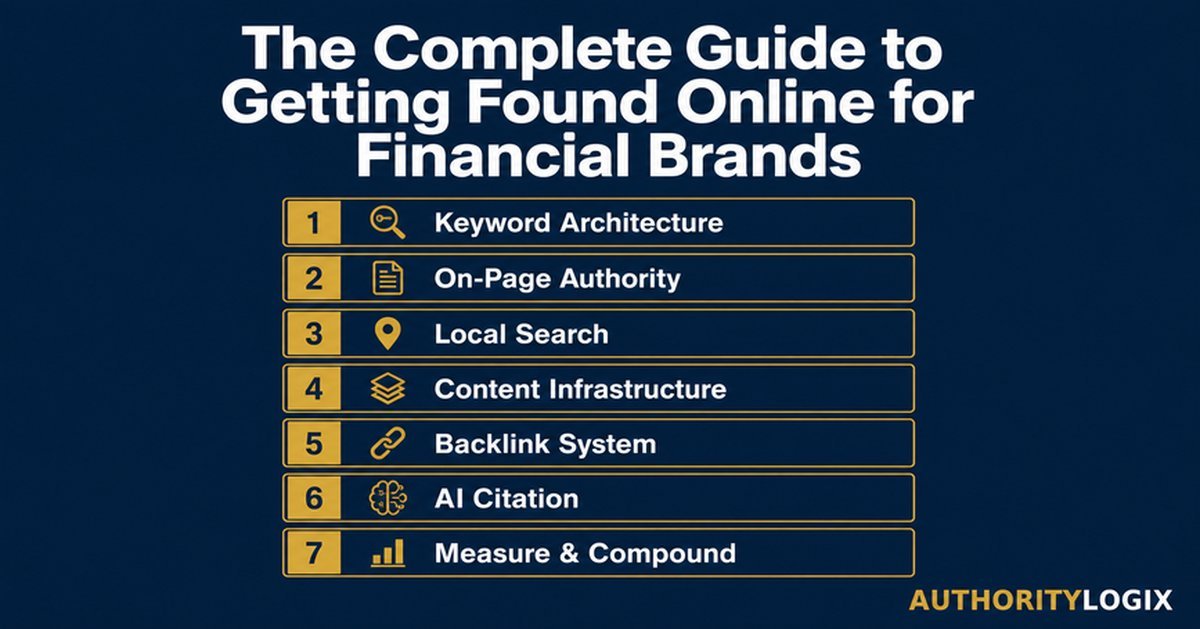
- The 7-step visibility system covers keyword architecture, on-page authority, local search, content infrastructure, backlinks, AI citation, and measurement.
- BKDSCR.com, built on this exact framework, dominates its niche for NYC outer-borough DSCR lending — without a paid ad budget.
Table of Contents
Getting found online for financial brands is not a marketing problem — it is an infrastructure problem. In 2026, 93% of mortgage journeys begin with an online search. DSCR lenders, mortgage brokers, real estate coaches, and financial advisory firms are operating in a search-driven market where the first page of Google — and now the first answer from an AI engine — captures nearly all the attention. The professionals who appear there get the calls. Everyone else waits for referrals.
The typical financial brand has a website, a LinkedIn page, and years of hard-won expertise. What it does not have is a system that makes that expertise visible to qualified prospects who are actively searching right now. That gap is what this guide closes.
The 7 steps below cover every layer of the visibility problem — from keyword architecture to AI citation strategy — with specific benchmarks from mortgage, lending, and financial services research. This is not theory. BKDSCR.com, a DSCR lending advisory platform built on this exact framework, dominates its niche for NYC outer-borough investors without a single paid ad.
See how Authority Distribution builds your backlink profile and multi-platform presence: See how Authority Distribution works
Why Most Financial Brands Are Invisible Online — and What Getting Found Online for Financial Brands Actually Requires
The credibility gap in financial services is specific: the professionals who know the most are often the least visible online. A mortgage broker with 20 years of closings, a DSCR lender with deep product knowledge, a financial advisor with a track record that speaks for itself — none of that expertise registers in a Google search if the underlying infrastructure is not built.
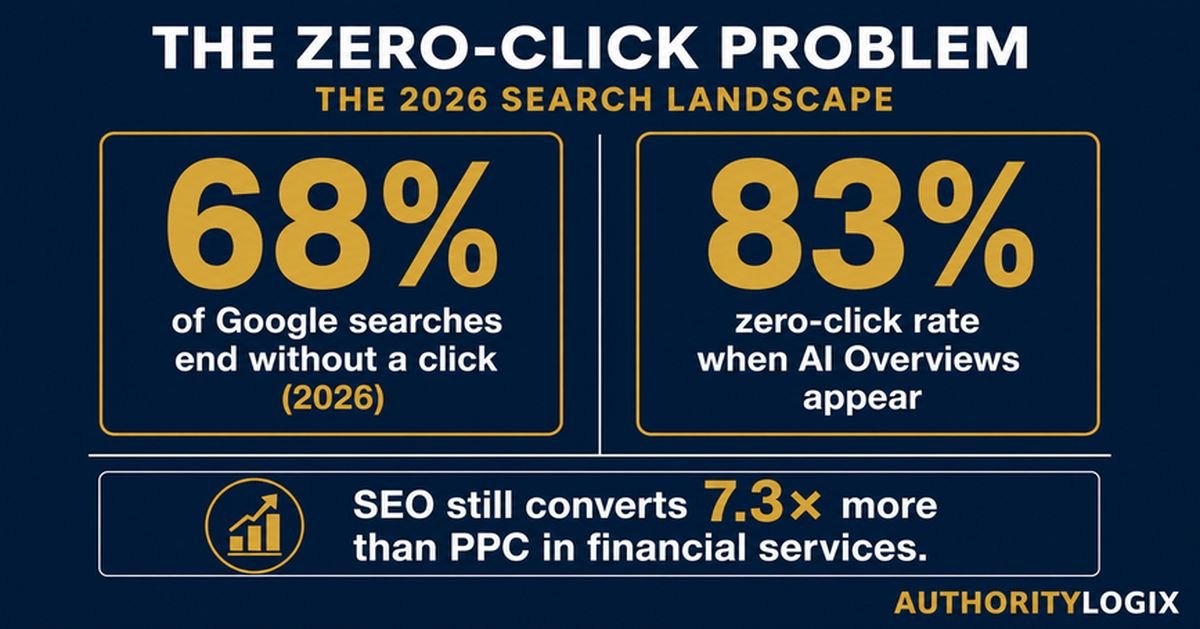
The search landscape has changed enough in 2026 to make this more urgent, not less. Zero-click searches — queries that end without a user ever clicking through to a website — now represent 68% of all Google searches, up from 60% in 2024 (SparkToro/Similarweb, 2026). When an AI Overview is triggered, that zero-click rate climbs to 83%. The click is no longer the only metric that matters.
At the same time, the brands that are cited inside those AI answers earn 35% more organic clicks and 91% more paid clicks than brands that are not cited — even when neither brand got the direct click from the AI answer (OptimizeGEO.ai, 2026). Citation is the new first-page ranking. You either build the infrastructure to earn it or you don’t appear.
For financial brands, the stakes are concrete. Research from FirstPageSage puts SEO ROI for financial services at 1,031% — the second-highest return of any industry measured. SEO converts 7.3× more leads than PPC in this space. The cost per organic lead runs approximately $31 versus $181 for paid (HubSpot, 2025). The math makes a clear argument for building the visibility system once and letting it compound.
The Specific Problem Financial Brands Face in Search
Financial services content falls under Google’s YMYL category — Your Money or Your Life — which subjects every mortgage, lending, and advisory page to Google’s most rigorous E-E-A-T quality standards: Experience, Expertise, Authoritativeness, and Trust. Generic content does not rank in this category. Thin pages, anonymous authorship, and undifferentiated service descriptions are actively penalized.
The professional who is “credible but invisible” is not losing to better competitors. They are losing to competitors who built better infrastructure around the same level of expertise. Getting found online for financial brands means solving that infrastructure problem systematically — which is what the 7 steps below do.
Step 1: Build a Keyword Architecture Around Buyer Intent, Not Industry Terminology
The first mistake most financial brands make in search is targeting the keywords they use internally rather than the language their prospects search. A DSCR lender may call their product a “debt-service coverage ratio loan.” Their prospects search “investment property loan no income verification” or “rental property loan Brooklyn.” The keyword architecture has to follow the buyer.
Keyword research for getting found online for financial brands begins with buyer-intent mapping across three search stages:
- Awareness-stage queries: “how do DSCR loans work,” “what is a non-QM mortgage,” “can I get a mortgage with rental income”
- Consideration-stage queries: “DSCR loan rates 2026,” “best DSCR lenders NYC,” “DSCR vs conventional loan comparison”
- Decision-stage queries: “DSCR lender Brooklyn,” “apply for DSCR loan New York,” “DSCR loan calculator investment property”
Each stage requires different content. Awareness content earns traffic and builds topical authority. Consideration content captures prospects who are evaluating options. Decision content converts. Building the architecture means having assets at all three stages — not just a homepage that targets one generic term.
Primary, Secondary, and Long-Tail Keyword Structure
Every financial brand needs a primary keyword — the core phrase that defines what they do and who they serve. That primary keyword anchors the homepage and the core service pages. Secondary keywords extend the primary into specific products, locations, or client types. Long-tail keywords are the specific questions prospects ask, and they belong in blog posts, FAQs, and educational content.
Sites that publish 8 or more topical cluster articles per pillar page average 2.3× more non-branded organic sessions than those publishing fewer than 4 (First Page Sage, 2026). The keyword architecture is not just a targeting exercise — it is the blueprint for the entire content system.
Step 2: On-Page Authority — How Getting Found Online for Financial Brands Starts with What Google Reads
On-page SEO is the technical layer of getting found online for financial brands. Google’s crawlers read your pages before any human does, and what they find determines whether your content ranks, gets ignored, or gets penalized. For financial services pages subject to YMYL standards, the on-page signals carry extra weight.
The core on-page elements that move rankings for financial brands:
- Title tags: 50–60 characters, primary keyword in the first half, one sentiment or power word
- Meta descriptions: 150–160 characters, primary keyword within the first 120 characters, written to earn the click
- URL slugs: short, lowercase, hyphenated, primary keyword included — e.g., /dscr-loans-nyc/ not /page?id=127
- H1 and H2 structure: H1 contains the primary keyword; at least 2 H2s contain the primary or secondary keyword
- Content length: for competitive financial terms, pages ranking on page one average 1,800–2,400 words
- Keyword density: 1.0–1.5% for primary keyword — enough for relevance signals without triggering stuffing filters
Author Authority and E-E-A-T Signals
YMYL pages without demonstrated author expertise struggle to rank regardless of technical optimization. Financial brands building search visibility need verifiable author credentials on content pages — professional licenses, years of experience, client track records. An author bio is not optional for mortgage or lending content; it is a ranking factor.
Google’s quality raters look for verifiable credentials, professional licensing disclosure, cited sources, and evidence of real client experience. Anonymous content on a financial services site is a ranking liability. Every page needs a named author with verifiable credentials, and every factual claim needs a source.
For the finance content development side of this problem — how to write credible, compliant, conversion-ready content in mortgage, lending, and advisory — see AuthorityLogix Finance Content Development. For the complete system that turns this on-page credibility into a market authority position, see the Complete Guide to Authority Marketing for Financial Services.
Before you build, know where the gaps are: Download the free Authority Gap Assessment
Step 3: Local Search — the Highest-Leverage Channel for Getting Found Online for Financial Brands with Geographic Markets
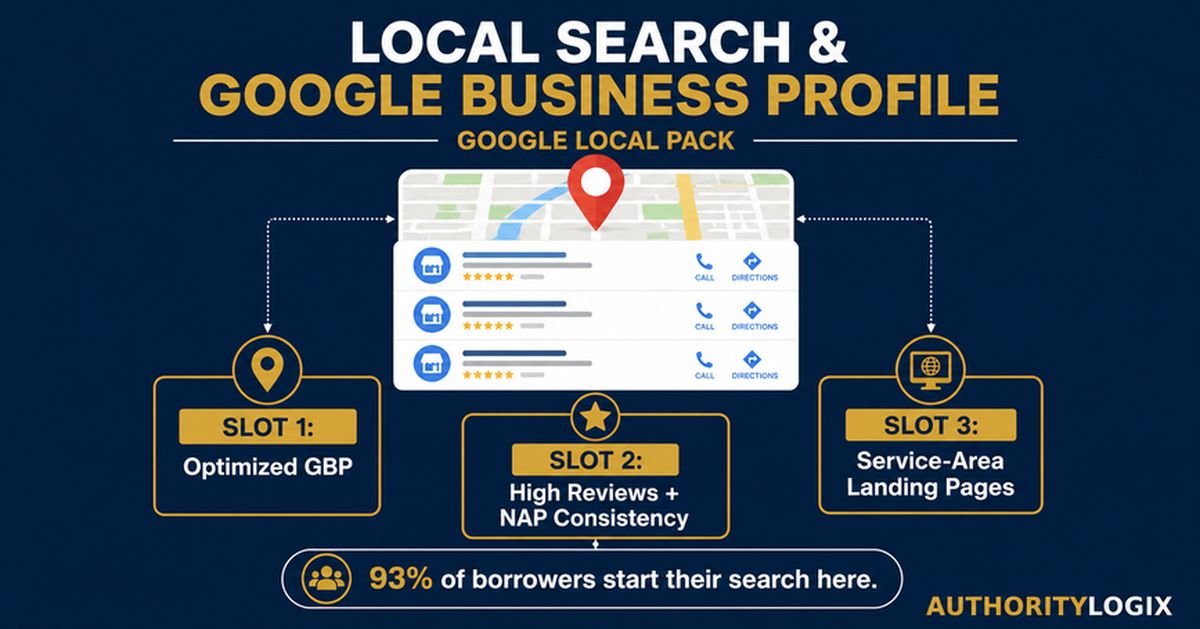
46% of all Google searches carry local intent (Digital Applied, 2026). For mortgage brokers, DSCR lenders, and real estate advisors whose markets are city- or metro-specific, local search is not a secondary channel — it is the primary discovery mechanism. A lender who dominates the Google Local Pack for “DSCR lender Brooklyn” has a structural lead-generation advantage that no amount of social media activity can replicate.
The Local Pack — the map and three listings that appear at the top of local search results — is the most valuable real estate in local search, often appearing above all organic results. Appearing in it for financial services queries requires a specific set of signals that most financial brands have not fully optimized.
Google Business Profile Optimization for Financial Brands
Google Business Profile (GBP) is the cornerstone of local SEO in 2026. The performance gaps between optimized and neglected profiles are significant. For mortgage professionals specifically:
- Select the exact correct primary category — “Mortgage Broker” and “Mortgage Lender” rank differently for the same query
- Complete every service listed in the GBP services section — list every loan product by name (DSCR, FHA, VA, conventional, non-QM)
- Upload 20+ geo-tagged photos of office, team, and client interactions with EXIF data intact
- Write a 750-character business description with primary and secondary keywords naturally embedded
- Post consistently — 2–3 times per week — to signal active management
- Reach 15–20 review citations on major platforms; review velocity in the first 60 days accelerates 3-pack entry
First 3-pack appearances for low-competition local queries arrive in 60–90 days with a well-optimized GBP. Compounding incremental leads from local SEO typically materialize in 120–180 days. The investment is cumulative — every optimization made today continues delivering without additional spend.
Service-Area Landing Pages
A single location page is not enough for financial brands serving multiple neighborhoods, boroughs, or markets. Each market deserves a dedicated landing page targeting the specific geographic + service term combination — “DSCR loans Brooklyn,” “non-QM lender Queens,” “investment property loans Bronx.” These pages build local topical authority and create multiple Local Pack entry points. Internal links from service pages to location pages strengthen both.
Step 4: Content Infrastructure — the Engine Behind Compounding Search Visibility for Financial Brands
Content is not getting found online for financial brands — content infrastructure is. The distinction matters. Posting articles without a keyword architecture, pillar-and-cluster structure, internal linking system, and editorial calendar is activity, not a system. Volume without infrastructure is noise. The financial brands that compound their visibility over 12–24 months are the ones that built the publishing infrastructure first.
The Pillar-and-Cluster Architecture
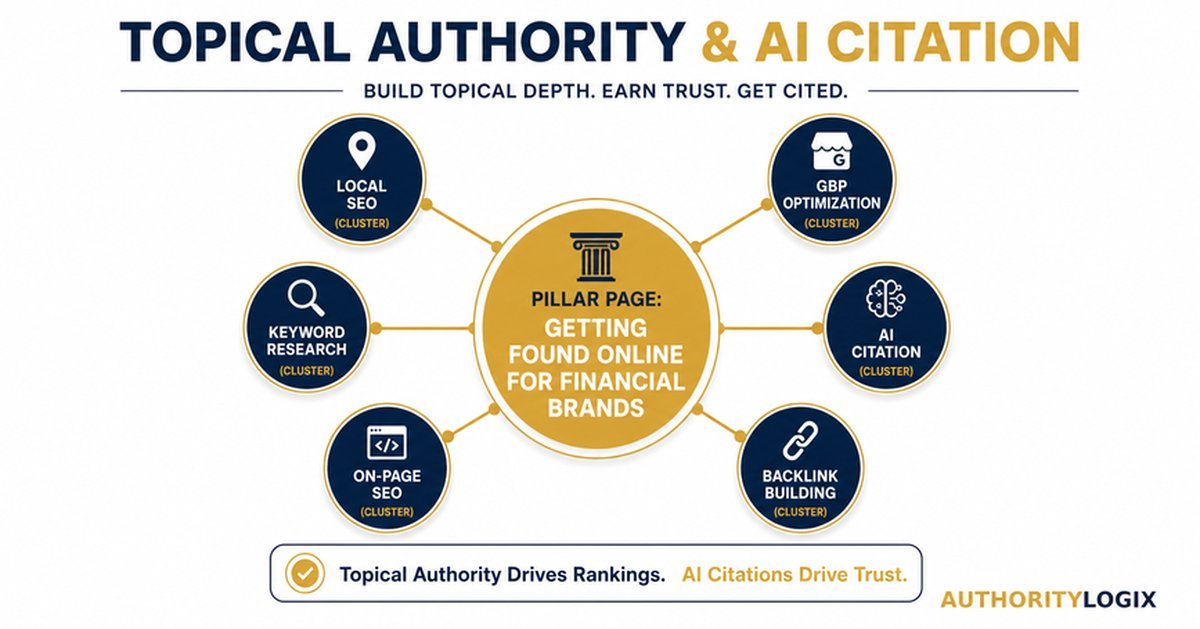
A pillar page is a comprehensive, authoritative resource on a primary topic — typically 2,000–3,000 words targeting a high-volume primary keyword. This article is a pillar page. Cluster content consists of shorter, more specific articles that target long-tail variations of the primary topic, all internally linked back to the pillar.
The pillar-and-cluster structure tells Google that your site has comprehensive, organized coverage of a topic — which is the definition of topical authority. Sites with strong topical authority rank for more queries across the entire topic cluster, not just the individual keywords they targeted. For a financial brand targeting “DSCR lending,” a single pillar page plus 8–12 cluster articles on specific subtopics (DSCR ratios, qualifying income, loan limits, underwriting, property types) creates a compounding authority position that a competitor with 5 generic pages cannot match.
For the editorial calendar, publishing system, and repurposing framework that runs this infrastructure without weekly reinvention, see Content Systems. If you want the full blueprint for building this publishing infrastructure from scratch, the Content System Blueprint covers every component in detail.
FAQ Content and Featured Snippets
FAQ sections and structured question-and-answer content serve two purposes simultaneously: they address the specific questions prospects type into Google, and they position your pages to appear in featured snippets and AI Overview citations. For financial brands, the most common prospect questions — “what is the minimum DSCR ratio,” “can I use rental income for a mortgage,” “how long does a DSCR loan take to close” — should all have dedicated, authoritative answers on your site before a competitor claims them.
Step 5: Building a Backlink System That Signals Authority for Financial Brands Getting Found Online
Backlinks remain among the strongest ranking signals in Google’s algorithm. For financial brands subject to YMYL standards, the quality of those backlinks is more important than the quantity. A single link from a regional real estate association, a licensed mortgage education platform, or a local business journal carries more weight than 50 links from generic directories.
The practical backlink strategy for financial brands:
- Local real estate blogs and publications — pitch a monthly mortgage market update column in exchange for a byline and backlink
- Industry associations — NMLS licensee directories, MBA membership listings, DSCR lender association profiles
- Local business directories — not bulk citation services; 15–20 high-quality, accurate NAP citations in relevant directories
- Partner linking — reciprocal or co-created content with real estate attorneys, title companies, property managers, and investor networks
- Podcast appearances and speaking engagements — transcribed content and show notes generate authority backlinks in the financial space
One case study from the mortgage SEO space: a broker who replaced paid lead sources entirely with 700+ monthly organic visitors built their backlink profile primarily through local real estate blog contributions and borrower-intent content — 12 high-quality backlinks per year from a single column relationship, plus direct leads from readers (Tim Armstrong Marketing, 2026). That is the compounding model.
To understand how Authority Distribution accelerates backlink acquisition through multi-platform content syndication, see the full service overview.
To understand how Authority Distribution accelerates backlink acquisition through multi-platform content syndication, see the full service overview.
Step 6: AI Citation Strategy — the New Front Line of Getting Found Online for Financial Brands
Search visibility in 2026 is not only about ranking in the 10 blue links. AI Overviews now appear on more than 60% of Google queries. When an AI Overview is present, organic click-through rates drop by an average of 18% — but brands cited inside the AI answer earn 35% more organic clicks and 91% more paid clicks than brands that are not cited (OptimizeGEO.ai, 2026). The question is no longer just “do you rank?” The question is “does the AI cite you?”
The brands that earn AI citations share specific characteristics: narrow topical authority on a well-defined subject, structured content that AI systems can parse cleanly, verifiable E-E-A-T signals (credentials, citations, original data), and comprehensive coverage of their topic cluster rather than thin coverage across many unrelated topics (Similarweb, 2026). These are the same fundamentals that earn strong organic rankings — but they need to be executed at a level of depth and structure that most financial websites have not reached.
How to Optimize for AI Citation
Generative Engine Optimization (GEO) is the 2026 addition to the SEO playbook. Alongside traditional on-page and backlink work, financial brands need:
- JSON-LD structured data: Google’s recommended schema format, cleanly separated from HTML, so AI systems can parse your content reliably
- Semantic HTML: clean heading hierarchy, proper use of lists, tables, and definition elements that AI models can extract directly
- First-party data and original research: AI systems preferentially cite content with verifiable, unique data points — a mortgage market report, a DSCR performance dataset, a proprietary lending benchmark
- Topical depth over breadth: narrow and deepen rather than broaden; AI cites specialists, not generalists
- Answer Engine Optimization (AEO): content structured as direct answers to specific questions, because AI systems pull from answer-format content first
BKDSCR.com runs this exact framework — structured DSCR educational content, deep topical coverage of NYC outer-borough investment lending, and verifiable author credentials from two decades of mortgage origination. The result is a platform that surfaces in both traditional search and AI answers for its target niche, without paid ad spend.
Step 7: Measure What Compounds — the Metrics That Matter for Search Visibility in Financial Services
Vanity metrics do not move a financial brand’s pipeline. Traffic spikes from a single article that does not convert are not the goal. The measurement system for getting found online for financial brands tracks the signals that actually correlate with inbound leads and revenue.
What to track:
- Organic lead volume: not sessions — actual form fills, phone calls, and direct contact from organic search
- Keyword rank movement: position tracking for primary, secondary, and long-tail keywords across the full cluster
- Local Pack appearances: how often your GBP appears in the 3-pack for your target geographic + service queries
- AI Overview citation frequency: which queries trigger AI answers that cite your brand — track via Ahrefs or BrightEdge AI Overview tracking
- Backlink acquisition rate: new referring domains per month, with quality filtering for domain authority and relevance
- Pages indexed vs. pages ranking: the gap between how many pages Google has indexed and how many are ranking on page one reveals infrastructure gaps
Meaningful returns from search visibility typically begin at the 6–9 month mark, once authority builds, content matures, and search visibility stabilizes. The thought leadership SEO model — deep keyword research, authoritative content creation at 6–8 pieces per month, and generative optimization — delivers approximately 748% ROI with an average 9-month break-even (FirstPageSage, 2025). For a financial brand with recurring revenue per client, the math is straightforward.
The Compounding Effect
A financial brand that executes all 7 steps consistently for 12 months builds a search asset that competitors cannot replicate overnight. After 12 months, a structured content system with 50+ optimized pages for Google to rank — cluster articles, pillar pages, location pages, FAQ content — creates a compounding lead-generation machine that a competitor with a 5-page website cannot touch. The visibility gap grows wider every month the system runs.
To understand how this system was validated through a live financial brand, see Why AuthorityLogix and the BKDSCR.com proof-of-work case study.
What Most Financial Brands Get Wrong About Getting Found Online
Mistake 1: Treating the website as the visibility system
A website is a destination. Search visibility is what brings prospects to that destination. Building a website and expecting it to generate inbound leads without keyword architecture, on-page optimization, local search signals, and content infrastructure is like opening a storefront in a basement and expecting foot traffic.
Mistake 2: Publishing without a structure
Blog posts that do not connect to a pillar page, do not target a specific keyword, and do not internally link to conversion pages generate traffic that bounces without converting. Every piece of content needs a purpose in the architecture — it should target a specific query, feed authority to a pillar page, and move the prospect toward a defined next step.
Mistake 3: Ignoring local search because the business does business “everywhere”
Financial brands that serve multiple markets still need to win their home market first. A DSCR lender who dominates “DSCR loans Brooklyn” before expanding to Queens, the Bronx, and New Jersey builds a local authority position that compounds. Trying to rank everywhere at once without a local foundation produces thin results in all markets.
Mistake 4: Waiting for organic results to measure success
Organic SEO does not deliver overnight results, and brands that do not track leading indicators — keyword movement, Local Pack appearances, backlink acquisition, AI citation frequency — conclude too early that the system is not working. The 6–9 month mark is when results begin compounding, not where they end. The brands that stay the course own their market by month 18.
Mistake 5: Outsourcing search visibility without retaining structural control
An agency that builds your search visibility on technical configurations only they understand creates dependency, not infrastructure. Getting found online for financial brands means owning the keyword architecture, understanding which pages carry which authority signals, and having the internal capability to sustain and expand the system. AuthorityLogix builds the system with clients — not just for them.
If you want to understand the full methodology, see How We Do It for the complete AuthorityLogix process overview.
The Infrastructure Advantage: What Getting Found Online for Financial Brands Builds Over Time
The financial brands that win in search over the next 3–5 years are the ones building the infrastructure now. The 7-step framework covered in this guide — keyword architecture, on-page authority, local search, content infrastructure, backlinks, AI citation, and measurement — is not a checklist to complete once. It is a system that compounds every month it runs.
The professionals in mortgage lending, DSCR, real estate advisory, and financial services who are building these systems are not generating more content. They are building better infrastructure. There is a structural difference between a financial brand with a presence and a financial brand with a platform. A presence means you exist online. A platform means qualified prospects find you before they find your competitors — and they arrive educated, pre-qualified, and ready to have a real conversation.
You already earned the credibility. The market needs to see it. Getting found online for financial brands is the system that makes that happen.
The complete Authority Gap Assessment identifies exactly which of these 7 layers your current visibility system is missing — and which ones to build first for the fastest compounding return. See how we built BKDSCR.com as proof that this framework works for financial brands in competitive markets, then book your free assessment to apply it to yours.
External reference: SEO for Financial Services: The Complete Guide for 2026 — Seoprofy
Ready to build your visibility system? Book a free Authority Gap Assessment