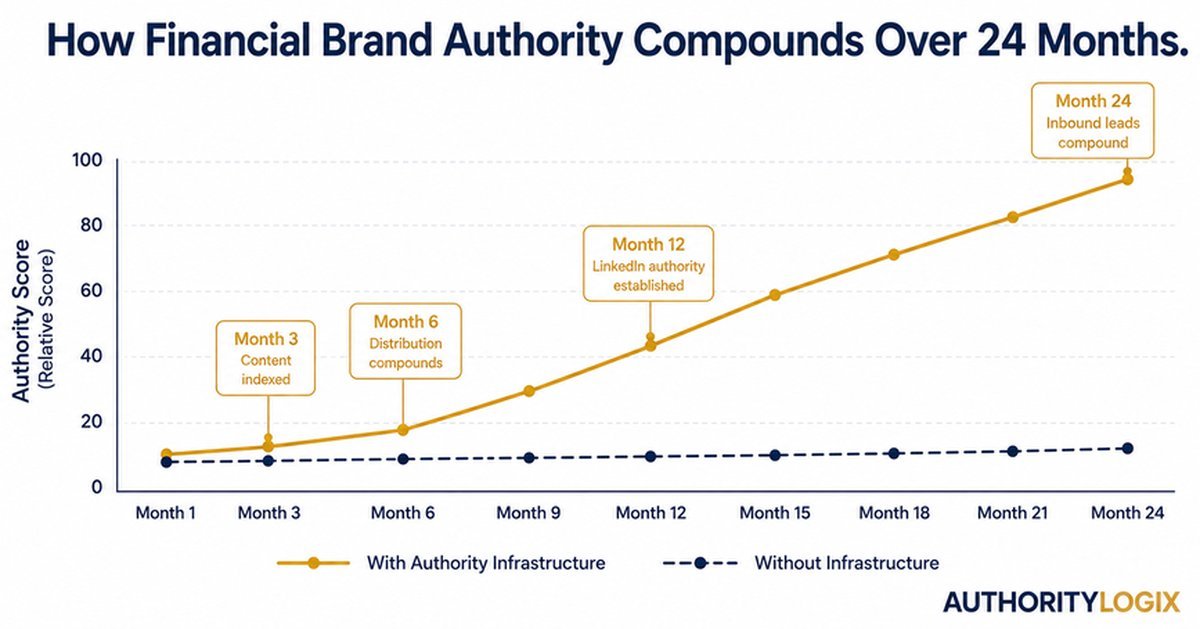

Key Takeaways
- The authority gap financial brands face is not a content problem. It is a visibility infrastructure problem. Most mortgage companies, DSCR lenders, and real estate investment firms produce some content and remain invisible because they have no system for distributing what they know.
- According to the Content Marketing Institute B2B Research 2026, 96% of B2B organizations create thought leadership content — but fewer than 37% do it at scale or depth. Creating content and building online authority are not the same thing.
- 96.55% of all web pages receive zero organic traffic from Google, per Ahrefs research across 14 billion pages. No backlinks. No external validation. The authority gap is why expertise does not convert to inbound leads.
- Brand visibility in financial services is now measured across search, AI-generated answers, and multi-platform brand mentions. McKinsey found that 84% of brands cannot track whether AI platforms cite them at all.
- The firms closing the authority gap financial brands face are not producing more content. They are building the infrastructure that makes their existing expertise findable, credible, and distributable at scale.
- Online authority building in financial services compounds. Firms that build now hold a structural advantage competitors starting later cannot recover through effort or spend alone.
Table of Contents
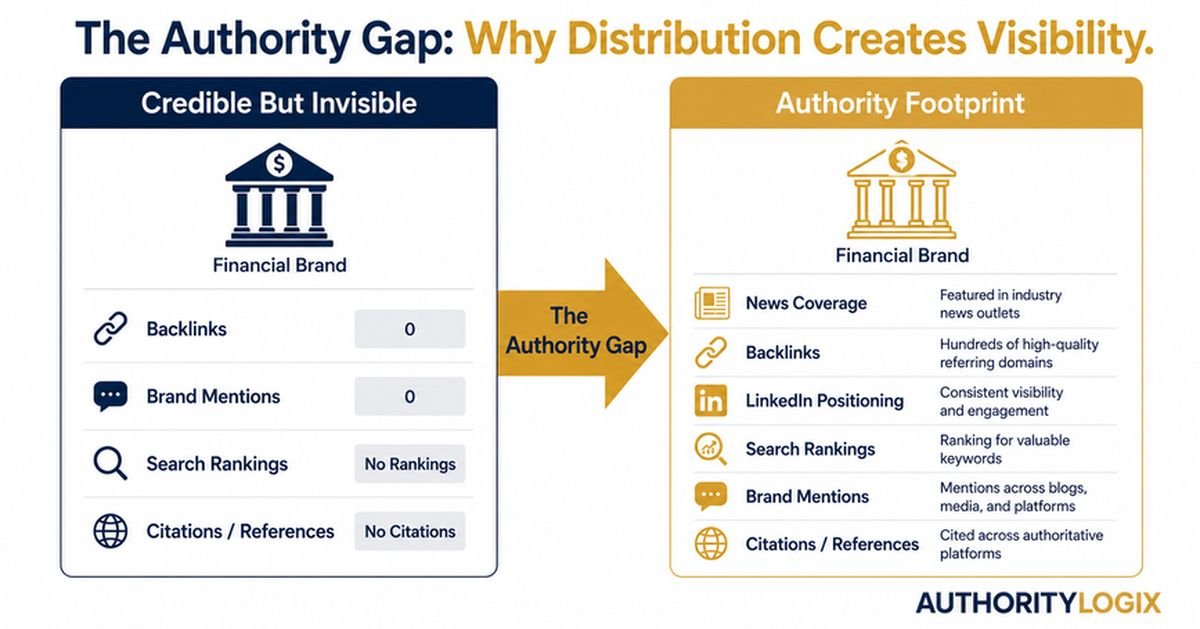
The authority gap financial brands face has a simple definition: the distance between what a business knows and what the market can find. A DSCR lender with 15 years underwriting NYC outer-borough deals knows more about that market than any aggregator website. A mortgage company founder who has navigated five rate cycles understands borrower risk that no content farm can replicate. None of that expertise shows up online if there is no infrastructure to make it visible.
According to the Content Marketing Institute B2B Research 2026, 96% of B2B organizations create some form of thought leadership content. Yet fewer than 37% do it at scale or with systems that produce compounding visibility. Creating content and building online authority are structurally different activities. The firms that confuse them remain credible but invisible.
This article breaks down what the authority gap financial brands face looks like, why it persists in firms with strong track records, and the infrastructure components that close it.
For the complete framework of how financial brands build visibility through search, content, and distribution, see the Complete Guide to Getting Found Online for Financial Brands.
See how Authority Distribution works: See how Authority Distribution works
What the Authority Gap Financial Brands Face Actually Looks Like
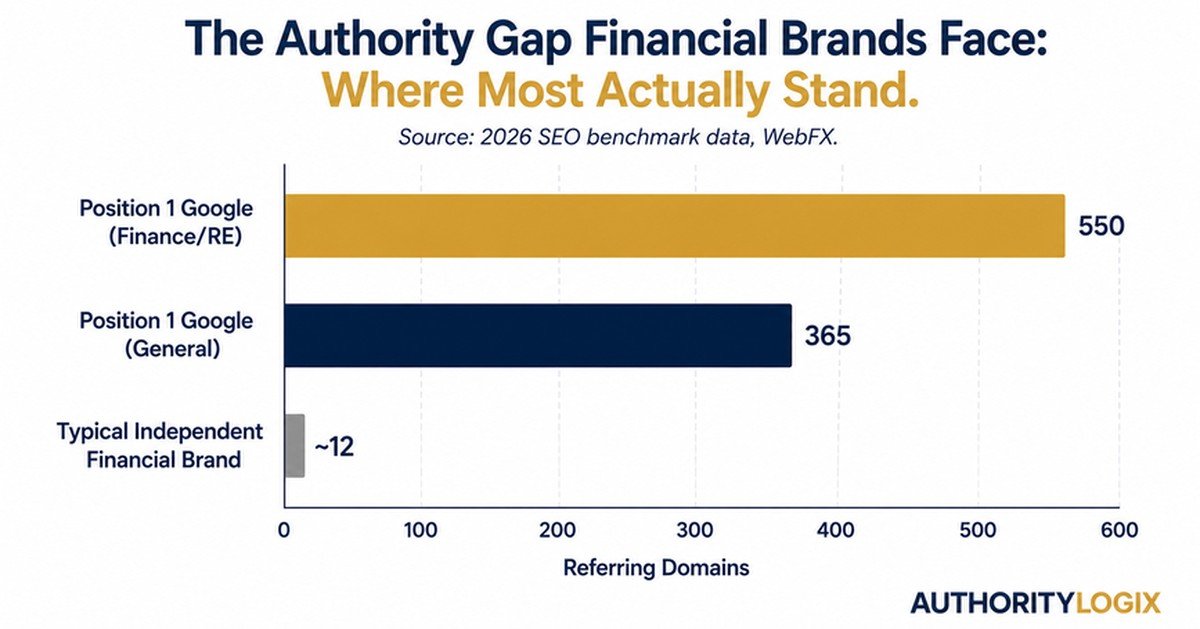
The authority gap financial brands face has a measurable shape. Ahrefs research across approximately 14 billion web pages found that 96.55% of all pages receive zero organic traffic from Google. The primary reason is the absence of external backlinks — no third-party domains pointing to the content, no external validation that tells search engines the page is worth surfacing. A financial brand can publish a technically excellent article on DSCR underwriting and have it read by nobody outside their existing email list if the page has no backlinks and no external authority signals.
This is the authority gap financial brands face in its simplest form: expertise exists, content exists, but brand visibility financial services does not — because the infrastructure that connects expertise to discoverability was never built.
The gap compounds in three ways. First, search invisibility: the firm does not rank for any search terms its ideal clients use. Second, brand mention absence: the firm is not cited in third-party publications, directories, or comparison sites that prospects read during research. Third, AI invisibility: with 44% of consumers now using AI-powered search as their primary information source, and McKinsey documenting that 84% of brands have no structured way to track AI citations, this third gap is the fastest-growing visibility problem in financial services.
The Credible But Invisible Problem
The firms most acutely affected by the authority gap financial brands face are typically the ones with the strongest actual track records. An independent DSCR lender who has funded 500 deals across five markets has more operational credibility than a large aggregator that has never underwritten a single loan. But the aggregator has 50,000 backlinks, content on 200 pages, and a distribution infrastructure compounding for a decade. That is the authority gap financial brands in practice: the expertise is real, the visibility infrastructure is missing.
A lead generation system cannot function without an incoming stream of discovered prospects. Discovery requires authority that shows up where prospects are searching, not authority that exists only in the firm’s own head.
Why the Authority Gap Financial Brands Face Persists
Three structural dynamics make the gap harder to close without a deliberate system.
Compliance Constraints Suppress Publishing
Mortgage companies and DSCR lenders operate under content restrictions most industries do not face. Many financial firms interpret compliance constraints as a reason not to publish at all, which leaves the authority gap financial brands face intact. The correct response is a structured finance content development approach — educational content demonstrating specific expertise that earns backlinks without the compliance risks promotional content carries. A DSCR lender publishing a quarterly analysis of cap rate trends and qualification benchmarks earns authority without making a rate claim.
Referral Dependence Creates False Confidence
Most financial firms in mortgage, DSCR lending, and real estate investment have grown on referrals for years. Referral pipelines create the impression that visibility is adequate. The authority gap financial brands face only becomes visible when referrals slow, a competitor with established online authority building captures prospects that used to come through word of mouth, or a referred prospect goes online to research the firm and finds almost nothing.Shorten with AI
According to a 2026 Exposure Ninja analysis, Wise beat Revolut in AI search recommendations by 12.8x despite Revolut’s larger customer base — because Wise had invested in educational content for a decade and Revolut prioritized product-led growth over authority. That same dynamic plays out between independent financial firms and large aggregator platforms every day.
No Distribution System
Even firms that publish consistently typically stop at the blog post. Without a content system blueprint that includes structured distribution — multi-platform syndication, third-party publication, LinkedIn positioning — every piece of content is a single-use investment. The authority gap financial brands face grows by the width of every piece of content published without a distribution plan attached.
Before you build, know where the gaps are: Download the free Authority Gap Assessment
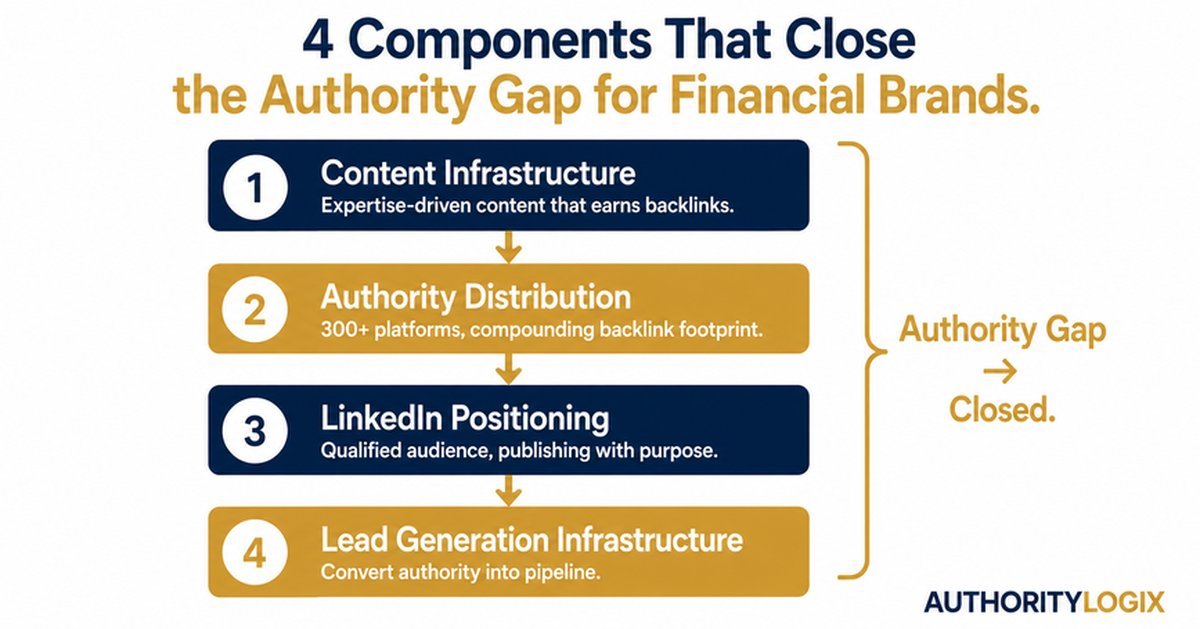
4 Components That Close the Authority Gap for Financial Brands
Closing the authority gap financial brands face requires four infrastructure components built in sequence. Each enables the next.
1. Content Infrastructure Built Around Specific Expertise
The foundation of online authority building is content structured around specific, earned expertise rather than generic industry knowledge. For a DSCR lender, this means content reflecting actual underwriting experience: what conditions cause deals to fail, what DSCR calculations look like across property types, what lender overlays in the current rate environment mean for specific investor profiles. This content earns backlinks because it provides information only someone with direct experience can produce accurately. An educational hub built around this expertise pre-qualifies every prospect who finds it.
2. Authority Distribution Across 300+ Platforms
The second component converts the content infrastructure into external authority signals. A single well-structured article pushed through authority distribution generates placements across news networks, podcast directories, video platforms, and infographic repositories. Each placement is a referring domain. Twelve months of consistent distribution produces a backlink profile that organic publishing alone cannot replicate. According to BrightEdge Content Distribution Research 2026, companies with strong content syndication strategies achieve 27% greater annual revenue growth than those relying solely on organic publishing. You can see exactly how this system works through the BKDSCR.com proof-of-work case study.
3. LinkedIn Positioning That Builds a Qualified Audience
The third component is LinkedIn positioning — publishing with purpose on a consistent schedule aligned with specific expertise and target audience. A DSCR lender posting market data specific to their target geography builds a qualified audience of exactly the investors they want to reach. This does not replace a lead generation system — it feeds one. The prospect who has followed a firm’s LinkedIn content for 90 days before making contact has already been pre-qualified by the content they consumed. CMI B2B Research 2026 confirms 96% of B2B marketers use LinkedIn for distribution — but specificity, not frequency, is the variable that builds financial brand marketing authority.
4. Lead Generation Infrastructure That Converts Authority Into Pipeline
The fourth component converts the authority footprint into a measurable pipeline. Authority without conversion infrastructure is brand awareness without revenue. The financial brand that has built content, distributed it, and attracted inbound traffic needs specific lead magnets matched to prospect research stage, nurture sequences delivering useful content during the 3 to 12 month decision window typical in mortgage and real estate, and a clear conversion pathway from first contact to booked consultation. This is the full lead generation system that makes the authority gap financial brands close produce revenue rather than just visibility.
How Long It Takes to Close the Authority Gap.
The authority gap financial brands face did not open overnight. The timeline for online authority building in financial services follows a consistent pattern.
- Months 1–3: Content infrastructure built, first distribution campaigns launched, LinkedIn positioning established. Domain authority begins to move. No significant inbound volume yet.
- Months 4–6: Backlink footprint accumulating. Branded search volume growing. First organic inbound inquiries from content beginning to rank for long-tail terms.
- Months 7–9: Distribution campaigns compounding. LinkedIn qualified audience measurable. Inbound inquiry volume trackable. Content pre-qualifying prospects before first contact.
- Months 10–12: Compounding visibility measurable. Organic traffic, branded search, and multi-platform brand mentions all contributing to inbound pipeline without additional spend.
The firms that built this infrastructure 12 months ago are experiencing compounding returns. The BrightEdge 27% revenue growth differential is the authority gap financial brands expressed in business outcomes. Treating online authority as optional is ceding that differential to competitors who made different decisions.
3 Mistakes That Keep the Authority Gap Open
Publishing Without Distribution
A blog post uploaded and left to accumulate organic traffic is a single-use investment. Without structured distribution — syndication, third-party placement, LinkedIn amplification — the content reaches only the existing audience once. The authority gap financial brands face grows by the width of every piece of content published without a distribution plan attached.
Producing Generic Content That Cannot Earn Backlinks
Generic financial content does not earn backlinks because the information it provides is already available from every large financial publisher. A content system built around a financial brand’s specific operational expertise produces content that earns authority. A calendar built around general industry topics produces volume without authority, which widens the authority gap financial brands face rather than closing it.
Waiting Until the Pipeline Slows
The authority gap financial brands face is most expensive to close under pressure. A mortgage company that begins building online authority building infrastructure during a strong referral period has 12 to 18 months to build compounding visibility before it becomes operationally critical. A firm that waits until referrals slow faces the same timeline without the revenue cushion to sustain the investment. Authority infrastructure is most efficiently built during periods of stability, not urgency.
For the complete content-to-client system that closes the authority gap and converts visibility into revenue, see the Finance Content Playbook: How Lenders, Advisors, and Real Estate Firms Turn Content Into Clients.
Why Closing the Authority Gap Requires a System, Not a Campaign
The authority gap that keeps most financial brands invisible online is not closed by a single campaign, a website redesign, or a burst of content production. It is closed systematically — through consistent publishing, structured distribution, and reputation signals that accumulate over months into a visibility profile that search engines and AI platforms recognize as authoritative. The financial brands that close their authority gaps do so by treating online visibility as infrastructure, not as a marketing initiative with a start and end date.
Every article published strengthens the content foundation. Every piece of content distributed across syndicated platforms builds the backlink profile that improves rankings. Every review earned deepens the reputation layer that converts visibility into trust. The process is not fast — but it is permanent. A financial brand that has spent 18 months systematically closing its authority gap has built an asset that no competitor can displace overnight, and one that continues generating inbound leads long after the initial investment is complete.
Financial brands that close their authority gap systematically — through content, distribution, and reputation signals maintained consistently over 18 to 24 months — build a visibility infrastructure that generates inbound leads independently of any advertising budget. The authority that compounds through consistent publishing and distribution is the most defensible competitive position available in financial services, because it cannot be purchased and it cannot be replicated quickly by a competitor who has not invested the time.
The authority gap is closable. The financial brands that close it do so not by spending more on advertising, but by building more consistently — more articles, more distribution, more credibility signals accumulated over more months. The decision to start building that infrastructure today is the decision that separates the firms that will dominate their markets in two years from the ones that will still be invisible.
Closing the authority gap requires one decision and consistent execution. The decision is to stop treating online visibility as a campaign and start treating it as infrastructure. The execution is publishing, distributing, and building reputation signals every month without interruption. The financial brands that make that decision today and execute it consistently will be the ones that are visible, trusted, and generating inbound leads two years from now — while the brands that waited are still wondering why they cannot be found online.
Ready to close the authority gap? Book a free Authority Gap Assessment
The Authority Gap Is a Solvable Infrastructure Problem
The authority gap financial brands face is not a talent gap or a content quality gap. It is an infrastructure gap. The expertise exists. The track record exists. The system that makes both visible, credible, and findable by the right prospects at the right moment is what is missing in most mortgage companies, DSCR lending operations, and real estate investment businesses operating today.
The data is consistent: 96.55% of financial brand web content gets zero organic traffic because it has no external authority signals. 84% of financial brands cannot track whether AI platforms cite them. The firms winning brand visibility financial services in 2026 are the ones that understood earlier than their competitors that visibility is a system to be built, not a result to be hoped for. You already earned the credibility — the market just cannot see it yet. That is the authority gap financial brands in a single sentence, and it is the only problem AuthorityLogix exists to solve.
The educational hub development infrastructure, the content systems, the authority distribution, and the lead generation architecture all serve one outcome: turning expertise into authority, and authority into qualified inbound leads. Authority compounds. The firms that build it now hold a structural advantage that competitors starting later cannot close through effort or spend alone. Review why clients choose AuthorityLogix. For the complete authority marketing guide that closes this gap, see The Complete Guide to Authority Marketing for Financial Services and Real Estate. and the BKDSCR.com proof-of-work case study that demonstrates the method at full scale.