
Key Takeaways
- A content strategy for a mortgage company is not a blog calendar. It is an architecture that connects borrower intent to content topics, lead capture, nurture, and conversion.
- Mortgage companies with a documented content strategy generate 3x more leads per dollar than those without one. The strategy is the multiplier, not the content volume.
- Borrowers research for 6 to 12 weeks before contacting a lender. A mortgage content plan that addresses the full research window captures borrowers that a contact form never reaches.
- Generic mortgage content competes with Rocket Mortgage, Bankrate, and every national lender. Specific content on DSCR loans, non-QM products, or local market conditions competes with almost nobody.
- The Homebuyers Privacy Protection Act (March 2026) ended trigger leads. Mortgage companies without inbound content systems lost a fallback channel they may not replace without building one.
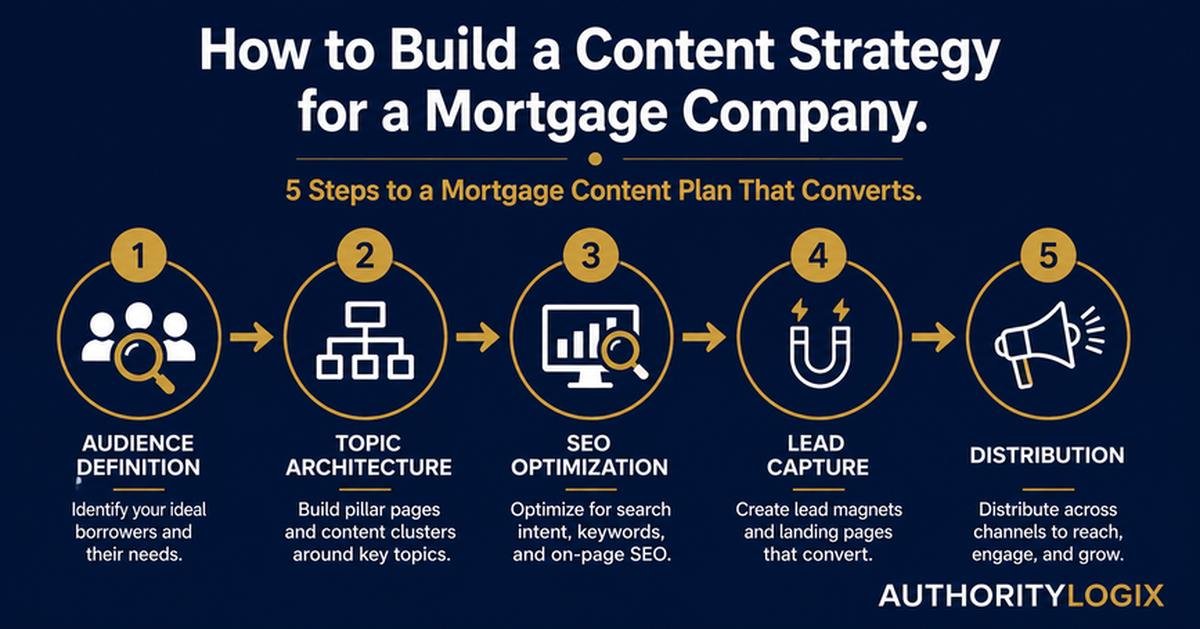
- A lender content marketing system has five components: audience definition, topic architecture, SEO optimization, lead capture, and distribution. All five must work together.
Table of Contents
A content strategy for a mortgage company is the document that turns a blog into a pipeline. Most mortgage companies have content without strategy — posts published inconsistently on topics chosen without research, with no internal linking architecture, no lead capture mechanism, and no distribution plan. The result is a content library that generates a small amount of organic traffic that arrives, reads, and leaves without any mechanism for conversion. A documented strategy changes every part of that outcome.
According to the Content Marketing Institute 2026 B2B Content Marketing Report, organizations with documented content strategies generate 3x more leads per dollar than those without one. That multiplier does not come from producing more content. It comes from producing the right content, for the right borrower, at the right stage of their research — with the right infrastructure behind it to convert attention into applications.
The timing has never been more consequential. The Homebuyers Privacy Protection Act, which took effect March 5, 2026, ended the trigger lead industry permanently. Mortgage companies that relied on trigger lead vendors lost a fallback channel. The ones with functioning inbound content systems did not notice. Building a content strategy for your mortgage company now is not a growth initiative — it is a risk management decision..
See how the Content System works: Explore Content Systems
Step 1 — Define the Borrower Your Mortgage Content Will Serve
Every effective mortgage content plan starts with a specific borrower profile. Not a demographic. A profile: who this borrower is, what loan product they are researching, where they are in the decision process, what questions they are asking, and what objections they are evaluating. A mortgage company that tries to produce content for every possible borrower produces content that resonates with no specific borrower. A company that defines one primary audience and publishes exclusively for them for 12 months builds the topical authority that makes their content rank and convert.
The borrower profiles that produce the most convertible mortgage content are specific. A DSCR investor purchasing multi-family properties in secondary markets. A self-employed borrower seeking bank statement qualification. A first-time homebuyer with strong income but limited down payment history. A VA-eligible veteran comparing loan programs. Each of these profiles produces completely different topic lists, different lead magnets, different keyword targets, and different conversion offers.
The most common mortgage company content mistake is publishing for the borrower you occasionally serve rather than the borrower you want to serve consistently. A mortgage content plan that defines the target borrower clearly produces a topic list that is specific enough to rank in search, relevant enough to convert on the page, and targeted enough to generate leads worth calling back.
Step 2 — Build a Topic Architecture Tied to Borrower Intent
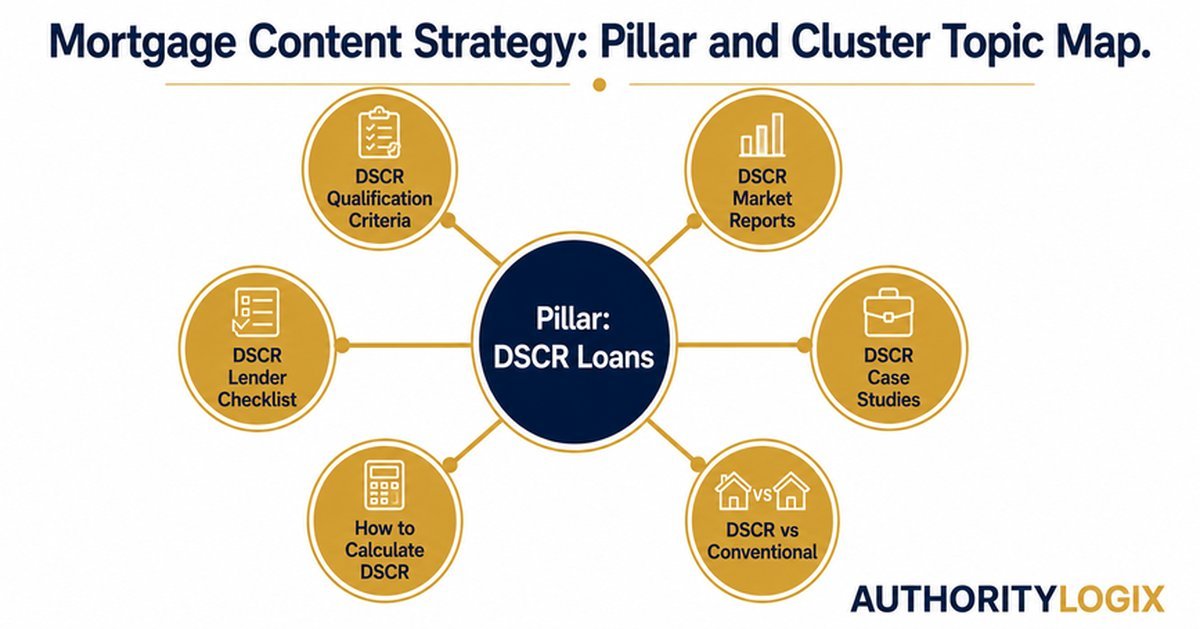
Once the target borrower is defined, topic architecture determines the full set of subjects your content will cover. In a content system blueprint for a mortgage company, topics are chosen based on the specific questions your target borrower is asking at each stage of their research — organized into pillar topics and cluster topics that build interconnected authority.
Pillar topics for a mortgage company content strategy are the broad subjects your brand will own. A DSCR lender might own DSCR loan qualification criteria, DSCR market analysis for target investment markets, and DSCR case studies. A non-QM lender might own bank statement loan qualification, self-employed mortgage options, and non-QM program comparisons. Each pillar encompasses dozens of specific cluster topics — individual articles, guides, and tools that link back to the pillar page. A structured educational hub is the architecture that holds this system together.
Borrowers research for 6 to 12 weeks before contacting a lender. During that window, they are asking specific questions at predictable stages: what loan program fits my situation, what are the qualification criteria, which lender understands my specific situation best. Your topic architecture needs to address all three stages — because the borrower who encounters your content in week two and finds it useful will return in week eight when they are ready to apply.
Step 3 — Build SEO Infrastructure Into Your Mortgage Content Plan
A mortgage blogging strategy without SEO is brand awareness, not lead generation. The content that generates inbound mortgage leads appears in search results when borrowers are actively researching — not the content shared once on LinkedIn and forgotten. SEO infrastructure is what makes your content findable by the borrowers who need it, at the moment they are looking for it.
Mortgage SEO is different from generic SEO because of YMYL standards, TRID and RESPA compliance requirements, and the specific search behavior of borrowers making high-stakes decisions. The top 3 search results capture 54.4% of clicks for mortgage queries. Mobile devices account for 63% of organic search visits, but desktop mortgage searches average 8+ page views per session — borrowers doing deep research before they call. Your content needs to serve that depth of research.
The SEO components of a mortgage company content strategy include:
- Keyword research tied to borrower intent: Not “mortgage” but “DSCR loan lender in Brooklyn” or “bank statement mortgage for self-employed 2026.”
- Loan program pages for every product you offer: FHA, VA, DSCR, jumbo, non-QM, refinance — each with a dedicated page optimized for that program’s specific borrower searches.
- Local pages for every market you serve: One homepage cannot rank for local mortgage searches across multiple cities.
- Long-form educational content: Articles of 2,000+ words earn 77% more backlinks than short-form content and rank significantly higher for competitive mortgage keywords.
- Internal linking discipline: Every article links to at least two related pieces. Every pillar page receives links from all cluster articles.
Before you build, know where the gaps are: Download the free Authority Gap Assessment
Step 4 — Integrate Lead Capture Into Every Piece of Mortgage Content
The most expensive mistake in mortgage company content marketing is generating traffic without converting it. A Lead Generation System for Financial Services and Real Estate for a mortgage company ensures that every article, guide, and loan program page has a specific, relevant lead capture mechanism positioned for the reader’s stage. The borrower reading your DSCR qualification guide is already thinking about whether their deal qualifies. A DSCR pre-qualification checklist offered as a download captures that borrower’s contact information before they move on to the next lender.
Lead capture formats that convert consistently in mortgage content include:
- Loan qualification checklists: Specific to a loan product — DSCR, bank statement, VA, FHA. The borrower who downloads a qualification checklist has self-identified their loan type and research stage.
- Mortgage calculators: A DSCR calculator, a payment calculator, or a refinance savings calculator placed on relevant content pages captures borrowers mid-research.
- Market reports: Local housing market data that borrowers cannot easily find elsewhere. A quarterly update earns email addresses from borrowers actively evaluating your target market.
- Rate comparison guides: Educational guides explaining how to evaluate rates in context — qualifying criteria, points, APR vs. rate, TRID disclosures. High value, compliant, and lead-generating.
The lead magnet that converts best is always the most specific one. A generic mortgage guide has broad appeal and low conversion. A DSCR Loan Qualification Checklist for NYC Outer-Borough Investors has narrow appeal and high conversion — because every person who downloads it is exactly the borrower you want to call.
Step 5 — Build a Distribution System for Your Mortgage Content
Publishing to your website is step one. Distribution is what turns your mortgage company content strategy into a compounding asset. Authority Distribution places your content on the third-party platforms, publications, and channels where your target borrowers and referral partners are already spending time. Each placed article builds a backlink. Each backlink strengthens your domain authority. The content keeps working after the publishing day is over.
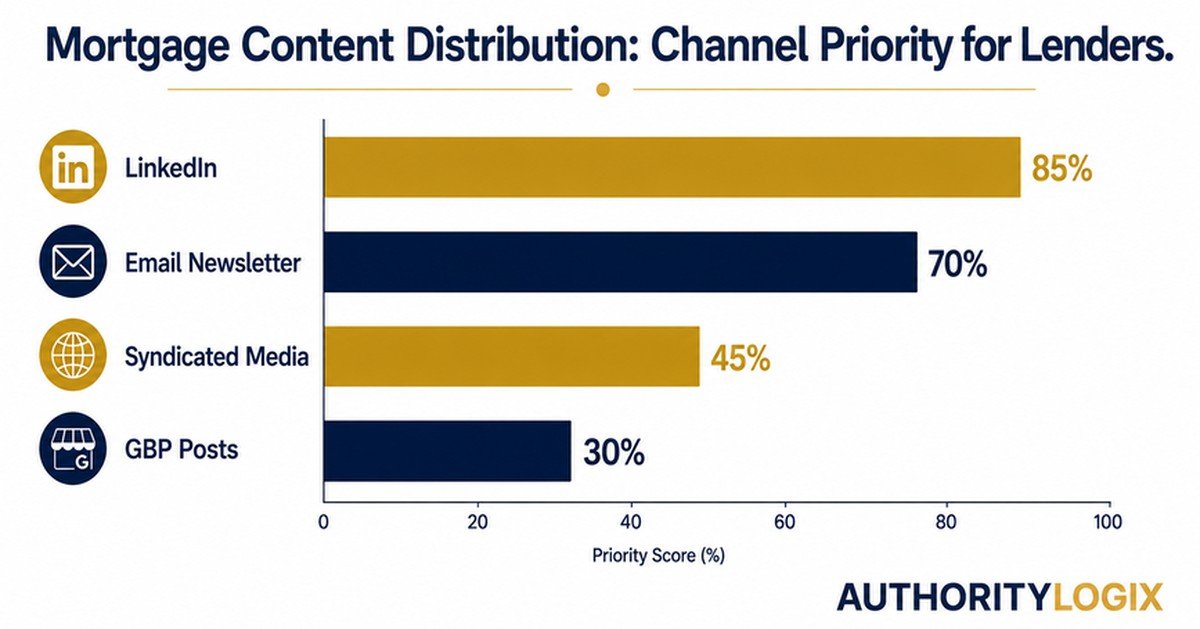
Distribution channels for a mortgage company content strategy:
- LinkedIn: The primary channel for reaching real estate agents, investors, financial advisors, and professional borrowers. A consistent LinkedIn content presence built from your pillar strategy places your expertise in front of the referral network that drives your business.
- Email newsletter: A monthly or bi-weekly newsletter to your existing database delivers your content to borrowers who have opted in and keeps your brand present during the 6-to-12-week research window.
- Syndicated media: Content placed on high-authority financial and real estate publications builds backlinks, increases branded search volume, and creates the multi-platform credibility footprint that makes your Google results page look like an authority.
- Google Business Profile posts: Weekly GBP posts that link to your content drive local search visibility and provide fresh signals to Google’s local ranking algorithm.
3 Mortgage Blogging Strategy Mistakes That Kill Lead Generation
Writing for National Audiences on National Topics
A lender content marketing strategy that publishes general articles about mortgage rates, homebuying tips, or how credit scores work is competing with Rocket Mortgage’s million-dollar content team, Bankrate, NerdWallet, and every major financial publisher. No independent lender or regional mortgage company wins that competition. The content that generates inbound mortgage leads is written for a specific borrower in a specific situation — DSCR investors in your market, VA borrowers in your state, self-employed borrowers who have been turned down elsewhere.
Publishing Without Compliance Review
Mortgage content that mentions rates, terms, or product features must comply with TRID, RESPA, and state licensing requirements. Content that includes rate quotes without required disclosures, referral arrangements without RESPA compliance, or testimonials that do not follow FTC guidelines creates regulatory exposure. A mortgage company content plan that does not include a compliance review workflow for every piece of published content is a liability, not an asset. Build the review step into your production process from the beginning.
Measuring Traffic Instead of Applications
Traffic is not a mortgage business outcome. Applications are. A mortgage content plan that measures page views, social impressions, and email open rates without connecting those metrics to loan applications and funded loans is measuring the wrong thing. Track which content generates leads. Track which leads submit applications. Track which applications close. That attribution data tells you which content to produce more of and which topics to abandon.
Why a Content Strategy for a Mortgage Company Compounds Over Time
The mortgage companies that generate consistent inbound leads through content are not the ones that publish the most — they are the ones that publish most consistently. A mortgage content strategy built on a realistic publishing cadence, maintained without interruption, produces compounding results that no burst of high-volume publishing can replicate. Search engines reward consistency. Audiences reward consistency. The mortgage company that publishes two authoritative articles per month for 24 months has built a more durable content asset than the one that published 20 articles in a single quarter and then went quiet.
Consistency in mortgage content strategy also means consistency of voice, depth, and specificity. Every piece of content should sound like it came from the same expert — because it did. The mortgage company whose content is recognizably specific, genuinely useful, and consistently published builds a brand through content that no advertising campaign can replicate at equivalent cost.
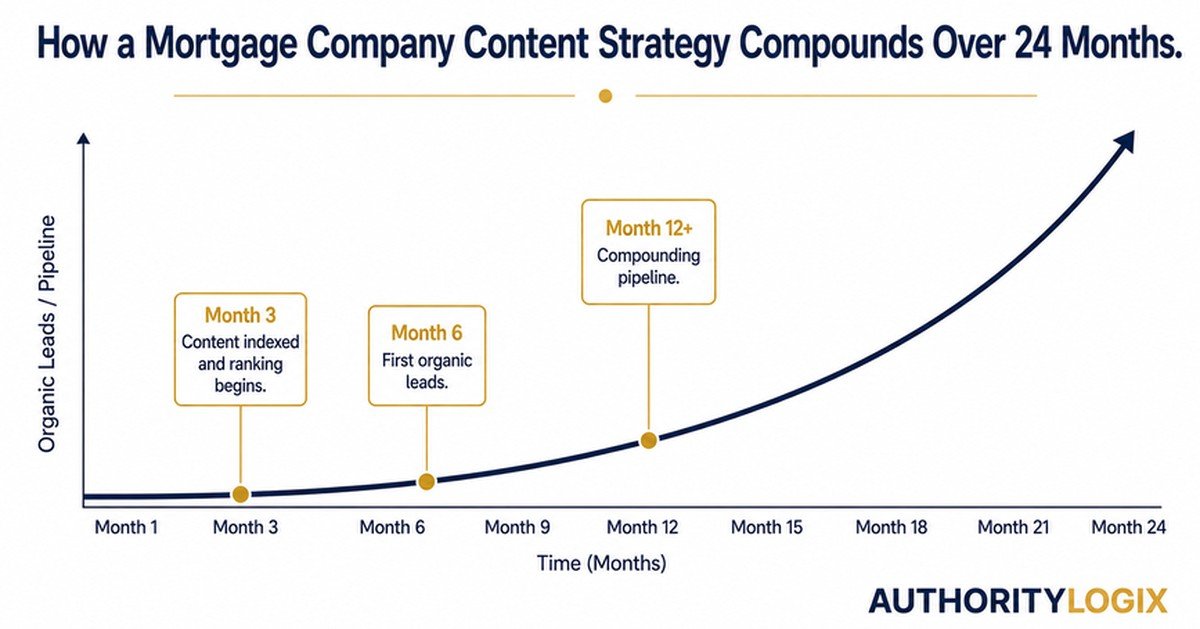
The mortgage company that invests in a documented content strategy today is building an asset that will generate qualified leads years from now at a fraction of the cost of any paid channel. The content published in month one ranks better in month twelve because of the authority accumulated by months two through eleven. The audience built through consistent mortgage content publishing is an owned asset — unlike a social media following or a purchased lead list, it cannot be taken away by a platform algorithm change or a lead vendor price increase.
A mortgage company content strategy that is built today and maintained consistently for the next two years will generate more qualified leads in month 24 than in month one — and at lower cost per lead, with higher conversion rates, and with better-qualified prospects. That is the compounding return that makes content strategy the most important marketing decision a mortgage company can make in 2026.
The mortgage companies that will own their markets in 2028 are the ones building their content strategy infrastructure in 2026. The lead generation advantages that compound from consistent mortgage content publishing — search rankings, email lists, authority reputation — take time to build and are nearly impossible for late entrants to displace quickly. Starting now is the strategic advantage. Waiting is the strategic risk.
Ready to build your content system? Book a free Authority Gap Assessment
Building a Mortgage Content Strategy That Compounds
A content strategy for a mortgage company that is built correctly does not just generate leads this quarter. It generates better leads, at lower cost, in greater volume, as the content library grows and distribution network expands. Mortgage sites see leads surge in 3 to 6 months with targeted SEO. After 24 months of consistent strategic publishing, cost per organic lead drops to a fraction of what purchased leads cost. The how it is built determines how fast that compounding begins.
For the full content-to-client system that connects mortgage content strategy to authority building, lead capture, and conversion, see the Finance Content Playbook: How Lenders, Advisors, and Real Estate Firms Turn Content Into Clients.
The trigger lead ban removed a channel many lenders depended on without fully understanding it. The lenders who built inbound content systems before March 2026 are not looking for replacement volume. Their content keeps generating applications from borrowers who find them through search, trust them through their published expertise, and reach out without being solicited. To see exactly what that system looks like fully built, start with the BKDSCR.com proof-of-work case study — a full-stack mortgage authority platform built from zero that ranks, generates leads, and converts borrowers without a single purchased lead.
Building a mortgage content strategy is not a marketing project. It is a business infrastructure decision that affects your pipeline independence, your cost per acquisition, and your ability to compete regardless of what any third-party lead channel does next. The firms and loan officers building it now are establishing a compound advantage that widens every month they publish.