
Key Takeaways
- A content strategy for real estate investors that actually generates leads is built on audience specificity, not volume. One well-targeted pillar article outperforms 20 generic posts.
- Real estate companies with active blogs generate 5.4x more leads than those without content marketing. That multiple reflects strategic publishing, not random posting.
- 97% of homebuyers use the internet in their search. The average online search duration before contacting an agent is 4.7 months. Your content needs to be present and useful across that entire window.
- Neighborhood guide pages rank 28% higher than generic service pages and generate 3.2x more leads. Specificity in real estate content is a measurable lead generation advantage.
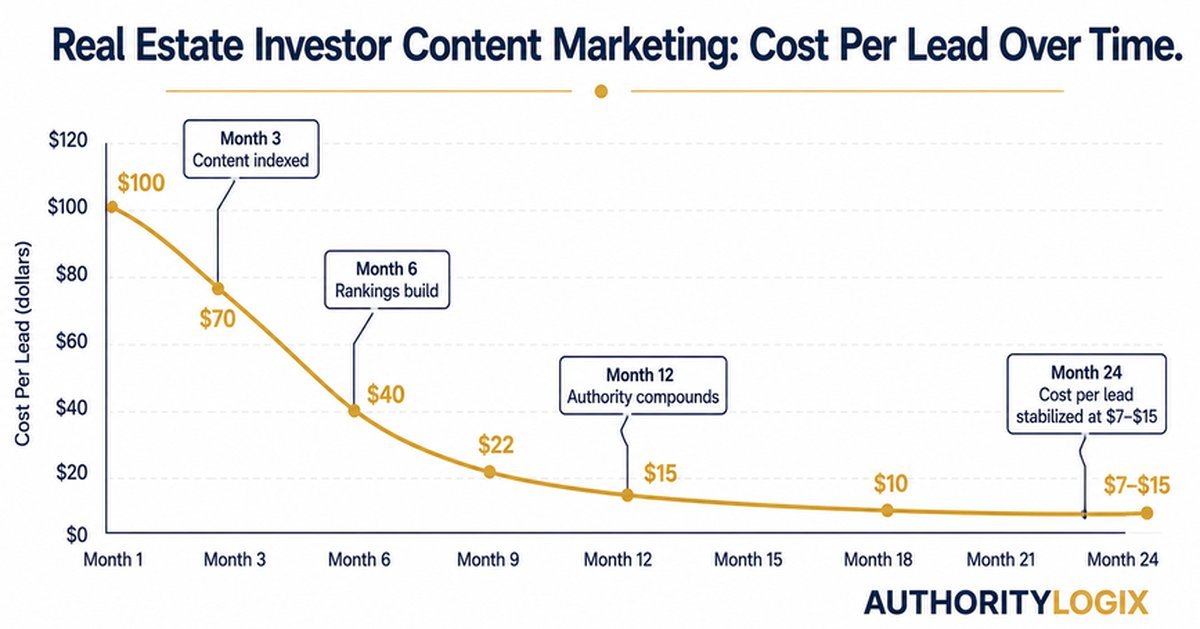
- Content marketing for real estate investors starts expensive at $80–$100 per lead in months 1–3, then drops to $7–$15 per lead after 24 months of consistent publishing. Infrastructure appreciates.
- The content that converts real estate investor leads is deal-oriented and market-specific. Generic tips produce readers. Deal math, market data, and investment case studies produce clients.
Table of Contents
A content strategy for real estate investors is not about posting more. Most real estate investors, firms, and coaches who try content marketing already know how to post. The problem is not output volume. It is the absence of a strategy that connects content to a specific audience, routes that audience toward a lead capture mechanism, and nurtures the resulting leads through the 4.7-month research window that precedes the average real estate decision. Content without that infrastructure produces visibility. Visibility without infrastructure produces nothing you can take to the bank.
According to NAR Research and Statistics 2026, 97% of homebuyers use the internet during their property search, and the average buyer searches for 4.7 months before contacting a professional. That research window is your content opportunity. The real estate investor, passive investor, or property buyer who has encountered your deal analyses, market reports, and investment frameworks a dozen times over four months arrives at the first conversation pre-qualified, pre-trusting, and pre-sold on your expertise.
Real estate companies with active blogs generate 5.4x more leads than those without content marketing. Neighborhood guide pages rank 28% higher than generic service pages and generate 3.2x more leads. The content generating real estate leads is specific, deal-oriented, and locally grounded. This guide covers exactly what that content looks like — and how to build the strategy behind it.
See how the Content System works: Explore Content Systems
Why Most Real Estate Investor Content Does Not Generate Leads
The most common real estate investor content mistake is broadcasting to everyone rather than publishing for someone specific. A social post about real estate investing in general, a blog about why real estate is a good investment, or a market update that could apply to any market is not a content strategy. It is output without direction — and output without direction produces exactly the leads you would expect from an unfocused message aimed at nobody in particular.
Real estate investor content fails to generate leads for three structural reasons. First, it is not specific enough to attract the right audience. An article about DSCR loans for NYC outer-borough multi-family investors is competing with almost nobody. An article about why real estate is a good investment is competing with every financial publisher and content farm producing for the same generic keyword. Specificity is the primary lever in a real estate investor content strategy that actually drives qualified traffic.
Second, it lacks a lead capture mechanism. Most real estate investor content is published without any way to convert readers into leads. No lead magnet, no email capture, no internal link to a service page. The content produces traffic that arrives and leaves without any mechanism for continuing the conversation.
Third, it does not connect to a distribution system. Publishing to your own website and waiting for Google is not a distribution strategy. Content needs to reach the audience through channels where they already spend time — LinkedIn for professional and accredited investors, email for your existing list, and authority distribution channels that place your content on third-party platforms. For the full local search strategy that supports this distribution, see Local SEO for Real Estate Companies: The Complete Guide. your ideal clients already trust.
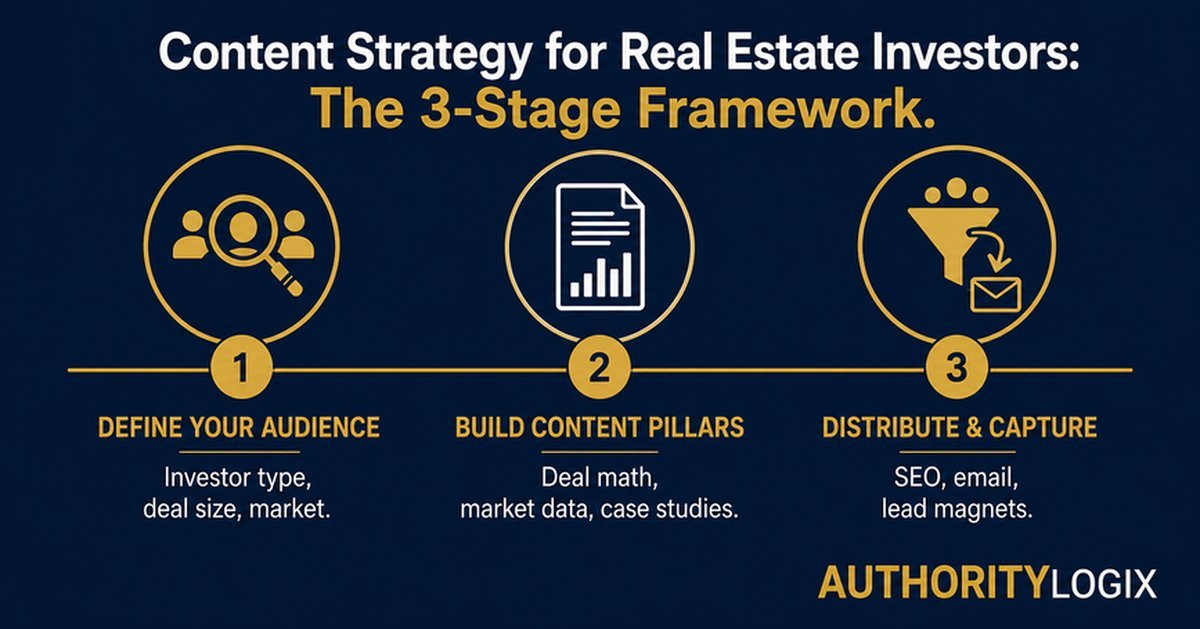
Step 1 — Define the Exact Audience Your Content Will Serve
A content strategy for real estate investors begins with audience definition — not demographics, but a specific description of the person your content will be written for, the problem they are trying to solve, and the stage of the investment journey they are in. Vague audience definitions produce vague content. Specific audience definitions produce content that resonates because it is clearly written for a specific person who recognizes themselves in it.
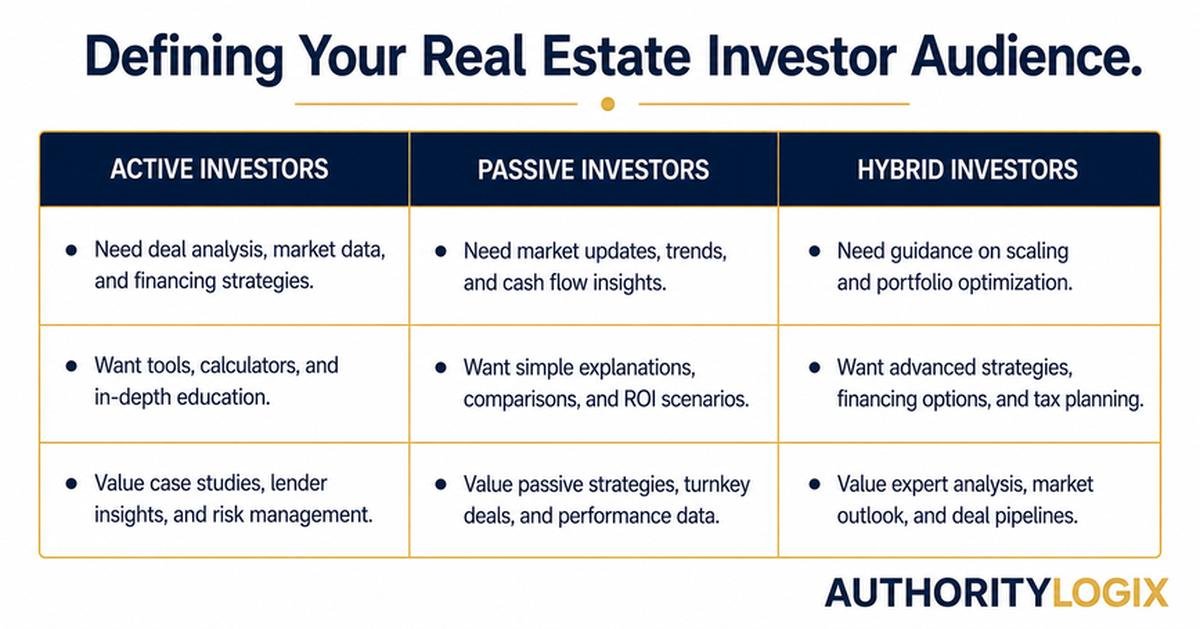
For real estate investment firms, the audience typically falls into three categories: active investors seeking deal flow and market intelligence; passive investors evaluating syndications who need credibility validation; or hybrid investors building portfolios who need both operational guidance and market data. Each requires a different content strategy, different topics, and different lead magnets.
For real estate coaches and educators, the audience is equally specific: first-time investors needing foundational education and confidence; mid-level investors stuck at a portfolio milestone; or advanced investors scaling into commercial portfolios. Each audience reads, searches, and converts differently.
The most effective content strategy for real estate investors targets one primary audience for a sustained period before expanding. Top agents using the pillar-cluster model rank for over 100 local search terms and generate an average of 8 leads per pillar post — 4x the lead generation of random content publishing. The complete authority marketing framework for financial services and real estate matters as much as the tactics. For the full content strategy that supports real estate investor audiences, see Local SEO for Real Estate Companies: The Complete Guide.
Step 2 — Build the Content Pillars That Drive Real Estate Investor Leads
Once the audience is defined, the content pillars determine the full set of topics your brand will cover systematically. A content pillar is a broad subject that encompasses multiple related articles, tools, and resources — each of which links back to the pillar page and to each other. This interconnected architecture is what builds topical authority in search engines. A structured educational hub is how this architecture is built and maintained.
For real estate investment firms, the content pillars that consistently produce the highest-quality leads are:
- Deal analysis frameworks: How to evaluate specific deal types in your target market — DSCR calculations, cash-on-cash returns, cap rates, stress test scenarios. This content attracts investors actively evaluating deals and positions your firm as the analytical authority.
- Market intelligence: Local and regional market reports that your target investors cannot easily find elsewhere. Median sale price trends, vacancy rates, rent growth data, zoning changes, development pipelines.
- Investment case studies: Real deals, structured honestly. What was acquired, at what price, with what financing, producing what returns. Case studies are the highest-converting real estate investor content type because they demonstrate competence through evidence, not claims.
- Educational guides for your investor type: The specific questions your target investor is asking at each stage of their journey — qualification guides, due diligence frameworks, advanced structuring content.
For real estate coaches and educators, the pillars that drive enrollment are student outcome case studies, curriculum previews that demonstrate methodology depth, current market analysis, and Q&A content that addresses the objections prospective students raise before investing in education.
Before you build, know where the gaps are: Download the free Authority Gap Assessment
For the complete content architecture behind the pillar-cluster model — editorial calendar, keyword structure, and publishing workflow — see the Content System Blueprint for Financial Brands.
Step 3 — Build Lead Capture Into Every Content Asset
Content that generates traffic without a lead capture mechanism is a brand awareness exercise. A lead generation system for real estate investor content ensures that every article, guide, and case study has a specific next step positioned for the reader. The lead magnet — the specific, valuable asset a reader can download in exchange for their email address — is the conversion mechanism that turns a content strategy into a pipeline.
A generic real estate investing guide attracts everyone and qualifies nobody. A DSCR deal qualification checklist for outer-borough NYC investors attracts a prospect who has already identified their investment strategy, target market, and financing preference. That pre-qualification happens through the specificity of the offer, not through any sales process.
Lead magnet formats that convert consistently for real estate investor content include:
- Deal analysis worksheets: A downloadable framework your audience can use to evaluate their own deals — positioned for the specific deal type you specialize in.
- Market data reports: A local or regional market summary with data your audience cannot easily access elsewhere — updated quarterly to maintain download motivation.
- Investment checklists: Step-by-step checklists for specific investment actions — due diligence, financing qualification, property inspection, syndication evaluation.
- Video training modules: Short educational videos on specific investment topics — gated behind an email capture form to generate qualified leads who have self-selected into your content.
Step 4 — Distribute Content Where Real Estate Investors Actually Are
Publishing to your own website is the starting point, not the end point. A structured finance content distribution approach ensures your content reaches the professional and investor audiences that your ideal clients trust.
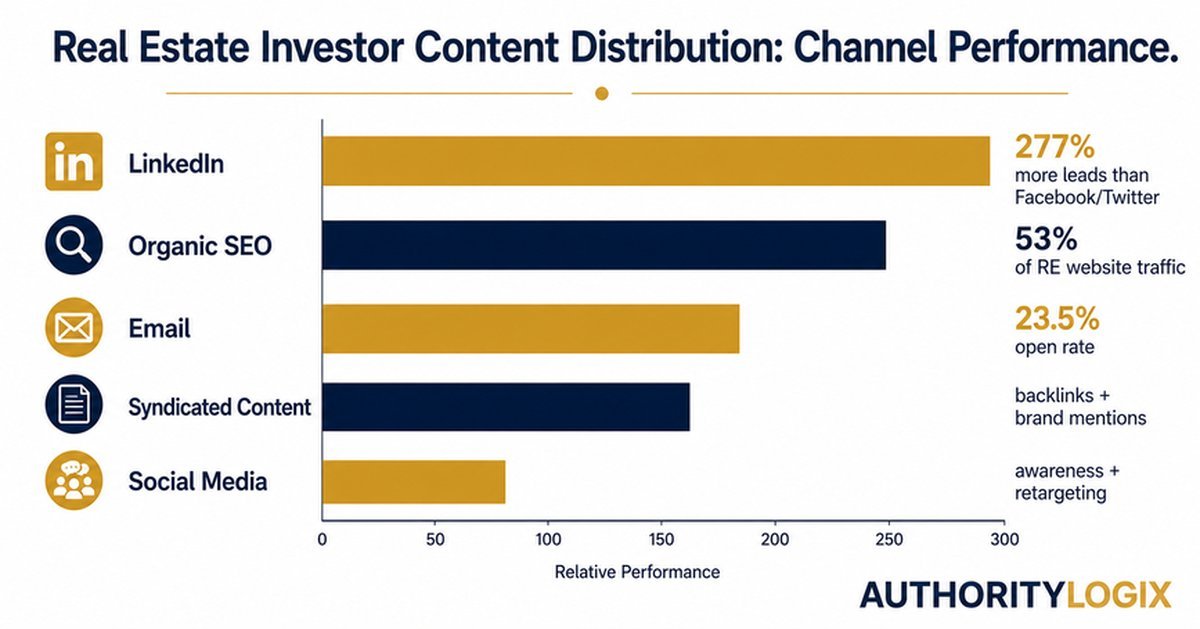
LinkedIn is the highest-leverage distribution channel for real estate investment firms and coaches. LinkedIn drives 277% more B2B leads than Facebook or Twitter, and 62% of investors discover financial products via LinkedIn. A consistent LinkedIn presence places your expertise in front of the professional investor audience that other channels cannot reach.
Email remains the most reliable nurture channel once leads are captured. Real estate email marketing generates a 23.5% open rate because subscribers have direct financial stakes in the information. A quarterly market report email keeps your brand present across the full 4.7-month research window.
Syndicated content distribution places your articles and analyses on high-authority third-party platforms where your ideal investor clients are already reading. Each syndicated placement builds backlinks, increases branded search volume, and creates the multi-platform credibility footprint that converts first impressions into inquiries. You can see how this is built in practice through the BKDSCR.com proof-of-work case study — a full-stack investor authority platform built from zero.
3 Real Estate Investor Content Mistakes That Kill Lead Generation
Publishing Deal-Agnostic Content
Real estate investor content that avoids specific deal math and market data appeals to the broadest audience and converts the fewest leads. The investor who reads a generic article about why real estate investing is smart has not learned anything specific enough to take action. The investor who works through a DSCR calculation for a specific Brooklyn two-family has encountered expertise specific to their situation. That specificity generates follow-up inquiries.
Skipping the Distribution Step
Content left sitting on your website is a hope strategy. The firms generating consistent inbound leads have built distribution protocols ensuring every piece of content reaches the relevant audience through LinkedIn, email, and syndication. The content itself does not generate leads. The combination of content and distribution does.
Measuring Traffic Instead of Leads
Page views and social impressions are not business outcomes. The metric that matters in a real estate investor content strategy is qualified leads generated — specifically, leads who match your target investor profile and are at a stage in their journey where your offer is relevant. Traffic metrics that do not connect to lead capture and conversion data tell you nothing useful about whether your content strategy is generating business.
For the full content-to-client system that connects content strategy to authority building, lead capture, and conversion, see the Finance Content Playbook: How Lenders, Advisors, and Real Estate Firms Turn Content Into Clients.
Why a Documented Content Strategy Produces Consistent Results
The difference between real estate investors who generate consistent inbound leads through content and those who publish sporadically with no results comes down to one thing: documentation. A documented content strategy is not a content calendar — it is a written framework that defines your audience, your topics, your publishing cadence, your internal linking rules, your lead capture mechanism, and your distribution channels. When every decision is pre-made, execution becomes consistent. Consistency is what produces compounding results.
Real estate investors who commit to a documented content strategy for 12 months build a content library that works independently of any single post. Each article links to related articles, strengthens topical authority in search engines, and funnels readers toward a specific lead capture offer. The investor who has built this system receives inbound inquiries from prospects who have already spent time inside the content ecosystem — pre-educated, pre-qualified, and pre-trusting before the first conversation.
The real estate investor who treats content strategy as a core business function — not a marketing afterthought — builds a compounding visibility asset that generates inbound inquiries for years. The content you publish today about the specific market, deal type, and investment strategy you specialize in is working for you every day it remains indexed. Each additional piece of content makes every prior piece more valuable. That is the compounding return that makes content strategy the highest-leverage marketing investment available to real estate investors in 2026.
A content strategy for real estate investors that is built on documented topic architecture, consistent publishing, and structured lead capture is not just a marketing plan — it is a business development infrastructure that operates independently of referral relationships, market conditions, and advertising platforms. That independence is what makes it the most valuable long-term investment a real estate investor can make in their business visibility.
Content strategy for real estate investors works because it targets the exact questions your ideal prospects are already researching. Every article that ranks for a specific investor question generates qualified traffic from prospects who have self-selected into your audience by virtue of the search they performed. That self-selection is pre-qualification at scale — and it is the mechanism that makes content strategy the most efficient lead generation investment available to real estate investors today.
Ready to build your content system? Book a free Authority Gap Assessment
Building a Real Estate Investor Content Strategy That Compounds
A content strategy for real estate investors built correctly generates better leads at lower cost as the library grows. Real estate content marketing starts at $80–$100 per lead in months one through three. By month 24, cost per lead drops to $7–$15. The infrastructure appreciates while the content keeps working.
A Google Ad stops generating leads the moment you stop paying. An article published today on DSCR loan qualification criteria for NYC investors will still rank and generate inquiries two years from now. The investment is front-loaded. The returns are back-loaded and compounding.
The real estate firms, coaches, and advisors that build this infrastructure now are establishing a content asset that no competitor can replicate overnight. To see exactly how a full-stack investor authority platform is built from zero, start with the AuthorityLogix Content Systems overview — the same model used to build BKDSCR.com into a ranking, lead-generating platform for NYC outer-borough real estate investors.