


Key Takeaways
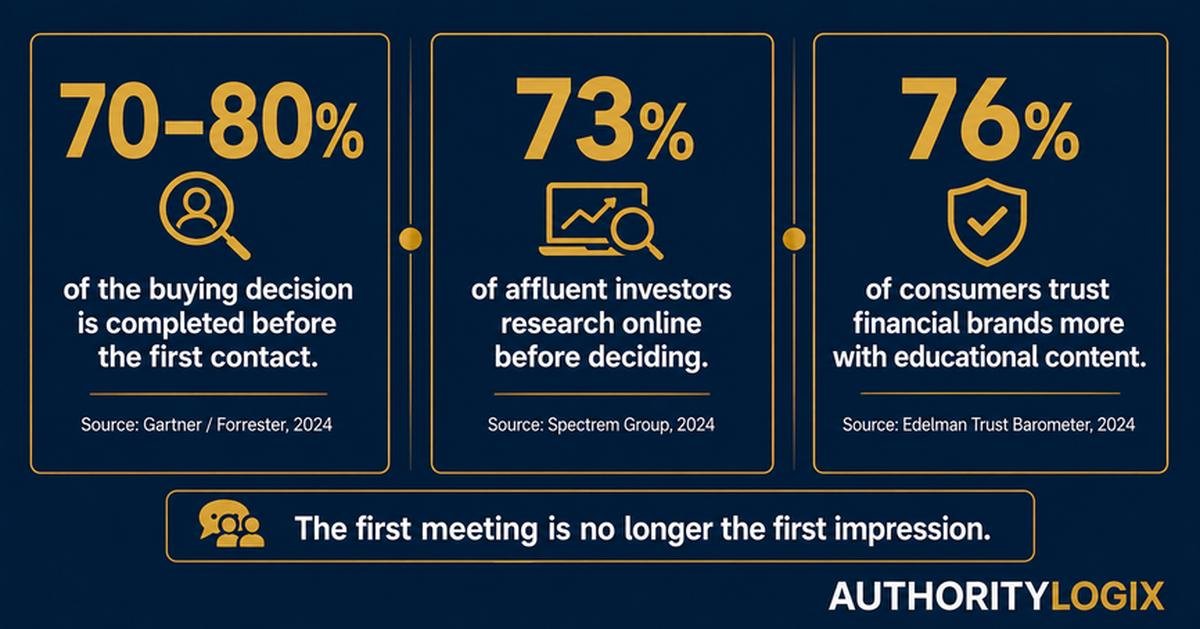
- 70–80% of the financial services buying decision is completed before a prospect ever contacts a professional. Content is what shapes that decision — not the first meeting.
- 76% of consumers trust financial brands more when they provide educational content. The finance content playbook is the system that makes that trust operational.
- Financial advisors who blog generate approximately 67% more leads than those who do not. The gap is not content quality — it is the presence or absence of a system.
- 73% of affluent investors research financial topics online before making decisions. The professional who answers those questions first owns the relationship before it begins.
- The finance content playbook connects five systems — positioning, publishing, distribution, capture, and conversion — into one closed loop. Every piece of content has a defined role in moving a prospect from awareness to client.
- BKDSCR.com is the finance content playbook in production — a DSCR lending platform that generates qualified investor inquiries through published content, without a paid lead source.
Table of Contents
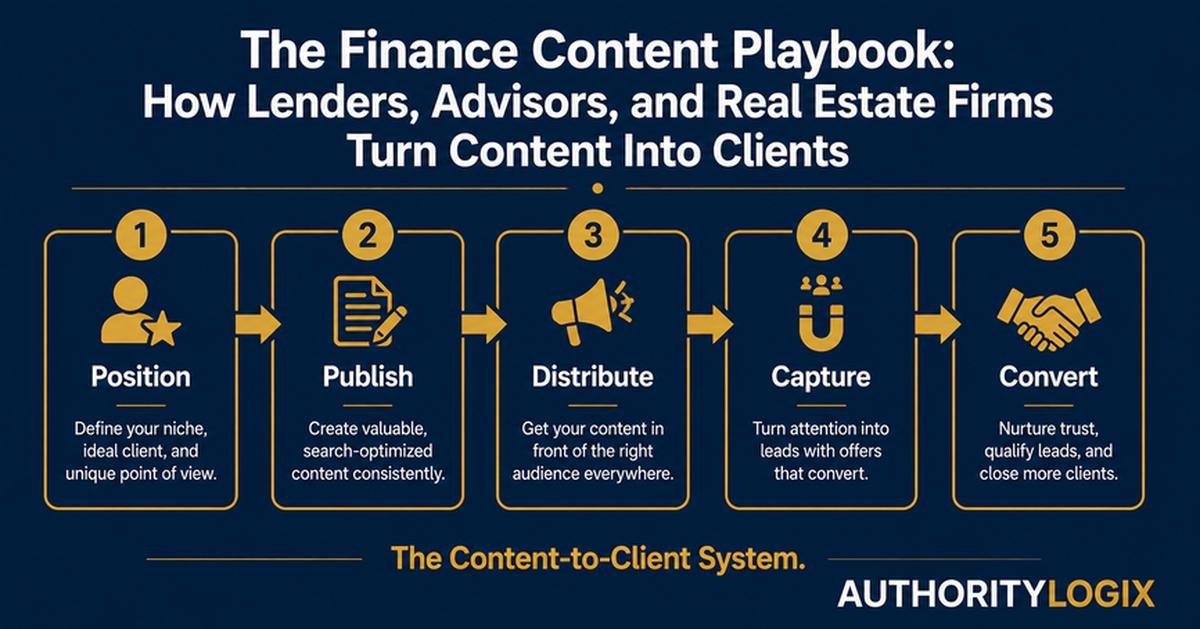
Finance content for lenders and advisors converts when it educates — not when it sells. A content strategy tells you what to publish. The finance content playbook tells you how published content becomes a client — the complete system that connects the first piece of content a prospect reads to the moment they book a call, submit an application, or sign an engagement.
The case for building this system is not abstract. 70–80% of the financial services buying decision is completed before a prospect ever contacts a professional (Gartner/Forrester, 2024). The first meeting is no longer the first impression — it is a validation point on a trust-building journey that content already shaped. The advisors, lenders, and real estate firms that understand this are already winning the client before the first call.
73% of affluent investors research financial topics online before making decisions. 76% of consumers trust financial brands more when they provide educational content (Averi.ai, 2026). Financial advisors who blog generate approximately 67% more leads than those who do not (Amra & Elma, 2026). These are not social media statistics — they are client acquisition statistics. Content is the mechanism by which the financial professional is present in the prospect’s research phase, trusted before the first conversation, and chosen before the first pitch.
This is the finance content playbook — the five-stage system that connects publishing to client acquisition for mortgage companies, DSCR lenders, real estate coaches, and financial advisory firms. BKDSCR.com runs this playbook for NYC outer-borough real estate investors and produces qualified inbound inquiries without a paid lead source, a cold call list, or an ad budget.
See how we do it: Explore How We Do It
Why Finance Content for Lenders and Advisors Converts When It Educates
The finance content playbook is not a publishing problem — it is a system problem. Most financial professionals who have tried content marketing have published articles, posted on LinkedIn, and sent emails. They have done the publishing. What they have not built is the system that makes the publishing convert.
The specific gap is in the connection between content stages. A financial professional who publishes a great DSCR market update on LinkedIn has done Stage 2 of the playbook. But if there is no lead magnet to capture the reader who wants to go deeper (Stage 4), no nurture sequence to follow up with the ones who provide their email (Stage 5), and no clear positioning that makes the reader understand why this is the professional they should contact (Stage 1), the article earns attention and produces nothing.
The finance content playbook closes every gap between the stages. It is a closed loop — each stage feeds the next, and no content effort is wasted because every piece has a defined role in moving a prospect from awareness to client. The financial professional who builds all five stages and connects them has a client acquisition system. The one who publishes without the system has a content archive.
The four preceding guides in this resource library each cover one layer of the system: search visibility is covered in the Complete Guide to Getting Found Online for Financial Brands; authority building in the Complete Guide to Authority Marketing for Financial Services; lead generation in the Lead Generation System for Financial Services and Real Estate; and publishing infrastructure in the Content System Blueprint for Financial Brands. This playbook synthesizes all four into the complete content-to-client model.
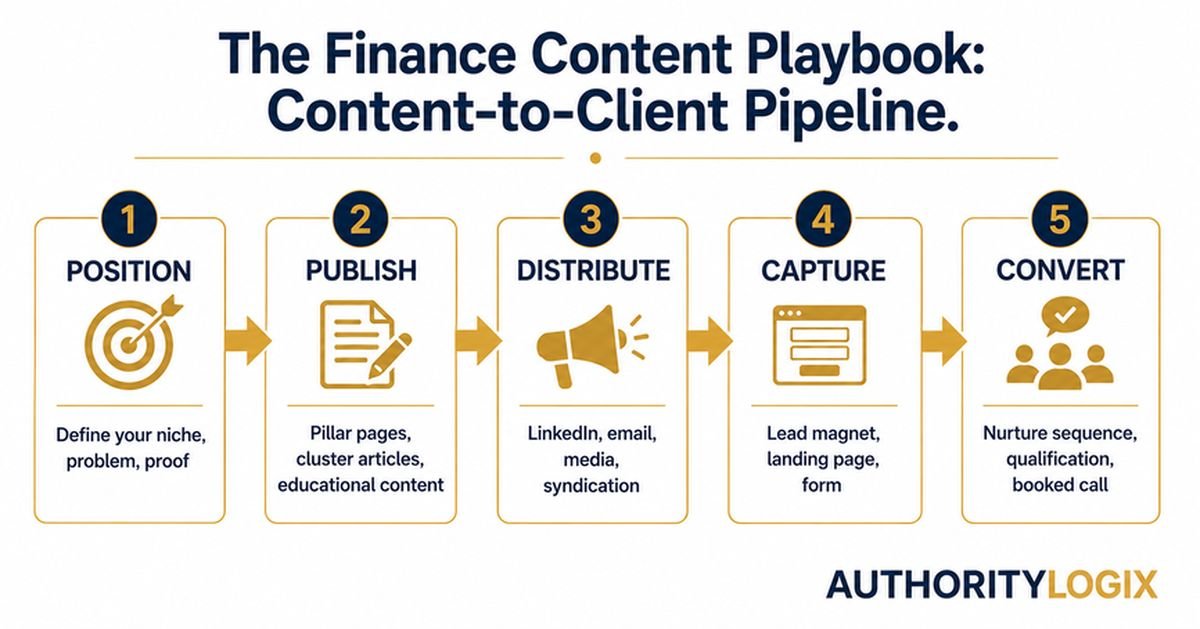
Stage 1: Position — the Finance Content Playbook Starts Before the First Word Is Published
Every piece of content in the finance content playbook is written for a specific person with a specific problem. The positioning decision — who you serve, what specific problem you solve, why you and not the next professional — is not a branding exercise. It is the instruction set that every subsequent stage of the playbook runs on.
A DSCR lender who positions around “I help outer-borough NYC real estate investors finance rental properties using debt service coverage ratio loans when their personal income doesn’t qualify under conventional underwriting” has a positioning statement that answers every question in the playbook: who the content is for, what the lead magnet should offer, what the nurture sequence should teach, who the ideal LinkedIn audience is, and what the first conversation sounds like.
Why Generalist Positioning Fails in the Finance Content Playbook
The most common positioning failure in financial services is targeting everyone. A mortgage broker who calls themselves a “full-service lender serving all borrowers” has no foundation for a finance content playbook — because every content decision requires a defined audience with a defined problem. Without the definition, every content decision becomes arbitrary and every piece of content competes for a generic audience already served by national lenders with enormous budgets.
Niche positioning is not limiting — it is liberating. The DSCR lender who owns a specific investor type in a specific market does not compete with Rocket Mortgage. They serve a client that Rocket Mortgage cannot serve, with expertise that Rocket Mortgage cannot replicate, through content that Rocket Mortgage is not publishing. That is a structural competitive advantage built entirely on clarity of positioning.
For how AuthorityLogix builds the positioning layer that anchors the full finance content playbook, see Why AuthorityLogix and the BKDSCR.com proof-of-work case study.
Stage 2: Publish — Building the Content Library That Drives the Finance Content Playbook
Publishing in the finance content playbook is not activity — it is asset construction. Every article, guide, market update, and FAQ entry is an asset that works indefinitely after publication, compounding in search authority, AI citation frequency, and trust with prospects who find it weeks or months after it goes live. The buyer’s journey in financial services typically involves 27 distinct interactions across channels before a decision is made (Forrester, 2024). The finance content playbook ensures the financial professional is present at as many of those 27 touchpoints as possible.
What the Finance Content Playbook Publishes
- Pillar pages — comprehensive, 2,000–3,000 word resources targeting primary keywords; these are the anchor assets that earn search rankings, build topical authority, and serve as the hub for all cluster content
- Cluster articles — 800–1,500 word pieces targeting secondary keywords and prospect questions, all linking back to the pillar page and extending the topical authority position
- Market data and commentary — regular updates on the specific market the professional serves, building the LinkedIn audience, populating the email list, and positioning the professional as the go-to market authority
- Educational hub resources — checklists, calculators, comparison guides, and deal analysis frameworks that pre-qualify prospects and shorten sales cycles by answering every question before the first meeting
For the complete architecture behind this publishing layer — keyword structure, pillar-and-cluster framework, and editorial calendar — see the Content System Blueprint for Financial Brands.
Before you build, know where the gaps are: Download the free Authority Gap Assessment
Stage 3: Distribute — Getting the Finance Content Playbook in Front of the Right Audience
Publication without distribution is content production, not a finance content playbook. Distribution is the stage that extends content beyond the organic audience and into the channels where the target client is consuming information, making decisions, and evaluating professionals.
LinkedIn — the primary distribution channel for financial professionals
In 2026, LinkedIn remained the top B2B lead platform for financial advisors, with over 69% reporting at least one high-value client acquisition directly tied to organic LinkedIn content or networking activity (Amra & Elma, 2026). The finance content playbook uses LinkedIn not as a separate marketing channel but as a distribution arm of the publishing system — every pillar page, market update, and educational resource gets a LinkedIn adaptation that carries the content to the professional’s network and beyond. LinkedIn personal profiles receive 65% of feed allocation versus 5% for company pages, making the professional’s personal profile the primary distribution vehicle.
Email — the owned distribution channel that converts at the highest rate
Every lead magnet download and inbound inquiry adds a subscriber to the email list. The finance content playbook distributes every new piece of published content to the list — a brief summary, the key insight, and a link to the full piece. Email generates $36–$42 per $1 spent, the highest ROI of any marketing channel, and financial services emails achieve a 39.8% open rate — significantly above the cross-industry average (CUFinder, 2026).
Media placement and syndication — the earned distribution layer
The finance content playbook includes a media distribution component that places the professional’s expertise in third-party publications, podcasts, and platforms that carry independent credibility. This is the Authority Distribution layer — a DSCR lender quoted in a regional real estate investor publication earns a backlink, reaches a new audience, and reinforces expert positioning across a channel the professional did not build and does not maintain.
For how AuthorityLogix executes multi-platform content syndication at scale as part of the finance content playbook, see Authority Distribution.
Stage 4: Capture — Converting Finance Content Playbook Readers into Identified Leads
The finance content playbook converts anonymous readers into identified prospects through a capture system — a lead magnet, a landing page, and a form that exchanges a valuable resource for a name and email. Without this stage, the playbook generates traffic and authority but no pipeline.
The capture stage of the finance content playbook is built around one principle: the lead magnet must be more specific than the content that drove the reader to it. A DSCR investor who read a pillar page on “DSCR Loans for NYC Real Estate Investors” is best captured by a lead magnet that goes one level deeper: “The DSCR Qualification Checklist for NYC Multi-Family Properties” or “DSCR Calculator: Know Your Ratio Before You Apply.”
The Capture System Architecture in the Finance Content Playbook
- Lead magnet — a short, specific, immediately useful asset exchanged for name, email, and one qualifying question; formats that work: qualification checklists, deal analysis calculators, market data reports, comparison guides, underwriting requirement summaries
- Landing page — single-purpose page with one offer, one form, no navigation links; headline names the specific prospect and their specific problem; 3–5 field form maximum
- Confirmation and delivery — immediate email delivery of the lead magnet, a brief credibility introduction, and routing into the nurture sequence
The lead capture form is the entry point to the finance content playbook for prospects who are ready to take the next step but not yet ready to book a call. For the full lead generation system surrounding this capture stage, see the Lead Generation System for Financial Services and Real Estate.
Stage 5: Convert — Turning Finance Content Playbook Leads into Booked Clients
The conversion stage of the finance content playbook is where leads become clients. The finance content playbook converts through a structured nurture sequence — 7 to 12 emails over 3 to 6 weeks that move a new lead from initial interest through education, trust-building, objection handling, and proof of work to a conversion CTA that feels like the obvious next step.
The Content-to-Conversion Flow in the Finance Content Playbook
- Day 0: Lead magnet delivery + credibility introduction — who you are, who you serve, what makes your approach different
- Days 2–5: Educational content that advances the prospect’s understanding of their specific situation — not general financial education, but the specific knowledge the defined client type needs to move toward a decision
- Days 8–12: Proof of work — a case study, a deal breakdown, a documented client outcome that demonstrates the professional’s ability to deliver the result the prospect wants
- Days 16–21: Objection handling — the specific reason the prospect has not moved forward yet, addressed directly with evidence, data, or a reframe that removes the obstacle
- Day 28: Conversion CTA — a direct, low-friction invitation to book a call, positioned as the natural next step after everything they have learned
The finance content playbook’s conversion rate is structurally higher than cold outreach because the prospect has already done the evaluation by the time the conversion CTA arrives. The first meeting becomes a formality — a confirmation of a decision already made — rather than a beginning.
For the complete email nurture system — automation setup, sequence structure, and compliance requirements specific to mortgage and DSCR content — see Content Systems.
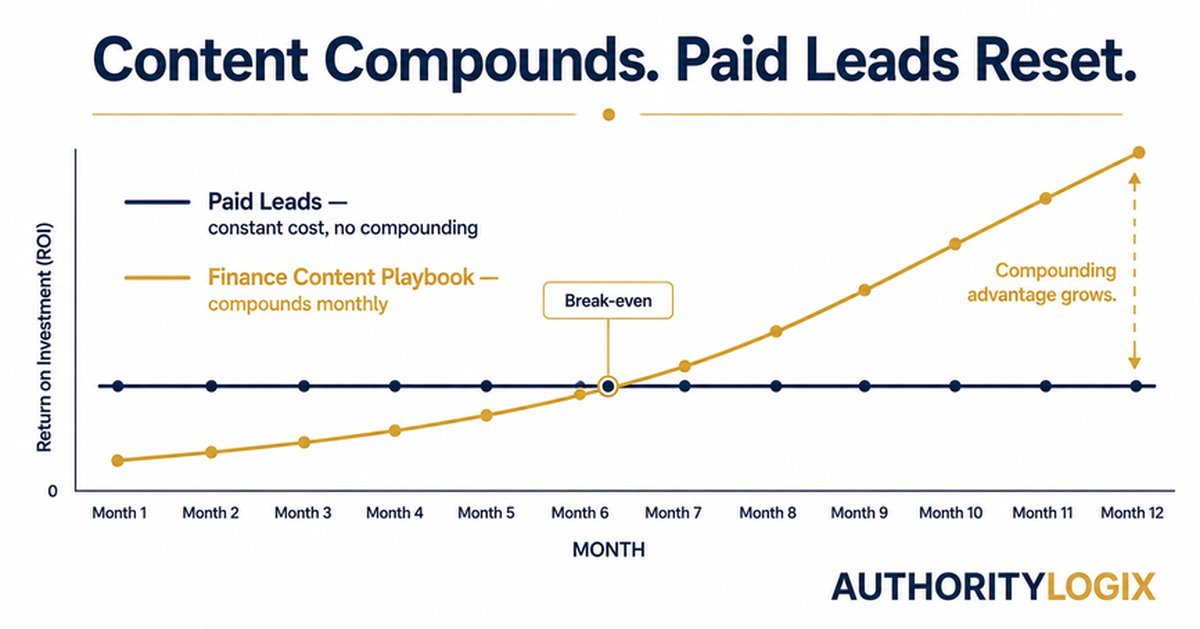
How the Finance Content Playbook Compounds — the Growth Model That Changes Client Acquisition Economics
The most important characteristic of the finance content playbook is not that it works. It is that it compounds. Each piece of content published earns organic traffic every month after publication with no additional cost. Each subscriber added to the email list compounds the distribution reach of every future article. Each backlink earned through media placement increases the search authority of every page on the domain. Each client acquired through the playbook is more likely to refer because they arrived through a content-driven trust journey, not a cold pitch.
Paid lead acquisition does not compound. A financial professional who spends $5,000 per month on purchased leads gets exactly $0 of value from that spend in month 13 if they stop in month 12. The finance content playbook’s 12-month investment continues producing in month 13, 18, and 24 — at increasing return per dollar invested as the domain authority builds, the content library grows, and the email list expands.
The financial services retention rate is 89.4% (CUFinder, 2026). The clients acquired through the finance content playbook arrive pre-sold on the professional’s expertise, stay longer, refer more, and produce higher lifetime value than clients acquired through paid sources.
What the Finance Content Playbook Looks Like at 12 Months
- A published library of 8–15 keyword-targeted articles covering the full buyer journey from awareness to decision for the defined client type
- A Google search presence that ranks for the specific terms the target client types when they are ready to find a professional in this space
- A LinkedIn authority position — a personal profile and content history that positions the professional as the recognized expert for this specific investor or borrower type
- An email list of 200–500 self-selected, pre-qualified prospects at various stages of the buyer journey
- A referral network of professional partners who send clients because they trust the professional’s expertise as demonstrated through the content they have read
- A pipeline of inbound inquiries arriving without cold outreach, paid advertising, or purchased lead lists — all attributed to the compounding content-to-client system
What Most Financial Firms Get Wrong When Trying to Implement the Finance Content Playbook
Mistake 1: Treating content as a campaign
Campaigns have launch dates and end dates. The finance content playbook does not. Financial professionals who approach content with a “let’s try this for 90 days” mindset will always abandon before the compounding phase and never experience the system’s actual return.
Mistake 2: Publishing without positioning
Content without positioning is noise. A financial professional who publishes market commentary without a defined audience, a defined problem, and a defined proof point produces content that attracts everyone and converts no one. The finance content playbook begins with positioning — and every content decision that follows flows from those three decisions.
Mistake 3: Skipping the capture stage
The most common implementation failure in the finance content playbook is publishing content without a lead magnet, a landing page, or an email list. The content earns attention. The attention earns nothing. Every piece of published content should have a visible, natural path to the capture stage — a CTA in the article, a link in the LinkedIn post — that gives the interested reader an immediate next step.
Mistake 4: Conflating distribution with publishing
Publishing an article is not the same as distributing it. A well-written piece that goes live on a website with no audience, no email list send, and no LinkedIn adaptation earns the traffic that finds it through search — which, in the first 6 months for a new domain, is approximately zero. Every piece published has a distribution plan before it goes live.
Mistake 5: Measuring too early
The finance content playbook’s compounding returns materialize at the 6–9 month mark. Financial professionals who measure content ROI at 60 days are measuring before the system has had time to build. Track keyword rank movement, email list growth, and LinkedIn follower quality in months 1–6. Inbound inquiries and booked calls materialize from month 7 onward and continue growing indefinitely.
The Finance Content Playbook Is the Growth Decision That Changes Client Acquisition Economics for Financial Firms
The finance content playbook is not a marketing project. It is a business infrastructure decision — one that determines whether the financial professional’s client acquisition depends on activity that stops the moment they stop paying for it, or on a system that compounds every month and produces clients who were already sold before the first conversation.
Lenders, advisors, and real estate firms that build the five stages of the finance content playbook — position, publish, distribute, capture, convert — create a client acquisition system that their competitors who are buying leads and running ads cannot replicate quickly. The head start compounds. The content library grows. The email list expands. The referral network deepens. The authority position in the market becomes harder to challenge with every piece of content published.
BKDSCR.com is the finance content playbook in production — not a demonstration of what is possible, but a live system producing results in one of the most competitive real estate investment markets in the country. Built on two decades of mortgage origination expertise, positioned for a specific investor type in a specific market, and published through a content system that compounds without constant reinvention.
The full resource library in the AuthorityLogix resources section covers every stage of the playbook in depth: getting found online, building authority, generating leads, and building the publishing infrastructure that makes the playbook run without weekly reinvention.
External reference: The Buyer’s Journey Has Changed. Has Your Marketing? — Advisor Perspectives, July 2026
Ready to build your finance content playbook? Book a free Authority Gap Assessment