


Key Takeaways
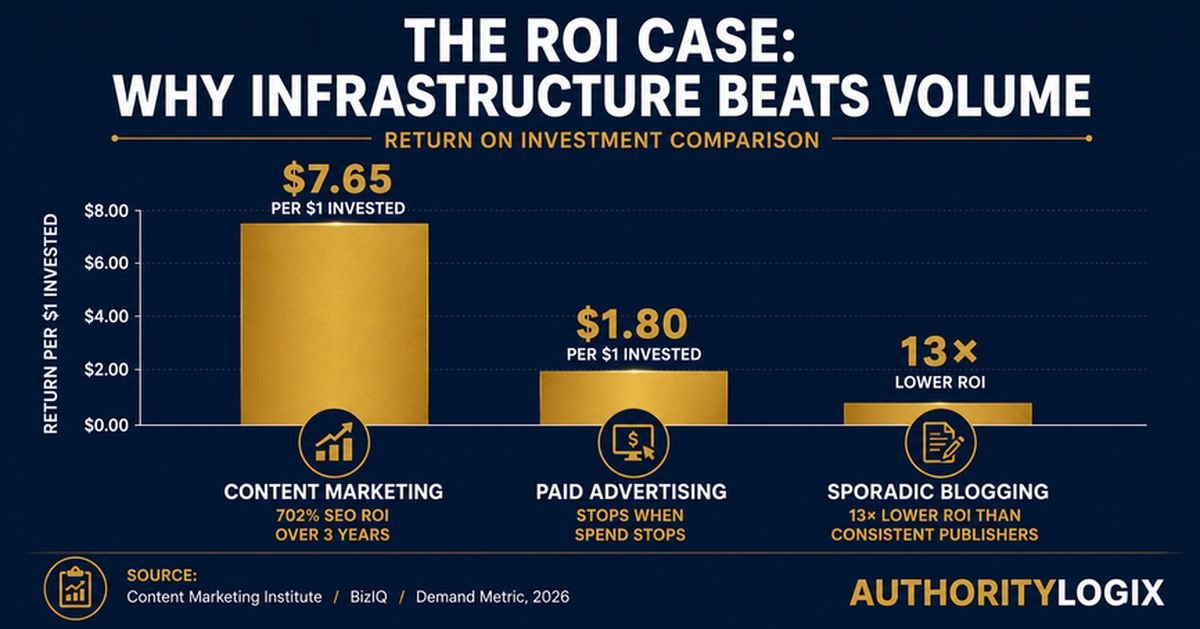
- Content marketing delivers an average $7.65 return per $1 spent in 2026 — with SEO-focused content averaging 702% ROI over three years. Paid advertising delivers $1.80 per $1, and stops the moment spend stops.
- Businesses that blog consistently generate 13× more positive ROI than sporadic publishers. The advantage is not content quality — it is publishing infrastructure.
- Organizations with a documented content strategy generate 3× more leads per dollar spent than those without. 73% of B2B marketers now have one.
- A content system blueprint for financial brands is not a content calendar — it is the architecture that makes every piece of content compound: pillar pages, cluster articles, repurposing workflows, distribution, and measurement.
- 80% of content loses money. The 20% that generates returns above 500% shares three characteristics: documented strategy, pillar-cluster architecture, and consistent publishing cadence.
- BKDSCR.com is the live content system blueprint — built from the ground up on this exact framework, compounding in authority and inbound visibility with every piece published.
Table of Contents
A content system blueprint is the framework that separates publishing that compounds from publishing that produces random results. A content system blueprint for financial brands is the architecture that makes publishing work the same way every week — without starting from scratch, without reinvention, and without the professional’s attention locked in production instead of client work. Most financial services and real estate professionals who try content marketing do not lack ideas. They lack infrastructure. The result is a burst of activity followed by months of silence, and a content archive that is neither organized nor compounding.
The ROI difference between infrastructure and activity is substantial. Content marketing delivers an average $7.65 return per $1 spent in 2026 — with SEO-focused content averaging 702% ROI over three years (Content Marketing Institute / BizIQ, 2026). But 80% of content loses money. The 20% that generates returns above 500% has one common characteristic: a documented strategy and a publishing infrastructure that compounds, rather than random articles published whenever inspiration strikes.
This guide builds the content system blueprint from the ground up — 6 components that transform publishing from a recurring creative burden into a compounding business asset. BKDSCR.com runs this blueprint for NYC outer-borough DSCR investing, producing authoritative educational content that compounds in search visibility and inbound leads without requiring weekly reinvention.
See how the Content System works: Explore Content Systems
Why a Content System Blueprint Produces Compounding Results
The distinction between content marketing and a content system blueprint is not semantic. Content marketing describes what you publish. A content system blueprint describes the infrastructure that determines whether what you publish compounds or evaporates.
Financial professionals who approach content marketing as a publishing activity — writing an article when they have time, posting to LinkedIn when inspired — produce content that accumulates without building authority. Each piece stands alone, targets no specific keyword architecture, links to nothing, and earns the attention of whatever audience happens to be watching that day. That is not a system. That is intermittent content production.
A content system blueprint for financial brands operates differently. Organizations with a documented content strategy generate 3× more leads per dollar spent than those without (Content Marketing Institute, 2026). Businesses that blog consistently generate 13× more positive ROI than sporadic publishers (Demand Metric, 2026). The gap between those numbers is not talent — it is infrastructure.
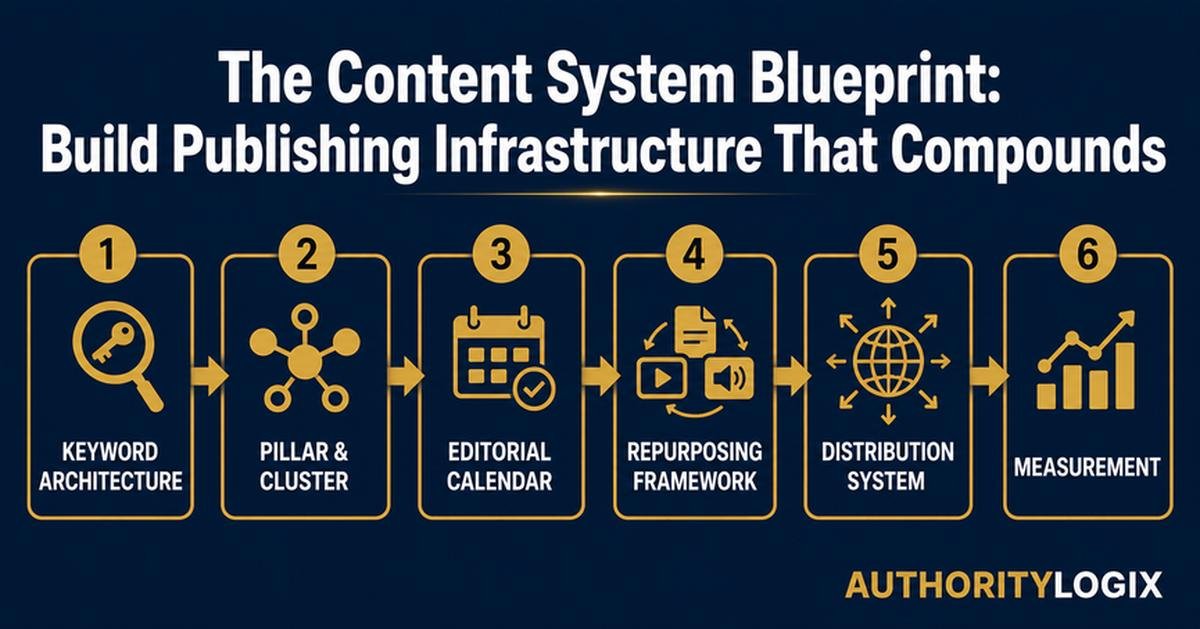
The 6 components of the content system blueprint — keyword architecture, pillar-and-cluster structure, editorial calendar, repurposing framework, distribution system, and measurement — work together as a closed loop. Each component feeds the next. A piece of content that enters the system gets a keyword target, a structural role in the architecture, a scheduled publish date, a set of derivative assets, a distribution plan, and a measurement track.
For how AuthorityLogix implements this content system blueprint across the full service model, see How We Do It.
Component 1: Keyword Architecture — the Strategic Foundation of a Content System Blueprint for Financial Brands
Keyword architecture is the map that tells the content system what to publish, in what order, and for what audience. Without it, the content system has no navigational logic — articles are written about topics that seem interesting rather than topics that match the search behavior of the specific prospect the financial professional is trying to reach.
Building keyword architecture for a content system blueprint in financial services requires mapping three layers:
Layer 1: Primary Keywords
Primary keywords define the core topic territory the financial brand owns. For a DSCR lender, the primary keyword might be “DSCR loans for real estate investors.” For a real estate coach, it might be “how to build a real estate investment portfolio.” Each primary keyword anchors a pillar page and defines the topical authority the brand is building.
Layer 2: Secondary Keywords
Secondary keywords are the specific sub-topics that branch off the primary keyword. For a DSCR lender, secondary keywords include “DSCR ratio requirements,” “DSCR loan rates,” “DSCR vs conventional mortgage,” and “DSCR loans for short-term rental properties.” Each secondary keyword anchors a cluster article that links back to the primary pillar page. Eight to fifteen secondary keywords per primary keyword produce a topical authority position that a competitor with one homepage cannot replicate.
Layer 3: Long-Tail and Question Keywords
Long-tail and question keywords are the specific queries prospects type when they are in the research phase: “what DSCR ratio do I need to qualify for a loan,” “can I use Airbnb income for a DSCR loan,” “how long does a DSCR loan take to close.” These keywords have lower search volume but higher conversion intent — the prospect asking this question is much further along the evaluation process. FAQ content, comparison posts, and how-to guides target this layer.
The keyword architecture that flows from this three-layer map is also the same architecture that makes a financial brand findable in search. For the full framework on how keyword architecture, on-page authority, and local search work together to drive qualified traffic, see the Complete Guide to Getting Found Online for Financial Brands.
Component 2: Pillar-and-Cluster Architecture — How the Content System Blueprint for Financial Brands Builds Topical Authority
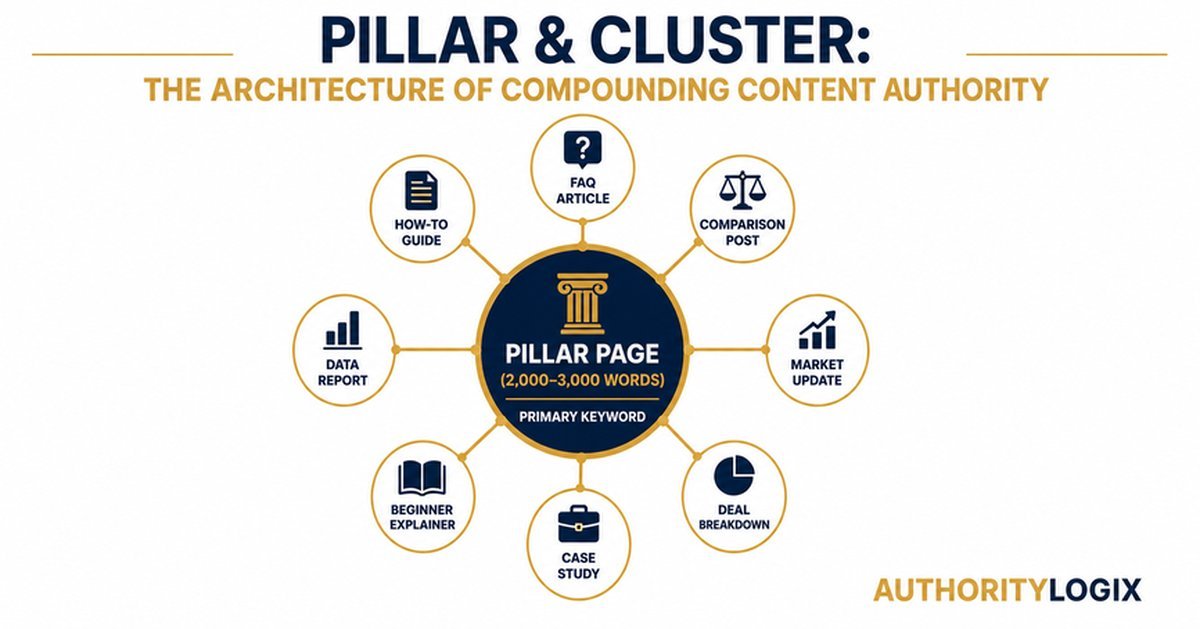
The pillar-and-cluster architecture is the structural backbone of the content system blueprint. It determines how pieces of content relate to each other, how internal linking flows, and how the publishing system signals topical authority to both search engines and AI citation systems.
A pillar page is a comprehensive, authoritative resource on a primary topic — 2,000–3,000 words targeting the primary keyword. It is the hub. Cluster articles are shorter, more specific pieces targeting secondary and long-tail keywords — all internally linked back to the pillar. The pillar-and-cluster structure tells Google, and AI systems like ChatGPT and Perplexity, that this website has comprehensive, organized depth on a specific subject — which is the definition of topical authority, and the primary signal that earns both rankings and AI citations.
How to Build the Pillar-and-Cluster in a Financial Services Content System
- Start with the pillar page — publish the comprehensive primary keyword resource first, before any cluster articles
- Publish cluster articles in sequence — one to two per month, each targeting a secondary keyword, each containing a natural internal link back to the pillar page
- Build the internal link web — as the cluster grows, cross-link cluster articles to each other where topics relate, not only back to the pillar
- Refresh the pillar every 6–8 months with links to new cluster articles, updated data, and expanded sections
- Add a second pillar only after the first cluster reaches 8 articles — never build two pillars in parallel
Component 3: The Editorial Calendar — Running the Content System Blueprint Without Reinvention
The editorial calendar is the operational layer of the content system blueprint. It is not a publishing schedule — it is the project management infrastructure that ensures a financial professional or small team can produce consistent content without treating every week as a new creative problem.
Teams using structured editorial calendars report a 42% increase in publishing efficiency and a 30% reduction in missed deadlines compared with ad hoc planning (Content Marketing Institute, cited in WaveGen, 2026).
Four-Horizon Editorial Planning
- Annual: Topic territory decisions — which primary keywords to build pillar pages around, which content categories to develop, which audience segments to prioritize
- Quarterly: Pillar page assignments, campaign alignment, and original data assets — which pillar publishes this quarter, which cluster articles accompany it
- Monthly: Title confirmation, keyword locking, and brief assignment — every piece planned for the month gets a confirmed title, primary keyword, publish date, and distribution plan
- Weekly: Production status — which articles are in draft, in edit, scheduled, and live; repurposing and distribution tasks tracked
The editorial calendar for a financial services content system blueprint requires one additional field most publishing calendars omit: the funnel stage. Every article is tagged as awareness-stage (informational), consideration-stage (evaluative), or decision-stage (transactional). A calendar that is 90% awareness and 10% decision-stage content builds traffic without building pipeline. The system that converts that pipeline-stage content into captured leads is covered in the Lead Generation System for Financial Services and Real Estate.
Before you build, know where the gaps are: Download the free Authority Gap Assessment
Component 4: The Repurposing Framework — Multiplying Each Asset in the Content System Blueprint
A content system blueprint for financial brands that publishes one article and moves on is leaving most of the value on the table. The repurposing framework is the system that turns every published piece into multiple distribution assets — without writing new content.
The core principle: one source article produces six distribution assets. For a DSCR lender who publishes a 2,000-word article on “How DSCR Ratios Work for Multi-Family Investment Properties,” the repurposing framework produces:
- LinkedIn post — the key insight from the article, distilled to 200 words with a call to read the full piece
- Email newsletter segment — a 150-word excerpt with a link to the article, sent to the existing subscriber list
- Short-form video script — a 90-second talking-points version of the article’s main finding, structured for the professional to record on camera or voice-over
- Infographic — the article’s core data or framework visualized for sharing on LinkedIn and embedding in the article itself
- Podcast talking points — a structured outline for a 10-minute episode covering the article’s topic, usable for a guest appearance or solo episode
- Social quote card — one high-impact sentence from the article, designed as a branded graphic for LinkedIn and Instagram
The repurposing framework does not require additional research or strategic thinking — the article has already done that work. It requires a documented workflow: which assets are produced from every article, who produces them, and in what timeframe after publication. Without the workflow, repurposing is an intention that never happens. With the workflow, one article published on Tuesday becomes six pieces of content distributed across the week.
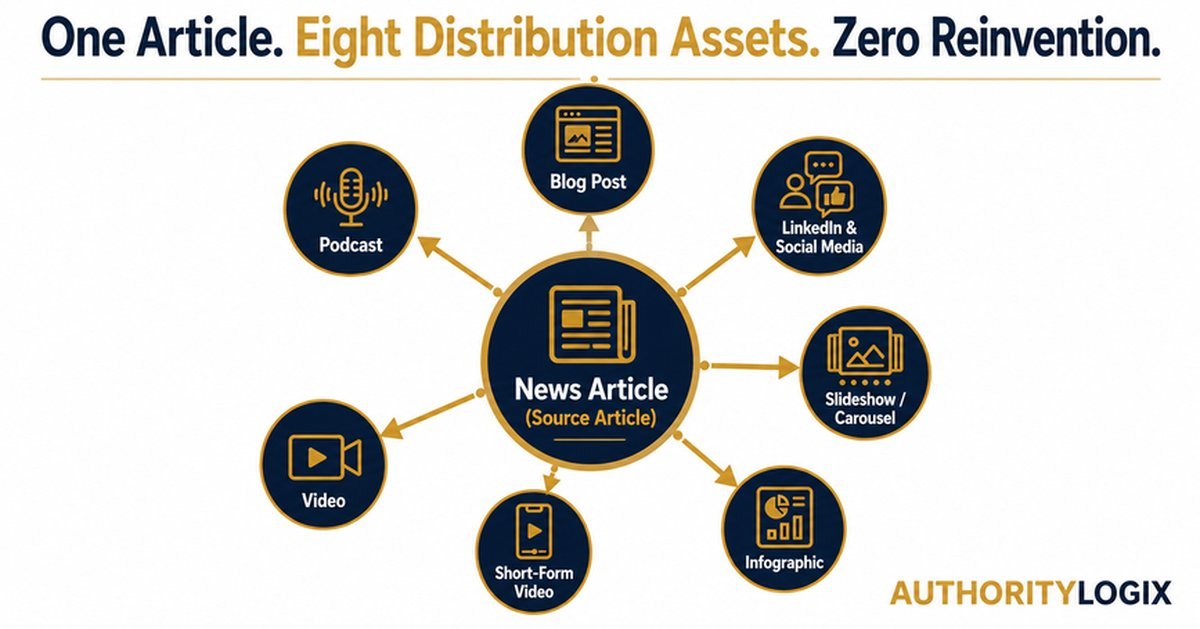
A repurposing framework turns one article into six distribution assets without writing new content.For the full repurposing workflow and how AuthorityLogix builds it into the content system for financial brands, see Finance Content Development.
Component 5: Distribution — Getting the Content System Blueprint in Front of the Right Audience
Publishing is not distribution. An article that goes live on a website with no audience, no promotion plan, and no systematic reach strategy earns exactly the traffic that finds it organically — which, for a new or low-authority domain, is close to zero for months. The distribution system in the content system blueprint bridges that gap.
Owned Distribution
The email list is the most reliable owned distribution channel. Every article published triggers an email to the subscriber list. The list compounds over time: every lead magnet download adds a subscriber, and every subscriber who receives consistent value becomes a candidate for a client conversation. Automated emails generate 320% more revenue than non-automated campaigns, and email delivers $36–$42 per $1 spent — the highest ROI of any marketing channel (Omnibound, 2026).
Earned Distribution
Earned distribution comes from third-party platforms that carry the content to audiences the financial professional has not yet reached. LinkedIn article publishing, industry publication guest contributions, podcast appearances, and press release distribution all fall in this category. Each earned distribution touchpoint generates a backlink, extends reach, and reinforces expert positioning.
Paid Distribution Amplification
Paid distribution in a content system blueprint is not the primary strategy — it is the amplification layer. A piece of pillar content that is already earning organic traction can be boosted through LinkedIn Sponsored Content to reach the exact professional demographic the financial brand targets. The paid spend amplifies organic content rather than replacing it.
For how AuthorityLogix’s Authority Distribution service executes the earned and amplified distribution layer across multiple platforms simultaneously, see the full service overview.
Component 6: Measurement — Proving and Improving the Content System Blueprint for Financial Brands
The measurement gap in content marketing is significant: only 42% of content marketers can prove ROI (Content Marketing Institute, 2026). The teams that can receive 3.1× more budget growth than those that cannot. Measurement is not a vanity exercise — it is what separates a content system from a content experiment.
The content system blueprint for financial brands tracks four measurement layers:
- Search performance — keyword rankings for pillar and cluster articles, organic impressions, click-through rates, and position movement over time
- Traffic quality — time on page, pages per session, and exit rate for key content pages; a pillar page with 200 visits and 15% CTA click rate outperforms one with 500 visits and immediate exits
- Lead attribution — which articles are generating lead magnet downloads, contact form submissions, and strategy call bookings; requires UTM parameter tracking and CRM integration
- Content ROI — pipeline revenue attributed to content-assisted deals divided by the cost of production; typically calculable at the 6–9 month mark
The content system blueprint does not need to deliver immediate ROI to be working. It needs to deliver improving metrics across all four measurement layers. Organic content takes 4–6 months to begin ranking, 6–9 months to begin generating measurable inbound, and 12–18 months to compound at the rate that justifies the infrastructure investment.
What Most Financial Brands Get Wrong About Building a Content System
Mistake 1: Building a content calendar instead of a content system
A content calendar tells you what to publish and when. A content system blueprint tells you why each piece exists, how it connects to every other piece, what keyword it targets, what assets it produces, how it gets distributed, and how its performance gets measured. Most financial professionals build the calendar and skip the system — producing publishing consistency without compounding returns.
Mistake 2: Publishing orphan content
Orphan content is any article with no internal links pointing to it and no internal links from it to a pillar page. Orphan content does not contribute to topical authority — it accumulates without building the interconnected architecture that signals expertise to search engines and AI systems. Every article in the content system blueprint has a defined place in the pillar-and-cluster map before it is written.
Mistake 3: Repurposing as an afterthought
Most financial professionals who do repurpose content do it inconsistently — when they remember to, when time allows. The repurposing framework in a content system blueprint is a defined workflow that runs for every article, every time, producing the same six assets in the same timeframe regardless of whether the content team is inspired that week.
Mistake 4: Measuring the wrong metrics
A content system blueprint that tracks impressions and social likes as its primary KPIs will never be able to prove its value. The metrics that matter are search rank movement, lead attribution, and pipeline revenue — and they require measurement infrastructure (UTM parameters, CRM integration, conversion tracking) built before the first piece is published, not six months later.
The Infrastructure Advantage: What a Content System Blueprint Builds Over Time for Financial Brands
A content system blueprint for financial brands is not a marketing strategy. It is a publishing infrastructure decision — one that determines whether the financial professional’s expertise accumulates into a compounding authority position or dissipates into a collection of unrelated articles.
The financial brands that build this infrastructure now — keyword architecture, pillar-and-cluster structure, editorial calendar, repurposing framework, distribution system, and measurement — create a content asset that grows in value every month. A competitor who has not built this infrastructure cannot replicate a 12-month head start in three months. The system advantage is durable.
BKDSCR.com is the content system blueprint in production. Every article on the platform targets a defined keyword, occupies a defined place in the pillar-and-cluster architecture, feeds a defined distribution system, and contributes to a compounding authority position in NYC outer-borough DSCR investing. That is what publishing infrastructure that compounds looks like.
For how AuthorityLogix designs and builds this content system blueprint for mortgage companies, DSCR lenders, real estate coaches, and financial advisory firms, see Why AuthorityLogix.
External reference: Content Marketing Statistics 2026: 180+ Data Points — Digital Applied
Ready to build your content system? Book a free Authority Gap Assessment