


Key Takeaways
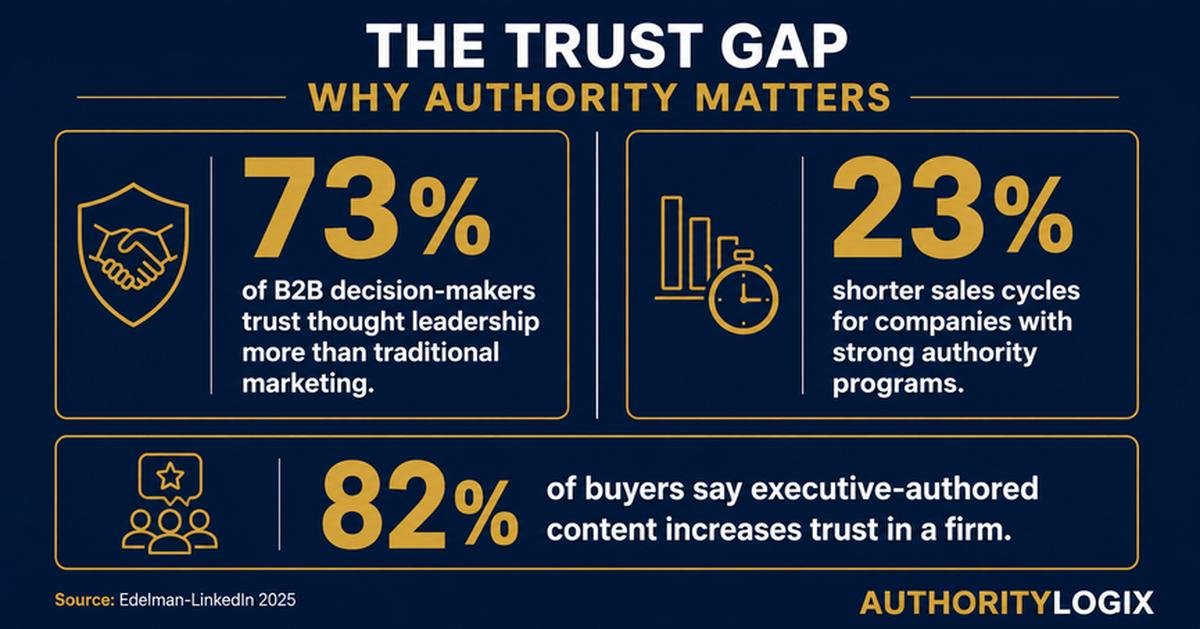
- 73% of B2B decision-makers say thought leadership content is more trustworthy than traditional marketing materials — and more influential on vendor selection (Edelman-LinkedIn, 2025).
- Authority marketing for financial services is not content volume — it is structured credibility. Publishing without a positioning framework produces noise, not authority.
- Companies with strong authority programs report 23% shorter sales cycles because prospects arrive pre-qualified and pre-sold on the expertise.
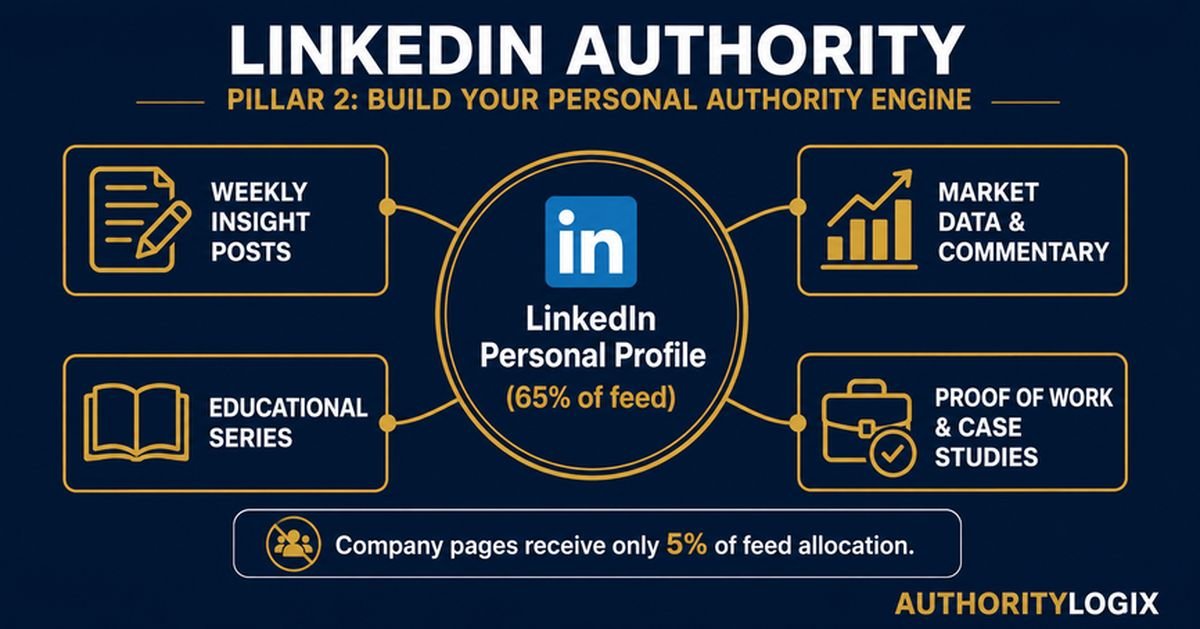
- LinkedIn personal profiles receive 65% of feed allocation; company pages receive 5%. Authority in financial services is built person-first, brand-second.
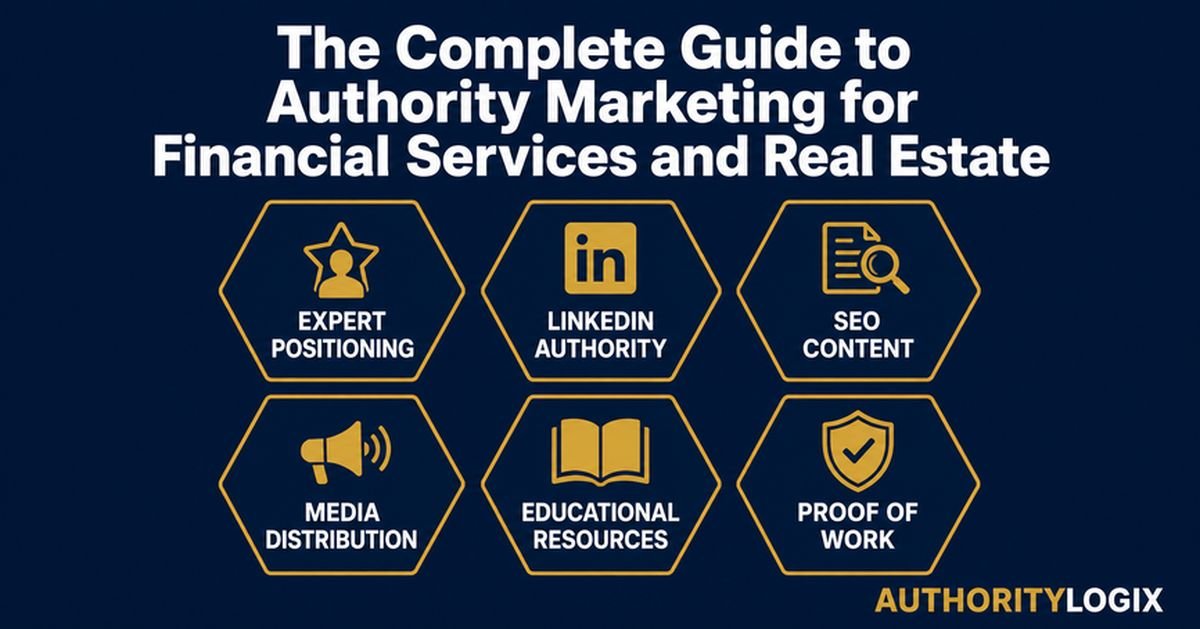
- The 6 pillars — positioning, LinkedIn authority, SEO content, media distribution, educational resources, and proof — work together as a compounding system.
- BKDSCR.com demonstrates that a single financial brand built on this framework can dominate a niche market without an ad budget.
Table of Contents
Authority marketing for financial services is the system that makes expertise visible — consistently, credibly, and in the places where qualified prospects are actively making decisions. In financial services and real estate, the buying decision is almost never impulsive. A mortgage broker, DSCR lender, real estate coach, or financial advisor earns a client call after weeks or months of a prospect watching, reading, and evaluating. The professional who is present at every stage of that evaluation wins the call. The one who is not present loses to someone with less experience who built better infrastructure.
The data on this is direct. 73% of B2B decision-makers say thought leadership content is more trustworthy than traditional marketing materials — and more influential on who they ultimately hire (Edelman-LinkedIn B2B Thought Leadership Impact Report, 2025). Companies with strong authority programs report 23% shorter sales cycles because prospects arrive pre-sold on the expertise. Published executives generate 3× more inbound opportunities than those who rely on referrals alone (Phantom IQ, 2026). These are not soft branding metrics — they translate directly into calls booked, deals closed, and pipeline that doesn’t depend on who you know.
This guide covers the 6 pillars of authority marketing for financial services and real estate — the complete system that takes a professional’s existing expertise and builds the infrastructure that makes it impossible to ignore. BKDSCR.com was built on this exact framework and today dominates its niche for NYC outer-borough DSCR investors. No ad budget. No agency. A system.
Explore how an educational hub pre-qualifies your best prospects: Explore Educational Hub Development
What Authority Marketing for Financial Services Actually Means — and What It Is Not
Authority marketing for financial services is not content marketing in the traditional sense. It is not posting on social media, sending a newsletter, or publishing a blog. Those are tactics. Authority marketing is the strategic system that deploys those tactics in a coordinated way to build a credible, compounding market position — one that makes a specific target audience think of one professional first when they are ready to make a financial decision.
The distinction matters because most financial professionals who try content marketing without a framework get the same result: effort without return. They publish inconsistently, target no specific keyword architecture, attract no structured audience, and generate no measurable inbound. The content is not the problem. The absence of a system is.
Authority marketing for financial services and real estate requires five conditions to compound:
- A defined expert positioning statement — who you serve, what problem you solve, why you and not the next professional
- A primary platform where that positioning is consistently demonstrated — for financial professionals, LinkedIn personal profiles receive 65% of feed allocation versus 5% for company pages
- A content infrastructure — pillar pages, cluster articles, FAQ content — that earns search visibility over time
- A distribution system that extends content reach beyond the immediate audience
- Proof of work — case studies, client outcomes, documented results — that converts interest into trust
Without all five, the effort dissipates. With all five working together, authority compounds every month — and the competitive gap between the brand that built the system and the one that didn’t grows wider every quarter.
Why Financial Services and Real Estate Are Uniquely Suited to Authority Marketing
High-trust, high-ticket, and relationship-dependent: financial services and real estate purchases are exactly the conditions where authority marketing produces the strongest returns. A borrower selecting a DSCR lender, an investor choosing a real estate coach, a business owner evaluating a financial advisory firm — these decisions involve significant money, significant risk, and a long evaluation period. The professional who is already trusted before the first call has an enormous structural advantage over one who must earn that trust in a single meeting.
82% of B2B buyers say that executive-authored content increases their trust in a company and its leadership team (Edelman-LinkedIn, 2025). 71% say thought leadership is more effective than conventional marketing at demonstrating value. These figures describe exactly what happens when a mortgage broker publishes a DSCR market update that a prospective investor reads three weeks before they’re ready to apply. The call comes in warm.
Pillar 1: Expert Positioning — the Foundation of Authority Marketing for Financial Services
Every authority marketing system begins with a positioning statement so clear that a prospect can identify within 10 seconds whether you are the right professional for their situation. Most financial professionals do not have this. They describe what they do — “I originate mortgage loans” — rather than who they serve, what problem they solve, and what makes their approach distinct. That distinction is the entire difference between a referral-dependent practice and a platform that generates inbound.
Expert positioning for financial services professionals requires three locked decisions:
Decision 1: The defined niche
Generalists in financial services compete on price because they cannot differentiate on expertise. The DSCR lender who specializes in NYC outer-borough multi-family has a positioning advantage over the generalist lender who does every product in every market. The real estate coach who works exclusively with first-time investors building a portfolio of 2–4 unit properties has a positioning advantage over the coach who works with everyone. Specificity is not a limitation — it is the source of authority.
Decision 2: The prospect’s specific problem
Authority marketing for financial services speaks to a specific, named problem the prospect is experiencing — not the solution the professional sells. “I help outer-borough real estate investors qualify for DSCR loans even when their personal income doesn’t reflect their investment earnings” speaks to a specific frustration a specific prospect has. “I offer DSCR loans” does not. The positioning statement that leads with the prospect’s problem earns attention because it proves the professional understands the situation before the first conversation.
Decision 3: The proof point
Positioning without evidence is a claim. Positioning with evidence is authority. The proof point is the single most compelling demonstration of the professional’s expertise — the track record, the case study, the portfolio, the published credential. For BKDSCR.com, the proof point is two decades of mortgage origination and a self-built platform that dominates a competitive niche. That proof point is woven into every piece of content, every platform bio, and every client interaction.
For how AuthorityLogix helps financial brands build this positioning layer, see How We Do It.
Pillar 2: LinkedIn Authority — the Primary Platform for Authority Marketing for Financial Services Professionals
LinkedIn is the only platform where the concentration of financial decision-makers, real estate investors, mortgage professionals, and advisory clients justifies the investment in authority marketing. More than 65 million decision-makers, 180 million senior-level influencers, and 10 million C-level executives are active on LinkedIn — the world’s highest concentration of professional buying power (Phantom IQ, 2026). LinkedIn drives 80% of B2B social media leads and is 277% more effective for lead generation than Facebook or X (HubSpot research).
The platform dynamics in 2026 favor personal profiles over company pages by a significant margin. LinkedIn’s algorithm allocates 65% of feed visibility to personal profiles and 5% to company pages. This means authority marketing for financial services professionals is built person-first: the individual expert publishing their own perspective, market analysis, and client insights — not the brand account posting announcements.
What Effective LinkedIn Authority Looks Like for Financial Professionals
The content types that build authority on LinkedIn for mortgage, DSCR, and real estate professionals share a common characteristic: they prove expertise rather than claim it.
- Market data and commentary — NYC rental market updates, DSCR rate movements, underwriting guideline changes with specific numbers and practical implications
- Deal breakdowns — anonymized case studies showing how a specific problem was solved, what the outcome was, and what made the approach work
- Educational series — sequential posts that build a concept across 4–8 weeks, creating a reason for the audience to follow rather than just like
- Positioning statements — direct articulations of the expert’s niche, what they do, who they serve, and what makes their approach different
- Industry commentary — responses to market events, rate decisions, regulatory changes, viewed through the lens of how they affect the specific client the professional serves
The posts that fail are the ones that perform for the algorithm without building the expert’s position: generic motivational content, vague market observations, or engagement-bait questions disconnected from the professional’s expertise. Authority marketing for financial services requires publishing with purpose — every post either demonstrates expertise, builds trust, or advances a prospect through the evaluation process.
For the content calendar, post structure, and publishing system behind consistent LinkedIn authority, see Content Systems.
Before you build, know where the gaps are: Download the free Authority Gap Assessment
Pillar 3: SEO Content — How Authority Marketing for Financial Services Earns Compounding Search Visibility
LinkedIn authority builds a platform. SEO content makes that platform findable to the qualified audience that is actively searching — and it does so in a way that compounds over time. A LinkedIn post has a 24–48 hour window of visibility. A well-optimized article targeting “DSCR loan requirements for multi-family properties” drives qualified traffic every month for years. These are different assets serving different functions in the authority marketing system.
For financial services and real estate professionals, SEO content takes two primary forms:
Pillar Pages
A pillar page is a comprehensive resource on a primary topic — 2,000–3,000 words targeting a high-volume, high-intent keyword. Pillar pages earn rankings for competitive terms and serve as the hub that links to all related cluster content. For a DSCR lender, the pillar page might be “The Complete Guide to DSCR Loans for Real Estate Investors.” For a real estate coach, it might be “How to Buy Your First Investment Property in [City].” These pages become the most-visited assets on the site — and the most powerful trust-builders, because they demonstrate depth of knowledge before the prospect ever contacts the professional.
Cluster Articles
Cluster articles target the specific sub-questions prospects ask within a topic. They are shorter (800–1,500 words), more specific, and all internally linked back to the pillar page. For a DSCR lender, cluster articles cover DSCR ratios, qualifying property types, loan limits, underwriting timelines, rate comparisons, and market-specific data. Eight to twelve cluster articles around one pillar page create a topical authority position that a single homepage cannot replicate.
Authority marketing for financial services and real estate is built on this pillar-and-cluster architecture because topical authority — comprehensive, organized coverage of a defined subject — is what both Google and AI systems reward. Sites with narrow, deep expertise on a specific topic earn citations and rankings that generalist sites cannot reach, regardless of domain age or page count. For the full system that makes search visibility work for financial brands, see the Complete Guide to Getting Found Online for Financial Brands.
For the full content infrastructure system — editorial calendar, keyword architecture, and publishing workflow — see Content Systems. For the specific challenges of compliant, credible content in mortgage and lending, see Finance Content Development. The complete blueprint for building this publishing infrastructure is covered in the Content System Blueprint for Financial Brands.
Pillar 4: Media Distribution — Extending the Reach of Authority Marketing Beyond Your Existing Audience
The authority marketing system builds a home base — LinkedIn, the website, the educational hub. Media distribution is what extends that content beyond the existing audience and into the publications, platforms, and channels where the target client is consuming information. For financial services and real estate professionals, this means appearing in places that carry third-party credibility: industry publications, real estate investor forums, mortgage professional associations, local business journals, and financial media.
The distribution channels that matter most for authority marketing in financial services:
- Press releases and news distribution — positioning the professional as a named source of expertise on market events
- Guest articles and contributed content — bylines in regional real estate publications, mortgage industry blogs, and financial advisory platforms that carry domain authority
- Podcast appearances — financial services, real estate investing, and mortgage-specific podcasts reach the exact buyer profile most professionals target; a single appearance generates a backlink, an audience, and a reusable content asset
- LinkedIn article publishing — long-form articles published natively on LinkedIn reach the platform’s notification system for followers, separate from the standard feed
- Multi-platform content syndication — structured distribution of core content across additional platforms that amplify reach and generate backlinks
The compound effect of media distribution is backlinks and brand mentions — both of which feed the SEO authority system. A regional business journal article about market conditions, with the financial professional quoted as the expert, generates a high-quality backlink, extends reach to the publication’s audience, and reinforces the expert positioning on every platform where prospects search.
For how AuthorityLogix’s Authority Distribution service executes multi-platform content syndication at scale, see the full service overview.
Pillar 5: Educational Resources — the Content Layer That Pre-Qualifies Prospects in Authority Marketing for Financial Services
Educational resources are the mid-funnel engine of authority marketing for financial services. Where pillar pages and cluster articles attract prospects at the search stage, and LinkedIn content builds the ongoing relationship, educational resources — guides, calculators, checklists, FAQ hubs — convert interest into trust and trust into action.
The financial professional who has built a resource library that answers the exact questions a prospect asks during the evaluation period is not competing for that client. They have already won the evaluation. The prospect who reads “The DSCR Investor’s Guide to Qualifying in NYC,” uses a DSCR ratio calculator, and downloads a multi-family due diligence checklist has consumed enough structured expertise to walk into a conversation pre-qualified and pre-sold.
91% of buyers say high-quality thought leadership helps them uncover challenges and needs they had not previously recognized (Edelman-LinkedIn B2B Thought Leadership Impact Report, 2025). Educational resources serve that function directly — they surface the problem more clearly, frame the solution more precisely, and position the professional as the obvious next step.
For how to build a resource library that serves as both an SEO asset and a pre-qualification engine, see Educational Hub Development.
For how to build a resource library that serves as both an SEO asset and a pre-qualification engine, see Educational Hub Development.
Pillar 6: Proof of Work — the Conversion Layer of Authority Marketing for Financial Services and Real Estate
Authority marketing for financial services builds attention, trust, and positioning. Proof of work converts them. Every other pillar in the system brings the prospect to the moment of decision — proof of work is what tips that decision. Clients who have consumed the content, absorbed the expertise, and identified with the positioning still need evidence that the professional delivers on what the content promises.
Proof of work in financial services takes specific forms:
- Documented case studies — not testimonials, but structured case studies with a named situation, the problem, the approach, and the measurable outcome
- Deal breakdowns — published on LinkedIn and the educational hub, showing the mechanics of a specific deal, the underwriting process, the challenges navigated, and the result
- Market authority data — proprietary data the professional has built: their own DSCR market reports, investment property performance benchmarks, or lending guideline comparisons across products
- Credentials and track record — displayed on every platform bio: years of experience, deals closed, total volume, specific certifications or licenses that carry weight with the target client
- The live case study — BKDSCR.com itself is the most powerful proof of work AuthorityLogix can present. A platform that dominates its niche in NYC outer-borough DSCR investing, built from the ground up using this exact authority marketing system, is not a claim. It is evidence.
Proof of work is what separates authority marketing for financial services from ordinary content production. Anyone can publish. Not everyone has the track record, the documented results, and the structured case studies that transform content from information into conviction.
What Most Financial Professionals Get Wrong About Authority Marketing
Mistake 1: Equating activity with authority
Posting on LinkedIn three times a week without a positioning framework, keyword strategy, or content architecture is activity. Authority marketing for financial services requires that every content asset serves a specific function in the system — positioning, SEO, trust-building, or conversion. Activity without architecture dissipates.
Mistake 2: Building the brand page instead of the personal platform
Company pages on LinkedIn receive 5% of feed allocation. Financial professionals who invest their authority marketing effort into a company page and leave their personal profile underdeveloped are working against the algorithm. The authority is personal — the expertise, the track record, the market perspective — and it needs a personal platform to compound.
Mistake 3: Treating thought leadership as a lead generation tactic
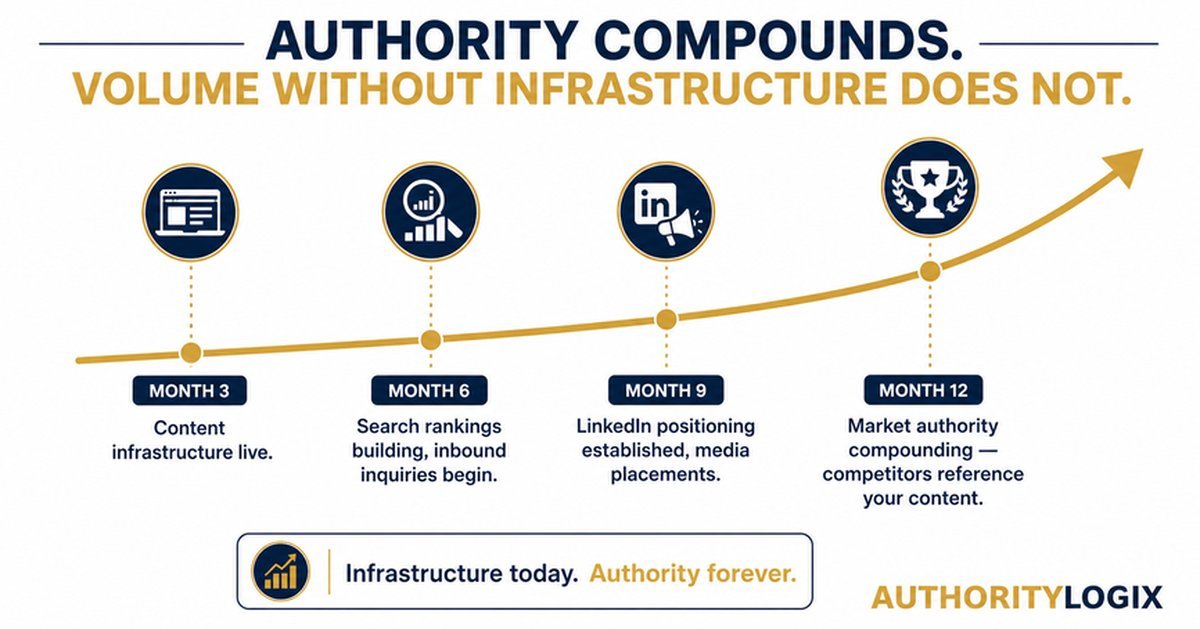
Authority marketing for financial services and real estate is not a campaign. It does not have a 90-day results window. The professionals who measure it against paid lead generation benchmarks misread the asset they are building. Authority compounds over 6–18 months and then produces qualified inbound that is cheaper, faster to close, and more loyal than any paid source. The measurement model is influence and pipeline, not impressions and clicks.
Mistake 4: Publishing without proof
Insight without evidence is opinion. A financial professional who publishes market commentary without data, deal breakdowns without outcomes, or positioning statements without a demonstrated track record builds an audience that finds them interesting — not one that trusts them enough to act. Authority marketing for financial services requires that every claim be grounded in a number, a case study, or a documented result.
Mistake 5: Stopping before the system compounds
The 6-month mark is where most financial professionals abandon an authority marketing system — right before it begins to work. Search rankings are building. LinkedIn following is growing. But the inbound calls have not started yet. The professionals who stay the course own their market by month 12–18. The ones who stop restart the clock every time, never reaching the compounding stage that makes the investment worth it.
Authority Compounds — the Case for Building the System Now
Authority marketing for financial services and real estate is a structural decision, not a content decision. The professionals who build the 6-pillar system — positioning, LinkedIn authority, SEO content, media distribution, educational resources, and proof of work — create a market presence that competitors cannot replicate quickly. The infrastructure takes time to build and time to compound. That is the point. Once it is built, it works every day without additional spend.
The financial professionals who are the first to build this infrastructure in their niche own that niche. The DSCR lender who publishes the definitive educational resource for NYC outer-borough investors, who appears in the top three search results for the relevant terms, who is cited in the LinkedIn feeds of every active investor in the market — that professional is not competing for clients. They are the obvious choice.
“Credible but invisible” is the most common position financial professionals occupy in 2026. Authority marketing for financial services is the system that ends it.
For the full proof-of-work case study — how BKDSCR.com was built on this exact framework from the ground up — see Why AuthorityLogix. For the next step in building your own authority system, the Authority Gap Assessment identifies exactly which of the 6 pillars your current presence is missing.
External reference: Edelman-LinkedIn B2B Thought Leadership Impact Report 2025 — Phantom IQ Statistics Summary
Ready to build your authority system? Book a free Authority Gap Assessment