
Key Takeaways
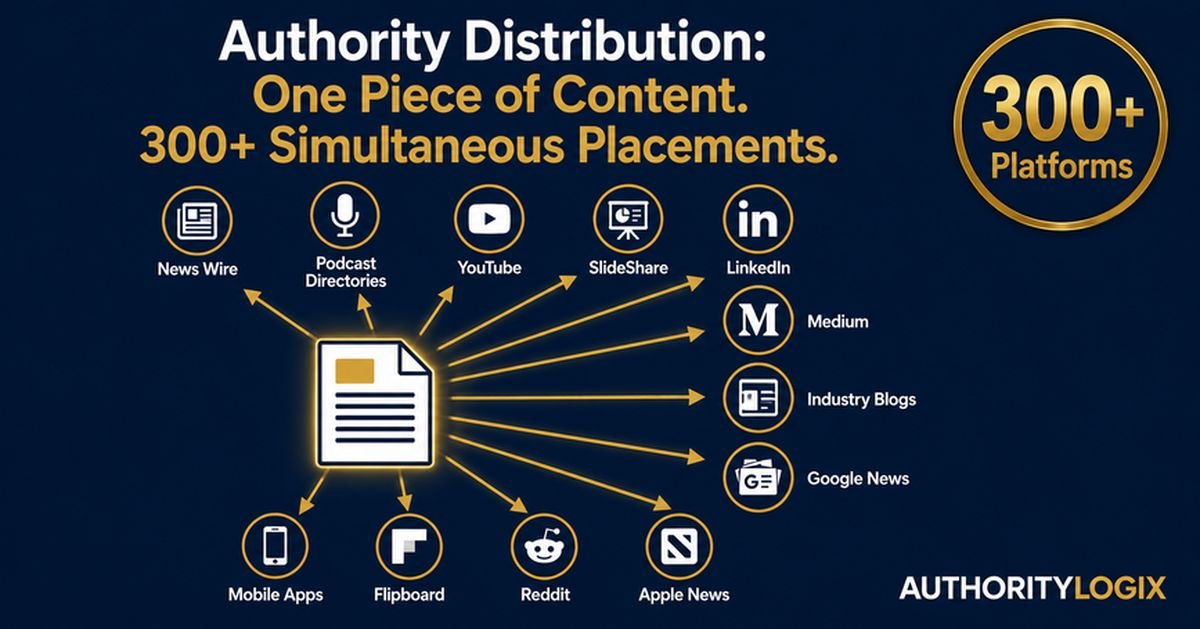
- Authority distribution is not a social media strategy. It is a systematic push of one piece of content across 300+ platforms simultaneously — news sites, podcast directories, video channels, and industry publications — generating backlinks and brand mentions that organic publishing cannot replicate at scale.
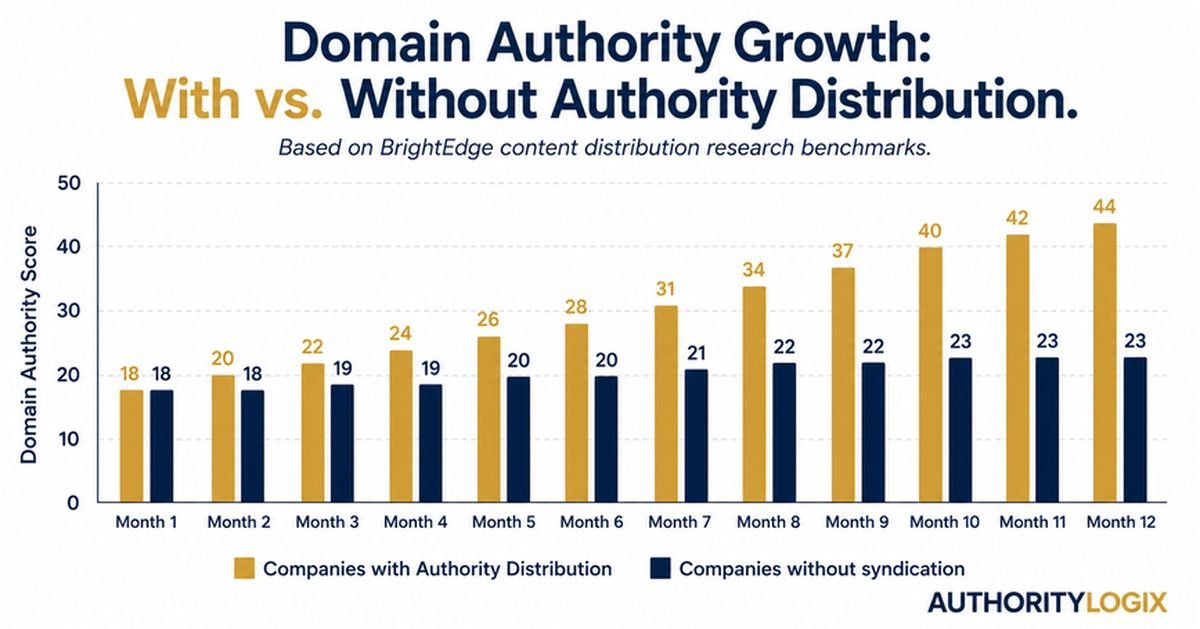
- According to BrightEdge Content Distribution Research 2026, companies with strong content syndication strategies achieve 27% greater annual revenue growth than those relying solely on organic publishing.
- 96.55% of all web pages have zero backlinks, according to Ahrefs’ study of approximately 14 billion pages. Authority distribution directly addresses that problem by generating referring domains from credible third-party placements with every campaign.
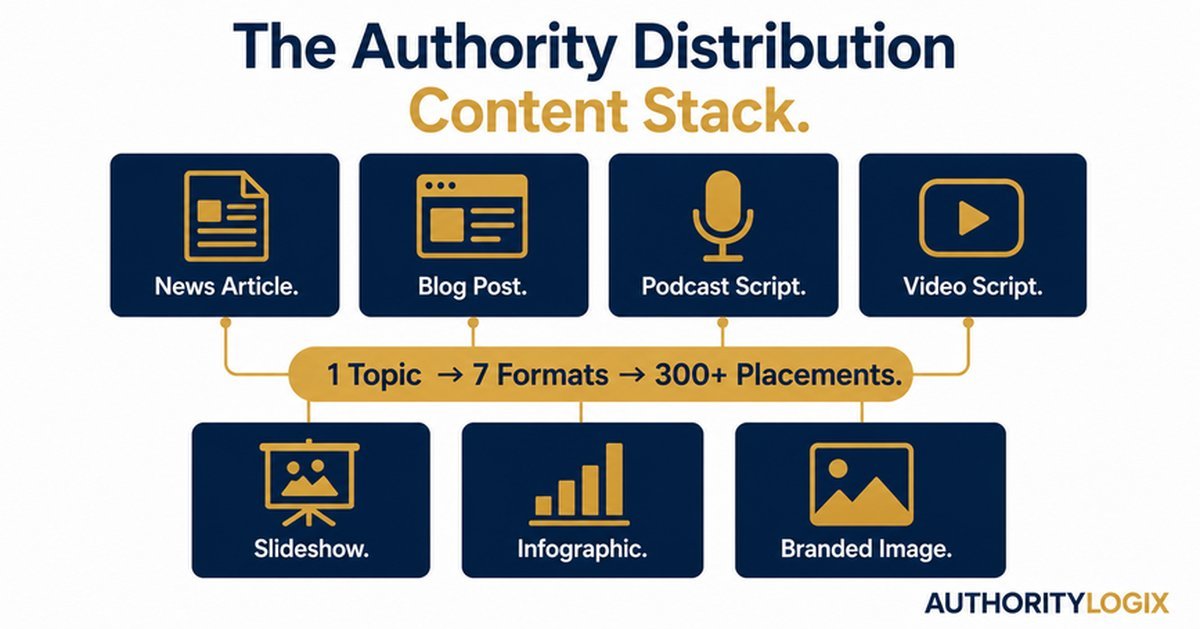
- One topic becomes 7 native content formats in authority distribution: a news article, blog post, podcast script, video script, slideshow, infographic, and branded image. Each format is built for a different platform type and audience intent.
- For mortgage companies, DSCR lenders, real estate investment firms, and financial advisory businesses, authority distribution produces domain authority lift, branded search volume, and inbound leads that persist months after a campaign goes live.
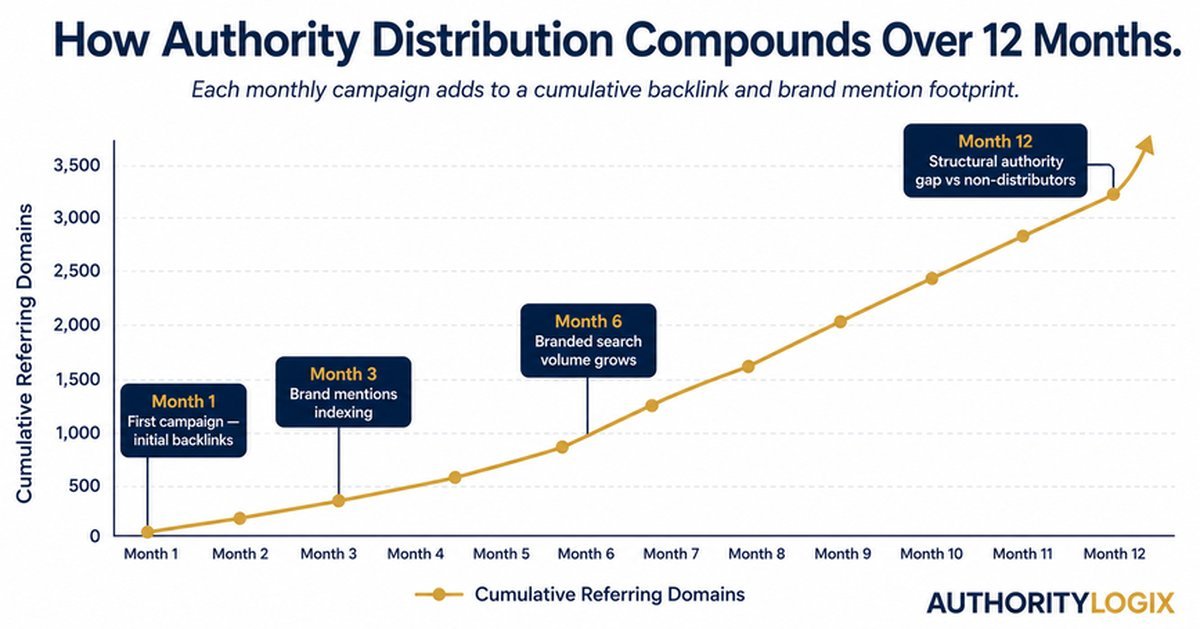
- The compounding nature of authority distribution means each monthly campaign adds to a cumulative backlink and mention footprint. After 12 months of consistent distribution, the visibility gap between firms using this approach and those without is structural, not marginal.
Table of Contents
Authority distribution is the mechanism that determines whether your expertise reaches the people looking for it or stays buried in a publishing stack that only your existing audience ever sees. Most mortgage companies, DSCR lenders, real estate investment firms, and financial advisory businesses publish content on their own website and stop there. That is a structural visibility problem, not a content quality problem — and it is why firms with genuine expertise remain invisible while competitors with inferior knowledge outrank them on every search that matters.
According to BrightEdge Content Distribution Research 2026, companies with strong content syndication strategies achieve 27% greater annual revenue growth than those without structured distribution. The data is unambiguous: producing content without distributing it systematically is the highest-leverage missed opportunity in financial services marketing today.
What happens when your content reaches 300+ platforms is measurable. It produces a sequence of backlink accumulation, branded search volume growth, multi-surface brand mentions, and eventually inbound leads from prospects who encountered your expertise on a news site, a podcast platform, or a video channel they were already using. This article documents exactly what that process looks like, what it produces, and why it compounds in ways organic-only publishing cannot replicate.
Explore Authority Distribution: Explore Educational Hub Development
What Authority Distribution Actually Does
The phrase “content syndication” describes everything from posting a blog to social media to distributing formatted content assets across 300 separate third-party platforms. Authority distribution is the latter — a structured, systematic push of professionally formatted content through a network of news distribution services, podcast aggregators, video platforms, slideshow hosts, infographic repositories, and industry publications.
The distinction matters because the outputs are fundamentally different. Social sharing produces reach within your existing qualified audience. Authority distribution produces third-party placements on domains your brand has no prior relationship with, generating referring domains, brand mentions, and indexed content on platforms that carry their own search authority. Each placement is a citation of your expertise on a site that Google already trusts.
A well-structured authority distribution campaign converts a single topic into 7 native content formats: a news article, blog post, podcast script, video script, slideshow presentation, infographic, and branded image. Each format is built for a different platform architecture and audience behavior. The news article is formatted for wire distribution. The podcast script is formatted for audio indexing. The video script is formatted for YouTube and video platform discovery. A single campaign brief generates all 7 — which is why multi-platform content distribution at this scale requires a structured production process rather than manual publishing.
The Platform Types Covered
The 300+ platforms reached through authority distribution span distinct categories. News distribution networks push formatted articles to Google News, Apple News, Bing News, regional news aggregators, and financial industry publications. Podcast directories index audio-ready scripts on Apple Podcasts, Spotify, Google Podcasts, and iHeart. Video platforms receive formatted scripts for YouTube, Vimeo, and Dailymotion. Slideshow hosts including SlideShare index presentation-format content. Infographic networks distribute branded visual assets across Pinterest, Infogram, and visual search platforms.
For a DSCR lender, a mortgage company, or a real estate investment firm, a single campaign on “How to Qualify for a DSCR Loan in 2026” generates a news article indexed by Google News, a podcast format discoverable on Spotify, a video script attracting YouTube search traffic, a slideshow appearing in SlideShare results, and a branded infographic circulating in visual search. That is multi-surface presence from a single content investment.
The compounding effect of multi-surface presence is what separates authority distribution from organic publishing. A prospect who finds a DSCR lender’s article on a news wire, then discovers the same firm’s podcast on Spotify, then encounters their branded infographic in a Pinterest search has received three independent trust signals before ever visiting the lender’s website. For how this connects to local search visibility and keyword rankings, see the Complete Guide to Getting Found Online for Financial Brands.
What Authority Distribution Produces: The SEO Mechanics
The SEO mechanics of authority distribution are grounded in the most durable ranking signal in search: referring domains. According to an Ahrefs study of approximately 14 billion web pages, 96.55% of all published pages have zero backlinks pointing to them. Those pages are effectively invisible in organic search regardless of their content quality. Position one in Google demands an average of 365 referring domains, with finance and legal verticals requiring 500 to 600, according to 2026 SEO benchmark data from WebFX.
Authority distribution directly addresses that gap. Each third-party placement generates a referring domain pointing back to the original source. A 12-month campaign running one distribution push per month accumulates referring domains from news sites, podcast platforms, video hosts, and infographic repositories — building a backlink profile that organic-only publishing at the same content volume cannot match. The velocity of that accumulation is what separates firms using structured authority distribution from those relying solely on organic search to build visibility.
Branded Search Volume and Brand Mentions
The backlink accumulation from multi-platform distribution has a secondary effect that compounds its value: branded search volume growth. As your firm’s name appears across news sites, podcast directories, video platforms, and industry publications, search engines accumulate brand mention signals that are distinct from and additive to backlink signals. A prospect who encounters your firm’s name in a Google News article, then again on a podcast platform, then again in a video result, builds a recognition pattern that converts to branded search — direct queries for your firm’s name.
Branded search is the highest-quality traffic a website receives because the searcher has already formed an intent signal toward your specific firm. Authority distribution is among the most cost-effective mechanisms for building branded search volume in a compressed timeframe because it generates simultaneous multi-platform mentions from a single campaign rather than requiring independent presence-building on each channel separately.
Before you build, know where the gaps are: Download the free Authority Gap Assessment
The 7 Content Formats in Authority Distribution
The core operational principle of authority distribution is format conversion: one topic, structured once, converted into 7 native formats built for 7 different platform architectures. This is not repurposing in the traditional sense — it is not shortening a blog post for social media. Each format is built to the specification of its destination platform, which is why distribution at this scale requires a structured content system blueprint rather than a manual publishing workflow.
News Article and Blog Post
The news article format is written to editorial standards for wire distribution — inverted pyramid structure, AP style, third-person attribution. It lands on Google News, financial news aggregators, and regional business publications. The blog post format is built for the destination website’s SEO structure, with keyword density, internal link architecture, and meta data formatted for Rank Math compliance. These two formats handle the written content distribution layer of every authority distribution campaign.
Podcast Script, Video Script, and Slideshow
The podcast script is formatted for audio distribution: conversational structure, natural spoken cadence, episode metadata. It lands on Apple Podcasts, Spotify, Google Podcasts, and iHeart — platforms where your target audience consumes information during commutes and site visits. The video script is structured for YouTube discovery with keyword-aware title and description for video platform SEO. The slideshow targets SlideShare and document repositories, generating a separate category of referring domains from document-platform backlinks.
Infographic and Branded Image
The infographic is a data visualization of the core content — a chart, comparison table, or process diagram formatted for visual search indexing on Pinterest, Infogram, and image search platforms. Infographic backlinks are among the most natural in SEO because the format earns shares and embeds from other sites referencing the data visually. The branded image ties the entire campaign to a consistent visual identity that reinforces recognition across every platform the campaign touches.
Authority Distribution for Mortgage and Real Estate Businesses
The mortgage and real estate sectors present specific characteristics that make authority distribution particularly effective. First, the compliance environment restricts certain marketing channels — particularly paid social and search advertising for regulated products — making organic authority-building channels more strategically important. Second, the purchase decision cycle for mortgage and real estate services is long: borrowers research for 3 to 12 months before applying, and investors evaluate lenders and advisors over extended periods. A firm that appears across multiple platforms during that research window accumulates a trust advantage a single website listing cannot match.
Third, the search environment for finance and real estate keywords is dominated by large institutional publishers — Bankrate, NerdWallet, Rocket Mortgage, Zillow. Independent lenders, regional mortgage companies, and boutique real estate investment firms cannot compete for head-term search traffic through content alone. Authority distribution creates an alternative visibility pathway: multi-platform presence that does not require outranking institutional publishers on competitive keywords to generate qualified inbound traffic.
Specific Applications by Business Type
- DSCR Lenders: A monthly campaign on topics including DSCR qualification criteria and loan-to-value benchmarks generates news articles, podcast formats, and video scripts that reach real estate investors on the platforms they already use for market research. The finance content development layer ensures every format meets financial content standards before distribution.
- Mortgage Companies: Monthly distribution campaigns on non-QM loan education, first-time buyer guidance, and rate environment analysis build a cumulative backlink profile that improves domain authority for competitive local search terms — reducing dependence on paid search budgets.
- Real Estate Investment Firms and Coaches: Topics including deal analysis frameworks and market cycle positioning reach accredited investors and active operators through news platforms, podcast directories, and video channels. The educational hub development layer converts that inbound traffic into qualified leads through structured content infrastructure on the firm’s own site.
- Financial Advisory Firms: Monthly campaigns on estate planning and wealth preservation reach high-net-worth prospects through editorial news channels that carry institutional credibility — building the trust signals that convert research-stage prospects into consultation requests.
What Authority Distribution Requires to Work
Authority distribution is not a substitute for content quality — it is a multiplier of it. A poorly structured topic pushed through 300+ platforms generates 300+ poor placements. The distribution infrastructure amplifies what is put into it, which is why the upstream content strategy determines the downstream distribution results.
First, topic selection must match the search behavior of the target audience, not just the firm’s internal areas of expertise. A DSCR lender distributing campaigns about general real estate investing rather than specific DSCR qualification and debt coverage ratios reaches a broad audience that self-selects poorly into their specific product. Topic selection is a content system decision before it is a distribution decision.
Second, campaign consistency over time is required for the compounding effect. A single authority distribution campaign generates placements, backlinks, and brand mentions. Twelve consecutive monthly campaigns build a cumulative footprint — each campaign’s placements remaining live while new placements are added, growing the referring domain count and brand mention velocity month over month. The compounding visibility effect is not present in a single campaign; it emerges from consistent execution over 6 to 12 months.
Third, the distribution must connect to a lead generation system for financial services and real estate on the receiving end. Authority distribution drives traffic, generates branded search, and creates inbound inquiry pathways. Without structured lead capture infrastructure — lead magnets, nurture sequences, and qualification flows — that traffic and those mentions do not convert into identified prospects. Distribution amplifies the visibility; the lead generation infrastructure converts it into pipeline.
3 Mistakes That Undermine Authority Distribution Results
Distributing Without a Core Content Strategy
Authority distribution amplifies whatever topic is put into it. Firms that distribute without a defined content strategy — no topic hierarchy, no audience segmentation, no keyword targeting — produce high-volume placements that collectively point at nothing specific. The backlinks land on pages that do not target any particular search term with competitive precision. Distribution without strategy is reach without relevance. You already earned the credibility — the distribution has to be aimed at the right audience or it compounds the wrong signal.
Treating Authority Distribution as a One-Campaign Solution
The most common misunderstanding about authority distribution is the expectation of immediate linear results from a single campaign. Month one generates placements and initial indexing. Months three through six begin to show domain authority movement, branded search lift, and occasional inbound inquiry. Months nine through twelve begin to show the compounding effect — new placements adding to an existing authority footprint already producing results. Evaluating authority distribution after one campaign is evaluating a lead generation system after a single email. The value is in the infrastructure, not the isolated execution.
Ignoring the Destination Experience
Authority distribution drives traffic and generates inbound interest. That interest lands on a website. If the website does not convert that interest into a lead — clear positioning, qualification pathways, specific calls to action — the distribution investment produces awareness without pipeline. BKDSCR.com is the proof-of-work case study for this principle: a full-stack content infrastructure with deal analysis tools, market reports, and qualification guides, structured so every inbound visitor encounters a defined conversion pathway. You can see exactly how that system was built. For the authority marketing framework this distribution powers, see The Complete Guide to Authority Marketing for Financial Services and Real Estate. and why it applies directly to your business.
For the complete system that connects authority distribution to content strategy, lead capture, and client conversion, see the Finance Content Playbook: How Lenders, Advisors, and Real Estate Firms Turn Content Into Clients.
Ready to build your authority? Book a free Authority Gap Assessment
The Compounding Case for Authority Distribution
The firms in mortgage, DSCR lending, real estate investment, and financial advisory that will dominate their market’s search landscape in the next 12 to 24 months are not necessarily the ones with the best content. They are the ones whose content is found — consistently, across the widest range of platforms, by the highest-intent prospects at the moment of research. That outcome does not happen through organic publishing alone. It happens through structured authority distribution executed consistently over time.
The BrightEdge research is clear on the revenue differential. The Ahrefs backlink data is clear on the zero-traffic reality for unpromoted content. The SEO benchmarks are clear on the referring domain requirements for competitive rankings in finance and real estate. Authority distribution addresses all three simultaneously: it generates the backlinks, creates the multi-surface presence, and builds the cumulative domain authority that converts a well-positioned firm into the default authority in its market.
What we build for you through the AuthorityLogix system follows the same principle: turn expertise into infrastructure, and infrastructure into authority distribution that reaches 300+ platforms with every campaign. Authority compounds. The firms that start now will hold a structural advantage that firms starting later cannot close through effort alone.