


Key Takeaways
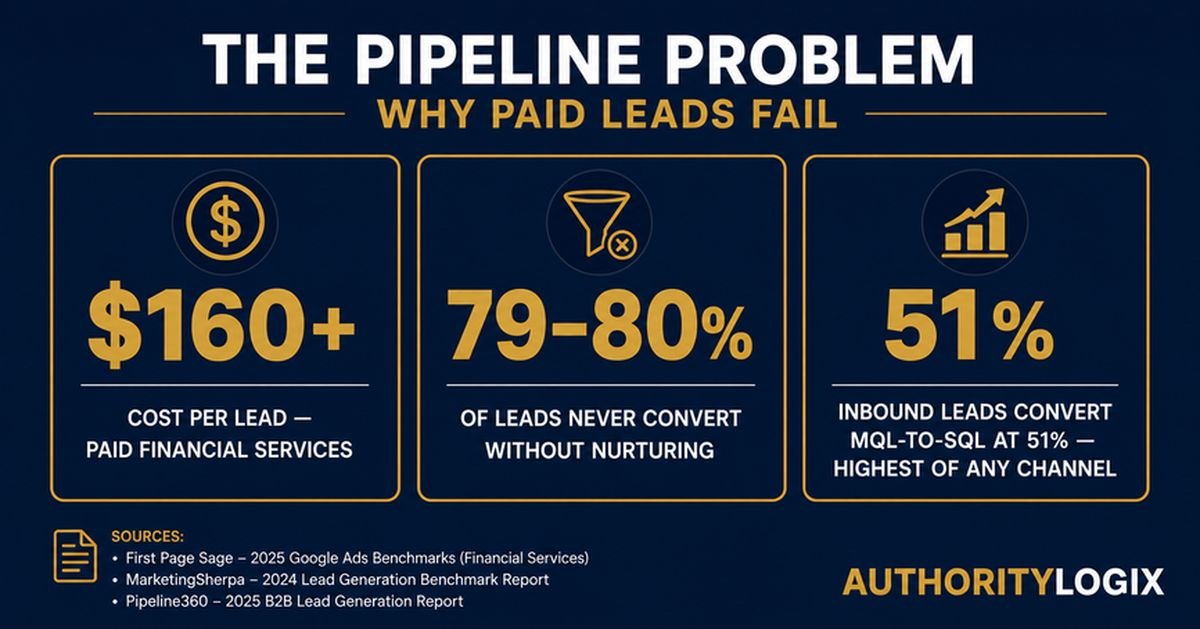
- Lead generation for financial services costs $160+ per lead through paid channels — inbound systems built on content and SEO eliminate that marginal cost entirely once the infrastructure is in place.
- 79–80% of leads never convert because they are not nurtured effectively. The pipeline leakage problem is not a traffic problem — it is a system problem.
- Companies with strong lead nurturing programs generate 50% more sales-ready leads at 33% lower cost, and nurtured leads make purchases 47% larger.
- SEO-captured leads convert MQL-to-SQL at 51% — the highest of any channel, including paid search, webinars, and events.
- The 6-step system — positioning, lead magnet, landing page, nurture sequence, qualification, and referral infrastructure — works together as a closed loop, not a collection of tactics.
- BKDSCR.com generates inbound investor inquiries through this exact system, without a paid lead source in the pipeline.
Table of Contents
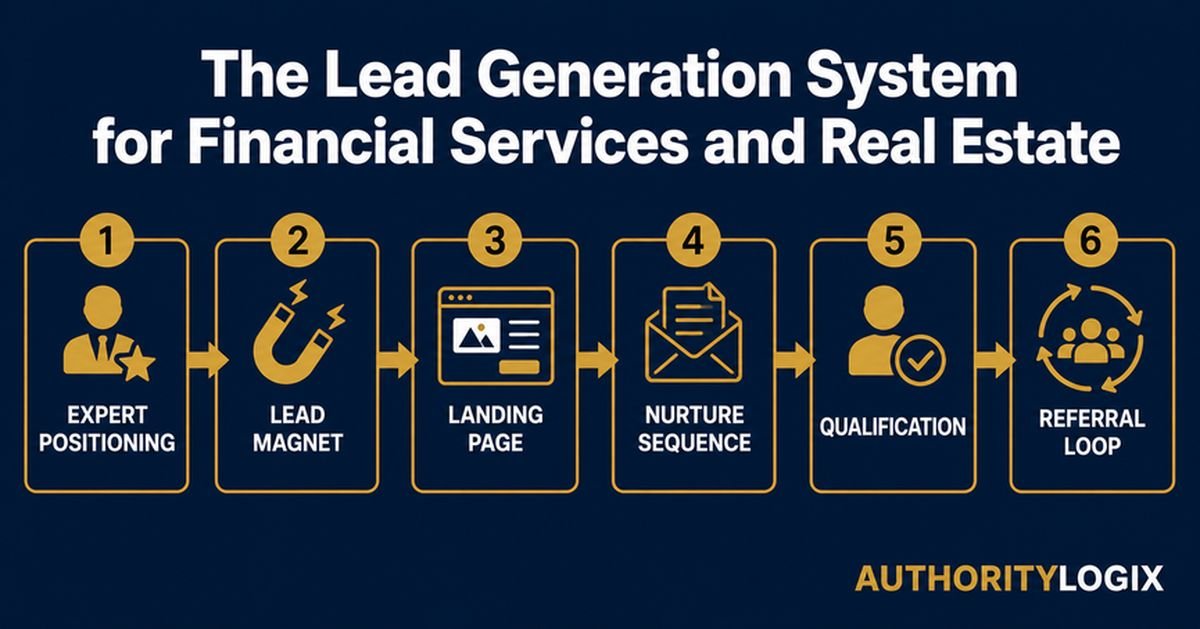
Lead generation for financial services and real estate is not a campaign — it is a system. A campaign runs for 90 days, spends a budget, and stops. A system builds pipeline that compounds month after month, costs less per lead over time, and produces prospects who arrive pre-qualified rather than cold.
The data on what financial professionals are doing instead is uncomfortable. Paid leads in financial services cost $160 or more per lead (DesignRush, 2026) — and that cost buys shared, unqualified contacts who have already been contacted by multiple competitors before the first call. 79–80% of all leads never convert because they are not nurtured effectively (DesignRush, 2026). 44% of sales reps never follow up with a lead at all. The pipeline problem most financial professionals diagnose as a lead volume problem is almost always a system problem.
This guide builds the system from the ground up — 6 steps that take a financial services or real estate professional from invisible to a compounding inbound pipeline that works without a paid lead vendor. BKDSCR.com runs this system for NYC outer-borough DSCR investors and generates qualified inquiries from organic search and content, with no paid lead source in the pipeline.
Build your Lead Generation System: See how Lead Generation Systems work
Why Most Lead Generation for Financial Services Fails Before It Starts
Most financial professionals approach lead generation the same way: buy a list, run an ad, or sign up for a lead aggregator. The results are predictable — high cost, low quality, and a pipeline full of contacts who have no particular reason to choose one provider over another. The fundamental problem is that paid lead generation in financial services rents attention rather than building it. The moment the spend stops, so does the pipeline.
Inbound lead generation built on content and SEO operates differently. SEO-captured leads convert from marketing qualified to sales qualified at 51% — the highest conversion rate of any channel, including paid search (26%), webinars (30%), and events (24%) (HubSpot, updated 2026). The leads are more qualified because they self-select: a prospective investor who searches “DSCR loan requirements for multi-family Brooklyn” and finds your educational resource has already demonstrated intent, investment focus, and geographic market before the first conversation.
The cost structure is equally different. Organic leads from search have zero marginal cost once the content ranks. A well-optimized article targeting a specific DSCR investor query drives qualified traffic every month for years — the same asset, compounding in value — while the equivalent paid lead costs $160+ per contact, every time.
The Real Reason Lead Pipelines Stall
Mortgage buying cycles are long. A DSCR investor who inquires in January may not be ready to apply until April or July. A real estate coach prospect who downloads a guide in March may need three months of education before they are ready for a strategy conversation. Most financial professionals lose these leads not because the prospect went elsewhere, but because there was no system to stay in front of them through a 60–90 day decision window.
Companies with strong lead nurturing programs generate 50% more sales-ready leads at 33% lower cost — and nurtured leads make purchases 47% larger than non-nurtured leads (TheDigitalBloom, 2026). Lead nurture is not optional in financial services. It is where the pipeline is won or lost.
Step 1: Position Before You Capture — the Foundation of Lead Generation for Financial Services
No lead generation system works without a positioning layer. The financial professional who tries to capture leads before they have answered “why me specifically, for this type of client, with this specific problem” builds a pipeline of unqualified prospects who have no particular reason to convert.
Positioning for lead generation in financial services requires three decisions made before the first landing page is built:
- The defined client type — not “real estate investors” but “outer-borough NYC investors buying 2–4 unit multi-family with rental income that doesn’t qualify under conventional underwriting”
- The specific problem — the exact friction point the prospect is experiencing that the professional solves, stated in the prospect’s own language
- The proof point — the single most credible demonstration of the professional’s ability to solve that problem, stated as a fact, not a claim
This positioning determines what the lead magnet covers, what the landing page says, what the nurture sequence teaches, and how the qualification conversation is framed. A lead generation system built on vague positioning produces vague leads. A system built on specific positioning attracts prospects who have already self-qualified before they fill out the form.
For the full positioning framework and how AuthorityLogix builds it for financial brands, see How We Do It. To understand how that positioning then translates into search visibility that brings prospects to the lead capture system, see the Complete Guide to Getting Found Online for Financial Brands.
Step 2: The Lead Magnet — the Entry Point of Every Lead Generation System for Financial Services
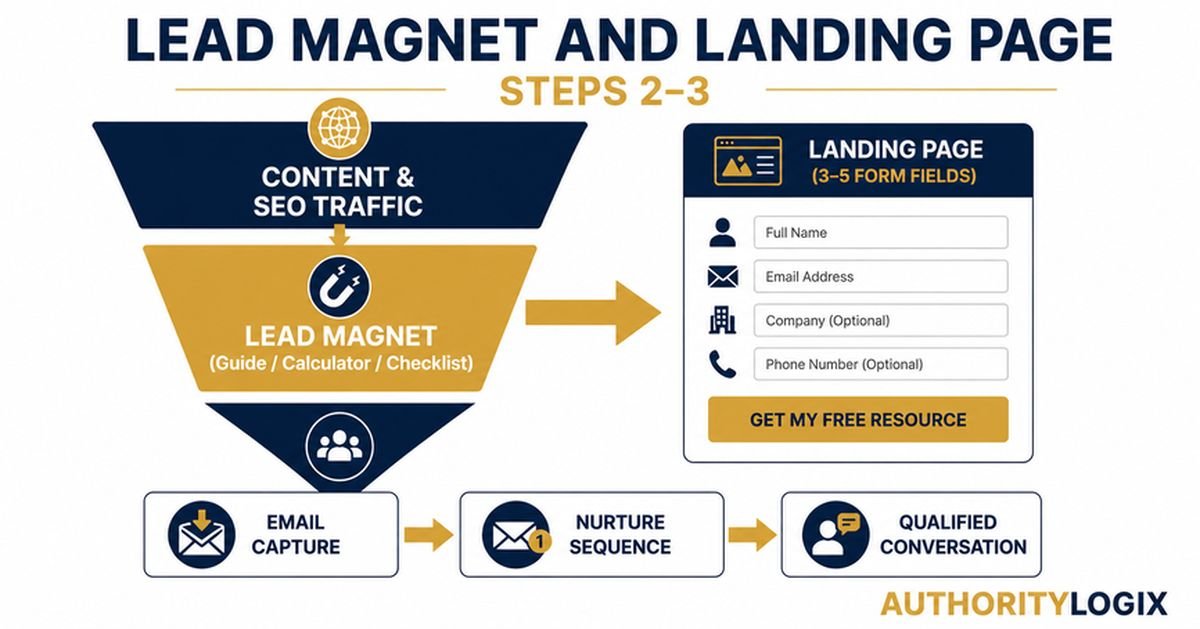
A lead magnet is a specific, high-value resource that earns a prospect’s contact information in exchange for something genuinely useful to them. In financial services and real estate, the most effective lead magnets are not generic — they are precisely targeted to the specific problem the defined client type is trying to solve.
The format matters less than the specificity. AI-personalized checklists achieve an 11.4% conversion-to-sale rate within a 30-day nurture window — more than double the 4.7% rate for long-form PDF guides (Content Marketing Institute, 2026). Short-form, specific, immediately useful assets outperform comprehensive but generic ones. A “DSCR Loan Qualification Checklist for NYC Multi-Family Investors” will outconvert “The Complete Guide to Real Estate Investing” every time, because the prospect who downloads the checklist has already told you exactly what they are trying to do.
Lead Magnet Formats That Convert in Financial Services
- Qualification checklists — “Does This Property Qualify for a DSCR Loan?” / “Is Your Real Estate Business Ready for Investor Coaching?”
- Calculators — DSCR ratio calculators, investment property ROI models, mortgage payment estimators that require an email to receive results
- Market data reports — proprietary analysis of specific markets the professional serves, positioning the professional as the expert source
- Deal analysis frameworks — step-by-step guides to evaluating a specific type of investment, such as outer-borough multi-family or short-term rental
- Comparison guides — “DSCR vs. Conventional Loans: Which Is Right for Your Investment Property?” targeting prospects in the evaluation stage
The lead magnet should require no more than one decision to access. HubSpot research confirms that 3–5 form fields produce a 20% conversion rate; 6 or more fields drop conversion to 15% or below. For financial services lead magnets, name, email, and one qualifying question (loan type or property type) is the optimal format.
Step 3: The Landing Page — Converting Traffic into Leads for Financial Services
The landing page is where lead generation for financial services either works or breaks down. Most financial professionals send traffic to a homepage or a general contact page and wonder why conversion is low. A homepage serves many audiences. A landing page serves one prospect with one specific offer and one action. The conversion difference is significant.
Financial services landing pages in 2026 convert at 2–5% on average (Martal.ca, 2026). The top-performing pages in this category share specific structural characteristics that separate them from the majority.
Landing Page Structure for Financial Services Lead Generation
- Headline that names the specific prospect and their specific problem — not “Download Our Free Guide” but “NYC Investor? Here’s How to Know If Your Next Property Qualifies for a DSCR Loan Before You Apply”
- 3–5 bullet points covering exactly what the prospect gets from the lead magnet — specific, outcome-oriented, no filler
- Trust signals above the fold — professional credential, years of experience, specific deal count or volume — not a logo wall
- A form with 3–5 fields maximum: name, email, and one qualifying question
- A single CTA button with action-oriented copy — “Get the Checklist” or “Run My DSCR Numbers” outperforms “Submit” or “Download”
- No navigation links — a landing page with site navigation bleeds conversion; the only exit should be the form submission
Desktop converts at roughly twice the rate of mobile in B2B financial services (5.06% vs 2.49%), even though mobile drives the majority of traffic (Martal.ca, 2026). Design the mobile landing page for research and low-friction capture — fewer fields, scannable content — and optimize desktop for conversion with full detail and social proof.
For the full landing page and lead capture architecture, including compliance requirements specific to mortgage and DSCR content, see Lead Generation Systems.
Before you build, know where the gaps are: Download the free Authority Gap Assessment
Step 4: The Nurture Sequence — the System That Converts Leads into Clients in Financial Services
A lead who downloads a DSCR qualification checklist is not ready to apply for a loan. They have identified a problem, demonstrated intent, and self-selected into the right audience — but the decision to work with a specific professional happens over time. The nurture sequence is the system that closes that gap.
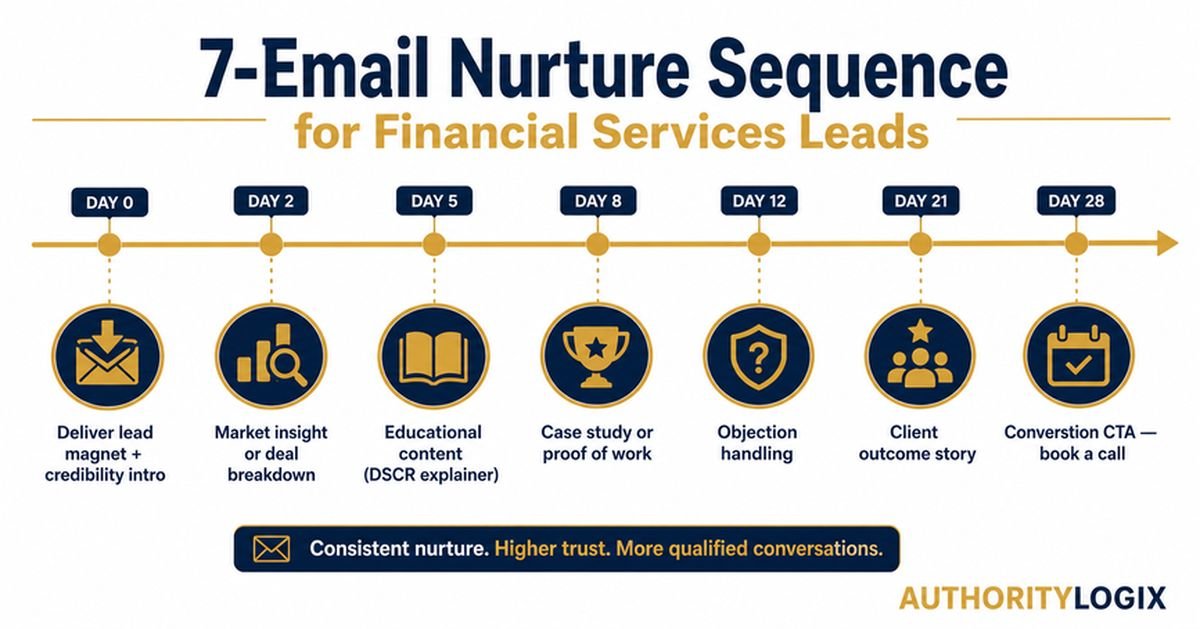
A well-structured lead nurture sequence for financial services runs 7–12 emails over 3–6 weeks, with spacing that mirrors a natural relationship-building cadence. Lead-magnet-specific sequences outperform generic sequences by 40–80% on click-to-conversion rate (LeadsuiteNow, 2026). The sequence should tell a cohesive story — each email building on the previous — rather than a series of disconnected promotional messages.
The 7-Email Nurture Sequence for Financial Services Leads
- Day 0 — Deliver the lead magnet + a brief credibility introduction: who you are, who you serve, what makes your approach different
- Day 2 — A market insight or data point relevant to the prospect’s situation: a DSCR rate update, a local market report, an underwriting guideline change
- Day 5 — An educational piece that advances the prospect’s understanding: “How DSCR Ratios Actually Work” or “3 Things Lenders Look For in an Investment Property Application”
- Day 8 — A case study or deal breakdown: an anonymized client situation, the problem, the approach, the outcome
- Day 12 — Objection handling: the most common reason the prospect has not moved forward yet, addressed directly with evidence
- Day 21 — A client outcome story: not a testimonial, but a structured narrative that shows the full arc from where the client started to where they ended up
- Day 28 — The conversion CTA: a direct, low-friction invitation to book a call — framed as the natural next step given everything they have learned, not a sales pitch
Real estate and mortgage buying cycles require patience. NAR data shows the average nurture window to conversion runs 10+ weeks — agents who stop following up after 3 touches quit right before the buying decision happens. The sequence has to be long enough to match the prospect’s timeline, not the professional’s.
For the full email nurture system — automation setup, compliance requirements, and sequence templates for DSCR and mortgage content — see Content Systems. The publishing infrastructure that produces the educational content driving each stage of the nurture sequence is covered in the Content System Blueprint for Financial Brands.
Step 5: Qualification — Separating Real Prospects from Lead Generation Noise in Financial Services
Not every lead that enters the system is a qualified prospect. In financial services and real estate, lead quality matters far more than lead volume — a pipeline of 200 unqualified contacts produces fewer closed deals than a pipeline of 20 pre-qualified prospects who understand what they need, can act on it, and match the professional’s specific client profile.
Qualification in a lead generation system for financial services happens at two points:
At the landing page
The qualifying question on the form does the first filter. “What type of property are you looking to finance?” with options including single-family, 2–4 unit multi-family, 5+ unit commercial, and short-term rental immediately segments the lead list and tells the professional which nurture sequence to deploy. A DSCR lender who specializes in outer-borough multi-family can route that specific segment into a tailored sequence and route others to a general resource or off the list entirely.
In the nurture sequence
Engagement with specific emails reveals intent. A prospect who opens the Day 5 DSCR educational email and clicks through to a calculator is demonstrating significantly higher intent than one who opened the Day 0 delivery email and went quiet. Email click behavior is the qualification signal that should trigger routing to a human follow-up cadence — a personal outreach from the professional within the window of demonstrated interest.
Lead response speed matters more in financial services than most professionals realize. Responding to a lead within 5 minutes makes a professional 21 times more likely to qualify them than waiting 30 minutes — and 100 times more likely than waiting 60 minutes (InsideSales.com/MIT, cited in CloseDaily 2026). The nurture sequence handles the 30-day window; the human follow-up handles the high-intent moment.
Step 6: The Referral Infrastructure — the Compounding Layer of Lead Generation for Financial Services
The most cost-effective leads in financial services and real estate consistently come from referrals. Referral leads convert at 15–30% — multiple times higher than any paid or organic channel — because they arrive with built-in trust from the referring relationship. The problem is that most financial professionals treat referrals as a passive byproduct of doing good work rather than an active, structured component of the lead generation system.
Building referral infrastructure means creating the conditions that make it easy for satisfied clients and professional partners to refer:
- A defined referral request — asking specifically, at the right moment (after a successful close or a positive outcome milestone), not generically at the end of every email
- A professional partner network — mortgage attorneys, title companies, real estate agents, property managers, CPAs, and financial advisors who serve the same client type and can refer proactively
- A partner education asset — a one-page explainer of who the professional serves, what specific situations they solve, and what makes a good referral, so partners can recognize and send the right clients
- A follow-up system for partners — a structured cadence that keeps the professional visible to referral partners without being transactional: a monthly market update, a deal breakdown, a lunch meeting, a co-authored piece of content
BKDSCR.com builds this referral infrastructure through its educational content — the DSCR market updates, deal breakdowns, and investor education resources that position the platform as the authority source for NYC outer-borough investors. Real estate agents, attorneys, and property managers who follow the content become natural referral partners because they already know exactly who BKDSCR serves and what it delivers.
For the full referral and partnership infrastructure framework, and how AuthorityLogix builds it alongside content and SEO systems, see Why AuthorityLogix.
What Most Financial Professionals Get Wrong About Lead Generation
Mistake 1: Buying leads instead of building a system
Purchased leads in financial services are almost always shared — the same contact sold to multiple providers. The prospect who submitted a form on a lead aggregator site is fielding calls from 3–5 competitors before the professional even dials. Buying leads rents attention at $160+ per contact. Building an inbound system owns it — and the cost per lead from organic sources drops toward zero as the content compounds.
Mistake 2: No lead magnet — just a contact form
A contact form captures prospects who are ready to talk to someone right now. A lead magnet captures prospects at every stage of the evaluation process — including the 80% who are not ready to apply or book a call today but will be within 30–90 days. The contact form alone misses the majority of the market.
Mistake 3: No nurture sequence
79–80% of leads who are not nurtured never convert. A prospect who downloads a DSCR checklist and receives one automated confirmation email, then nothing, does not become a client. They become a contact in a dead list. The nurture sequence is what turns lead capture into lead generation.
Mistake 4: Chasing volume instead of quality
Lead generation for financial services is not a numbers game at the top of the funnel — it is a qualification game in the middle. A mortgage professional who captures 500 leads per month from a generic lead magnet with no qualification system produces the same results as one who captures 50 highly targeted leads from a specific asset. The qualified 50 close at a higher rate, require fewer touchpoints, and generate larger transactions.
Mistake 5: No referral system
Most financial professionals who do strong work for clients get some referrals — but they do not get all the referrals they could because they never asked specifically, never made it easy for partners to refer, and never built the professional partner network that turns one closed deal into a stream of pre-qualified introductions.
Building a Lead Generation System That Compounds for Financial Services and Real Estate
Lead generation for financial services and real estate that compounds over time is not built on ads, purchased lists, or sporadic content. It is built on a system where every component feeds the next: the positioning attracts the right prospect, the lead magnet earns their contact, the landing page converts the visit, the nurture sequence builds trust over time, the qualification layer filters intent, and the referral infrastructure turns closed clients into ongoing sources of pre-sold introductions.
The financial professionals who build this system own their pipeline. The ones who rent attention through paid leads are one budget cut or algorithm change away from starting over. Lead generation for financial services is the infrastructure decision that separates the professional who is always looking for the next lead from the one who cannot handle all the inbound they are receiving.
BKDSCR.com is the proof that this system works in a competitive financial services niche. It generates qualified inbound investor inquiries through content, SEO, and the referral infrastructure built over two decades of NYC mortgage origination — no paid lead sources, no cold outbound, no shared contact lists. That is what a lead generation system built to compound looks like.
For the full case study on how AuthorityLogix builds lead generation systems for mortgage companies, DSCR lenders, real estate coaches, and financial advisory firms, see Why AuthorityLogix.
External reference: Lead Generation Statistics 2026: Benchmarks, AI Trends & Revenue Growth — DesignRush
Ready to build your lead generation system? Book a free Authority Gap Assessment