
Key Takeaways
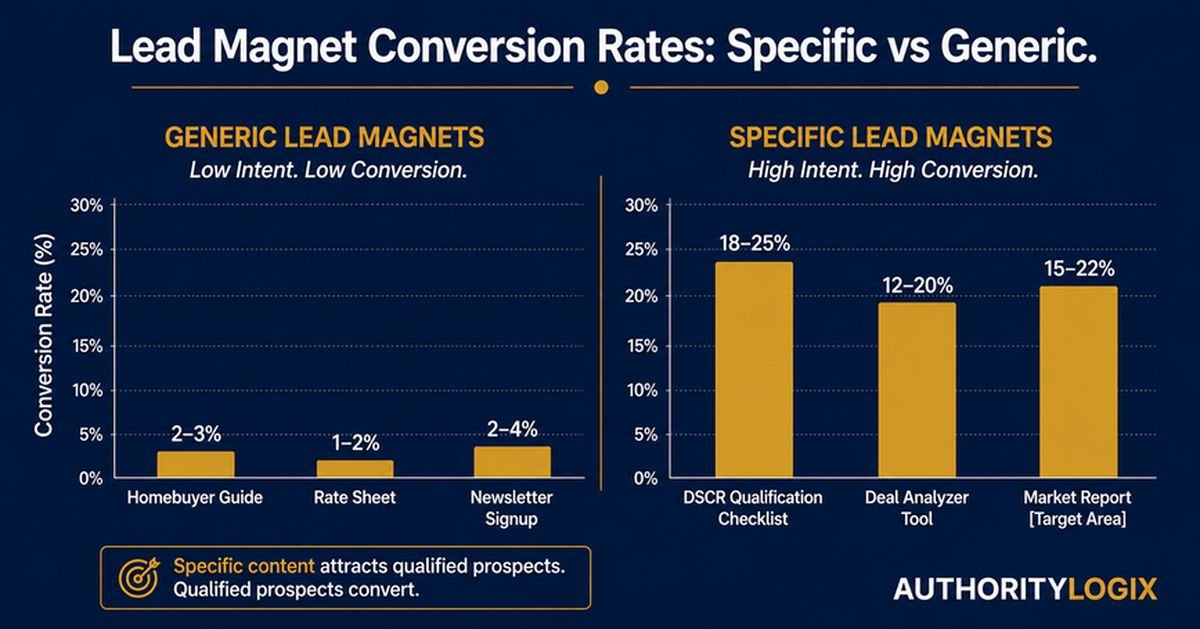
- Lead magnets for mortgage and real estate businesses fail for one reason: they are too generic to qualify the prospect. A checklist for DSCR investors converts at 5x the rate of a generic homebuyer guide.
- Specific lead magnets pre-qualify leads before any human contact. The prospect who downloads a DSCR loan qualification checklist has already identified their loan type, investment strategy, and research stage.
- According to HubSpot State of Marketing 2026, companies with lead capture systems generate 3x more qualified leads per dollar than those relying on contact forms alone.
- Mortgage leads contacted within 5 minutes convert at 21x the rate of leads contacted after 30 minutes. A lead magnet that captures intent data tells you exactly when to make contact.
- The best lead magnets for real estate and mortgage businesses are interactive tools — calculators, deal analyzers, assessment tools — that provide immediate personalized value.
- Lead magnet specificity is the highest-leverage variable in the entire lead generation funnel. One highly specific magnet outperforms five generic ones.
Table of Contents
Lead magnets for mortgage and real estate businesses are one of the most misused tools in the entire marketing stack. The concept is sound: offer something of value in exchange for contact information, and convert anonymous website visitors into identified prospects. The execution is where most mortgage companies, lenders, and real estate firms go wrong — producing lead magnets that are too generic to attract the right prospect, too thin to demonstrate expertise, and too disconnected from the sales process to generate leads worth pursuing.
According to the HubSpot State of Marketing 2026, companies with documented lead capture systems generate 3x more qualified leads per dollar than those relying on contact forms alone. But the data also shows that lead quality matters far more than lead volume. A mortgage company that generates 500 unqualified leads per month from a generic homebuyer guide is filling a CRM with contacts who never convert and consuming sales capacity that should be spent on qualified prospects.
The difference between a lead magnet that generates pipeline and one that generates noise is specificity. The prospect who downloads a DSCR Loan Qualification Checklist for NYC Multi-Family Investors has already told you their loan type, investment strategy, target market, and research stage — before you have ever spoken to them. That is what a lead magnet that actually works looks like.
See how Lead Generation Systems work: See how Lead Generation Systems work
Lead Magnets for Mortgage and Real Estate: What Actually Works
The most common mortgage lead magnet is some variation of a free homebuyer guide. These exist on thousands of websites and attract every type of borrower indiscriminately — which means they attract no specific borrower effectively. A prospect who downloads a generic guide has told you almost nothing useful: not their loan type, timeline, credit profile, or investment strategy.
Generic lead magnets also fail at the SEO level. A downloadable PDF titled “The Complete Mortgage Guide” competes against content produced by Rocket Mortgage, Bankrate, NerdWallet, and every major financial publisher. A lead magnet titled “DSCR Loan Qualification Checklist for Outer-Borough NYC Investors” competes with almost nobody and attracts exactly the prospect that lender is positioned to serve. Specificity is not just a conversion strategy — it is a lead capture mortgage positioning strategy.
Generic mortgage lead magnets convert website visitors at 2 to 5%. Specific, targeted lead magnets convert at 15 to 25% for the right audience — because the prospect has already self-selected into the offer. The lower absolute conversion rate of a narrow lead magnet is compensated by the dramatically higher quality of every lead it generates.
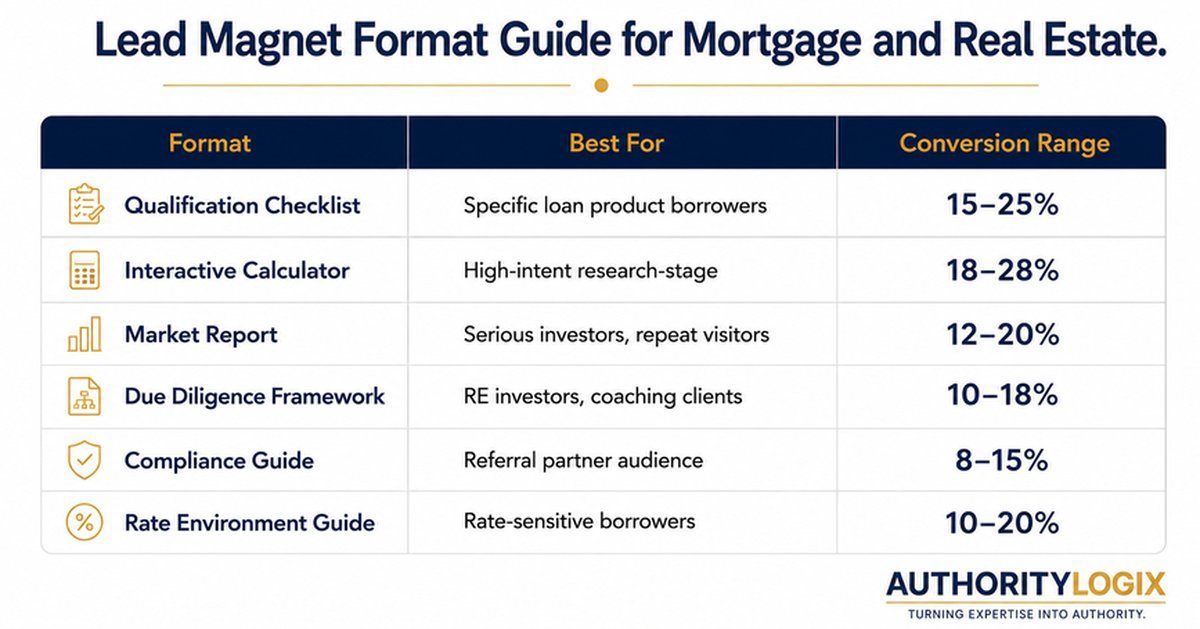
The 6 Lead Magnet Formats That Convert in Mortgage and Real Estate
1. Loan Qualification Checklists
A qualification checklist is the highest-converting real estate lead magnet format in financial services because it addresses the most immediate anxiety a prospect has: do I qualify? A DSCR investor reading your content is already wondering whether their deal will pass. A self-employed borrower researching non-QM loans is already worried about whether their income documentation will work. A checklist that walks them through the exact qualification criteria for that specific loan product solves their immediate problem — and captures their contact information in the process.
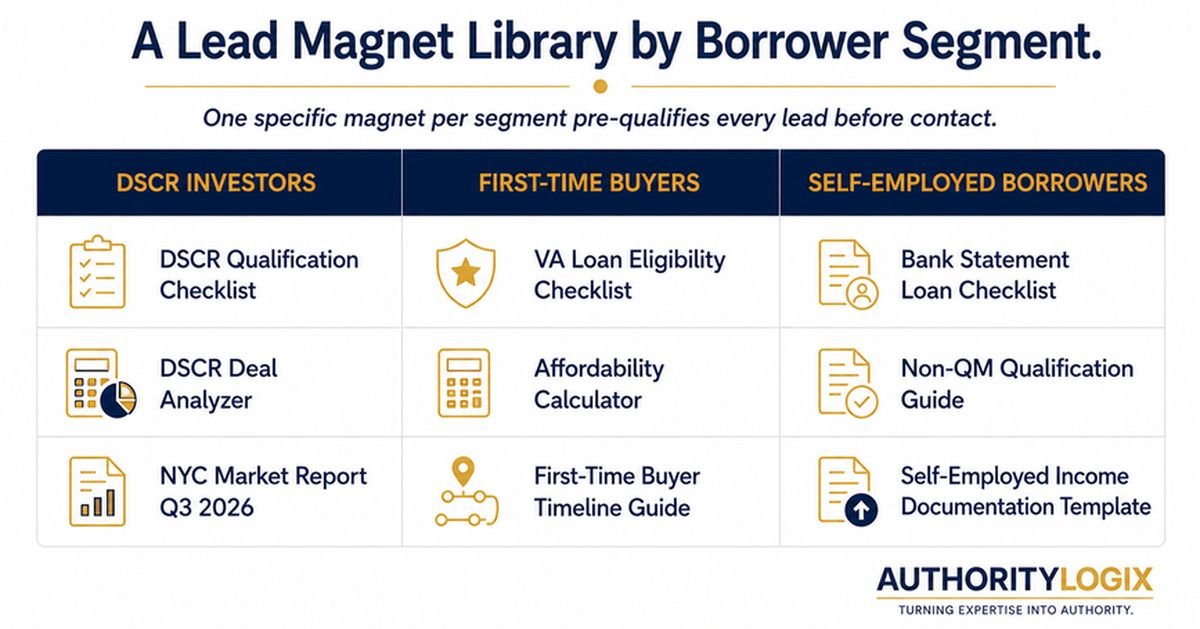
The checklist that converts best is a specific qualification framework for a specific loan product and borrower profile — DSCR Qualification Checklist for NYC Multi-Family Investors, Bank Statement Loan Checklist for Self-Employed Borrowers, VA Loan Eligibility Checklist for First-Time Veterans. Each tells the prospect exactly who this lender serves.
2. Interactive Calculators and Deal Analyzers
Interactive tools are the single highest-converting lead capture format in mortgage and real estate — not because they collect email addresses, but because they provide immediate, personalized value before any contact information is requested. A DSCR calculator that lets an investor input their property details and see their DSCR ratio in real time has already delivered a tangible result. A well-built lead generation system for financial services and real estate positions interactive tools at the highest-intent points of the content experience. The email capture that follows a personalized result converts at 15 to 25% because the user has received something genuinely useful.
For real estate firms and coaches, the equivalent is a deal analyzer. The investor who has used your deal analyzer to evaluate a specific property has already engaged with your methodology, built implicit trust in your approach, and provided contact information in exchange for a result they genuinely wanted.
3. Market Reports and Local Data
Original market data that your target audience cannot easily find elsewhere is among the highest-value mortgage lead magnet ideas available to any lender or real estate firm. A quarterly report on DSCR lending conditions and cap rates in your target investment market, a local housing market analysis with median price trends and days-on-market by neighborhood, or a rent growth analysis for a specific metro area positions your firm as a data source that serious investors return to repeatedly.
Market reports also create a returning visitor dynamic. A prospect who downloaded your Q2 DSCR market report will return for your Q3 report — deepening the relationship each time. By the time they are ready to apply, they have been in your content ecosystem for months.For the full content architecture that supports lead magnet integration — pillar pages, cluster articles, and website CTA placement — see the Content System Blueprint for Financial Brands.
Before you build, know where the gaps are: Download the free Authority Gap Assessment
4. Due Diligence and Investment Frameworks
For real estate investment firms and coaches, a downloadable due diligence framework positions you as the expert who has already done the analytical work. A property due diligence checklist, a syndication evaluation framework, or a deal underwriting template provides genuine operational value to a prospect actively evaluating investments. The investor who uses your due diligence framework to evaluate a deal has already been educated by your methodology. A structured educational hub that attracts, educates, and converts for a real estate firm should include at least one due diligence framework built for its primary investor audience. This is how authority converts prospects into clients without a single sales call.
5. Compliance and Regulatory Guides
For mortgage companies and lenders, compliance guides are an underutilized lead magnet format. A TRID disclosure timeline, a RESPA compliance guide for agent-lender co-marketing, or a non-QM documentation requirements guide attracts the real estate agents, financial advisors, and sophisticated investors who become long-term referral partners and repeat clients. A structured finance content program for a mortgage company should include at least one compliance guide built for its primary referral audience.
6. Rate Environment Guides and Financial Analysis
A rate environment guide is not a rate sheet. It explains what the current rate environment means for a specific borrower — how to evaluate whether now is the right time to buy, how to assess refinance calculus, or how to structure a DSCR deal in the current scenario. Updated quarterly, it positions the lender as the analytical resource serious borrowers trust. The authority distribution layer amplifies these guides beyond your own hub — syndicating them to third-party platforms builds backlinks and brand recognition simultaneously.
How to Position Lead Magnets for Maximum Conversion
Three positioning decisions determine whether a lead magnet generates qualified leads or collects random email addresses.
First, placement on the page must match the intent of the visitor arriving at that page. A DSCR qualification checklist positioned on a DSCR loan program page converts at dramatically higher rates than the same checklist buried in a blog post sidebar. Lead magnet placement should be content-specific — every article, guide, and tool page should offer a lead magnet directly relevant to the specific intent of that visitor.
“Download our free guide” converts poorly. “Download the DSCR Qualification Checklist for Outer-Borough NYC Investors” converts well. Specificity tells the right prospect this is exactly for them — and filters out the wrong prospect before they enter the pipeline. A content system that pairs specific content with specific lead magnets ensures that every email captured is from a prospect who self-identified into the right audience.
Third, follow-up must be immediate. Mortgage leads contacted within 5 minutes convert at 21x the rate of those contacted after 30 minutes. The lead magnet should trigger an immediate, relevant follow-up — not a generic welcome email, but delivery of the promised asset plus the next relevant resource in the prospect’s research journey.
3 Lead Magnet Mistakes That Generate the Wrong Leads
Offering Something Borrowers Already Have
A lead magnet that offers information a prospect can easily find elsewhere provides no genuine value exchange. The prospect who downloads it has not learned anything they did not already know, and the lender has collected a contact who has not signaled any real intent. Every lead magnets for mortgage strategy should start with the question: what does my target borrower need that they cannot easily find anywhere else?
Building One Lead Magnet for Every Audience
A single lead magnet attempting to serve every possible borrower serves none of them specifically. A mortgage company with three specific lead magnets — one for DSCR investors, one for first-time buyers, one for self-employed non-QM borrowers — builds a lead capture system that pre-qualifies every prospect into the right segment before any human contact occurs. The authority distribution layer ensures each specific lead magnet reaches the specific audience it was built for.
Ignoring the Nurture Sequence After Download
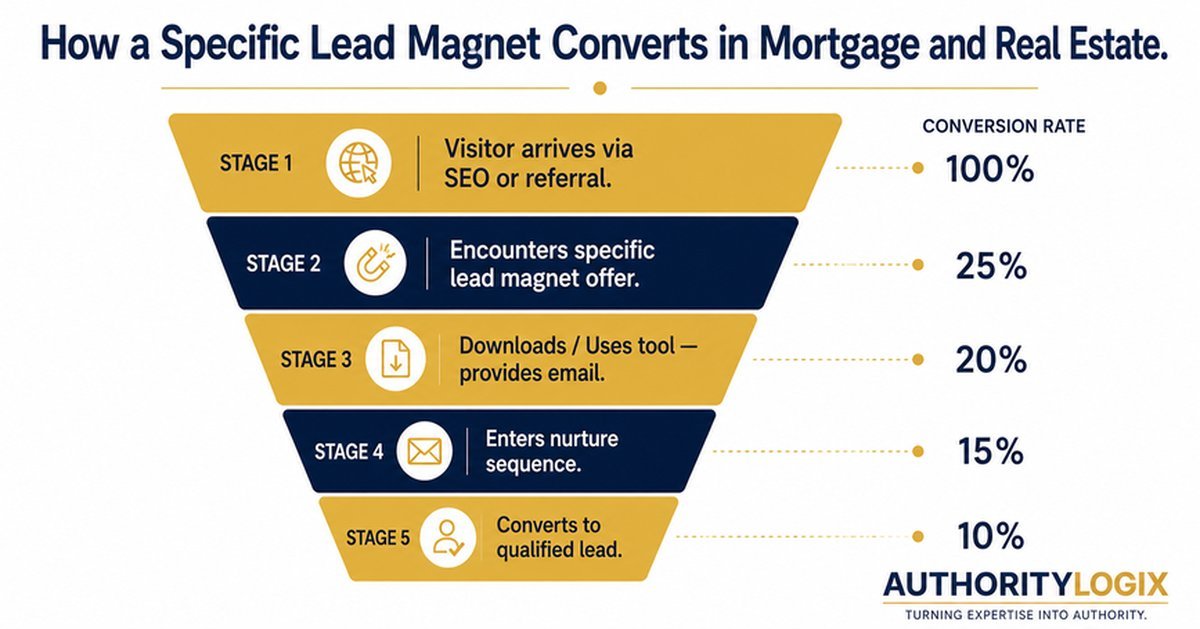
80% of mortgage leads require nurturing — they are not ready to apply when they download a checklist or use a calculator. The lead magnet is the entry point to a nurture sequence that delivers useful content over the 6 to 12 week research window typical of a mortgage or real estate decision. Building that nurture sequence is as important as building the magnet itself.
For the complete content-to-client system that connects lead magnets to authority building, conversion, and pipeline growth, see the Finance Content Playbook: How Lenders, Advisors, and Real Estate Firms Turn Content Into Clients.
Why Lead Magnet Specificity Is the Highest-Leverage Variable
Of all the variables in a lead generation system for mortgage and real estate businesses, the specificity of the lead magnet produces the largest impact on both conversion rate and lead quality. A generic lead magnet — a mortgage guide, a real estate investing checklist — attracts a broad audience and converts a small percentage into identified prospects. A specific lead magnet — a DSCR qualification checklist for NYC outer-borough multi-family properties — attracts a narrow audience and converts a high percentage, because the prospect who downloads it has already self-identified as the exact client the firm wants to serve.
The downstream effect of lead magnet specificity extends through the entire system. Specific lead magnets produce specific prospects who respond better to specific nurture sequences, convert at higher rates in the strategy call, and close faster because the relationship is built on demonstrated expertise in their exact situation. Investing in specificity at the lead magnet stage is the highest-return decision in the entire lead generation system.
The mortgage and real estate businesses that invest in building specific, relevant lead magnets today are creating assets that generate qualified leads for years. A DSCR qualification checklist published today will be downloaded by investors evaluating DSCR deals months and years from now. Each download is a pre-qualified prospect who has self-identified their loan type, their research stage, and their intent — without any human intervention. That level of automated pre-qualification is what makes lead magnets the highest-return investment available in the lead generation system.
The lead generation system built on specific, relevant lead magnets, targeted landing pages, CRM-integrated capture, and automated nurture sequences is the infrastructure that separates growing mortgage and real estate businesses from stagnant ones. Building it requires an upfront investment of time and strategy — but the return compounds indefinitely, making every subsequent lead cheaper, better qualified, and faster to convert than the one before it.
Lead generation for mortgage and real estate businesses works when the system is built correctly from the top down — attract the right audience with specific content, capture them with specific lead magnets, nurture them through the research window with relevant educational content, and convert them with a clear, timely offer. Every element must connect to the next. When they do, the result is a pipeline that generates pre-qualified inbound leads automatically — and compounds in quality and volume every month the system operates.
The mortgage company or real estate firm that builds a complete lead generation system — specific lead magnets, dedicated landing pages, CRM integration, and automated nurture sequences — owns its pipeline in a way that referral-dependent businesses never do. That ownership compounds over time as the content library grows, the lead magnet library expands, and the nurture sequences mature. Building that system is the most important infrastructure decision a growing mortgage or real estate business can make.
Ready to build your lead generation system? Book a free Authority Gap Assessment
Building a Lead Magnet System That Compounds
A single well-built lead magnet is a start. A library of specific lead magnets — each built for a specific borrower profile, loan product, and research stage — is a lead generation system that compounds. Each new magnet expands capture surface area. Each updated report creates a reason for past visitors to re-engage.
The mortgage companies and real estate firms that have built this library over 12 to 24 months are generating pre-qualified inbound leads from multiple audience segments simultaneously — without a single additional dollar spent on paid acquisition. You can see exactly what this infrastructure looks like fully built through the BKDSCR.com proof-of-work case study. For the full funnel that converts those leads into clients, see Building a Lead Generation Funnel That Qualifies for You. — a full-stack real estate investor authority platform with deal analysis tools, market reports, and qualification guides that generate inbound leads from NYC outer-borough investors continuously.
The lead magnet is the first handshake between your brand and your prospect. Make it specific enough to matter to exactly the right person.