Key Takeaways
- Firms with clearly defined target markets tend to grow faster than generalist practices, command pricing premiums, and retain clients longer. Niche positioning is not a marketing preference — it is a compounding growth engine.
- The number of advisors at independent RIAs has grown faster than the number of independent RIA firms over the last decade — a sector expanding faster than the firms that serve it. The firms capturing disproportionate share of that growth are not the ones spending more. They are the ones positioning more specifically.
- In 2026, niche positioning has become a core growth engine rather than a marketing preference. Every search engine and AI-driven platform rewards clarity of expertise — making specificity a ranking signal, a trust signal, and a conversion signal simultaneously.
- Organic niche growth produces results that private equity capital cannot replicate on a compressed timeline. The independent firms on the 2026 fastest-growing list with no PE backing achieved strong organic growth by executing service-line discipline: niche depth over geographic scale.
- The financial services growth playbook is not a marketing document — it is a business architecture document. Positioning, authority infrastructure, content system, lead generation system, and distribution channel are the five components. Each feeds the next. All five compound together.
- Most sub-$75M financial firms have not exhausted the organic niche growth model before opening conversations about external capital. They are selling equity before earning the multiple that equity should command. The playbook in this guide builds the multiple first.
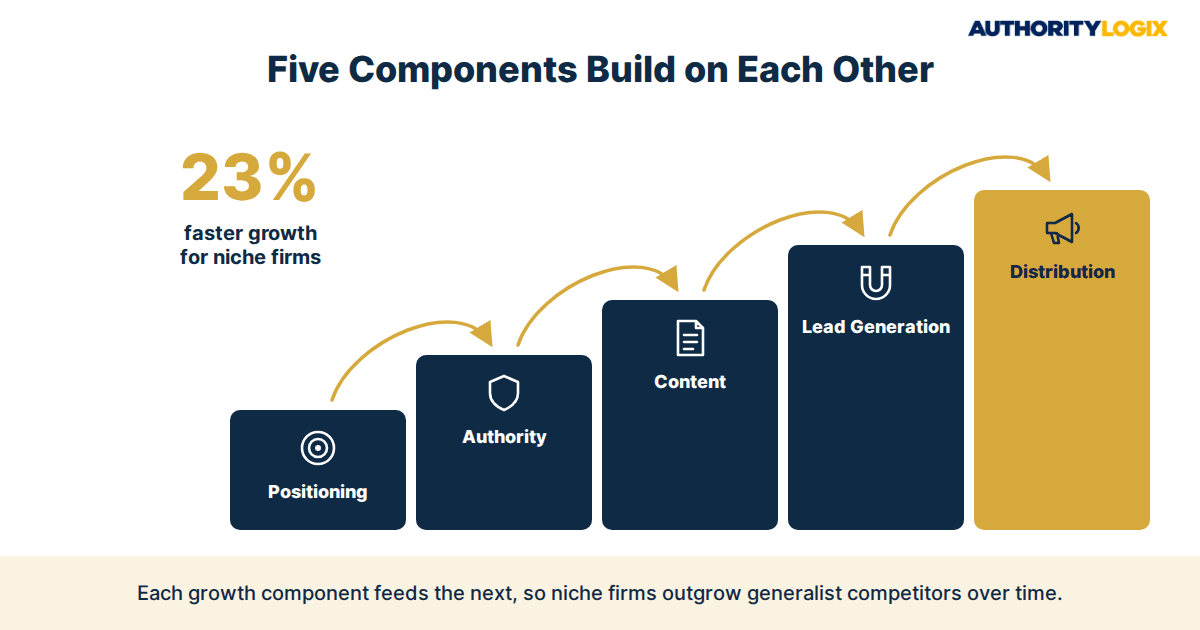
The financial services growth playbook exists because growth in financial services in 2026 is no longer a function of market timing, rate environment, or referral volume. It is a function of positioning clarity, authority infrastructure, and the compounding effect of executing all five components of the growth system simultaneously. A DSCR lender that built its market position in 2021 on the back of a refinance boom and a rising investor market is not building — it is riding.
A financial advisory firm that grew from 20 to 80 clients entirely through COI referrals has a growth rate that is permanently capped by the capacity of its referral network. The financial services growth playbook replaces riding and capping with building and compounding.
The data behind this distinction is specific. Firms with clearly defined target markets tend to grow faster than generalist practices, command pricing premiums, and retain clients longer. The non-PE-backed firms on that 2026 fastest-growing list achieved strong organic growth by executing service-line discipline — niche depth over geographic scale.
The
SEO playbook covers how that positioning clarity translates into search visibility. This guide covers how to build the positioning clarity itself — and how to connect it to the five growth systems that compound once it is in place.
This playbook documents five components of the financial services growth system: niche positioning, authority infrastructure, content compounding, lead generation architecture, and distribution reach. Every component feeds the next. The full system — built and maintained consistently over 18 to 36 months — produces the market authority position that no single tactic, no competitor spend, and no PE capital can buy its way into quickly.
The Financial Services Authority Guide covers the trust and credibility infrastructure that makes every component of the growth playbook convert into compounding market authority.
Authority Guide →
Why Financial Services Growth Must Be Built, Not Bought
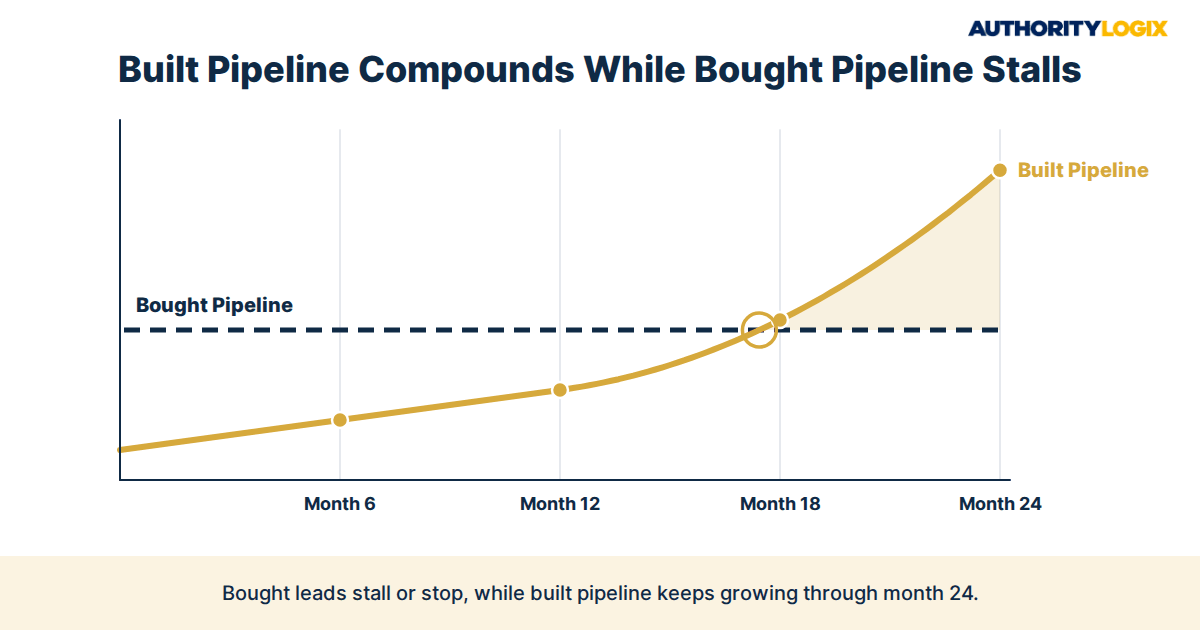
The financial services growth playbook begins with a structural observation that most conversations about growth in this industry skip: there are two kinds of growth available to a mortgage company, DSCR lender, or financial advisory firm — growth that is purchased and growth that is built. Purchased growth — paid leads, aggregator placements, ad spend, rate-table positions — produces volume in proportion to spend and stops the moment the budget does. Built growth — authority position, organic search presence, referral network depth, email list size, content asset library — compounds in value every month it runs and generates returns that do not expire.
Our
educational hub tracks how 96% of prospects research a financial firm online even after receiving a referral, and how 60% of U.S. adults now use AI to search for information. Purchased visibility does not survive these due-diligence moments. Built authority does — because the content, credentials, reviews, and external citations that constitute genuine authority appear in every channel the prospect checks, whether they arrived from a paid ad, a referral, or a direct search.
The Compounding Growth Curve
The financial services growth playbook operates on a compounding curve that most financial firms abandon before reaching its inflection point. Months one through six: infrastructure built — positioning defined, content architecture established, Google Business Profile optimized, lead capture assets deployed. No visible market movement yet.
Months seven through twelve: traction appears — first organic rankings, first email list growth, first referral reinforcement from improved digital presence, first AI citations. Months thirteen through twenty-four: compounding begins — each new content piece ranks faster, each new referral converts at a higher rate, each new lead costs less. Month twenty-four and beyond: the market position is structurally defensible — competitors would need to start their infrastructure build now to reach the same position in another two years.
Component 1 — Niche Positioning: The Foundation of Compounding Growth
The financial services growth playbook treats niche positioning not as a marketing exercise but as a business architecture decision — the one that determines whether every other growth component compounds or plateaus. A generalist mortgage company that serves every borrower in every geography with every product type cannot build topical authority in any specific area, cannot become the recognizable expert in any specific market, and cannot generate the referral network depth that comes from being the obvious choice in a defined niche. It can only compete on price, which is a race to the bottom in any rate environment.
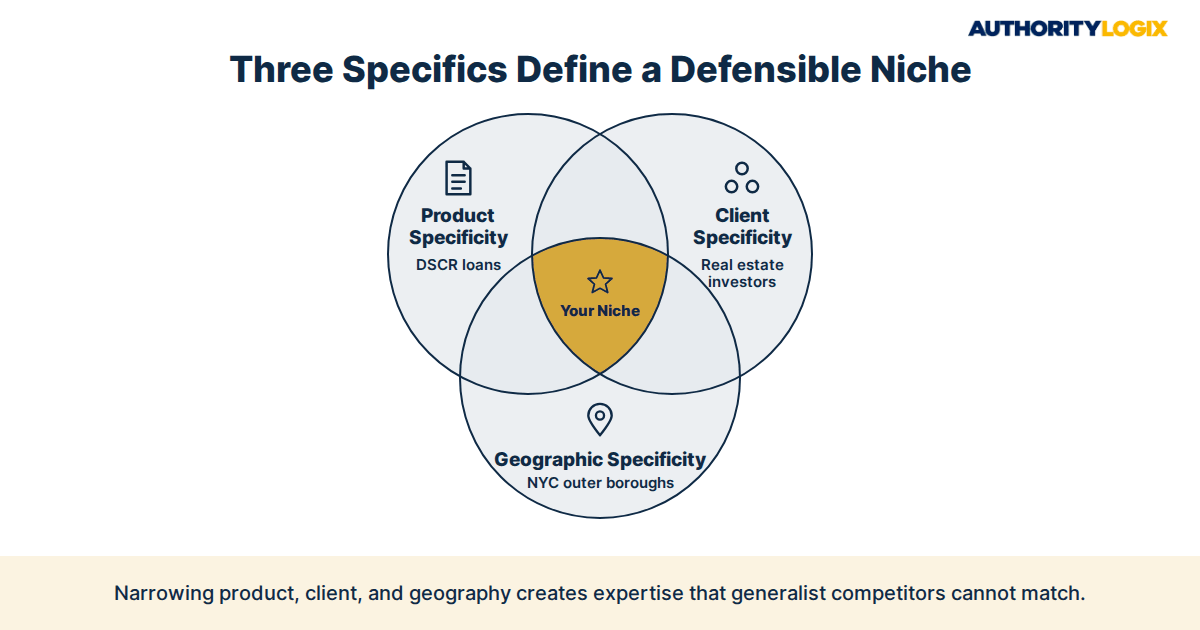
The niche positioning formula has three variables: product specificity — the specific loan type or advisory service the firm does best; client specificity. The specific type of borrower, investor, or client the firm is built to serve; and geographic specificity. The specific market where the firm’s network, licenses, and market knowledge give it a structural advantage. In 2026, niche positioning has become a core growth engine rather than a marketing preference. Every search engine and AI-driven platform rewards clarity of expertise as a ranking signal, a trust signal, and a conversion signal simultaneously. The
lead generation system is built on top of this positioning foundation — capturing the specific borrowers and investors the firm is positioned to serve.
Component 2 — Authority Infrastructure: Making the Position Visible
The financial services growth playbook defines authority infrastructure as the collection of verifiable signals that make a financial firm’s niche position visible to search engines, AI systems, prospects, and referral partners simultaneously. A financial firm with a well-defined niche but no authority infrastructure has a position that exists internally — in the firm’s own understanding of what it does — but not externally, where prospects and referral partners are looking. Authority infrastructure is the bridge between internal positioning and external recognition.
The authority infrastructure has five layers: credentialed content authorship, schema markup, review infrastructure, external validation, and a fully optimized Google Business Profile. The
content system documents how credentialed authorship and schema markup are built into the content production workflow from the brief stage — before any content is written, before any technical optimization is applied, and before any distribution channel is engaged.
The Niche Depth Advantage
Authority infrastructure compounds faster in a defined niche than in a generalist market because topical authority is additive: each new piece of niche-specific content strengthens the authority of every previous piece on the same topic cluster. BKDSCR.com demonstrates this model in a live market — built from zero to a recognized DSCR educational resource for NYC outer-borough investors in under 18 months, without paid advertising, by executing niche authority infrastructure systematically. The resource library documents the full architecture that BKDSCR.com’s model informed.
Component 3 — Content Compounding: The Engine of Sustained Visibility
The financial services growth playbook treats content not as a marketing tactic but as the primary engine of sustained market visibility. Sustainable advisor growth in 2026 requires intentional marketing, a strong and educational online presence, authentic personal branding, and strategic PR exposure — content is the mechanism that produces all four outputs from a single production workflow.
The content compounding model operates on two timelines simultaneously. The short-term timeline covers content that serves immediate intent: FAQ content, local service area pages, and lead magnet content that converts research-stage visitors into email subscribers. The long-term timeline covers content that builds topical authority: cornerstone guides, case study content, and market report content that establishes the firm as the source of niche-specific market intelligence. The
industry hub covers how the content compounding model is calibrated to a specific financial services niche and market.
Content as Capital: The Compounding Asset Model
A compliance-reviewed, search-optimized, niche-specific resource article published today generates organic search traffic in month one, earns E-E-A-T authority signals in month three, gets cited by AI systems in month six, and earns referral traffic in month twelve — without additional spend. The
content systems service is the production infrastructure that executes this model — brief through compliance review through publication through distribution — for financial firms that cannot dedicate internal bandwidth to the full workflow.
The
finance content service provides the compliance-reviewed, credentialed-author content production that feeds the compounding asset model. Together, the two services cover both the volume and the credibility side of the same compounding asset.
Component 4 — Lead Generation Architecture: Converting Authority Into Pipeline
The financial services growth playbook connects authority infrastructure to business results through a lead generation architecture that converts the organic search traffic and external authority signals built in components one through three into identified prospects, qualified appointments, and funded accounts. Authority without lead generation is brand awareness. Authority with lead generation is pipeline.
The Four Lead Generation Mechanisms in the Financial Services Growth Playbook
The lead generation architecture has four mechanisms: organic search capture through high-value lead magnets, email nurture across the long financial services decision cycle, referral reinforcement through digital authority that converts referred prospects at the rate they deserve, and retargeting for prospects who have visited the site without converting. The
pipeline infrastructure covers how all four mechanisms are structured, sequenced, and measured as a unified lead generation architecture.

Component 5 — Distribution Reach: Making Authority Multi-Channel
The financial services growth playbook treats distribution not as an optional amplification step but as a required component of the authority-building infrastructure. Content published only on the firm’s own website builds internal authority. The external validation signals that differentiate a genuinely authoritative firm — external citations, backlinks, press mentions, directory listings — do not accumulate without active distribution to external channels.
The distribution architecture operates across four channels: press syndication through AmpiFire or equivalent services, LinkedIn publishing for professional network authority, email distribution to an owned subscriber list, and organic search distribution through E-E-A-T and AI citation-eligible content. The authority
distribution system manages all four channels — ensuring that every piece of content earns external validation from the channels that produce E-E-A-T authority signals, not just internal page views.
What Most Financial Firms Get Wrong About the Financial Services Growth Playbook
Confusing activity with architecture
The most common financial services growth mistake is treating individual tactics — a new ad campaign, a social media push, a referral partner lunch, a new website — as growth strategies rather than as components that only compound when connected into a system. A new website without content architecture is a brochure. A referral partner lunch without a digital presence that reinforces the referral is a one-time conversion that may or may not close. The financial services growth playbook connects all five components into an architecture where each one reinforces the others. The
what we do page covers how AuthorityLogix builds the architecture, not just the individual components.
Generalizing when they should be specializing
Specialists tend to close engagements through faster sales cycles than generalists — because a prospect specifically looking for a DSCR lender serving NYC outer-borough investors does not need to be convinced a generalist mortgage broker is a fit. The fit is self-evident from the positioning. Every search engine, every AI platform, and every referral partner evaluates specificity as a quality signal. The financial services growth playbook is built around a specific niche, not a broad market.
Measuring growth by volume instead of by compounding velocity
A firm that closed 200 loans last year by increasing aggregator spend 40% is not compounding — it is buying growth that will require the same or greater spend next year. A firm that closed 180 loans last year and saw its cost per funded loan decline 30% as organic search matured is compounding. The financial services growth playbook measures compounding velocity: is each new content piece ranking faster, is cost per organic lead declining, is referral conversion rate rising, is the ratio of built-to-bought pipeline improving? The
why us page covers how AuthorityLogix tracks compounding velocity through the infrastructure build timeline.
Starting too late and stopping too early
The two most common timing mistakes are starting the infrastructure build too late — waiting until a rate environment or aggregator pricing change forces the issue — and stopping too early, when the lack of visible traction in months two through six creates pressure to redirect budget to faster-producing paid channels. Both mistakes produce the same outcome: the firm stays on the rented pipeline model indefinitely, watching the compounding advantage accumulate for the firms that started earlier and stayed committed longer. The financial services growth playbook is a 24-month commitment. The firms that understand this going in are the ones that reach the compounding phase.
Frequently Asked Questions: Financial Services Growth Strategy
How long does it take for the growth playbook to produce measurable results?
The financial services growth playbook produces results in three phases on a 24-month timeline. The infrastructure phase — months one through six — establishes positioning clarity, builds the authority infrastructure, launches the content system, and deploys the lead capture architecture. The traction phase — months seven through twelve — produces the first measurable market signals: organic rankings, lead magnet subscribers, referral conversion rate improvement. The compounding phase — months thirteen through twenty-four — produces the business results: cost per funded account declining, organic pipeline share increasing, referral network generating consistent volume. The
process page documents the checkpoint framework AuthorityLogix uses to track progress through each phase.
Does the growth playbook work for small independent firms without large marketing budgets?
The financial services growth playbook is specifically calibrated for independent mortgage companies, solo advisors, and small practices that cannot compete on institutional marketing spend. The compounding advantage of the playbook is structural, not financial: niche specificity produces rankings that a national aggregator cannot replicate without building niche-specific content, which requires time that money cannot compress. A solo DSCR lender who has published 24 niche-specific, compliant, credentialed content pieces in a specific geographic market over 18 months has a topical authority position that a national competitor with a $500,000 marketing budget cannot buy faster than the time it takes to build it.
How does the financial services growth playbook connect to the other four cornerstone guides?
The five FS Cornerstone Featured Assets form a connected growth system. The FS SEO Playbook builds the search visibility foundation. The FS Authority Guide builds the E-E-A-T credibility infrastructure that search visibility requires to convert. The FS Lead Generation System converts traffic and authority into identified prospects and funded accounts. The FS Content System builds the compliance-aware publishing workflow that produces the content all three previous components require. The FS Growth Playbook — this guide — documents how all five components connect into a single compounding architecture and the sequencing and timeline that produces market authority rather than individual tactics.
What is the role of AI search in the financial services growth playbook?
AI search — ChatGPT, Perplexity, Gemini, Google AI Overviews — is now a parallel visibility channel that must be addressed explicitly in the financial services growth playbook. According to
AP-NORC polling, 60% of U.S. adults now use AI to search for information. A financial firm building for traditional search rankings but not for AI citation eligibility is ignoring a search channel that most U.S. adults now use. AI citation eligibility requires the same authority infrastructure that traditional search requires — with additional emphasis on FAQ schema, question-and-answer formatted content, and structured data tables that AI systems retrieve as citable content chunks. The growth playbook builds for both simultaneously from the same infrastructure foundation.
Ready to build the financial services growth infrastructure that compounds into a defensible market position?
Work With Us →
The Market Position That Cannot Be Bought: Why the Financial Services Growth Playbook Works
The financial services growth playbook closes with the distinction that drove every component documented in this guide: there is a market position available to every financial firm that cannot be purchased with ad spend, cannot be acquired through aggregator placements, and cannot be replicated by a competitor without years of consistent infrastructure execution. It is the position of the recognized niche authority — the firm that consistently appears when the right borrower or investor searches for what it offers, that earns referrals from professionals who send clients specifically because of its demonstrated expertise, and that converts at rates that generalists cannot approach because the prospect’s research confirms the firm’s authority before the first conversation.
Building that position requires all five components of the financial services growth playbook executed in sequence and maintained over the 18-to-36-month compounding timeline. Positioning clarity that makes every other component specific and defensible. Authority infrastructure that makes the positioning visible and verifiable to search engines, AI systems, and prospects simultaneously. A content system that produces compliant, credentialed, niche-specific content that compounds in search authority and AI citation eligibility over time. A lead generation architecture that converts the traffic and authority into owned pipeline that does not expire when the budget does.
And a distribution system that amplifies the authority to the external channels that produce the E-E-A-T signals Google and AI systems use to determine who gets cited and who gets skipped. You already have the expertise, the credentials, and the market knowledge. The financial services growth playbook builds the infrastructure that turns all of it into a market position the competition cannot buy its way around.