Key Takeaways
- The Homebuyers Privacy Protection Act took effect March 5, 2026, banning most uses of mortgage trigger leads and eliminating the cheapest segment of the purchased lead supply curve. Costs for internet leads on some platforms rose about 45% year over year, according to a Cotality estimate.
- The financial services lead generation system replaces rented pipeline — aggregator leads that stop the moment the check stops — with owned pipeline: organic search traffic, lead magnet subscribers, email nurture sequences, and referral networks that compound in value over time.
- SEO leads tend to convert from marketing qualified to sales qualified at higher rates than webinar or PPC leads. The channel that costs the least per lead also converts the best downstream.
- Interactive lead magnets — calculators, assessments, audit tools — tend to convert at much higher rates than static eBooks. For mortgage companies and financial advisors, a DSCR loan calculator or retirement gap assessment is the highest-ROI lead capture asset available.
- Financial services CPL averages $653 in 2026. Cost per lead is the wrong optimization target — cost per qualified appointment and cost per funded account are the metrics that separate profitable pipelines from expensive noise.
- Pipeline that is owned compounds. Pipeline that is rented expires. A financial firm that builds the lead generation infrastructure systematically produces a pipeline that improves in quality and decreases in cost every quarter it runs.
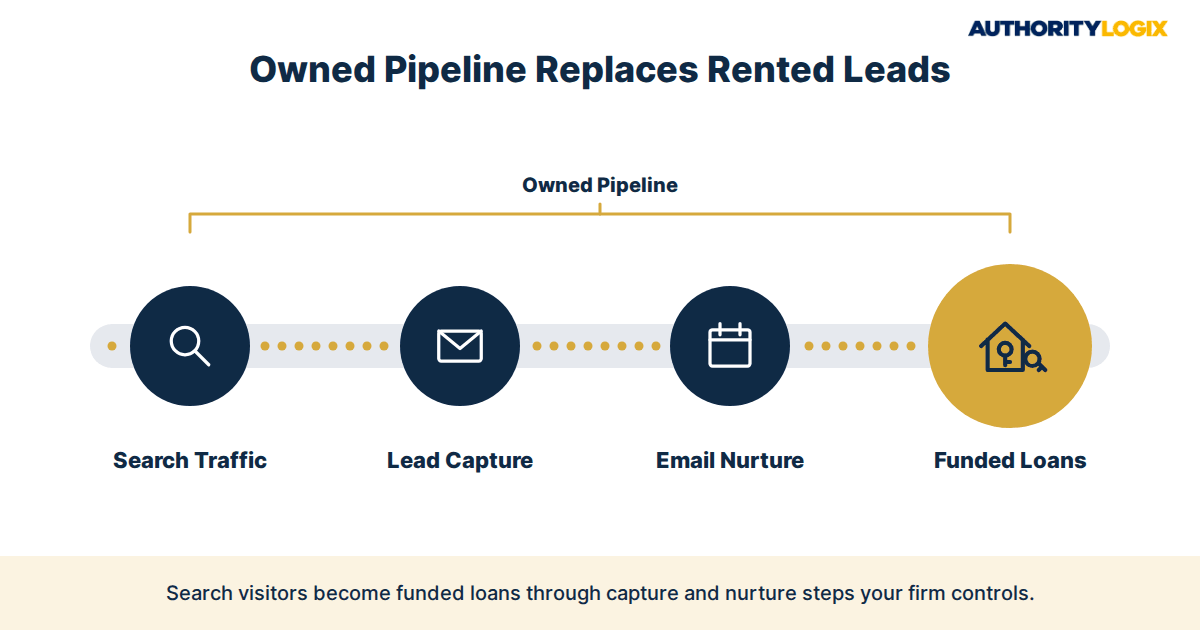
The financial services lead generation system addresses the question every lender and financial advisor eventually confronts. Where does the next client come from, and what does it cost to get them there? For most financial firms in 2026, the answer changed materially on March 5, when the Homebuyers Privacy Protection Act took effect and federally banned most uses of mortgage trigger leads. The law eliminated the cheapest segment of the purchased lead supply curve overnight.
Costs for internet leads on some platforms rose about 45% year over year, according to a Cotality estimate reported in
HousingWire’s February 2026 market analysis. The firms that had already been building first-party pipeline infrastructure absorbed the change without disruption. The firms that had not are now competing for fewer, more expensive rented leads in a market that is moving against them.
The financial services lead generation system documented in this guide is the infrastructure that replaces rented pipeline with owned pipeline. It is built on the same search visibility foundation covered in the
SEO playbook — organic traffic, Map Pack positioning, AI citation eligibility — combined with the lead capture, nurture, and conversion architecture that transforms search visitors into identified prospects, identified prospects into qualified appointments, and qualified appointments into funded loans and advisory relationships.
Every component has a specific function. The system compounds over time. Rented pipeline expires when the budget does. Owned pipeline compounds every quarter it runs. This guide documents five components of the financial services lead generation system: the traffic foundation, the lead capture architecture, the email nurture system, the referral reinforcement network, and the measurement framework that tracks pipeline quality instead of lead volume.
The Financial Services Authority Guide covers how lenders and advisors build the trust and credibility infrastructure that turns inbound pipeline into closed business.
Authority Guide →
Why Bought Leads Are a Ceiling, Not a Foundation
The financial services lead generation system begins with a structural analysis of purchased pipeline that most financial firms have never formally made: bought leads are a ceiling on growth, not a foundation for it. A mortgage company that generates 100% of its pipeline from aggregator platforms is renting its pipeline at market price. The moment it stops paying, the pipeline stops. The moment the aggregator raises prices, the firm’s cost structure rises with it. The moment a competitor outbids the firm on the platform, the lead goes somewhere else. None of these outcomes are within the firm’s control, because none of the infrastructure belongs to it.
Our
lead generation systems page documents how organic leads convert from search to funded loan at higher rates than aggregator leads. The conversion gap is structural: a borrower who found your firm through their own search has already pre-qualified themselves for your geography and product before they contact you. A platform lead was matched to your firm by an algorithm after submitting their information to a comparison site — and they were matched to three other lenders at the same moment. The difference in intent produces the difference in conversion rate. The financial services lead generation system is built to generate the higher-intent, higher-converting organic leads at a fraction of the aggregator’s cost per funded account.
The Cost Reality of Aggregator Dependence
Financial services CPL averages $653 in 2026, according to First Page Sage’s cost-per-lead benchmarks. For mortgage companies specifically, exclusive purchase leads from rate-table placements on the major aggregator platforms often cost hundreds of dollars per lead. And that is after the roughly 45% rise in internet lead costs reported ahead of the HPPA trigger lead ban. At a 2% conversion rate, a mortgage company paying $200 per aggregator lead is paying $10,000 per funded loan before accounting for time and overhead.
Or the competitive pressure created by other lenders who received the same lead. The financial services lead generation system targets a materially different cost structure. As organic pipeline matures, the marginal cost of each additional organic lead approaches zero, because the infrastructure that generates it was built once and compounds from there.
Component 1 — Traffic Foundation: Search-Driven Inbound
The financial services lead generation system is built on a traffic foundation, and that foundation is organic search. Paid traffic stops when the budget stops. Organic traffic compounds as domain authority, topical depth, and E-E-A-T signals accumulate. For a DSCR lender serving NYC outer-borough investors, the traffic foundation is built on keyword-mapped content addressing every informational, navigational, and transactional query in the DSCR investor journey — from “what is a DSCR loan” through “DSCR lender near me” to “apply for DSCR loan Queens.” For a financial advisory firm, the foundation is built on the same three intent layers mapped to retirement planning, income strategy, and fiduciary advisor queries in their geographic market.
The Three Traffic Layers of the Financial Services Lead Generation System
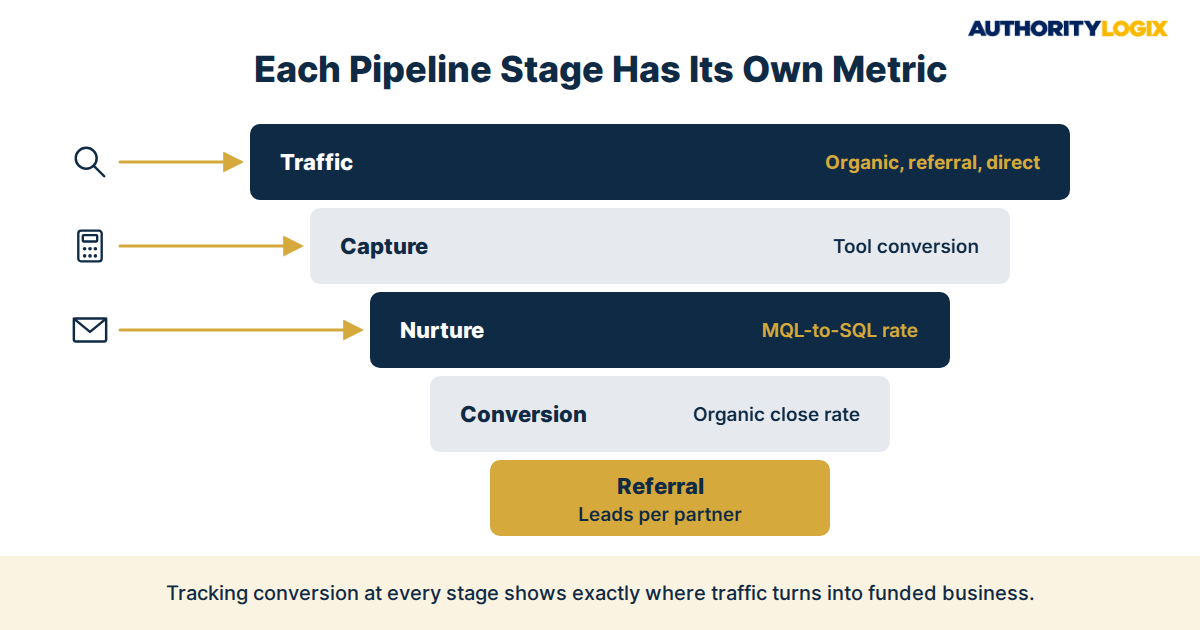
The traffic foundation has three layers. The organic search layer — SEO-optimized resource content, local search Map Pack positioning, and AI citation eligibility — generates high-intent traffic without marginal cost per visitor once the infrastructure is established. The referral traffic layer — professional network links, industry directory listings, press syndication — generates credibility-validated traffic from audiences predisposed to trust the firm. The direct traffic layer — email list subscribers returning to new content, repeat visitors moving through the decision process — represents the most advanced segment of the pipeline with the highest conversion rate. The
content system documents how content architecture is built to generate all three traffic layers simultaneously.
Component 2 — Lead Capture: Converting Visitors to Identified Prospects
Traffic without capture is audience, not pipeline. The financial services lead generation system converts anonymous search visitors into identified prospects through lead capture infrastructure — primarily lead magnets and structured conversion points that exchange a specific, high-value resource for a name and email address. This exchange is the moment a visitor moves from prospect to contact, and from a traffic statistic to a pipeline asset the firm can actively nurture.
The lead magnet format determines the conversion rate more than the topic. Conversion rates for gated eBooks have declined as buyers grow wary of static downloads. Interactive tools, calculators, and assessments now tend to convert at higher rates than static PDF guides. For a DSCR lender, a DSCR loan eligibility calculator or deal analyzer is a categorically more effective lead capture asset than a “Guide to DSCR Lending” PDF.
For a financial advisory firm, a retirement income gap assessment or Social Security optimization calculator converts at a rate that generic educational PDFs cannot approach. The tool does the pre-qualification work the firm would otherwise do in the first discovery call — at scale, 24 hours a day, before any human time is spent. The
growth playbook covers how lead capture tools connect to the long-term compounding pipeline strategy.
Compliance-First Lead Capture for Financial Firms
Lead capture for financial services firms requires explicit written consent documentation that most other industries do not need. TCPA requirements govern text and phone follow-up. CAN-SPAM requirements govern email. CFPB UDAAP standards prohibit deceptive opt-in language. A lead capture form that does not include the required consent disclosures — and that does not document those disclosures in the firm’s CRM — is not just a marketing gap. It is a compliance exposure. The financial services lead generation system treats consent infrastructure as the first technical requirement of lead capture, not an afterthought.
The financial services lead generation system converts identified prospects into qualified appointments through email nurture sequences. The decision cycle for mortgage and financial advisory relationships is long — weeks to months for most borrowers and investors, sometimes years for high-net-worth advisory relationships. Email nurture is the infrastructure that maintains the relationship across that cycle without requiring the advisor’s or loan officer’s time for each individual touch. Email-captured leads from lead magnets tend to convert from marketing qualified to sales qualified lead at strong rates — among the highest MQL-to-SQL rates of any acquisition channel, and above the rate of PPC leads.
The email nurture sequence has three phases. The onboarding phase — the first 7 to 14 days after opt-in — delivers the promised lead magnet and establishes the relationship with educational emails that reinforce the firm’s specific expertise. The consideration phase — days 15 through 60 — addresses the objections and questions that typically delay a financial services decision. The conversion phase — triggered by behavioral signals like repeated content consumption or tool usage — moves the prospect toward a specific action: scheduling a discovery call, requesting a pre-approval, or booking an introductory advisory meeting. The resource library documents the content types and sequences that perform at each phase of the financial services nurture cycle.
Segmentation for Mortgage and Advisory Pipelines
Email nurture for financial services firms must be segmented by product type, intent stage, and geographic market to maintain compliance and relevance. A DSCR investor lead captured from a rental property calculator should not receive the same nurture sequence as a first-time homebuyer lead captured from an FHA loan guide — not just because the messaging would be irrelevant, but because in some states, sending certain loan product communications to unqualified recipients triggers licensing and disclosure requirements. Segmentation is simultaneously a marketing efficiency requirement and a compliance requirement. The
industry hub covers the segmentation architecture that the financial services lead generation system uses to maintain compliance across multi-product pipelines.
Not sure whether your current pipeline infrastructure is capturing and converting the traffic your firm is generating?
FS Authority Gap Assessment →
Component 4 — Referral Reinforcement: The Highest-Converting Pipeline Source
The financial services lead generation system treats referrals not as a passive outcome of good service but as an active infrastructure component — one that can be systematized, reinforced, and scaled without violating the compliance requirements that govern most other outbound financial services communications. Referrals remain one of the highest-converting lead sources in financial services, and a firm with a broad network of active referral partners can generate a steady flow of qualified leads from that network alone.
The referral reinforcement infrastructure has three components. The content visibility component ensures that referral partners who search for the firm — which 96% of prospects do even after receiving a referral — find a credible, comprehensive digital presence that confirms the referral rather than creating doubt. The systematic follow-up component provides a structured, compliant process for asking satisfied clients and professional partners for referrals. The reciprocal value component builds the professional relationships that produce consistent referral volume: real estate attorneys, CPAs, estate planners, and property managers who encounter the firm’s specific type of client regularly. The
content systems service documents how content visibility and referral infrastructure are built to reinforce each other.
Component 5 — Measurement: Tracking Pipeline Quality, Not Lead Volume
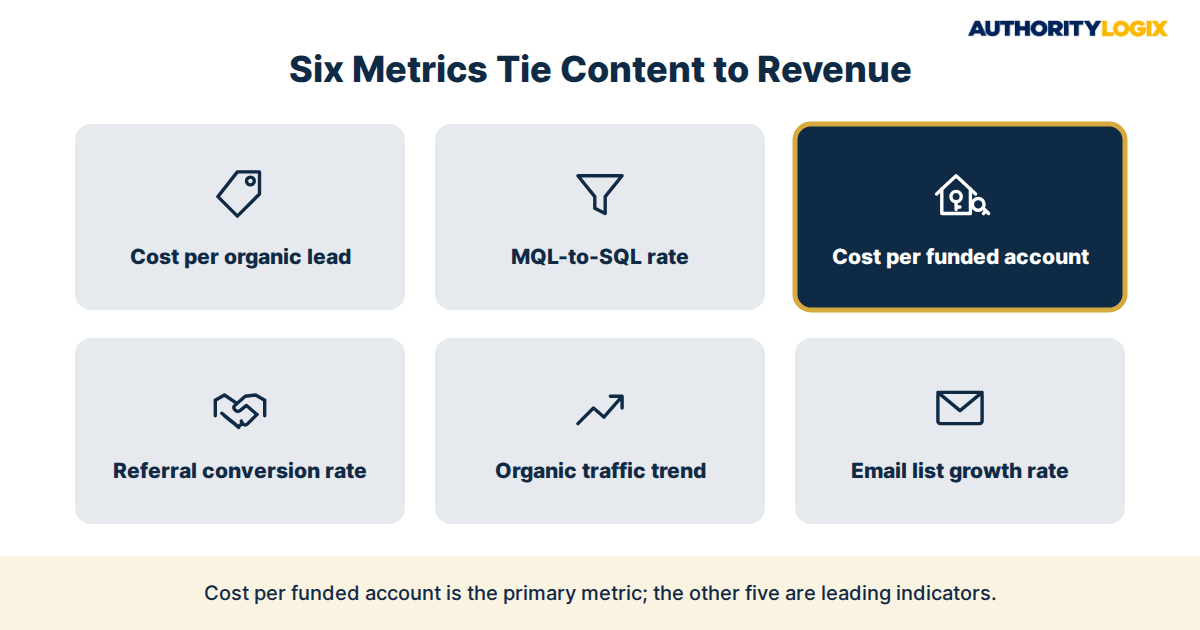
The financial services lead generation system measures the wrong metric at most financial firms: lead volume. The number of leads a firm generates tells almost nothing useful about whether the lead generation system is performing — because lead quality, lead source, and conversion rate determine revenue, and lead count determines none of them. Financial services CPL averages $653 in 2026.
A firm generating 100 leads per month at $653 per lead and converting 2% to funded accounts is producing 2 funded accounts at a total lead cost of $65,300. A firm generating 40 leads per month at $200 per organic lead and converting 6% to funded accounts is producing 2.4 funded accounts at a total lead cost of $8,000. The second firm has fewer leads and better results.
| Metric |
What It Measures |
Why It Matters |
| Cost per organic lead |
Marginal cost of each inbound lead from owned channels |
Tracks whether organic infrastructure is reducing dependence on paid pipeline |
| MQL-to-SQL rate |
Percentage of email subscribers who become qualified appointments |
Identifies nurture sequence effectiveness and lead quality by source |
| Cost per funded account |
Total lead cost divided by funded loans or advisory relationships |
The ROI metric that connects marketing investment to business results |
| Referral conversion rate |
Percentage of referrals that convert to funded accounts |
Tracks whether digital presence is reinforcing referral conversion |
| Organic traffic trend |
Month-over-month change in search-driven visitors |
Leading indicator of compounding infrastructure value |
| Email list growth rate |
Net new subscribers per month |
Tracks whether lead capture infrastructure is accumulating pipeline assets |
The
finance content service includes the measurement dashboard that financial firms use to track these six metrics monthly. It connects every content investment to pipeline output and every pipeline output to funded account revenue.
What Most Financial Firms Get Wrong About the Financial Services Lead Generation System
Optimizing cost per lead instead of cost per funded account
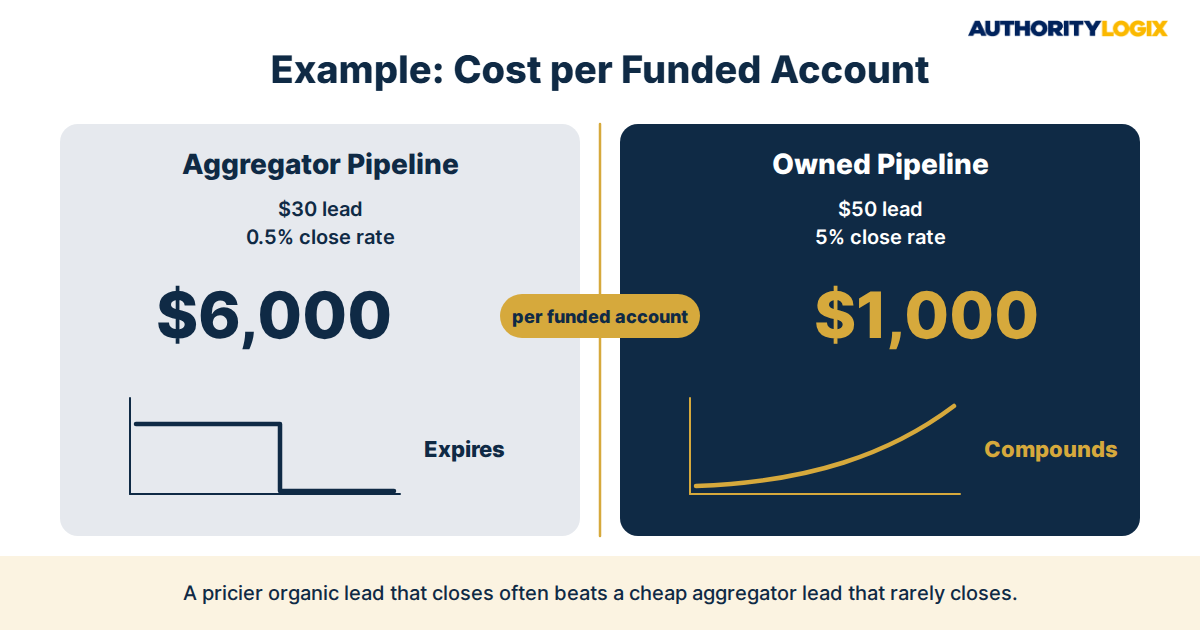
A $30 aggregator lead that closes at 0.5% costs $6,000 per funded account. A $50 organic lead that closes at 5% costs $1,000 per funded account. The firm optimizing for the lower CPL is paying six times more per result while believing it is being efficient. The financial services lead generation system measures cost per funded account as the primary efficiency metric — not cost per lead, not cost per click, not cost per appointment. Every other metric is a leading indicator of this one. The
educational hub produces the content that generates the organic leads that cost $1,000 per funded account rather than $6,000.
Building single-source pipeline dependence
A financial firm that generates pipeline from a single source has a business that is one relationship or one policy change away from a pipeline crisis. The HPPA trigger lead ban demonstrated this in real time: direct-to-consumer lenders and call-center operations that had built 10 to 30% of their pipeline on trigger leads saw that source eliminated overnight. The financial services lead generation system is built across multiple owned channels so that no single source carries more than 40% of pipeline. Diversification is not just a growth strategy — it is a resilience strategy. The authority
distribution system ensures that organic authority compounds across all channels simultaneously.
Treating lead magnets as one-time assets instead of infrastructure
A DSCR loan calculator built once and maintained consistently generates leads for years. A PDF guide published once and never updated generates leads for months before it becomes stale enough to suppress organic rankings and reduce conversion rates. The financial services lead generation system treats lead capture assets as infrastructure — built to the highest quality standard initially, then maintained on a regular update cycle that keeps the content current with regulatory changes, market conditions, and competitive positioning.
Neglecting the nurture phase
Most financial firms capture leads and then contact them when they remember to — which is not a system, it is a habit. The financial services lead generation system replaces sporadic follow-up with a structured, automated nurture sequence that maintains the relationship across the long financial services decision cycle without requiring the advisor’s or loan officer’s time for each touch. The gap between a lead captured and an appointment booked is where most financial firms lose pipeline that their lead generation effort already earned. The
what we do page covers how AuthorityLogix builds and maintains the nurture infrastructure that closes that gap.
Frequently Asked Questions: Financial Services Lead Generation
How long does it take to build a first-party lead generation pipeline?
The financial services lead generation system produces initial results in three phases. The infrastructure phase — months one through three — establishes the technical foundation: lead capture assets built, email sequences loaded, CRM configured, consent infrastructure documented. The traction phase — months four through nine — produces measurable pipeline: organic leads arriving, email list growing, referral network activated. The compounding phase — months ten through twenty-four — produces the pipeline quality improvements and cost reductions that justify the infrastructure investment. The
why us page covers how AuthorityLogix measures each phase and the checkpoints that indicate the system is compounding correctly.
Is a first-party lead generation system compliant for mortgage companies?
Yes — the financial services lead generation system is specifically designed around the compliance requirements that govern mortgage marketing. Content marketing, organic search, and email nurture are all explicitly permitted channels under CFPB, NMLS, TCPA, and CAN-SPAM frameworks, provided that opt-in consent is properly documented, email content meets CAN-SPAM requirements, and marketing copy does not contain guaranteed rate claims or other UDAAP violations. The HPPA trigger lead ban was specifically about the purchase and use of data from credit bureau trigger feeds without an existing relationship — not about inbound organic lead generation.
What type of lead magnet works best for DSCR lenders?
For DSCR lenders specifically, interactive tools outperform static content by a wide margin — consistent with HubSpot’s 2026 finding that interactive formats convert at nearly six times the rate of eBooks. A DSCR deal analyzer that lets an investor input a property address, purchase price, expected rent, and loan amount — and then outputs a DSCR ratio, estimated cash flow, and loan eligibility indication — pre-qualifies the lead while delivering genuine value. BKDSCR.com demonstrates this model: 7 interactive investor tools including a DSCR Calculator, Stress Test, Cash Flow Analyzer, and Deal Filter, all built to capture investor contact information through a high-value exchange that the investor initiates because the tool solves their immediate problem.
How does the referral network integrate with the digital pipeline?
Referral and digital pipeline reinforce each other rather than competing. A referral partner who sends a borrower to a DSCR lender is implicitly trusting that the lender’s online presence will confirm, not undermine, the referral. The digital pipeline — search-ranked content, credentialed author attribution, consistent review velocity — provides the due-diligence infrastructure that converts referrals at the rate they deserve. Simultaneously, the referral network produces the highest-converting leads in the pipeline, which feed positive reviews, case study content, and social proof that strengthens the digital pipeline. The
process page documents the integration architecture AuthorityLogix uses to connect referral network development with digital pipeline infrastructure.
Ready to replace aggregator dependence with first-party pipeline infrastructure that compounds?
Work With Us →
Pipeline That Is Owned Compounds: Why This Financial Services Lead Generation System Works
The financial services lead generation system closes with the distinction that the Homebuyers Privacy Protection Act made impossible to ignore in 2026: there are two types of pipeline in financial services, and they produce fundamentally different business outcomes. Rented pipeline — aggregator leads, purchased lists, trigger lead data — produces immediate lead volume at market price and stops the moment you stop paying. Owned pipeline — search-driven traffic, lead magnet subscribers, email nurture contacts, referral network relationships — compounds in value every month the infrastructure runs and costs nothing in marginal terms after the initial build.
The five components of the financial services lead generation system documented in this guide. Traffic foundation, lead capture architecture, email nurture, referral reinforcement, and measurement framework — are each individually valuable and collectively compounding. A DSCR lender that has built a DSCR deal analyzer as a lead magnet, an email nurture sequence that addresses every objection a NYC outer-borough investor carries into the decision. And a referral network of property managers and real estate attorneys who send qualified investor leads consistently has a pipeline that improves in quality and decreases in cost every quarter it runs.
That is the infrastructure this guide builds. You already have the expertise. The financial services lead generation system builds the pipeline that puts that expertise in front of the right borrowers and investors at the right moment. Without paying for the introduction every single time.