Key Takeaways
- Financial services SEO operates under Google’s YMYL standard — meaning content from lenders, mortgage companies, and advisors is evaluated at a higher bar for expertise, authority, and trust than almost any other industry.
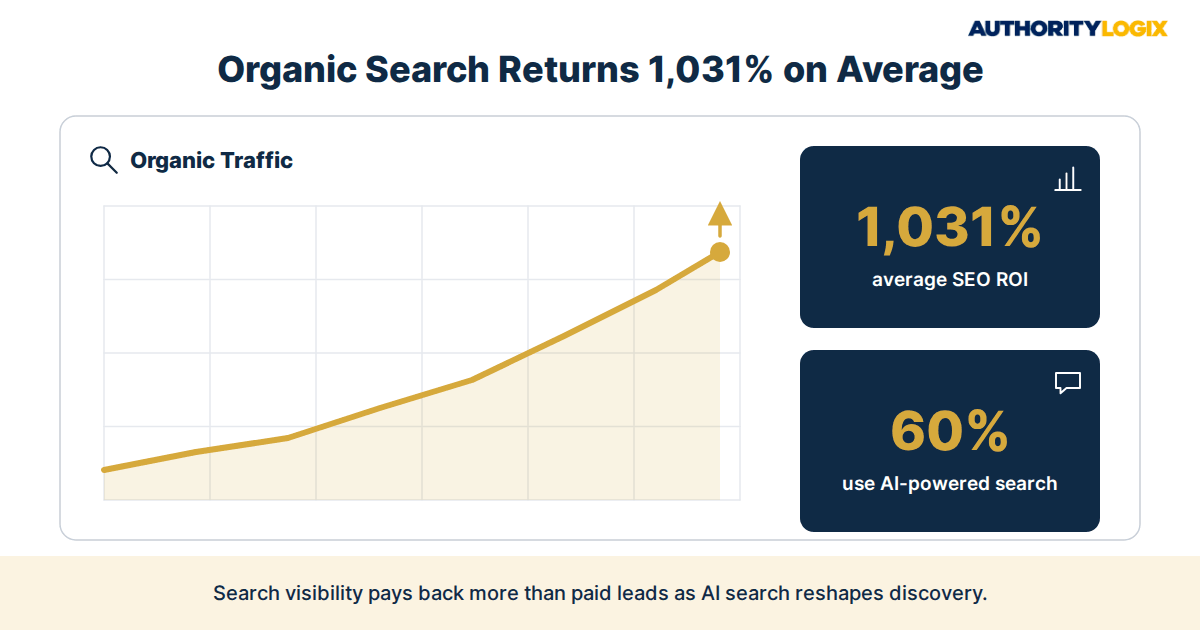
- The financial services sector produces a 1,031% average ROI from SEO investment — the fourth-highest of the 19 industries First Page Sage tracks — driven by the outsized gap between organic lead quality and paid lead cost.
- Organic mortgage leads convert to funded loans at higher rates than aggregator leads, because a borrower who found you through their own search has already pre-qualified for your geography and product.
- 60% of U.S. adults now use AI to search for information, and consumer lending brands that sustain managed SEO campaigns can build meaningful AI engine citations over time — making AI citation eligibility a mandatory component of any 2026 financial services SEO playbook.
- The March 2026 Google Core Update produced 79.5% movement in top-3 results, according to SE Ranking — far more volatile than the December 2025 update, and reshuffling results across many verticals including financial services.
- Authority compounds. A financial firm that builds the search infrastructure systematically — technical foundations, E-E-A-T signals, local optimization, content architecture, AI citation eligibility — produces a market position that competitors cannot buy their way into.
The financial services SEO playbook is the infrastructure document that most lenders and advisors have been looking for without knowing exactly what to call it. It is not a list of keyword tips or a guide to meta tags. It is a systematic framework for building the organic search presence that puts your firm in front of borrowers, investors, and clients at the precise moment they are searching for what you offer — before they find a competitor who built the infrastructure earlier.
In 2026, the financial services SEO landscape shifted on two axes at once. Google’s March 2026 Core Update — far more volatile than the December 2025 update, with 79.5% of top-3 URLs changing position according to SE Ranking data — reshuffled results across many verticals. Simultaneously, 60% of U.S. adults now use AI to search for information, according to
AP-NORC polling, creating a second visibility layer entirely separate from traditional blue-link rankings.
A financial firm not building for both is not building complete
content infrastructure — it is building for half the market. That half is where AI-powered search adoption is growing fastest, and it is not going away.
This playbook maps every component of the financial services SEO system: technical foundations, E-E-A-T compliance, local search, content architecture, keyword strategy, AI citation eligibility, and the measurement framework that tells you whether the infrastructure is compounding. Every component has a job. Every component feeds the next.
The Financial Services Authority Guide covers how lenders and advisors build the trust and credibility infrastructure that makes search visibility convert.
Authority Guide →
Why Financial Services SEO Operates by Different Rules
The financial services SEO playbook begins with a reality check that most generic marketing agencies skip: this industry plays by fundamentally different rules than retail, SaaS, or local services. Google classifies financial content — mortgage advice, investment guidance, loan comparisons, insurance explanations — as Your Money or Your Life (YMYL) content, meaning pages that can directly affect a person’s financial stability are evaluated at a materially higher standard for expertise, authoritativeness, and trustworthiness. A thin blog post that might rank for a recipe site will not rank for a mortgage company. The bar is higher. The signals required are more specific.
The YMYL classification has concrete consequences for the financial services SEO playbook. Author credentials must be verifiable — anonymous content carries ranking risk. NMLS IDs, CPA designations, CFP credentials, and SEC ADV filings are not just compliance requirements; they are ranking signals that Google’s quality raters evaluate. External citations from recognized financial sources — CFPB, MBA, FINRA, peer-reviewed research — strengthen E-E-A-T in ways that citations from general marketing blogs do not. And the March 2026 Core Update made these signals more decisive than ever, rewarding firms with genuine credential depth and penalizing sites with generic, uncredentialed content regardless of technical SEO performance.
The upside of this higher bar is significant. Financial services keywords carry some of the highest cost-per-click rates in Google Ads. A firm that earns organic rankings for those keywords is capturing traffic that would cost competitors tens of thousands of dollars per month in paid advertising. According to First Page Sage’s 2026 industry benchmark analysis, the financial services sector produces a 1,031% average ROI from SEO investment — the fourth-highest of the 19 industries it tracks. The difficulty of the game is precisely what makes winning it so valuable.
The E-E-A-T Framework Every Financial Services SEO Playbook Needs
Experience, Expertise, Authoritativeness, and Trustworthiness — Google’s E-E-A-T framework — translate into specific, concrete signals for financial services firms. Experience means demonstrating real transactional history: deal case studies, market reports with specific data, documented client outcomes framed as educational content. Expertise means credentialed authorship on every piece of content — loan officers writing about DSCR loans, CFPs writing about retirement strategy, CPAs writing about tax-aware investing. Authoritativeness means external validation — citations from MBA reports, links from recognized industry publications, media appearances, and consistently accurate regulatory information. Trustworthiness means technical integrity: HTTPS, accurate NAP data, NMLS compliance on every page, and review profiles with verified ratings across Google and industry-specific platforms.
The authority signals that rank the page are the same signals that convert the visitor into a qualified inquiry. That is a direct connection between search visibility and
lead generation that most financial firms have not yet built into a system.
The Technical Foundation: What Must Be Right Before Content Matters
The financial services SEO playbook builds the technical foundation before producing a single piece of content. Technical SEO failures — slow page speed, crawl errors, duplicate content, broken schema — suppress rankings regardless of content quality. For financial firms, the stakes of technical failures are amplified by the YMYL standard: a financial site with Core Web Vitals failures is not just underperforming; it is actively signaling poor quality to Google’s quality systems.
Core Web Vitals and Mobile-First Indexing
Google indexes and ranks the mobile version of every website first. For financial firms, this means the mobile experience is the ranking experience — not a secondary consideration. Mobile page speed, specifically Largest Contentful Paint under 2.5 seconds, is the technical threshold that separates competitive sites from penalized ones. Mobile search now accounts for a large majority of mortgage-related queries — meaning a lender whose site fails mobile performance standards is being ranked on the experience that serves most of its potential audience.
Beyond page speed: structured data implementation is the technical layer that connects E-E-A-T signals to machine-readable format. Financial firms should implement Organization schema with NMLS ID, Person schema with professional credentials on author pages, FAQPage schema on resource content, and LocalBusiness schema with accurate service area data. The
content system documents how schema implementation integrates with the content production workflow.
Site Architecture for Topical Authority
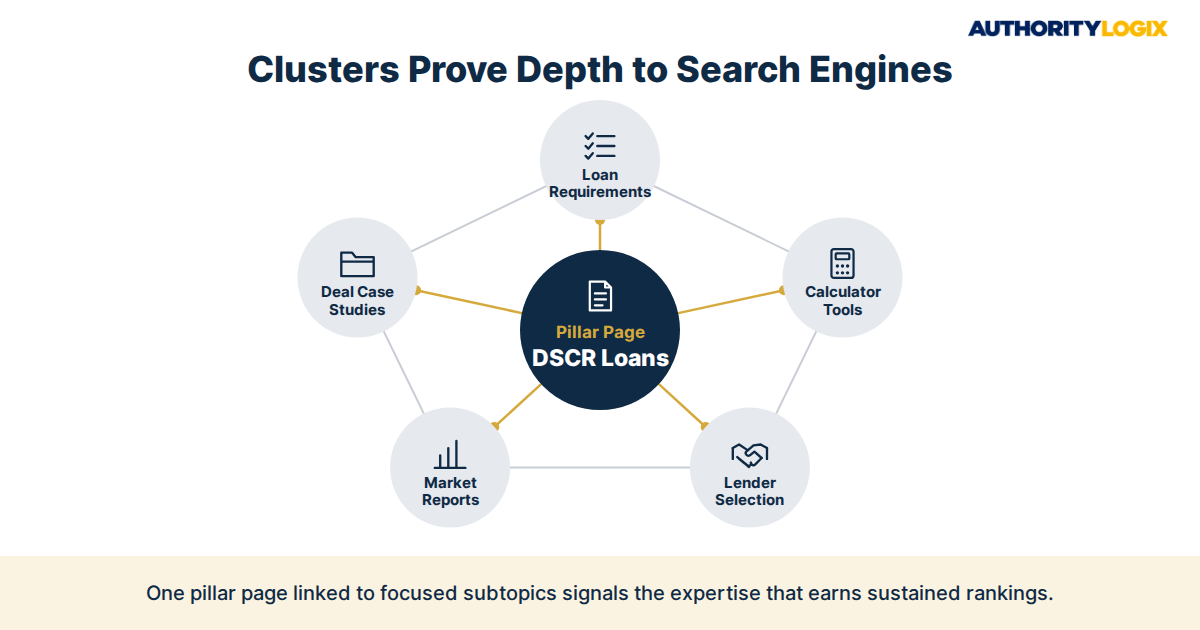
Topical authority — Google’s assessment of a site’s comprehensive expertise on a subject — is built through site architecture, not through individual pages. A mortgage company that has one page on DSCR loans and fifty pages on unrelated topics has not demonstrated topical authority in DSCR lending. A mortgage company that has built a structured cluster of content covering DSCR loan requirements, DSCR calculator tools, DSCR lender selection criteria, DSCR market reports, and DSCR deal case studies has demonstrated the content depth that search engines reward with sustained rankings.
Keyword Strategy: How Financial Firms Map Search Intent
The financial services SEO playbook treats keyword strategy as an intent mapping exercise, not a volume ranking exercise. A mortgage company that optimizes exclusively for high-volume head terms — “mortgage rates,” “home loans,” “DSCR loans” — is competing against national aggregators and major banks with institutional domain authority. The same mortgage company that maps its keyword strategy to the specific intent of its target borrower — “DSCR loan requirements for mixed-use property,” “FHA loan Brooklyn first-time buyer,” “non-QM lender NYC investor” — is competing in a segment where its genuine market expertise gives it a structural content advantage.
Long-tail keywords drive more qualified traffic than head terms like “mortgage rates,” with significantly lower competition. The qualified nature of the traffic is the key metric: a borrower who searched “DSCR loan requirements for three-family Brooklyn” and found your site has pre-qualified themselves for your product, your geography, and your level of market knowledge before they ever contact your firm.
Mapping Borrower Search Journey Stages
The keyword map for a financial services SEO playbook covers three intent stages. Informational queries — “what is a DSCR loan,” “how does an FHA loan work,” “what credit score do I need for a mortgage” — capture borrowers at the research stage. These are the highest-volume, lowest-competition keyword opportunities, and they are where most financial firms have the deepest content gap. Navigational queries capture borrowers with geographic intent who are close to a decision. Transactional queries capture borrowers at purchase intent. A complete financial services SEO playbook addresses all three.
The
educational hub system is specifically designed to build the informational content depth that captures the research-stage borrower. From there, it nurtures that borrower through the buyer journey until they are ready for navigational and transactional intent.
Local Search: The Highest-Intent Channel for Independent Lenders
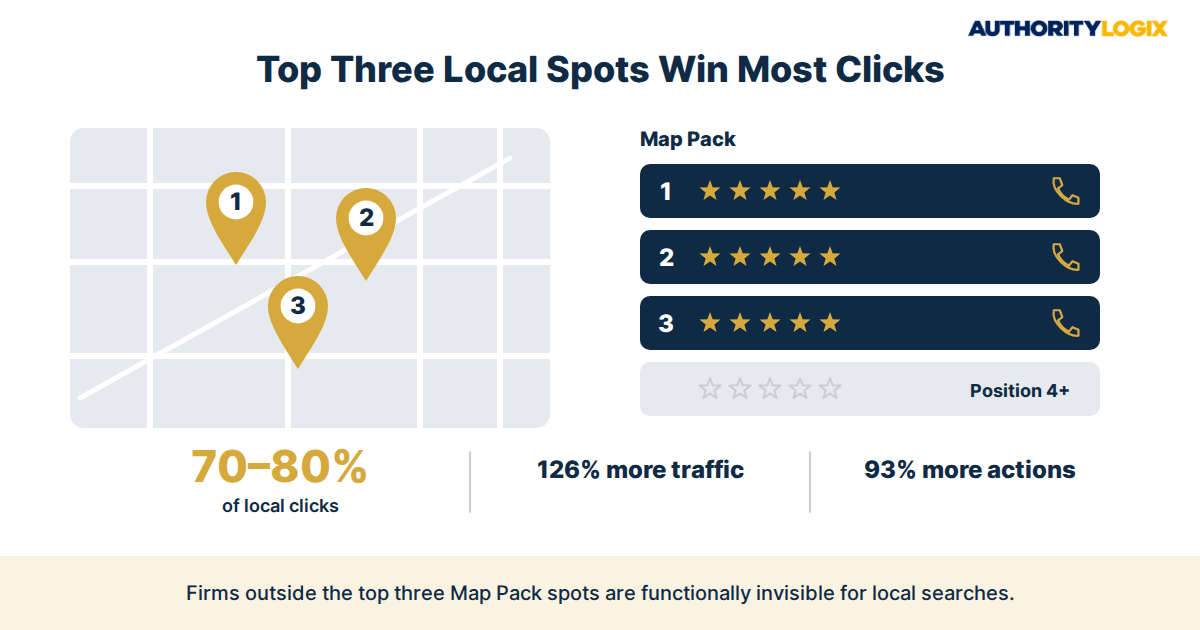
For independent mortgage companies, DSCR lenders, and financial advisory firms serving a specific geographic market, local search is the most direct line from search investment to funded loans. When a borrower searches “mortgage broker near me” or “DSCR lender Queens,” the Google Map Pack captures the large majority of clicks. Firms in the top three Map Pack positions receive 126% more traffic and 93% more actions — calls, clicks, direction requests — than firms ranked below position three. The Map Pack is a binary competitive landscape: either you are in the three-result block, or you are functionally invisible for local-intent queries.
Local SEO for financial firms requires three components working together. The Google Business Profile — with accurate primary category selection, complete service area configuration, NMLS ID in the description, and a review velocity strategy — is the foundation. NAP consistency across every directory including NMLS Consumer Access and FINRA BrokerCheck is the compliance layer that most lenders neglect. Location-specific content captures the long-tail local queries that the Map Pack does not serve. The
pipeline infrastructure covers how local search traffic is captured and converted into funded loans once a borrower makes contact.
AI Citation Eligibility: The New Layer of Financial Services Visibility
The financial services SEO playbook in 2026 requires a component that did not exist two years ago: AI citation eligibility. Consumer lending brands that sustain a managed SEO campaign over many months can build a meaningful volume of citations across multiple AI engines. That citation count is now a competitive metric in the same way page-one organic rankings were a decade ago — and the firms building for AI citation eligibility now are accumulating a visibility advantage over competitors who have not yet recognized this as a distinct infrastructure requirement.
AI citation optimization — or AEO (Answer Engine Optimization) — operates on different mechanics than traditional SEO. ChatGPT, Perplexity, Gemini, and Google AI Overviews do not browse websites the way Google’s crawler does. They retrieve content from indexed sources, evaluate those chunks for trust and relevance, and synthesize responses that cite the sources used. The financial firms that get cited are the ones whose content was structured to be retrievable, clearly attributed, and factually verifiable by AI systems. The requirements are specific: FAQ schema on resource pages, clear data tables with cited sources, question-and-answer formatted content, accurate entity data that AI systems can verify against external databases, and structured NAP data that matches regulatory filings.
The authority
distribution system covers how content is structured and syndicated for AI citation eligibility. That includes the schema requirements and channel strategy that make financial services content machine-readable across all major AI platforms.
Content Architecture: The Publishing Infrastructure That Compounds
The financial services SEO playbook treats content as capital investment — not as an operational expense. A well-structured resource article published today generates organic search traffic in month one, earns E-E-A-T signals in month three, gets cited by AI systems in month six, and earns referral traffic from professionals who found it in month twelve. Its returns do not expire when the publishing budget is cut. Volume without infrastructure is just noise — a sequence of posts that each expire individually without accumulating into a durable authority position.
The content architecture for a financial services SEO playbook is built in three layers. Cornerstone assets anchor the architecture and establish topical authority at the category level. Supporting resources build the topical cluster depth that strengthens the cornerstone’s authority. Distribution content drives traffic to the architecture and generates the behavioral signals that reinforce rankings. Every piece has a job. The
growth playbook covers how this content infrastructure connects to the broader business growth and compounding authority strategy.
Compliance-Aware Publishing for Financial Firms
The financial services content system requires a compliance layer that most marketing agencies have not built. CFPB UDAAP standards prohibit deceptive or misleading marketing claims. FINRA Rule 2210 governs communications for registered broker-dealers. NMLS licensing requirements apply to certain mortgage content. A content workflow that does not route drafts through compliance review before publication is not a content infrastructure — it is a liability. The
finance content service is designed around exactly this compliance-aware production workflow, with documented review steps built into the brief-to-publish sequence.
Measurement: What a Compounding Financial Services SEO Playbook Tracks
Most financial firms measure SEO incorrectly — tracking individual keyword rankings or monthly traffic instead of infrastructure compounding metrics. At month two, the correct measurement is infrastructure completeness. At month eight, it is traction indicators. At month eighteen, it is compounding velocity: is each new piece of content ranking faster than the previous, is cost per lead declining, is the referral network reinforcing organic traffic? The resource library documents the full measurement framework for each component of the financial services SEO system.
| Measurement Phase |
Timeline |
Key Metrics |
| Foundation |
Months 1–3 |
Technical audit complete, schema deployed, GBP optimized, content brief pipeline full |
| Traction |
Months 4–8 |
First topical rankings appearing, GBP leads increasing, email list growing |
| Compounding |
Months 9–18 |
Cost per lead declining, content velocity accelerating, AI citations appearing |
| Authority |
Month 18+ |
Category reference status, referral network routing leads, organic outperforming paid |
What Most Financial Firms Get Wrong About the Financial Services SEO Playbook
Building for quick wins instead of infrastructure
The most common financial services SEO mistake is optimizing for this month’s rankings instead of next year’s authority position. A financial firm that publishes ten generic blog posts, sees no ranking movement in 90 days, and concludes that SEO doesn’t work has measured a tactic instead of an infrastructure. The compounding returns of a well-built financial services SEO playbook appear on a 12–24 month timeline — which means the decision to start is the most consequential variable. Firms that started in 2023 are compounding in 2026. Firms that wait until 2027 will be compounding in 2029, watching the 2023 starters collect the leads.
Ignoring the AI citation layer
Most financial firms are optimizing for traditional Google rankings while their competitors are building AI citation eligibility simultaneously. According to AP-NORC polling, 60% of U.S. adults now use AI to search for information. A financial advisory firm that appears in AI-generated answers to “which financial advisor should I use for retirement planning” has a visibility advantage not captured in traditional rank tracking. The firms building for this layer now are accumulating citations. The firms ignoring it are invisible in the channel that is growing fastest.
Delegating SEO to a generalist agency
YMYL content requirements, NMLS compliance obligations, E-E-A-T credential standards, and financial services keyword economics are not transferable from generalist agency experience. An agency that ranks restaurants and retail shops does not have the vertical knowledge to navigate financial services SEO without significant ramp time — and that ramp time is paid by the client in the form of ranking delays and compliance exposure. The
services hub documents the specific requirements that a financial services SEO engagement must address from day one.
Confusing presence with platform
A website, a LinkedIn profile, and a Google Business Profile listing constitute a presence. A topical authority content architecture, a structured E-E-A-T signal stack, a Google Business Profile with consistent review velocity, AI-citation-eligible resource content, and a local search footprint that covers every geographic market the firm serves constitutes a platform. Most financial firms have presence. The ones generating compounding organic leads have platform. The difference between the two is not budget — it is infrastructure. See
what we do for how AuthorityLogix builds the platform, not just the presence.

Frequently Asked Questions: Financial Services SEO
How long does financial services SEO take to produce results?
For most financial firms, meaningful organic visibility begins appearing between months four and eight of systematic infrastructure execution. Local search improvements — Map Pack positioning — typically arrive within 60 to 90 days of Google Business Profile optimization. National or multi-city organic rankings for competitive keywords require the full 9–12 month maturity timeline. A financial services SEO playbook is a 24-month commitment before the compounding returns outperform any single period’s investment cost.
What makes financial services SEO different from other industries?
Three things: the YMYL classification elevates content quality requirements, keyword cost economics make organic rankings exceptionally valuable, and the compliance layer makes content production more complex. The same tactics that rank a home services company — generic keyword-stuffed blog posts, thin service pages, auto-generated content — actively suppress rankings for financial firms because Google’s quality systems evaluate financial content at a higher bar.
Do financial firms need separate SEO strategies for AI and traditional search?
The foundations overlap significantly — structured data, authoritative citations, verified credentials, and well-organized content serve both traditional Google rankings and AI citation eligibility. The distinction is in the specific optimizations. A financial services SEO playbook addresses both simultaneously because they share the same infrastructure base. The
why us page covers how AuthorityLogix’s methodology addresses both tracks from day one.
How does a financial firm measure SEO ROI?
The correct ROI metric for financial services SEO is cost per funded loan from organic channels, benchmarked against the firm’s cost per funded loan from aggregator channels, paid search, and referrals. Organic search tends to generate a substantially lower cost per funded loan than paid aggregator channels once the SEO investment reaches maturity. The
process page documents the measurement framework AuthorityLogix uses to track this metric throughout the infrastructure build.
Ready to build the financial services search infrastructure your firm has earned the right to own?
Work With Us →
The Infrastructure That Makes the Market See What You’ve Built
The financial services SEO playbook is not a set of tactics. It is a systems build — a structured sequence of infrastructure components that each feed the next and compound over time into a market position that competitors cannot displace without years of catch-up work. Technical foundations that pass Google’s YMYL standards. E-E-A-T signals that verify the expertise the firm has spent years earning.
Local search infrastructure that puts the firm in front of borrowers at the precise moment of geographic intent. Content architecture that builds topical authority across every query type in the firm’s market. AI citation eligibility that extends visibility into the channels where financial consumers are now beginning their research. And a measurement framework that tracks compounding returns instead of individual campaign performance.
Most financial firms already have the credibility. The NMLS license, the years of deals closed, the client relationships, the market knowledge — the expertise is there. What most firms lack is the infrastructure that makes the market see it. You already earned the credibility. The financial services SEO playbook builds the infrastructure that makes the market see it.