


Key Takeaways
- Financial services citation building means publishing your firm’s name, address, and phone number identically on every directory, map platform, and data source.
- Whitespark’s 2026 Local Search Ranking Factors survey ranked a website NAP matching the Google Business Profile 15th of 187 local pack and Maps factors.
- BrightLocal found 77% of consumers had seen conflicting business details across directories, and 63% said incorrect details would stop them using a business.
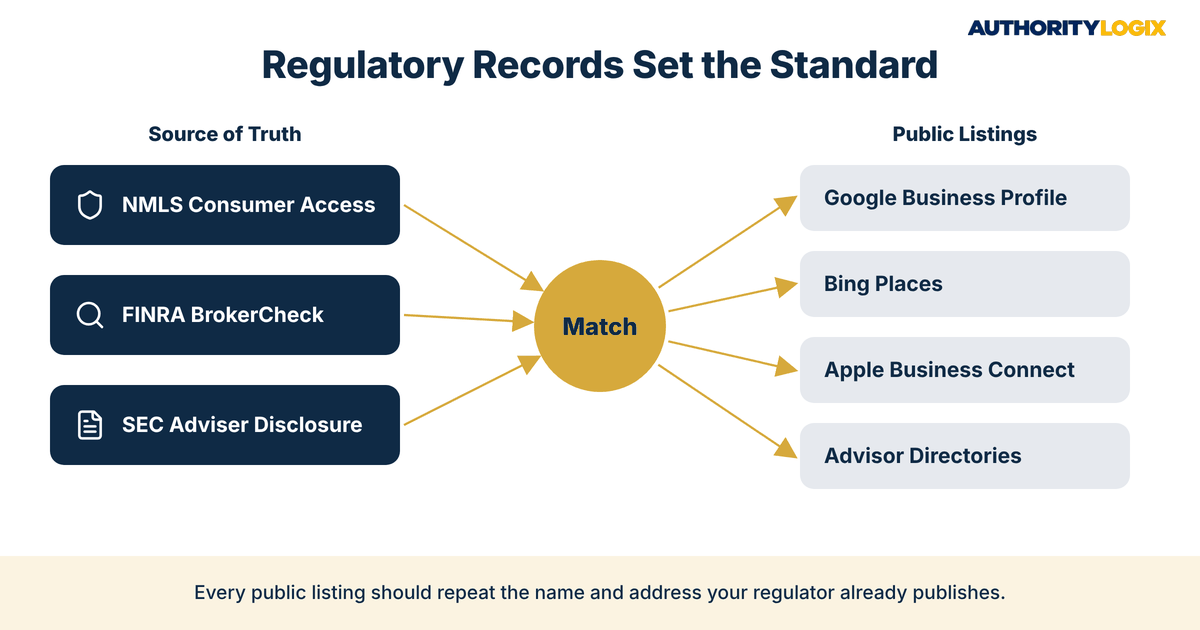
- For lenders and advisors, NMLS Consumer Access and FINRA BrokerCheck records are the source of truth for financial services citation building.
- Three of the top five AI search visibility factors in Whitespark’s survey are citation factors, so listing data now shapes AI recommendations too.
- Financial services citation building is maintenance infrastructure — every office move, rebrand, or phone change must flow through every record.
Table of Contents
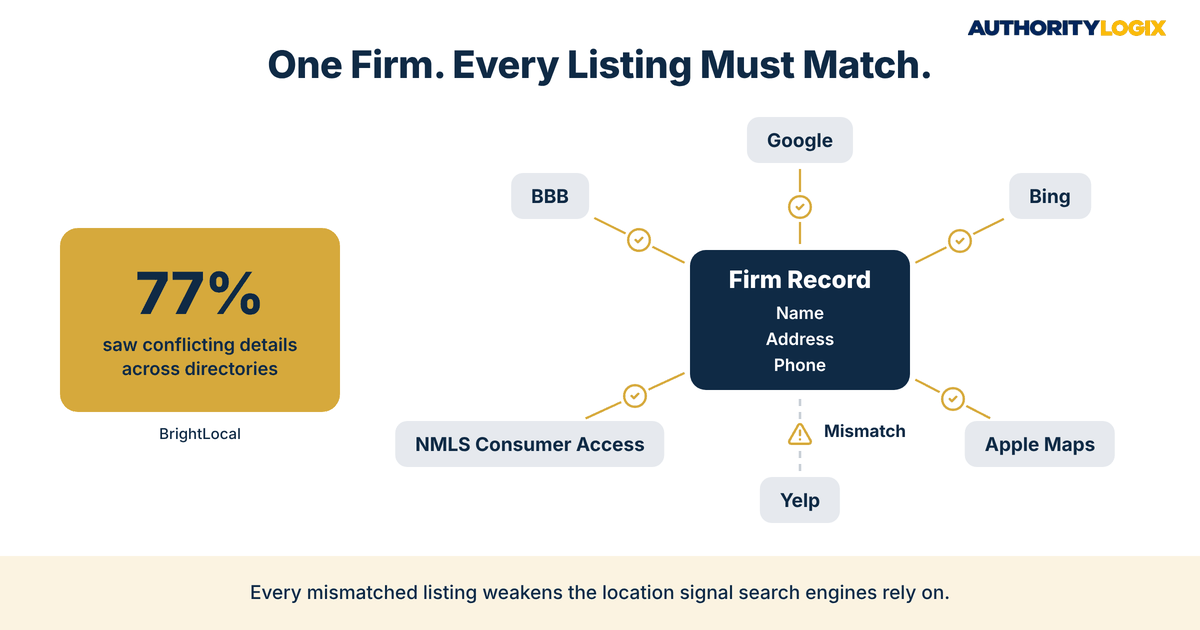
Financial services citation building sounds like a clerical task until you see what inconsistent listings cost a lender or advisory firm in local search. You have spent years earning a reputation, yet the map results show a competitor with half your experience because Google trusts their location data more than yours. That is credible but invisible in its most literal form: the expertise is real, but the records describing your firm disagree.
Citations are any online mention of your firm’s name, address, and phone number — NAP — on directories, map platforms, aggregators, and industry sites. They are one layer of a broader local SEO program, and most firms set them up once and never touch them again. This article covers which data must match, which directories matter, and how financial services citation building holds up as the firm changes.
Why Financial Services Citation Building Still Moves Local Rankings
Whitespark’s 2026 Local Search Ranking Factors survey asked 47 local search practitioners to score 187 factors. A website NAP matching the Google Business Profile ranked 15th for local pack and Maps results, and citation consistency on Google, Bing, and Apple Maps ranked 28th.
The same survey found that citations as a group lost about half a percentage point of weight, continuing a decade-long slide. That does not mean listings can be ignored. It means hundreds of low-value directory entries no longer move rankings, while accuracy on the platforms that matter still does — financial services citation building has shifted from volume to precision.
Trust matters too. Google treats lending and investment topics as Your Money or Your Life content, so signals confirming that a firm is real, located where it says, and reachable at its listed number carry extra weight. Consistent citations are one of the quiet credibility signals described in the authority guide, and financial services citation building supports every other trust signal a firm builds.
AI search raises the stakes. BrightLocal’s Local Consumer Review Survey 2026 found that 45% of consumers had used AI tools for local business recommendations, up from 6% a year earlier, and Whitespark reported that three of the top five AI visibility factors are citation factors. Those assistants draw on the same directories and data sources your citations live on.
That is why financial services citation building belongs inside a connected visibility system, not a one-time task list. Listing data feeds the map pack, which feeds branded searches and the website. Our financial services hub shows how those layers connect for mortgage companies, DSCR lenders, and advisory firms.
The Financial Services SEO Playbook shows where financial services citation building fits inside the full search visibility system for lenders and advisors.
Mortgage NAP Consistency: The Data That Must Match
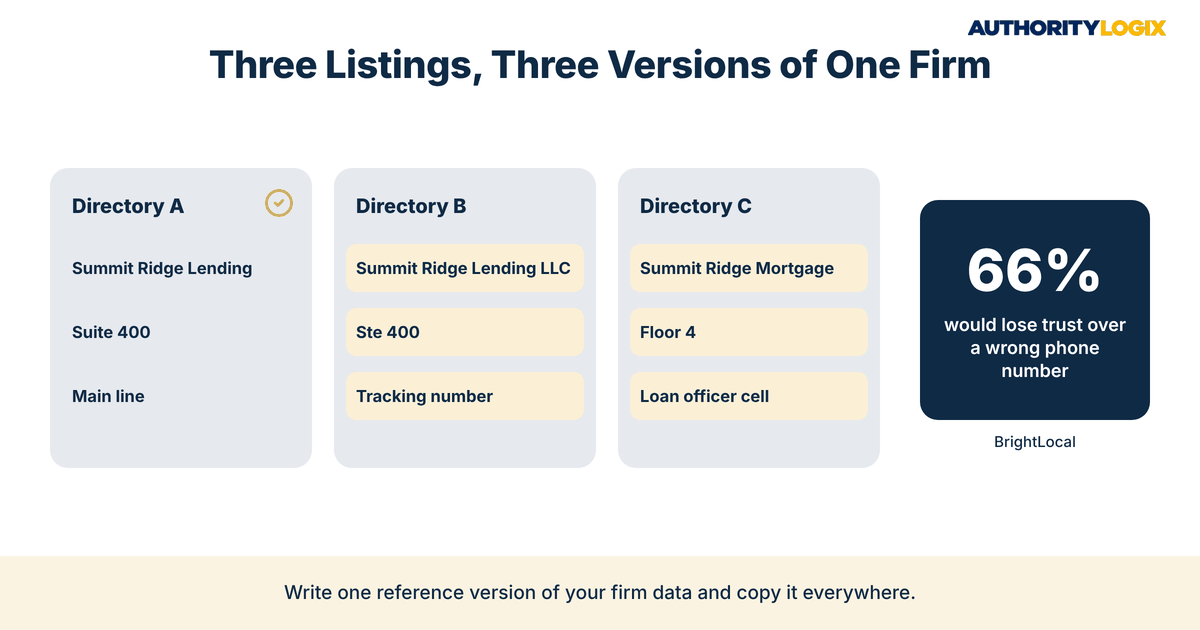
Mortgage NAP consistency starts with a decision most firms never formally make: what is the one correct version of our name, address, and phone number. Without a written standard, everyone improvises — one loan officer adds “LLC,” another writes “Ste,” and a vendor’s call-tracking number ends up in a dozen directories.
BrightLocal’s Business Listings Trust Report found that 85% of consumers had encountered incorrect or incomplete business information online, and 66% would lose trust in a business over a wrong or inconsistent phone number. For a borrower comparing lenders, two different numbers raise a simple question — which one is real — and many do not stay to find out.
The Fields That Carry the Most Weight in Financial Services Citation Building
Name, address, and phone are the core, but a complete record for financial services citation building includes more. Lock these fields in one reference document before any listing is created or corrected.
- Business name exactly as it appears on your licensing record, with no keywords or city names added.
- Street address formatted one way, with the suite or floor written identically everywhere.
- One primary local phone number, with call-tracking numbers kept off citation sources.
- Website URL pointing to the same office or location page every time.
- Primary category, such as Mortgage Lender or Financial Planner, used consistently across platforms.
- Hours, service areas, and licensed professional names wherever the platform supports them.
The Google Business Profile is the anchor record, and Google compares what your site says against what your profile says. If your profile was created years ago by someone who has since left, start with a proper GBP setup review before touching outside directories. In financial services citation building, every other record is copied from the corrected profile.
Inconsistency also costs inquiries before rankings change. A 2026 Data Axle survey of 1,000 consumers, fielded by Dynata, found that 66% had visited or tried to visit a business only to find its online information was wrong. Mortgage NAP consistency protects the inquiry you already earned.
Your own website follows the same standard. The footer, contact page, office pages, and every article in your educational hub should show the NAP exactly as the reference document defines it. Many firms clean up outside directories and leave three versions of the address on their own pages, which undercuts financial services citation building at the source Google checks first.
Lender Local Citation SEO: Which Directories Matter
Lender local citation SEO is about being listed accurately on the platforms that search engines, AI tools, and borrowers actually consult — not about being listed everywhere. Whitespark’s rankings set the order: primary map platform consistency ranked 28th for local pack results, key directory sites 63rd, and data aggregators 85th.
Where Financial Services Citation Building Should Start
Work from the top tier down. An error in a primary record spreads to the sites that copy from it.
| Citation Tier | Examples | Why It Matters | Priority |
|---|---|---|---|
| Primary map platforms | Google Business Profile, Bing Places, Apple Business Connect | Feed map results, voice assistants, and many AI answers directly | Fix first |
| Data aggregators | Data Axle, Neustar Localeze, Foursquare | Distribute listing data to hundreds of downstream sites | Fix second |
| Major directories | Yelp, BBB, Yellow Pages | High-authority pages that often rank for branded searches | Fix third |
| Industry directories | Zillow lender directory, NAPFA Find an Advisor, CFP Board Let’s Make a Plan | Confirm category relevance for mortgage and advisory searches | Build selectively |
| Regulatory records | NMLS Consumer Access, FINRA BrokerCheck, SEC Investment Adviser Public Disclosure | Public source of truth for licensed firms and professionals | Match every listing to these |
Industry directories deserve more attention in financial services citation building than they usually get. A recognized lender or advisor directory listing confirms both your NAP and your category. Google’s E-E-A-T standard rewards that third-party confirmation on financial topics, because it shows outside organizations recognize what you do and where you do it.
What lender local citation SEO should not include is a blast of submissions to hundreds of generic directories. Whitespark’s experts ranked the quantity of structured citations 110th of 187 local pack factors. Each one becomes another record to maintain. Volume without infrastructure is just noise.
The firms that get this right treat citations as a managed data set. One owner holds the reference document, one spreadsheet tracks every live listing with its login and last-verified date, and corrections follow the same workflow as any published asset. Well-run content systems apply that discipline to pages, and financial services citation building needs it too.
Not sure how your financial services citation building compares to the lenders and advisors showing up in your local map results?
Financial Advisor Directory Listings and Regulatory Records
Financial advisor directory listings carry a complication most local businesses never face: regulators already publish the firm’s identity and location. Broker-dealers appear on FINRA BrokerCheck, registered investment advisers on the SEC’s Investment Adviser Public Disclosure site, and mortgage companies and loan originators on NMLS Consumer Access.
Those records should be the source of truth for financial services citation building. If your Form ADV or NMLS record lists one office address and your Google profile lists another, your marketing and your regulatory filing disagree. Correct whichever record is wrong through the proper channel, and involve compliance before changing anything filed with a regulator.
Mortgage firms face a related rule. Regulation Z section 1026.36(g) requires a loan originator organization’s name and NMLS identifier on the credit application, required disclosures, note, and security instrument. That rule governs loan documents rather than directories, but it points the same way: your NMLS name is the name your listings should use.
Advisory firms also have more individual profiles to manage — a firm bio page, a planner directory profile, LinkedIn, and a BrokerCheck entry for each advisor, all listing the same office. Building those pages through one content system keeps them tied to the firm record, which makes financial services citation building far easier as advisors join or leave.
Financial advisor directory listings also work better when they point somewhere useful. Linking each listing to an office page with real finance content — local market context, clear service explanations, and named professionals — turns a citation into a path toward a client conversation.
Maintaining Citations as the Firm Changes
Citations decay. Offices move, phone systems change, firms rebrand after a merger, and loan officers leave with listings nobody remembers creating. BrightLocal’s NAP consistency guidance makes the same point: listing details should be updated whenever the business changes, because inaccurate data confuses search engines and misleads potential customers.
A firm that cleaned up its citations three years ago, then moved once and changed phone providers, likely carries more bad records now than before. Aggregators keep redistributing old data, and downstream sites keep copying it. Financial services citation building only holds its value when maintenance is scheduled, not remembered.
A Quarterly Review Cycle for Financial Services Citation Building
A recurring review catches most problems early. These changes should trigger an update.
| Change at the Firm | Records to Update | Timing |
|---|---|---|
| Office move | Google profile, aggregators, regulatory records through compliance, website, all directories | Planned before the move date |
| New phone system | Google profile, website, primary map platforms, major directories | Same week as the switch |
| Rebrand or merger | Every listing, plus regulatory filings handled by compliance | A written project checklist |
| Loan officer or advisor departure | Practitioner listings, team pages, individual directory profiles | Within 30 days |
| No change | Spot-check the top 20 listings against the reference document | Every quarter |
Every press mention, podcast appearance, or syndicated article that names the firm is an unstructured citation. Whitespark’s experts ranked the quality of unstructured citations from news sites, blogs, and industry associations 37th for local organic results. A deliberate authority distribution program places those mentions on credible sites with the correct name and location.
Clean records also protect inquiries from other channels. A borrower who hears your name in a referral, searches it, and finds two phone numbers hesitates at the moment your lead generation infrastructure expected a call. In the Data Axle survey, 87% of consumers said they were likely to choose a business with more accurate and complete information, which is the practical payoff of financial services citation building.
Financial Services Citation Building Mistakes That Fragment Local Authority
Most financial services citation building problems come from a short list of repeated mistakes. Each one is cheaper to prevent than to clean up after aggregators copy it.
Mistake: Putting call-tracking numbers on citation sources
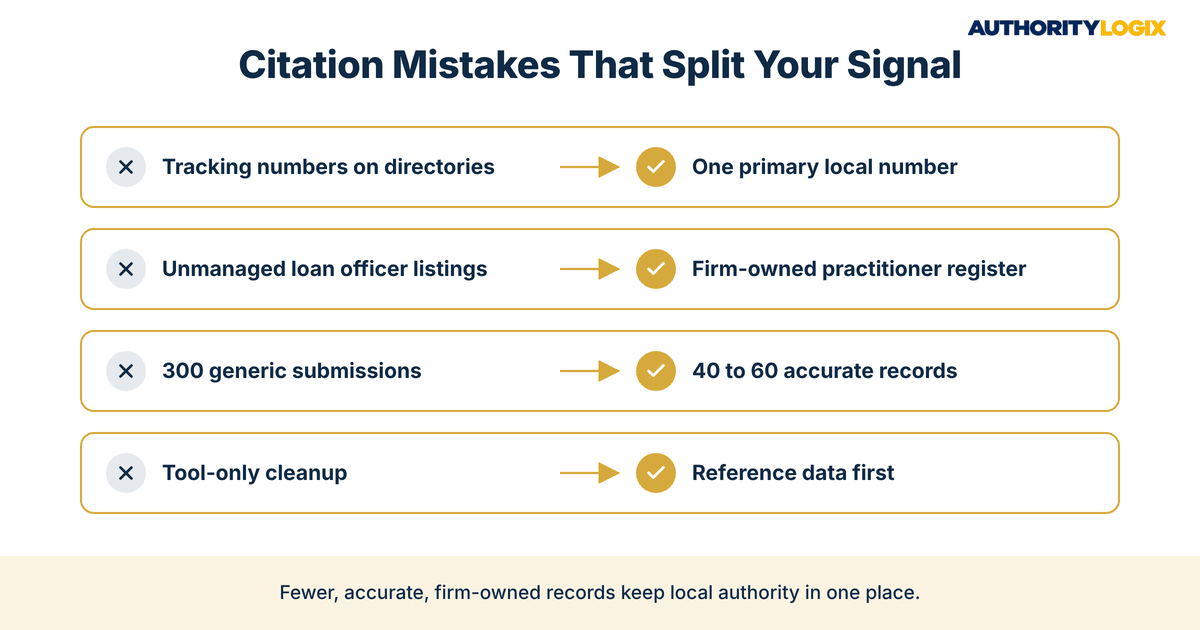
Tracking numbers help measure campaigns, but on directories they create a second phone number for the same firm. Keep the primary local number on every citation and use tracking numbers only on ads and landing pages you control. For attribution, your lead system can measure source through forms and campaign URLs instead.
Mistake: Letting each loan officer create their own listings
Google allows individual practitioner listings for licensed professionals, but unmanaged ones often duplicate the firm’s address with a slightly different name or category. Keep a register of every practitioner listing, assign ownership to the firm, and remove or merge listings when people leave.
How many citations does a financial firm actually need?
There is no fixed number for financial services citation building. Accuracy on the primary map platforms, the major aggregators, a handful of high-authority directories, and the directories specific to your field matters far more than total count. A focused set of 40 to 60 accurate records is far easier to keep consistent than 300 scattered ones.
Should we pay for a listing management subscription?
Subscription tools push updates to many directories at once, which helps multi-office firms. They do not fix the reference data, choose which directories matter, or correct regulatory records, and some listings revert when a subscription ends. Setting the data standard comes first, and that diagnostic work is part of what we do before any tool is involved.
How long before consistent citations affect rankings?
Search engines and aggregators recrawl on their own schedules, so corrections can take weeks to several months to propagate. Sequence matters as well — corrected profile first, aggregators second, directories third — which is the foundation-first order behind how we build visibility systems for financial firms.
Ready for listings that match everywhere prospects look? We’ll clean up and build the citations that strengthen your local rankings.
Financial Services Citation Building: Consistent Data, Compounding Rankings
Financial services citation building is rarely the part of a visibility system a firm owner wants to discuss. It is, however, one of the few local ranking inputs a firm controls completely. The growth playbook treats this foundational accuracy as the base layer that every later investment in content and distribution depends on.
BKDSCR.com, the AuthorityLogix proof-of-concept in the NYC outer-borough DSCR niche, was built with 18 pillar pages, 7 interactive investor tools, and 48 SEO-optimized blog posts, with zero paid ads. It shows why it works to get the foundation right before adding volume.
The honest assessment is that most lenders and advisors already have the credibility their market should see. What is usually missing is the infrastructure underneath it, and inconsistent listings are among the most common gaps. If you want financial services citation building handled alongside the rest of your visibility system, the next step is to work with us on a plan for your markets.