


Key Takeaways
- Mortgage market data content compliance is what separates rate and market commentary that builds authority from copy that quietly becomes a regulated advertisement.
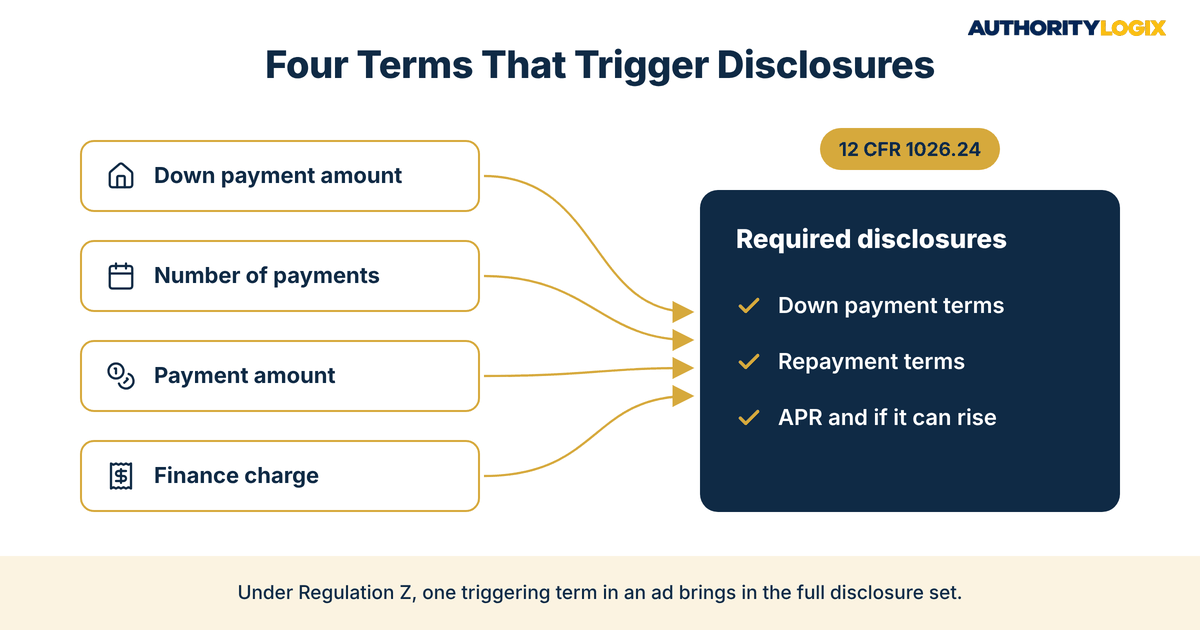
- Under Regulation Z, stating a down payment, number of payments, payment amount, or finance charge triggers the full disclosure set, including the APR.
- Regulation N bars material misrepresentations about mortgage terms and requires lenders to keep copies of materially different ads for 24 months after last use.
- National averages such as the Freddie Mac Primary Mortgage Market Survey describe a defined borrower profile, so they work as market context, not as an offer.
- A repeatable source, date, frame, review, and archive workflow keeps mortgage market data content compliance from depending on one person catching every line.
- Mortgage market data content compliance is publishing infrastructure. It earns trust because the data is accurate, current, and honest about its limits.
Table of Contents

Mortgage market data content compliance is the discipline that decides whether a lender’s weekly rate update builds authority or builds a regulatory file. Most mortgage companies already hold the data borrowers search for every week, and most publish none of it because nobody is sure where commentary ends and advertising begins.
That hesitation has a cost. Borrowers keep searching for what rates are doing, and the answers come from portals and national publishers rather than the local lender who closes the loans. A documented compliance system removes the guesswork, so the team knows which numbers can run and who signs off.
The firms that solve this problem stop being credible but invisible. They become the source borrowers check before they call anyone.
Why Mortgage Market Data Content Compliance Matters Before Publishing
Rate and market data sits at an awkward intersection: borrowers search for it constantly, and regulators read it closely. That combination is why mortgage market data content compliance deserves a system, not a gut check. When a loan officer posts “rates just dropped to 6.1 percent” on a Tuesday, the post is not commentary anymore — it is a rate statement, and the rules for advertised rates apply.
Search visibility is the other half of the equation. Educational pages that explain why rates moved and what a national average measures are evergreen assets that rank. The SEO playbook covers how that visibility compounds, and mortgage market data content compliance is what keeps those ranking pages from turning into liabilities.
What Mortgage Market Data Content Compliance Actually Covers
In practice, the discipline covers four kinds of content: rate commentary, market trend analysis, affordability and payment examples, and forecasts. Each carries a different risk profile. A mortgage company that treats all four the same either over-restricts its educational content or under-protects its advertising.
For lenders still mapping which services support each content type, the services hub lays out how the publishing, distribution, and lead systems fit together. This article is marketing and visibility education, not legal advice. Your compliance counsel and the rules that govern your license always have the final word on any specific piece of copy.
The Financial Services Content System lays out the compliance-aware publishing blueprint that turns rate and market data into a dependable authority asset.
Lender Rate Content CFPB Rules and Trigger Terms
The core of the lender rate content CFPB rules sits in Regulation Z, specifically the advertising section at 12 CFR 1026.24. If an advertisement states a rate of finance charge, it must state it as an annual percentage rate, and it must say so if that rate may increase after consummation. That requirement alone applies to any casual post that names a rate.
The second requirement is the trigger-term rule. Under 1026.24(d), an ad that states the amount or percentage of a down payment, the number of payments or period of repayment, the amount of any payment, or the amount of any finance charge must also disclose the down payment terms, the repayment terms, and the APR. The CFPB’s own commentary notes that a phrase like “no downpayment” does not trigger the rule on its own.
| Content Element | How It Is Treated | What the Copy Needs |
|---|---|---|
| National average rate from a named survey | Market context when sourced and dated | Source name, survey date, borrower profile it reflects |
| “Our rate today is 6.25%” | Advertised rate under Regulation Z | APR stated, and whether it can increase |
| “Just $1,850 a month” | Trigger term (payment amount) | Down payment, repayment terms, and APR |
| “30-year fixed” | Trigger term (repayment period) | Full disclosure set, and “fixed” used accurately |
| Rate trend chart with commentary | Educational when no offer is implied | Mortgage market data content compliance review before publishing |
| “Government-backed program” | Restricted claim for dwelling-secured credit | Only for actual FHA, VA, or similar programs |
Regulation Z also lists prohibited acts for dwelling-secured credit at 1026.24(i). These include misleading use of the word “fixed” in variable-rate ads, implying government endorsement for a non-government product, and calling a for-profit lender or broker a “counselor.” A broker-dealer or advisory firm faces a parallel set of rules, and the FINRA compliance guide explains how Rule 2210 treats projections in retail communications.
Every one of these rules is published and free. The CFPB maintains its regulations, supervision materials, and guides on its compliance resources page, which belongs in every content team’s bookmarks. Mortgage market data content compliance begins with the team reading the actual rule text rather than repeating what someone heard at a conference.
Structurally, the cleanest fix is to separate rate offers from rate education. Product pages and ads carry offers with full disclosures. An educational hub carries sourced market data, plain-language explanations, and no offer at all. With separate homes and review paths, the trigger-term problem mostly disappears.
Mortgage Market Commentary Compliance Without Losing Value
Mortgage market commentary compliance does not mean stripping the numbers out until the content says nothing. Borrowers want specifics, and Google rewards specific answers. The goal of mortgage market data content compliance is to present real data as what it is — a measurement of the market — rather than as a promise of what a particular borrower will receive.
The Freddie Mac Primary Mortgage Market Survey is the clearest example. Since November 2022, Freddie Mac has calculated it from thousands of purchase applications submitted through its Loan Product Advisor, and its FAQ describes the profile as borrowers with good to excellent credit putting 20 percent down on owner-occupied single-family homes. It also no longer publishes fees and points. Under mortgage market data content compliance, content that explains those limits beats content that repeats the headline.
Framing Rules That Keep Mortgage Market Data Content Compliance Intact
- Name the source and the release date in the same sentence as the number.
- State the borrower profile the figure reflects, and say plainly that individual rates vary.
- Keep calls to action pointed at education or a conversation, never at a specific rate.
- Route any sentence with a payment, term, or down payment figure to full review.
Accuracy and transparency are also ranking factors in their own right. Google treats mortgage content as Your Money or Your Life material, and the E-E-A-T signals that lift it — named authors, cited sources, visible update dates — are the same signals that make mortgage market commentary compliance easier to prove.
A lender that publishes sourced weekly commentary for a year builds a body of work borrowers recognize and search engines trust. Well-built content systems give that commentary a fixed format, review path, and home on the site.
Not sure your rate content meets mortgage market data content compliance standards? The FS Authority Gap Assessment shows where your publishing infrastructure is exposed.
The Financial Services Data Content Legal Review Workflow
A financial services data content legal review should not hold every post for two weeks. Mortgage market data content compliance works best as a predictable sequence that most content clears quickly because it was built to clear. Firms that publish market data weekly without incident do not have braver compliance officers — they have a workflow.
Workflow is also where credibility gets made visible. The authority guide explains why buyers in financial services trust firms that show their work, and a documented review process is exactly that.
The Five-Step Review Sequence
- Source: every number links back to a named, primary data release in the working draft.
- Date: every figure carries the release date and the date the page was last checked.
- Frame: the writer applies the framing rules and flags any trigger term for full disclosures.
- Review: compliance approves, edits, or rejects using a written checklist, not memory.
- Archive: the approved version is stored with its approval record and publish dates.
The archive step is not optional for mortgage advertising. Regulation N, the Mortgage Acts and Practices Advertising Rule at 12 CFR 1014, requires covered persons to keep copies of all materially different commercial communications about mortgage credit terms for 24 months from the last date they were made or disseminated. Built into mortgage market data content compliance, automatic archiving turns a legal requirement into a byproduct of publishing.
Writers need a standard to work from as well. Specialized finance content development starts with a style sheet that lists approved phrasing, banned phrasing, required disclosures, and approved data sources. Once that sheet exists, financial services data content legal review shrinks from line-by-line rewriting to a confirmation step, and the publishing cadence finally holds.

Keeping Mortgage Market Data Content Compliance Current and Accurate
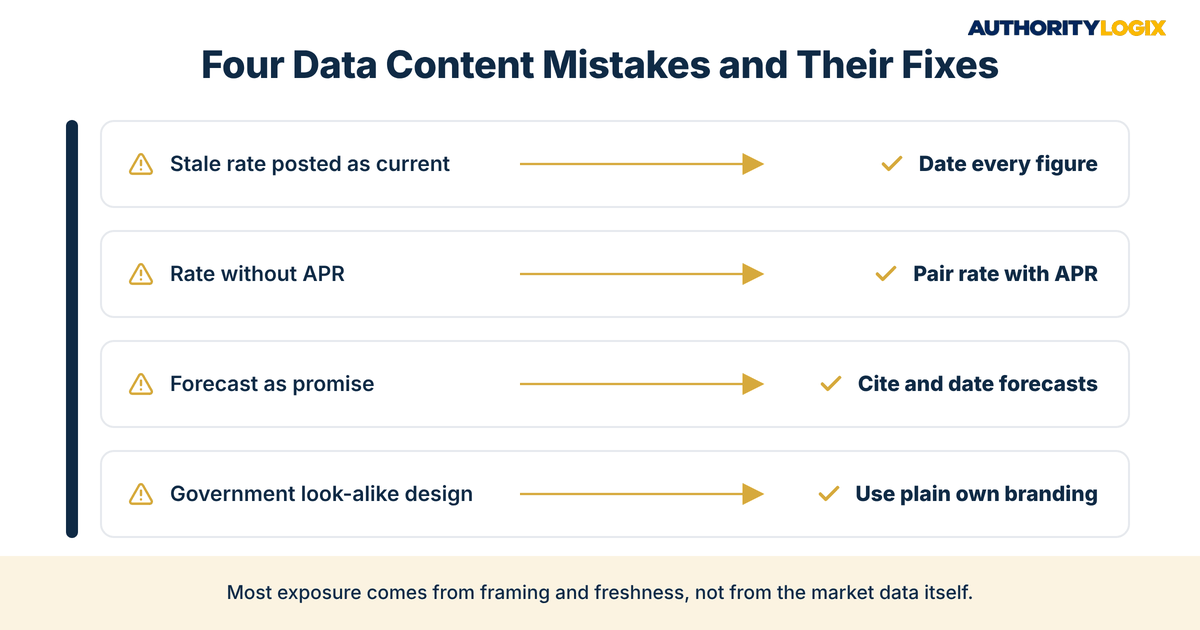
Market data spoils. A rate commentary page that was accurate on a Thursday can be misleading three weeks later if it still reads like today’s news. Stale data is one of the quietest mortgage market data content compliance failures — nobody wrote anything wrong, and the page simply stopped being true while it kept ranking.
Freshness is also a conversion issue. Borrowers who land on outdated numbers leave, and the inquiries a lead system depends on never happen. A visible last-updated date and a current figure keep readers moving toward a conversation.
For mortgage market data content compliance, the fix is a refresh cadence matched to how often each source updates. Freddie Mac publishes its survey weekly on Thursdays, so weekly commentary pages need a weekly check. Forecast pages tied to quarterly releases need quarterly checks. Evergreen explainers need an annual review.
| Data Type | Typical Update Cycle | Refresh Rule |
|---|---|---|
| National rate averages | Weekly | Update or clearly archive the post each week |
| Industry origination forecasts | Monthly to quarterly | Cite the forecast date and replace when revised |
| Local inventory and price trends | Monthly | Refresh figures and the as-of date monthly |
| Regulatory explainers | When rules change | Annual review plus a check after any rule update |
| Payment examples | Whenever rates move | Treat as advertising and rerun mortgage market data content compliance review |
Forecasts deserve special care. The Mortgage Bankers Association projected roughly 2.2 trillion dollars in single-family originations for 2026 in its October 2025 forecast, an 8 percent increase. That is useful context for an outlook piece, as long as it is attributed as a forecast, dated, and replaced when the MBA revises it.
Distribution multiplies whatever the original page says, accurate or not. Syndicated versions, social excerpts, and email digests all inherit the same numbers, which is why authority distribution should only pick up content after it clears review. Mortgage market data content compliance has to travel with the content, or every channel becomes a separate liability.
Data Content Mistakes That Create Exposure
Most exposure in rate content comes from habits that feel harmless, not from bad intent. The questions below are the ones lenders ask most when they start building mortgage market data content compliance into publishing.
Is it safe to post the rate we are quoting today on social media?
Posting a specific rate is advertising, and it carries the Regulation Z requirements for advertised rates, including stating the APR. Most firms keep quoted rates inside reviewed ad templates and use social posts for market context instead. Social content still feeds lead generation when it points readers toward an explainer or a conversation rather than a number.
Can we use a monthly payment example to make the data relatable?
A payment amount is a trigger term, so a payment example brings in the full disclosure set. Many lenders handle this part of mortgage market data content compliance by moving payment examples into calculators or reviewed ad copy where disclosures are built in. Educational pages can explain how payments respond to rate changes in general terms without quoting a figure.
What happens when a market forecast sounds like a promise?
Language such as “rates will drop next quarter” reads as a prediction a borrower can rely on, and it creates expectations the lender cannot control. Frame forecasts as named third-party projections with dates and ranges. Sorting out which pages carry that risk is part of what we do when an audit starts.
Does design count, or only the words?
Design counts. In the joint CFPB and FTC review of about 800 randomly selected mortgage ads, some ads used official-looking seals or logos that could suggest government affiliation, and the agencies warned the companies behind them. Venable reported civil penalties of 225,000 dollars for Flagship Financial Group and 85,000 dollars for American Preferred Lending in 2015.
Who should own mortgage market data content compliance inside a small firm?
One named person should own the checklist, even if outside counsel does the final review. That person tracks refresh dates, archives approvals, and updates the style sheet. That ownership model is built into how we build publishing systems from the first page.
Want to publish market data without compliance worries? We’ll build a content process with sourcing and review built in.
Building Authority Without Regulated Claims
Mortgage market data content compliance done well does not produce cautious content. It produces the most useful content a lender can publish — numbers borrowers can trust and context a headline cannot give. Over time, that is what turns a loan officer into a recognized market voice, a path the growth playbook traces from first page to compounding authority.
BKDSCR.com, the AuthorityLogix proof-of-concept in the NYC outer-borough DSCR niche, shows the approach in a live market. It runs 48 SEO-optimized blog posts and 7 interactive investor tools with zero paid ads. That is why it works — the platform earns attention by teaching first, and the business conversation follows.
The honest assessment is simple. Most lenders already understand the market better than the national publishers who outrank them, and mortgage market data content compliance is the missing piece that lets that expertise reach borrowers safely. If you want that infrastructure built rather than improvised, work with us to put the rules, workflow, and publishing system in place before the next rate move.