


Key Takeaways
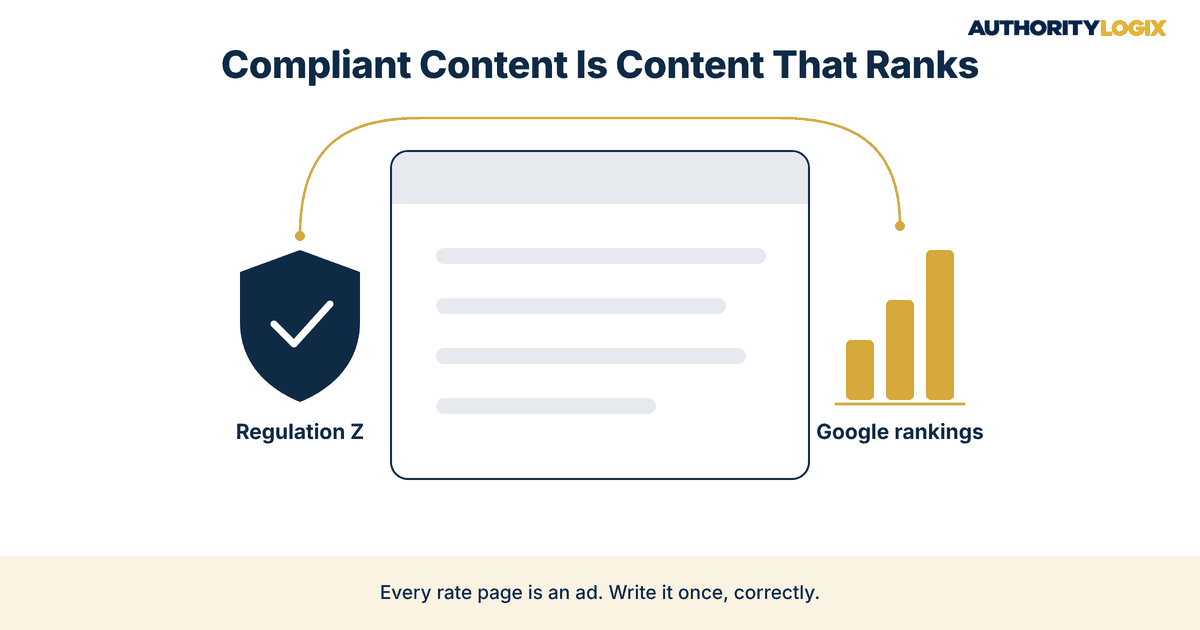
- Mortgage SEO compliance is the discipline of publishing content that ranks on Google while meeting the federal and state advertising rules that govern mortgage marketing.
- Under Regulation Z, naming a down payment, a number of payments, a payment amount or a finance charge in an ad triggers extra disclosures, including the annual percentage rate.
- RESPA Section 8 bars paying or accepting anything of value for referrals of settlement service business, which shapes how partner pages and co-marketed content are built.
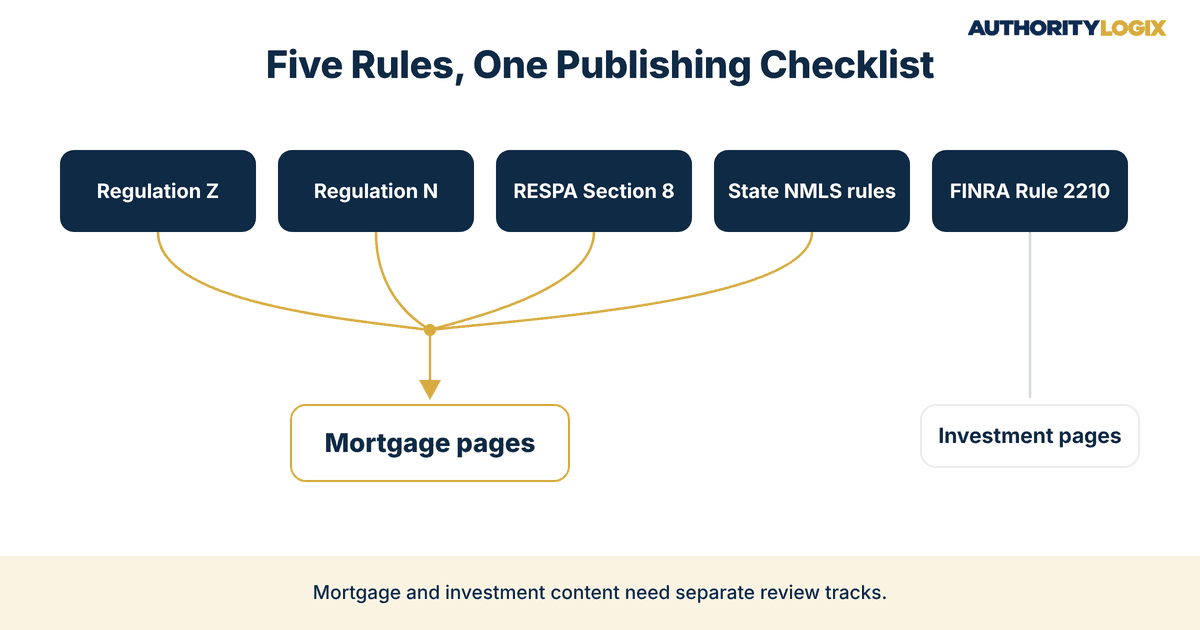
- FINRA Rule 2210 governs broker-dealer communications, not mortgage lenders, so firms that sell both loans and investments need two separate review tracks.
- Google rates mortgage content as Your Money or Your Life material, so compliant, accurate pages are also the pages most likely to earn trust in search.
- A written pre-publish compliance check turns mortgage SEO compliance from a legal bottleneck into a repeatable publishing step.
Table of Contents
Why Mortgage SEO Compliance Decides What Ranks
Mortgage SEO compliance is the part of search strategy most lenders treat as someone else’s problem, and it is often the reason a well-written page never goes live. Marketing drafts an article about current rates, compliance flags three sentences, the edits stall, and a competitor publishes first. A documented content system closes that gap by building the rules into the draft instead of discovering them at review.
If you have run a mortgage shop for years, you already know the rules. What usually fails is the publishing process around them. Most compliance conflicts in search content come from a small set of repeat triggers: a payment example without the required disclosures, a “lowest rate” claim that cannot be supported, a partner page that looks like a paid referral, or a loan officer page missing a license number.
Treating mortgage SEO compliance as a writing standard rather than a final checkpoint changes the economics. Writers who know the triggers produce drafts that pass review the first time, which is the core idea behind specialized finance content — copy written by people who know both the rule and the search intent.
Google Treats Mortgage Content as Your Money or Your Life
Google’s Search Quality Rater Guidelines place financial topics in the Your Money or Your Life category, described as topics that could damage a person’s ability to support themselves and their families. Mortgage pages sit squarely inside that definition, so the standard for accuracy, clear authorship and trustworthy sourcing is higher than it is for most industries.
That is good news for compliant lenders. The same habits regulators expect — stating terms accurately, avoiding misleading comparisons, identifying who is offering the loan — are the trust signals described in the authority guide. Mortgage SEO compliance and search authority are not competing goals. They are the same discipline viewed from two angles.
The Financial Services SEO Playbook shows how lenders and advisors get found before the competition does, and where mortgage SEO compliance fits into every page you publish.
Regulation Z Trigger Terms: The Advertising Rule Behind Every Rate Page
Regulation Z is the rule mortgage marketers run into most often online. Section 1026.24 of Regulation Z governs advertising for closed-end credit, and it applies to the rate pages, calculators, blog posts and social posts that many lenders do not think of as ads. For mortgage SEO compliance, this is the first rule to build into every template.
The core mechanism is the triggering term, and Regulation Z trigger terms are narrower than most writers assume. Under Section 1026.24(d)(1), an ad that states the amount or percentage of any down payment, the number of payments or period of repayment, the amount of any payment, or the amount of any finance charge must also state the down payment, the terms of repayment, and the annual percentage rate, using that term. If the rate can increase after closing, the ad must say so.
For mortgage SEO compliance, the practical test is simple: scan each page for a number tied to cost or repayment. If one appears, the full disclosure set must appear with it, clearly. Pages that pass that test can be optimized freely, because the risk sits in the numbers, not in the length or depth of the answer.
What Counts as an Advertisement Online
A blog post titled “What a $400,000 Loan Costs Per Month” is an advertisement the moment it shows a monthly payment. So is a featured snippet answer that names a rate, a calculator results page, and a loan program page that lists “3% down” in a headline. Search content that answers payment questions — exactly the queries borrowers type — is where trigger terms appear most.
The fix is structural rather than editorial. Build a disclosure block into every page template that can show a payment, rate or down payment figure, and let the content team fill it from an approved table. That approach works for lenders and advisors alike, because the disclosure lives in the layout instead of depending on each writer remembering it.
Section 1026.24(i) also lists prohibited practices for ads secured by a dwelling, including misleading use of “fixed” rates and payments, misleading comparisons, misrepresentations about government endorsement, misleading use of the current lender’s name, misleading claims of debt elimination, misleading use of the term “counselor,” and misleading foreign-language ads. A publishing workflow that screens for those seven phrases catches most problems before review.

RESPA Co-Marketing Rules for Lead Pages and Partner Content
RESPA co-marketing rules shape a different part of search strategy: the pages built with or for real estate agents, builders and other partners. Section 8 of RESPA, implemented in Regulation X at 12 CFR 1024.14, states that no person shall give and no person shall accept any fee, kickback or other thing of value for referrals of settlement service business. Partner pages, shared landing pages and co-branded guides all sit close to that line.
The rule does not ban co-marketing. Section 1024.14(g) allows payment for goods or facilities actually furnished or services actually performed, which is why a defensible co-marketing arrangement ties each party’s share of the cost to its real use of the material. The risk appears when a lender pays for a page that mostly promotes the agent, or when a partner directory exists mainly to reward referrals.
For a search-driven lead generation system, the safer path is owning the asset. A lender that publishes its own neighborhood buying guides and first-time buyer resources generates inquiries without any payment flowing to a referral source, and mortgage SEO compliance stays a writing question instead of a contract question.
Where co-marketing does make sense, document it. A written agreement that ties each party’s share of the cost to its share of the space keeps the arrangement inside the rule, and it gives your mortgage SEO compliance review something concrete to check before the page is indexed.
Forms and calls to action need the same care. A lead capture page that promises a specific rate or “approval in minutes” can raise Regulation Z or misrepresentation concerns before RESPA ever comes up. Keep lead pages focused on the next step — a consultation, a checklist, an assessment — rather than on terms the firm cannot guarantee to every borrower.
Not sure where your firm stands on mortgage SEO compliance and search visibility? The assessment scores your current content against what borrowers and regulators both expect.
Mortgage Marketing Regulations Beyond Reg Z: MAP Rule, NMLS IDs and FINRA
Regulation Z is the rule most writers know, but it is not the only one. The Mortgage Acts and Practices Advertising Rule, codified as Regulation N at 12 CFR part 1014, prohibits material misrepresentations in any commercial communication about mortgage credit products and includes recordkeeping requirements for those communications. Blog posts, emails and social updates about loan products all fall under it.
State licensing rules add identity requirements. Virginia’s rule at 10VAC5-160-60, for example, requires mortgage advertisements to show “NMLS ID #” followed by the unique identifier and the NMLS Consumer Access website address. Rules differ by state, so multistate firms should template the strictest version. An educational hub with author pages that carry each loan officer’s license details handles this once, sitewide.
FINRA is where many firms get confused. FINRA Rule 2210 governs communications with the public by FINRA member firms, which are broker-dealers. A mortgage lender is not covered by it, but a financial firm that offers both loans and securities through registered representatives must route investment content through a separate review. Keeping the two content streams apart is a structural decision covered in the growth playbook.
| Rule | Who it covers | What it means for search content |
|---|---|---|
| Regulation Z, 12 CFR 1026.24 | Creditors advertising closed-end credit, including mortgages | Trigger terms require the down payment, repayment terms and APR |
| Regulation N (MAP Rule), 12 CFR part 1014 | Anyone making commercial communications about mortgage credit | No material misrepresentations; keep records of communications |
| RESPA Section 8, 12 CFR 1024.14 | Settlement service providers and their partners | No fees or things of value for referrals; pay only for real services |
| State licensing rules (e.g. Virginia 10VAC5-160-60) | State-licensed lenders and brokers | Show the NMLS ID and other required identifiers on ads |
| FINRA Rule 2210 | FINRA member broker-dealers | Separate review for investment content; not a mortgage rule |
Read across the table and a pattern appears. None of these mortgage marketing regulations forbid publishing educational content. They forbid publishing it carelessly, and good mortgage SEO compliance is simply careful publishing written down. That distinction is what makes mortgage SEO compliance achievable at scale for a firm that wants to rank on dozens of borrower questions.
A Mortgage SEO Compliance Workflow That Still Ranks
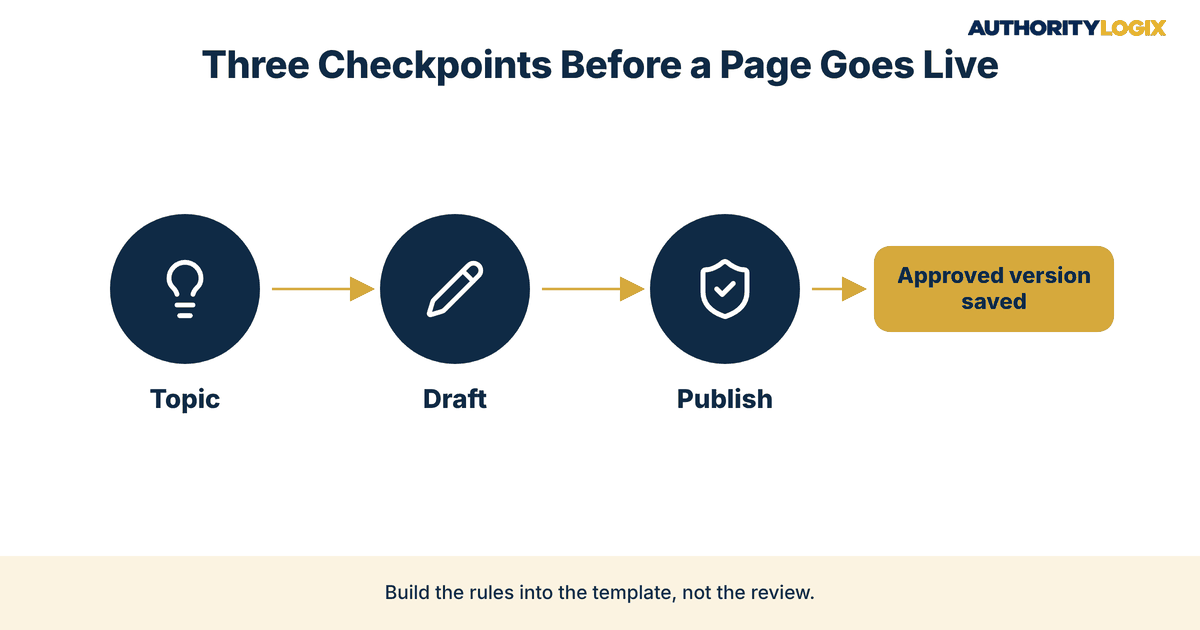
The firms that publish consistently in this space do not have looser compliance teams. They have a workflow in which mortgage SEO compliance happens at three points: when the topic is chosen, when the draft is written, and before the page goes live. Each point catches a different kind of problem, and none of them depends on a single reviewer remembering every rule. Together they make mortgage SEO compliance a routine step rather than a last-minute negotiation.
Topic selection is where the work starts. Questions such as “how much house can I afford” or “what credit score do I need” invite payment and rate figures, so those briefs carry the disclosure requirements from the beginning. Educational topics that explain a process — how underwriting works, what an appraisal checks — rarely trigger anything and can move faster through a resource library.
The Mortgage SEO Compliance Checklist Before You Publish
- Trigger terms: any down payment, payment amount, number of payments or finance charge is followed by the full disclosure set and the APR.
- Claims: no “lowest,” “guaranteed” or “fixed” language unless it is accurate for every borrower the page reaches.
- Identity: company name, NMLS ID and state license details appear where your states require them.
- Partners: no partner page or listing exists in exchange for referrals, and shared costs match real use.
- Records: the approved version of each page is saved with its review date.
- Separation: investment or securities content is routed to its own reviewer.
Distribution needs the same rules. A compliant article can become non-compliant when it is cut into a social post that keeps the payment figure and drops the disclosure. Any authority distribution plan should reuse approved language only, so the version a borrower sees on a social feed matches the version compliance signed off.
When the checklist lives inside the template, writers stop guessing and reviewers stop rewriting. It is also how we work: the compliance rules for each client’s states are written into the brief before the first draft, which is described on the how we work page.
What Mortgage Companies Get Wrong About Mortgage SEO Compliance
Most mortgage SEO compliance problems are not exotic. They are the same few mistakes repeated across hundreds of pages, often because the site was built quickly and the content was added later by different writers. Fixing them is less about new rules and more about knowing where the old ones bite, and a short audit of existing pages against the mortgage SEO compliance checklist usually finds them quickly.
Mistake: treating blog posts as editorial, not advertising
A post that shows a sample payment is an ad under Regulation Z, whatever the page template calls it. Review every article that names a figure, not just the pages labeled as rate pages.
Mistake: publishing nothing to stay safe
Silence is not a compliance strategy. Competitors who publish carefully take the search positions, and borrowers form their first impression of the market from someone else. The goal is careful publishing, which is exactly what we build for lenders who have been holding back.
FAQ: Do I need a compliance review for every blog post?
For mortgage SEO compliance, any post that states rates, payments, down payments or loan terms should be reviewed, because those are the triggering terms. Purely educational posts that explain a process can usually follow a lighter review path that your compliance lead approves in advance.
FAQ: Can a mortgage company still rank without quoting rates?
Yes. Many of the questions borrowers search are about process and eligibility rather than rate quotes, and those answers rarely trigger disclosures, which keeps mortgage SEO compliance simple. A library built around those questions ranks without the review burden of rate content.
FAQ: Who should write mortgage content, marketing or compliance?
Writers who understand both. The quickest route is a writer with industry experience in lending who drafts to the rules, with compliance reviewing rather than rewriting. That split keeps review time short and the content accurate.
Ready to build mortgage content that ranks on borrower questions and clears compliance review the first time?
The Honest Assessment: Compliance Is a Publishing System, Not a Brake
Mortgage SEO compliance looks like a constraint until you see it as a system. The rules are specific, documented and stable enough to build into templates, briefs and checklists. Once they live there, they stop slowing the content down and start protecting the rankings it earns. That is the real return on mortgage SEO compliance: pages that stay live, stay accurate and keep earning trust.
The firms that win search in this industry are rarely the ones with the biggest budgets. They are the ones that publish accurate, well-disclosed answers to the questions borrowers actually ask, month after month. You can see that approach applied in our work, including BKDSCR.com, built with 18 pillar pages and 7 interactive investor tools in the DSCR lending niche.
The honest answer is that most lenders already have the expertise and the compliance knowledge. The missing piece is the infrastructure that turns both into content the market can see.
This article is educational marketing guidance, not legal advice. Confirm the rules that apply to your firm and your states with your compliance counsel before publishing.