


Key Takeaways
- A financial advisor newsletter content strategy keeps your firm in front of clients and prospects during the long months between their decisions, when referrals and meetings go quiet.
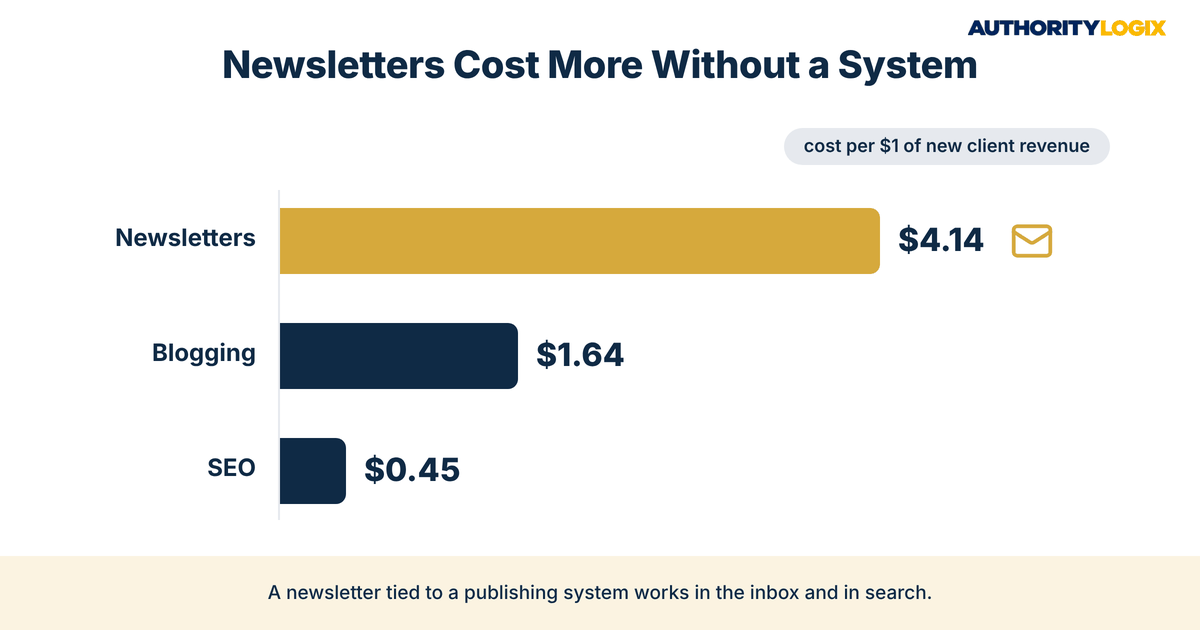
- In the Kitces Report’s 2026 survey of 506 advisors, 31% of practices used newsletters, yet newsletters cost $4.14 in marketing spend per dollar of new client revenue, one of the least efficient methods measured.
- The channel is rarely the problem. Newsletters sent as generic market recaps, with no link to a website, a lead path, or a publishing system, are why that cost runs so high.
- Open rates are a weak scorecard: Litmus reports Apple accounted for 76.56% of tracked email opens in September 2026, and Mail Privacy Protection inflates opens automatically.
- Measure a financial advisor newsletter content strategy by replies, site clicks, and booked meetings, and plan review time into the calendar so compliance never forces a skipped issue.
Table of Contents
A financial advisor newsletter content strategy is the difference between a firm clients remember and a firm they quietly forget between annual reviews. Most advisors have the expertise: decades of planning conversations, several market cycles, and clients guided through retirements and estate transitions. What the market sees is something else, usually a quarterly email that recaps the index returns, gets skimmed, and disappears. The gap is not about writing more. It is about whether the newsletter is wired into an email nurture path that moves a reader from interested to booked.
This article covers how a financial advisor newsletter content strategy keeps a firm visible to clients and to prospects not ready to move yet. It walks through efficiency data, issue structure, compliance cadence, and measurement by meetings instead of opens.
Why a Financial Advisor Newsletter Content Strategy Keeps You Visible
Referrals still run the advisory business. In the Kitces Report’s 2026 study, How Financial Planners Actually Market Their Services, 88% of practices used client referrals and 64% used centers-of-influence referrals, the two most common methods by a wide margin. The same research found that high-growth firms get about one-third of new-client revenue from those referrals, while slower-growing peers rely on them for about 80%. Your referral network is a ceiling, not a foundation.
A newsletter is one of the few channels that reaches both groups at once: the clients who generate referrals and the prospects who heard your name and are not ready to call. That dual job is why a financial advisor newsletter content strategy matters more than the newsletter itself. The newsletter is the delivery vehicle, and the strategy decides what each issue says, who it is for, and where it sends the reader next. It is the same discipline the SEO playbook applies to search content.
What a Financial Advisor Newsletter Content Strategy Actually Includes
Strategy is a short list of decisions made once and then repeated every issue. Most firms skip those decisions and go straight to writing, which is why their issues feel interchangeable.
- A defined reader for each track: current clients, prospects, or centers of influence such as CPAs and estate attorneys
- One educational topic per issue, tied to a question clients actually ask in meetings
- A single next step that points to a page on your site, not a generic contact form
- A fixed cadence your compliance review can support without delays
- A measurement plan built on replies and meetings, not opens
None of this requires a large team. It requires knowing where the newsletter sits inside the firm’s wider visibility system, which the services hub maps out across content, education, lead paths, and distribution. Once that map exists, each issue has a job instead of a deadline, and the financial advisor newsletter content strategy becomes repeatable rather than improvised every month.
Newsletters are one layer of a larger publishing system. The Financial Services Content System lays out the full compliance-aware blueprint behind a financial advisor newsletter content strategy that compounds.
RIA Newsletter Lead Nurturing for Prospects Not Ready Yet
Most prospects who find an advisor are not ready to move their assets this month. They are waiting on a bonus, a business sale or a retirement date. RIA newsletter lead nurturing is the work of staying useful during that waiting period, so that when the trigger event arrives, your firm is the one already sitting in the inbox.
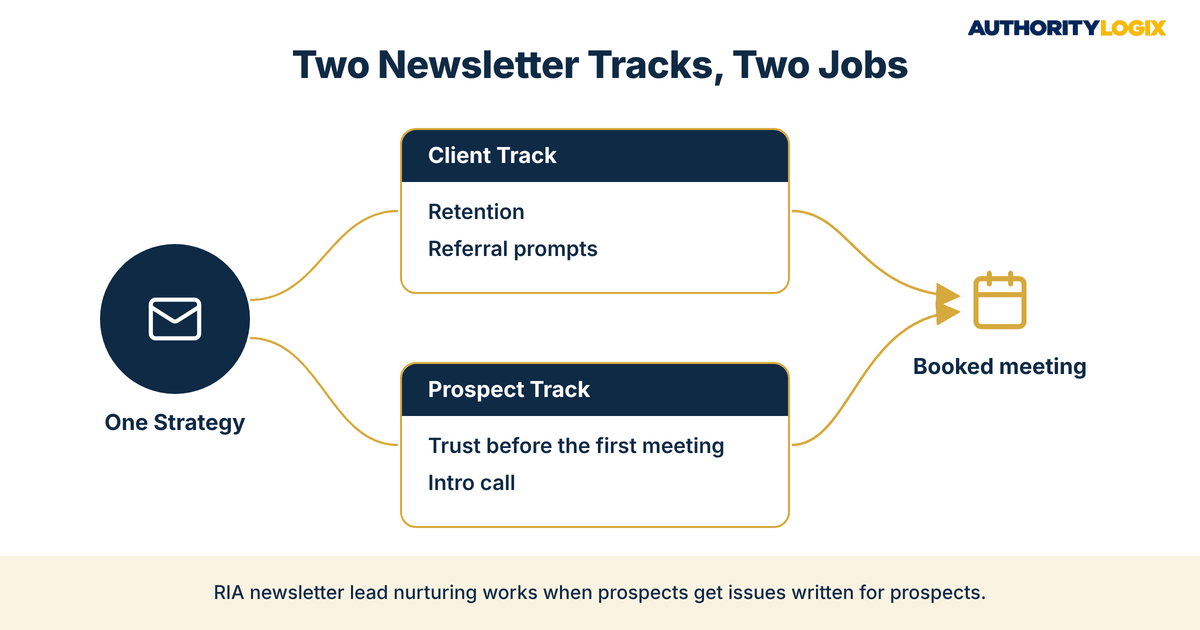
A financial advisor newsletter content strategy only works for prospects if they receive issues written for prospects. A client-facing note about rebalancing suits someone you already serve, while a prospect needs to understand how you think, what you notice, and what a first conversation looks like. Firms that run one list for everyone end up writing for no one. A content calendar can schedule both tracks, but a calendar alone is not publishing infrastructure, because it tells you when to send and not what each issue needs to accomplish.
| Element | Client Track | Prospect Track |
|---|---|---|
| Role in the financial advisor newsletter content strategy | Keeps existing relationships warm and prompts referrals | Turns a known name into a booked first meeting |
| Typical topic | Year-end planning checklist, tax-season document reminders | How the firm approaches a retirement income decision |
| Next step in each issue | Reply with a question or schedule a review | Read a site guide or book an intro call |
| Cadence | Monthly | Monthly, plus a short welcome sequence |
| Success signal | Referrals forwarded, review meetings booked | Replies, intro meetings booked |
The prospect track also needs somewhere for the reader to go deeper. A newsletter issue is short by design, so each one should point to a longer resource on your site. An educational hub gives those links a useful place to land, with organized pages a prospect can browse at their own pace. That is how RIA newsletter lead nurturing turns curiosity into a meeting request without a single sales email.
Advisor Email Newsletter Authority Through Useful Content
Advisor email newsletter authority is earned the same way authority is earned in a client meeting: by saying something specific the reader did not already know. Generic market commentary fails that test, because every reader already received a similar recap from their custodian, their bank, and several financial news sites. The issue that gets forwarded is the one that explains a decision in plain language, such as when to revisit beneficiary designations or how a business owner should prepare questions before a liquidity event.
This is where a financial advisor newsletter content strategy connects the newsletter to the rest of the firm’s educational content and stops acting as a standalone broadcast. Each issue summarizes one idea and links to the full explanation on your site, so the newsletter becomes a doorway rather than the whole room. Over twelve months, that produces an archive of answers your clients and prospects can find, share, and return to.
Volume does not substitute for this. Sending more issues with thinner content trains readers to ignore you, and the Kitces data shows how expensive that gets: newsletters cost $4.14 per dollar of new client revenue, compared with $1.64 for blogging and $0.45 for search engine optimization. Most firms simply run it without the infrastructure that makes each issue work twice, once in the inbox and again in search, which is the core of any financial advisor newsletter content strategy worth the effort.
Building that infrastructure is the job of content systems that plan topics, produce issues, publish the matching web pages, and repurpose each piece across channels. That is what gives advisor email newsletter authority staying power: every issue adds to a body of work instead of vanishing after the send.
Not sure whether your newsletter is building authority or just filling inboxes? The FS Authority Gap Assessment shows where your financial advisor newsletter content strategy and wider visibility infrastructure are weak, and what to build first.
Financial Firm Newsletter Publishing Cadence and Compliance
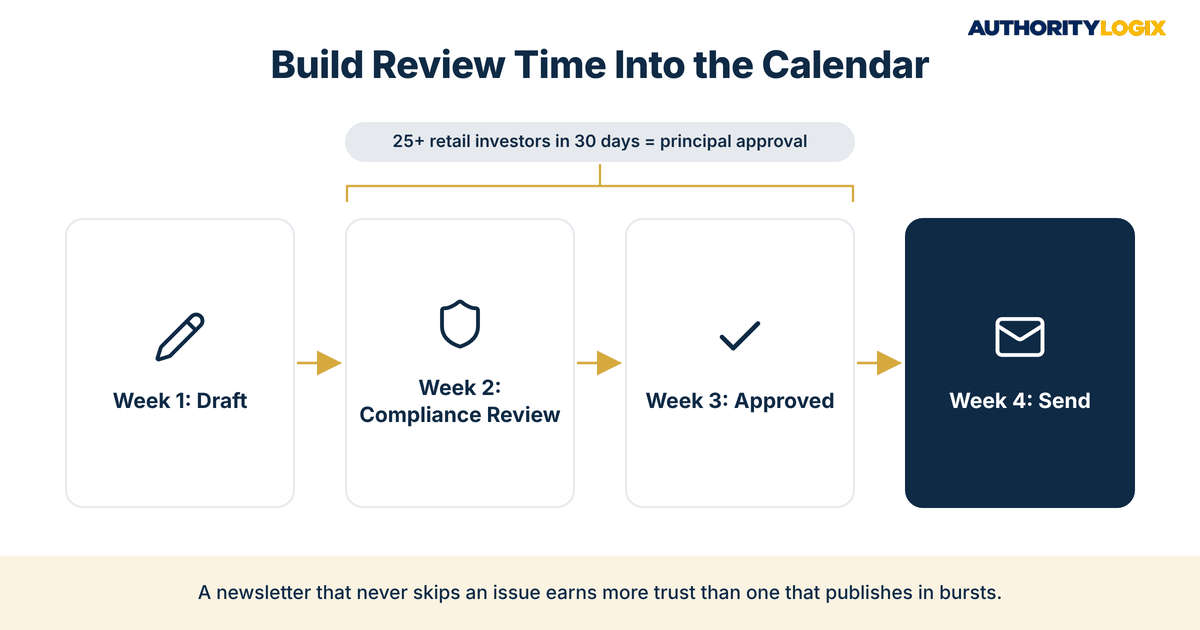
Cadence is a compliance question before it is a marketing question. For broker-dealer affiliated advisors, FINRA Rule 2210 defines a retail communication as any written or electronic communication distributed to more than 25 retail investors within any 30 calendar-day period, and each one must be approved by a qualified registered principal before use. Under almost any financial advisor newsletter content strategy, a send to the full list clears that threshold. Registered investment advisers answer to the SEC marketing rule and their own compliance policies instead, but the practical lesson is the same: review time has to be built into the schedule.
Building a Financial Advisor Newsletter Content Strategy Around Review Time
Financial firm newsletter publishing works best when the calendar runs backward from the send date. Draft the issue three to four weeks out, route it to compliance with the linked web page attached, and lock the send only after both are approved. Firms that write in the week of the send skip issues whenever review runs long.
Monthly is the cadence most small advisory teams can sustain with review built in. The authority guide treats consistency as a trust signal in its own right, and a newsletter that arrives during the same week every month is one of the clearest versions of that signal. A financial advisor newsletter content strategy that holds its cadence for a full year earns more credibility than one that publishes in bursts.
The review burden also drops when issues are built from pre-approved source material. Firms that keep a library of reviewed explanations can assemble new issues faster, because most of the language has already cleared compliance. Specialized finance content development produces that library in a form that serves the website, the newsletter, and social distribution from one approved source, which keeps financial firm newsletter publishing on schedule.
Measuring Newsletters by Meetings, Not Opens
Open rates have become an unreliable scorecard for a financial advisor newsletter content strategy. Litmus email client data shows Apple accounted for 76.56% of tracked opens in its September 2026 report, and Litmus estimates that Apple’s Mail Privacy Protection now affects roughly 55 to 60% of all email opens by loading messages automatically. An open no longer reliably means a person read anything.
Benchmarks still help as a rough baseline. In Campaign Monitor benchmark data drawn from more than 100 billion emails sent in 2021, financial services emails averaged a 27.1% open rate, a 2.4% click-through rate, and a 0.2% unsubscribe rate. Mailchimp’s benchmarks, last updated in December 2023, put its Business and Finance category at a 31.35% open rate and a 2.78% click rate.
Financial Advisor Newsletter Content Strategy Metrics That Matter
| Metric | What It Tells You | Weight |
|---|---|---|
| Opens | Delivery and rough interest, distorted by privacy features | Low |
| Clicks to site pages | Which topics earn deeper reading | Medium |
| Direct replies | Readers treating the issue as a conversation | High |
| Forwards and referrals mentioned | Clients sharing your thinking with others | High |
| Intro meetings booked | The newsletter’s direct contribution to pipeline | Highest |
The measures that matter in a financial advisor newsletter content strategy sit further down the path. Track replies, clicks to specific site pages, intro meetings booked from newsletter links, and the number of new prospects who mention an issue in their first conversation. Feeding those signals into a lead system shows which topics produce meetings and which only produce opens.
Measurement should also follow the content beyond the inbox. A strong issue can be posted to LinkedIn, and published as a site page, and authority distribution tracks how each version performs so next month’s topics follow evidence instead of guesswork. Litmus’s 2025 State of Email research found that 21% of marketing leaders do not measure email ROI at all, a gap any financial advisor newsletter content strategy can close with simple tracking.
Financial Advisor Newsletter Content Strategy Mistakes That Drive Unsubscribes
Unsubscribes are rarely about frequency alone. They come from issues that feel written for someone else. The mistakes and questions below come up most often when advisory firms review a financial advisor newsletter content strategy that has stopped producing replies.
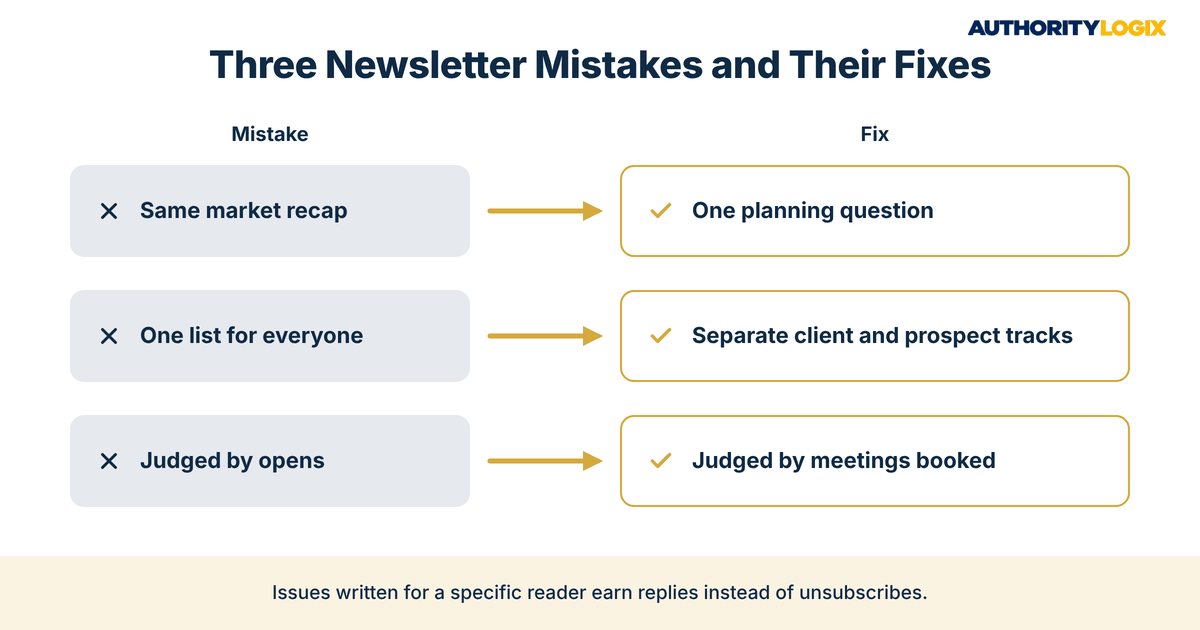
Mistake: sending the same market recap everyone else sends
Readers already get daily commentary from custodians and financial media, so a recap adds nothing they cannot find elsewhere. Replace it with one planning question per issue and a clear next step, which is how newsletters start contributing to lead generation instead of just maintaining a list.
Mistake: running one list for clients, prospects, and partners
Each group needs something different, and a single list forces every issue into a compromise. Segment at signup with one simple question about the reader’s relationship to the firm, then write separate tracks.
How long should each newsletter issue be?
Long enough to make one point well and short enough to read in a few minutes. Put the depth on the linked site page, where it also builds search visibility.
Should an advisor write the newsletter personally?
The advisor’s thinking should drive every issue, because judgment and experience are what readers subscribe for. Expertise is the asset. The drafting, editing, compliance routing, and publishing can sit with a team or partner, which is the division of labor behind what we do for financial firms.
How quickly does a newsletter produce new clients?
There is no honest guarantee, because events in a prospect’s life set the timeline, not your send schedule. What a financial advisor newsletter content strategy can do is make sure your firm is remembered when that moment arrives. The process for how we build that kind of steady visibility starts with the system, not the send button.
Ready for a newsletter clients open and prospects join? We’ll plan the content and build the sign-up path around it.
Staying Visible Between Client Decisions
A financial advisor newsletter content strategy is not a shortcut. It is a quiet, steady system that keeps a firm present in the long gaps between a client’s decisions, and those gaps are where many advisory relationships are won or lost. The firms that grow are the ones still being read when a prospect’s circumstances change, a point the growth playbook builds on across every channel.
The honest answer is that most advisors already have the expertise their readers want. What is missing is the infrastructure that turns that expertise into a monthly issue worth opening, a page worth finding, and a meeting worth booking. AuthorityLogix built that approach on its own platform first, and BKDSCR.com reached 48 SEO-optimized blog posts and 18 pillar pages with zero paid ads, which is why it works as a model rather than a theory.
If your financial advisor newsletter content strategy sends an issue every month and nothing comes back, the channel is not the problem. The system around it is, and that system can be built in stages, starting with the issue you send next month. When you are ready to map it out, work with us to build the publishing infrastructure behind it.