


Key Takeaways
- Financial services authority compliance marketing builds trust by publishing what a firm can prove — credentials, process, and education — instead of outcomes it cannot promise.
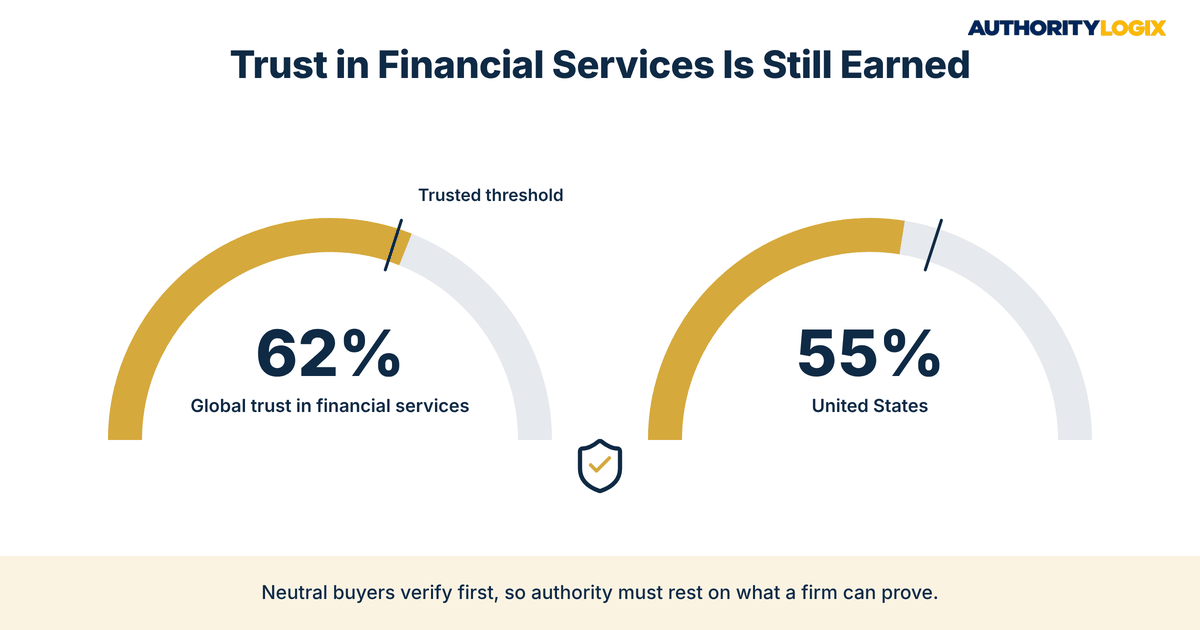
- Trust is still fragile: Edelman’s 2024 Trust Barometer special report found 62% of people globally trust financial services, while the United States sat at a neutral 55%.
- Regulators target promises, not expertise — FINRA’s 2026 oversight report flags promissory claims and omitted material information in social posts and app notifications.
- In one September 2023 sweep, the SEC settled with nine advisers for a combined $850,000 over hypothetical performance shown on their public websites.
- Compliant financial marketing authority comes from an educational library a compliance reviewer can approve once and a search engine can rank for years.
- Financial services authority compliance marketing is a system build: review workflow, educational content, and distribution working together under one set of approved claims.
Table of Contents
Financial services authority compliance marketing starts from an uncomfortable fact: the firms with the deepest expertise are often the ones least willing to say anything in public, because every sentence feels like a potential exam finding. You have spent years earning credibility with clients, referral partners, and regulators, yet the market outside your network sees almost none of it. That silence is not caution paying off — it is a visibility gap, and it is why a firm with half your experience shows up first. The answer is not louder claims but a publishing approach built around FINRA compliance from the first draft, so authority grows without a promise you would have to walk back.
Skeptical buyers have seen rate ads that hid the terms, hypothetical performance charts, and “guaranteed approval” mailers that ended in consent orders. Financial services authority compliance marketing is the alternative — authority built from verifiable proof, inside the rules.
Why Financial Services Authority Compliance Marketing Wins Trust
Trust in financial services is earned slowly and lost quickly. Edelman’s 2024 Trust Barometer special report on financial services found that 62% of respondents worldwide trust the sector to do what is right. That narrowly puts the industry in Edelman’s “trusted” range for the first time and is the strongest reading since the 2008-2009 financial crisis. In the United States the figure was 55%, which Edelman classifies as neutral. A neutral audience is not hostile, but it is not giving anyone the benefit of the doubt either.
That is the environment financial services authority compliance marketing is designed for. A neutral buyer verifies before calling — they search your name, read what you have published, and compare it with what competitors say. Firms that answer those searches with clear education, visible credentials, and plainly explained processes pass the verification test. The search side of that equation, from keyword targeting to page structure, is mapped in the SEO playbook.
The regulatory frame actually helps. FINRA Rule 2210 requires broker-dealer communications to be fair and balanced and prohibits promissory or exaggerated statements, and the SEC Marketing Rule applies similar discipline to registered investment advisers. Read as marketing guidance, those rules describe what a skeptical buyer already wants: substance, balance, and no hype. Financial services authority compliance marketing turns that standard into a publishing system for lenders, advisors, and DSCR specialists alike, which is why the services hub organizes the work by system rather than by tactic.
The Financial Services Authority Guide covers how lenders and advisors build trust and credibility that converts in a skeptical market — the foundation of financial services authority compliance marketing.
Advisor Authority Building FINRA Reviewers Can Approve
Advisor authority building FINRA reviewers can approve starts with a different question than most marketing does. Instead of asking what will grab attention, ask what you can say that is true, balanced, and useful to a prospect who is still deciding. The regulator’s published FINRA guidance on communications with the public sets the boundaries — fair and balanced presentation, no promissory language, and filing requirements for certain retail communications, including all widely distributed retail communications during a new member firm’s first year.
The 2026 FINRA Annual Regulatory Oversight Report shows where firms still slip. Its findings include social media promotions and mobile app push notifications that made promissory claims or omitted material information, and firms that failed to supervise influencers posting on their behalf. It also states that communications created with generative AI must meet the same standards as anything else a firm publishes. None of those findings involve an advisor explaining how a planning process works — they involve shortcuts that financial services authority compliance marketing is built to avoid.
That distinction is the opening. Educational content — how a fee structure works, what a first planning meeting covers, which questions a prospect should ask any advisor — demonstrates expertise without promising results. Routed through a documented review workflow like the compliance system built for mortgage publishers, each piece is approved once, archived for recordkeeping, and then keeps working in search for years.
The Financial Services Authority Compliance Marketing Review Loop
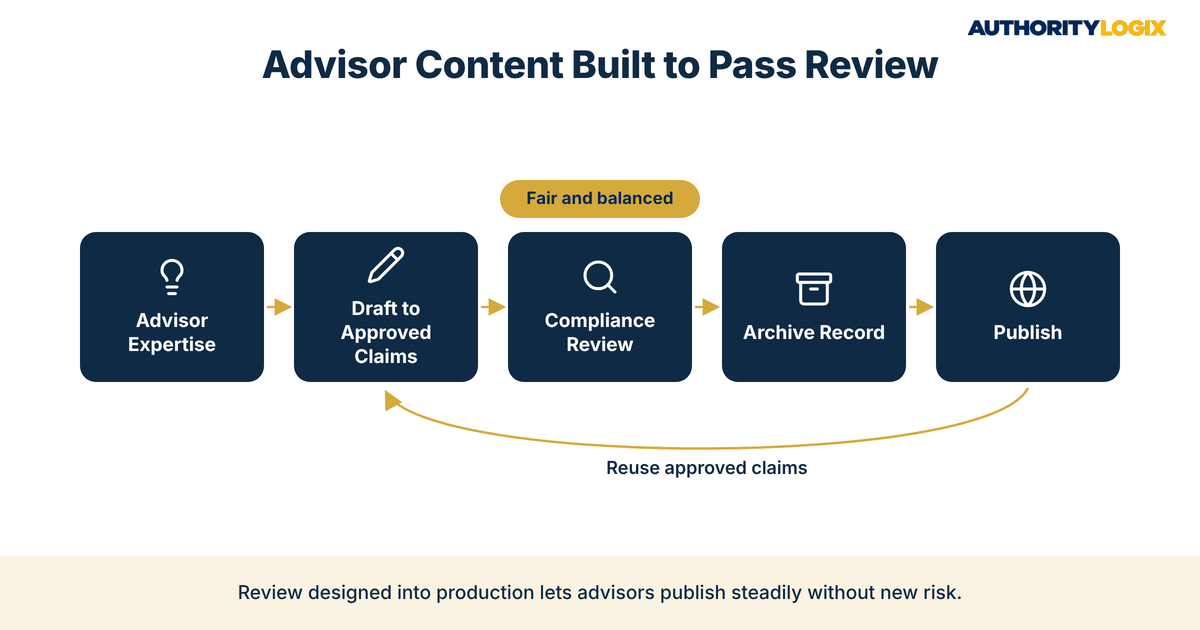
Financial services authority compliance marketing works best when review is designed into production rather than bolted on at the end. The loop is simple: the advisor supplies the expertise, a writer drafts against a pre-agreed list of approved claim types, compliance reviews against Rule 2210 or the Marketing Rule, and the approved version is archived before publication. Building finance content this way cuts rework, because writers stop producing the language reviewers will strike in the first place.
Lender Authority CFPB Rules Do Not Penalize
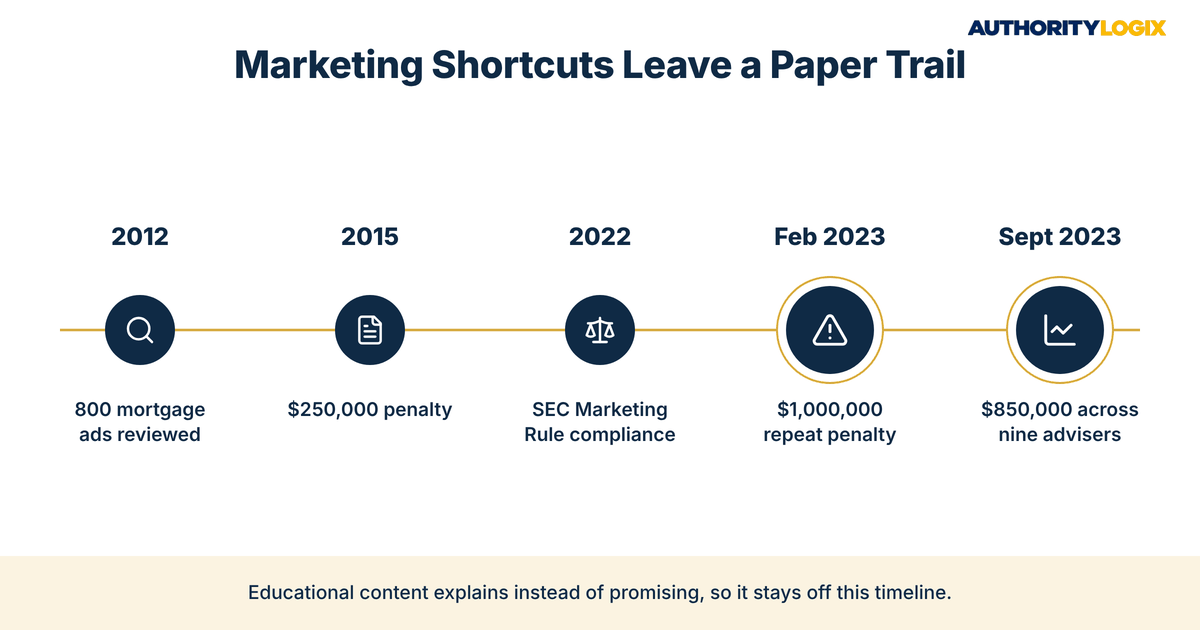
Mortgage lenders face a parallel set of guardrails. The Mortgage Acts and Practices Advertising Rule — Regulation N — prohibits material misrepresentations in mortgage advertising, and the CFPB and FTC share enforcement over non-bank lenders, brokers, and the agencies that create their ads. When the two agencies reviewed about 800 randomly selected mortgage ads in 2012, they flagged patterns including official-looking seals and logos that implied government affiliation, low advertised rates that could mislead consumers about the actual product, and mock checks or offers implying pre-approval when more steps were required.
Notice what was missing from that list. No regulator flagged a lender for explaining how DSCR underwriting works, publishing a plain-language guide to closing costs, or showing a loan officer’s NMLS number and years in the business. Lender authority CFPB rules do not penalize is built from exactly that material — specific, verifiable, and useful. Google’s search quality guidelines reward the same qualities, which is why the E-E-A-T signals that help a mortgage site rank overlap so heavily with the ones that keep it compliant.
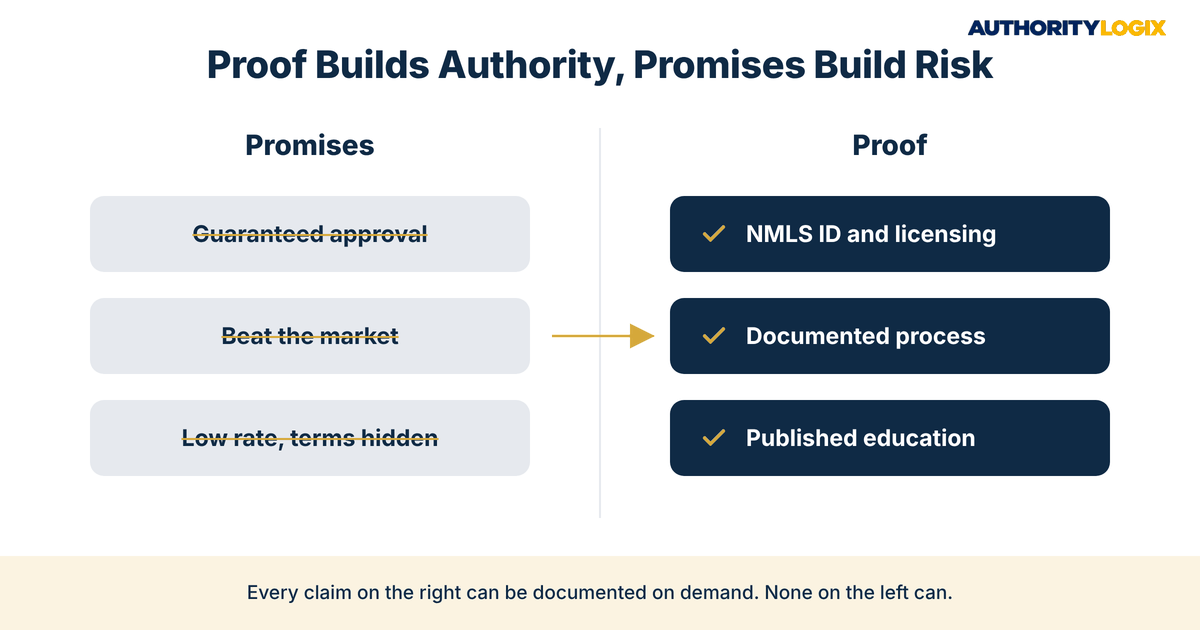
The practical structure is a set of substitutions. Each common promise has a financial services authority compliance marketing alternative that does the same persuasive job with far less exposure:
| Rule or Regulator | Promise That Creates Risk | Financial Services Authority Compliance Marketing Alternative |
|---|---|---|
| FINRA Rule 2210 | “This strategy will beat the market” | Explain the process and its risks in plain language |
| SEC Marketing Rule | Hypothetical performance on a public website | Publish the investment philosophy and how decisions get made |
| Regulation N (MAP Rule) | A low “fixed” rate with the terms hidden | An educational rate guide with every material term disclosed |
| Regulation N (MAP Rule) | Seals or wording that imply government affiliation | Real credentials: NMLS ID, licensed states, years lending |
| CFPB and FTC enforcement | “Guaranteed approval” offers | Published qualification criteria and the documents a borrower needs |
Each row replaces a claim the firm cannot control with proof the firm can demonstrate on demand. Lenders that run this substitution across every page, post, and listing — through content systems rather than one-off copywriting — end up with a site where nothing needs to come down after an exam. Financial services authority compliance marketing at the lender level is mostly that discipline repeated until it becomes the default.
Not sure where your firm stands on compliant authority? The Authority Gap Assessment shows where your visibility, credibility signals, and review workflow are weakest — and what to build first.
Compliant Financial Marketing Authority: Proof Without Promises
Compliant financial marketing authority rests on one test: could the firm document this claim tomorrow if a regulator, a prospect, or a journalist asked? Credentials, licensing details, years in business, a clearly described process, and educational material all pass it. Outcome promises fail it, with regulators and with buyers.
This is where the parent framework matters. A compliance-aware content system organizes proof into layers — credential pages, process explainers, educational articles, and FAQs — so each claim lives in one approved place and every other page points to it. Financial services authority compliance marketing then becomes cumulative: every approved piece adds to the library instead of starting from zero.
Expertise is the asset. A loan officer who can explain why a lender cares about a 1.25 DSCR, or an advisor who can walk through the trade-offs of a Roth conversion in plain language, already holds the raw material for authority. The job is to turn that knowledge into an educational hub organized by the questions buyers search — the format regulators read as education and Google treats as topical depth.
What Financial Services Authority Compliance Marketing Can Prove
The most persuasive proof in financial services authority compliance marketing is often the least glamorous. Publication history shows consistency. A transparent process page shows how decisions get made. A named, credentialed author on every article shows accountability — which matters because buyers in a neutral-trust market want to know who is speaking before they decide whether to believe it.
BKDSCR.com, the AuthorityLogix proof-of-concept in the NYC outer-borough DSCR niche, was built on that principle. Its 18 pillar pages, 7 interactive investor tools, and 48 blog posts explain DSCR lending without promising anyone a loan, and the platform was built in under 18 months with zero paid ads. The authority comes from depth and usefulness, not from claims about results.
Distributing Compliant Authority Content Without Creating New Risk
Approved content still has to reach people who will never visit your site — through syndication, LinkedIn, search, and AI answer engines. Each channel creates a new copy of your claims, so financial services authority compliance marketing keeps distribution inside the same review boundaries as the original piece.
FINRA’s 2026 findings on influencer supervision show what happens when it does not: content posted on a firm’s behalf, outside normal review, became a supervision failure. A disciplined approach to authority distribution avoids that by pushing out only pre-approved assets, keeping the archive intact, and treating every reposted excerpt as the same communication it came from. Financial services authority compliance marketing at the distribution layer is less about reach and more about control.
Distribution also connects authority to pipeline. Kitces Research’s 2026 marketing study, as reported by Financial Planning, put the typical advisor client acquisition cost at $2,551 and found search engine optimization to be one of the more efficient tactics measured, at $0.45 of cost per dollar of new client revenue. Approved educational content that ranks and gets shared is what feeds a lead system built on first-party inquiries rather than purchased lists.
The same study found high-growth firms drew about a third of new-client revenue from referrals, versus roughly 80% for slower-growing peers. Financial services authority compliance marketing is what makes the channels they added safe to run at volume.
Financial Services Authority Compliance Marketing Mistakes That Undermine Authority
Most compliance problems are shortcuts taken under pressure to produce leads, not bad intent. Here are the mistakes and questions that matter most in financial services authority compliance marketing.
Mistake: Treating hypothetical performance as harmless website copy
The SEC Marketing Rule’s compliance date was November 4, 2022, and within a year the agency had settled ten cases under it. In September 2023 alone, nine registered investment advisers paid a combined $850,000 for advertising hypothetical performance on their public websites without the required policies and procedures, according to Simpson Thacher’s summary of the sweep. A chart that feels like marketing to the firm reads as a performance claim to the regulator.
Mistake: Repeating a claim after being told to stop
In February 2023, the CFPB ordered RMK Financial Corp., doing business as Majestic Home Loan, to pay a $1,000,000 civil penalty over mortgage ads that implied VA and FHA affiliation. The company had already paid $250,000 under a 2015 order for similar conduct, and the Bureau found violations across more than seven million ads through 2019. Authority borrowed from government credibility does not compound — it accumulates penalties.
Question: Does compliance review make lead generation impossible?
No — financial services authority compliance marketing changes what generates the lead. Gated guides, rate-explainer tools, and educational webinars all work inside the rules when the claims are reviewed once and reused, which is how compliant lead generation keeps producing inquiries without a new review cycle every week. The firms that struggle are the ones pushing unapproved promotional copy through review one ad at a time.
Question: Should we publish less to stay safe?
Publishing less does not reduce risk — publishing unreviewed material does. A silent firm hands the search results to less careful competitors. An audit of what you have, what you need, and where the compliance gaps sit is what we do before any new content is written.
Question: How long before compliant authority shows results?
There is no guaranteed timeline, and anyone promising one is making exactly the kind of claim this article warns against. What can be planned is the sequence — review workflow, credential pages, core educational content, then distribution — and that order is how we build every engagement. Educational content tends to gain search visibility over months, not weeks.
Want marketing that builds authority and passes compliance review the first time? We’ll design a content system around the rules your firm follows.
Financial Services Authority Compliance Marketing: Credibility Built on What You Can Prove
Compliance is not the obstacle to authority in financial services — it is the filter that separates durable authority from noise. The firms that will own their markets over the next five years are building libraries of approved, verifiable, genuinely useful content now, a long-horizon approach the growth playbook treats as the core of compounding growth. Authority compounds.
Financial services authority compliance marketing will not make a weak firm look strong, and it will not produce leads overnight. What it does is make a strong firm visible on terms a regulator can approve and a skeptical buyer can verify. The evidence behind why it works is a platform built in a live market without paid ads — not a promise about what will happen in yours.
The honest answer is that most lenders and advisors already have the expertise and the track record. What is missing is the financial services authority compliance marketing infrastructure that makes the market see it, without a single claim you would have to defend in an exam. If that is the gap in your firm, work with us to build it in the right order.