


Key Takeaways
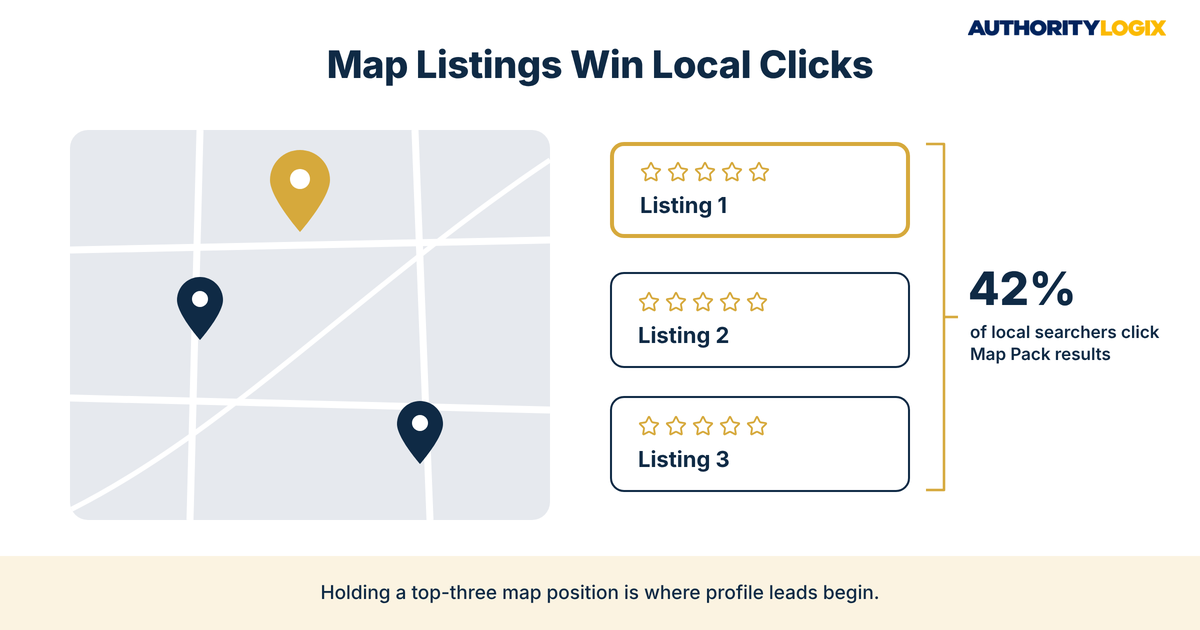
- Mortgage Google Business Profile leads come from the Map Pack, where 42% of local searchers click on results, according to Backlinko.
- Published benchmarks show GBP mortgage leads per month climbing from about 3 in month one to 31+ by month twelve when the profile is backed by local SEO work.
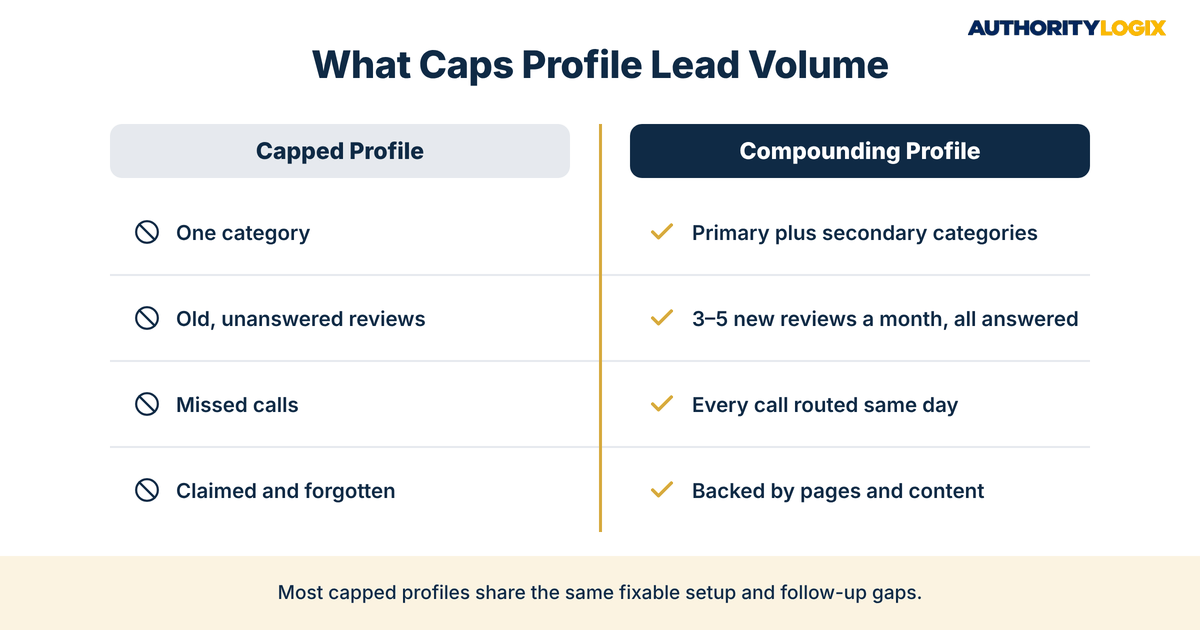
- A Klinically audit of 59 mortgage profiles found 95% use only one category, even though Whitespark’s 2026 ranking factors report rates primary category as the strongest local pack signal.
- Review standards keep rising: 31% of consumers only use businesses rated 4.5 stars or higher, according to BrightLocal’s 2026 Local Consumer Review Survey.
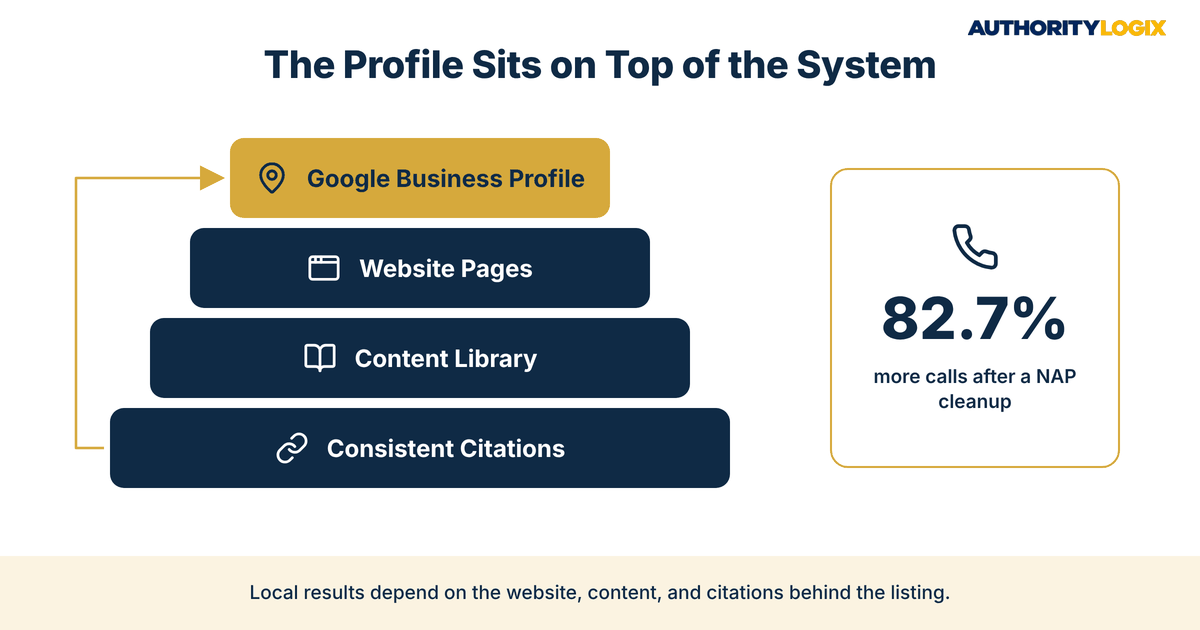
- Mortgage local SEO results depend on the website, content library, and citations behind the profile, not on the listing alone.
- Mortgage Google Business Profile leads are only captured when every call, message, and form from the map is routed and answered the same business day.
Table of Contents
What Drives Mortgage Google Business Profile Leads in a Local Market
Mortgage Google Business Profile leads come from a place most loan officers treat as an afterthought: the small map listing that appears above the organic results when a borrower searches for a lender nearby. You have spent years building a reputation with realtors, past clients, and builders, yet a borrower who searches “mortgage lender near me” sees three businesses on a map — and they may not include you. That listing is not a directory entry to claim once and forget. It is the front door that a properly built GBP setup turns into a steady source of calls, direction requests, and website visits.
The firms that collect mortgage Google Business Profile leads every week are rarely the largest lenders in town. They are the ones whose profiles send Google clear, consistent signals. Whitespark’s 2026 Local Search Ranking Factors report rates the primary business category as the single strongest local pack factor, followed by proximity to the searcher and keywords in the business name — and it notes that review signals and behavioral signals gained importance this year.
Prominence is where experience finally shows up. Reviews, consistent business details across directories, and a website that demonstrates real expertise all tell Google that a lender is established — the same trust principles the authority guide applies to every financial services firm. Without the infrastructure that surfaces those signals, Google and the borrower cannot tell the difference.
This is why the profile cannot be managed in isolation. It works as one component of a connected visibility system that also includes the website, the content library, and the citation footprint, which is how the financial services services hub frames every engagement. When those pieces point at the same business with the same details, mortgage Google Business Profile leads stop arriving at random and start arriving on a predictable curve.
The Financial Services SEO Playbook explains how lenders build the search infrastructure that local profiles depend on — from category structure to content architecture.
GBP Mortgage Leads Per Month: What the Benchmarks Show
The 31+ figure in this article’s title comes from published mortgage SEO research, not a promise. According to Web Tonic data compiled for 2026, a mortgage profile supported by local SEO work moved from roughly 3 leads in month one to 31 or more by month twelve, a ramp the report attributes to TheBigBot. The same roundup credits Backlinko, whose own data shows 42% of local searchers click on results inside the Map Pack.
That ramp matters more than the endpoint. GBP mortgage leads per month do not jump from zero to thirty because a profile was claimed; they climb as reviews accumulate, categories sharpen, and the website behind the profile earns trust. Your own volume of mortgage Google Business Profile leads will depend on your market, your competition, and how complete the system around the profile is.
| Benchmark | Figure | Source |
|---|---|---|
| Mortgage Google Business Profile leads, month one vs month twelve | About 3 rising to 31+ per month | Web Tonic 2026, citing TheBigBot |
| Local searchers who click results inside the Map Pack | 42% | Backlinko |
| “Home-loan lender near me” searches that trigger the Map Pack | 74% | ClicksGeek |
| Mortgage profiles using only one GBP category | 95% | Klinically audit of 59 profiles |
| Consumers who always read reviews when browsing for a business | 41%, up from 29% in 2025 | BrightLocal 2026 Local Consumer Review Survey |
Read together, these benchmarks describe a narrow funnel with a wide top. Nearly three in four local lender searches show a map, most clicks go to three listings, and a meaningful share of those clicks become phone calls. Holding one of those three positions is the job of local SEO, and the profile is only the most visible part of it.
The first four months are spent building the review base, citations, and supporting pages Google uses to validate a profile. That groundwork is easy to misread as failure. A lender who pairs the profile with an educational hub of answers to local borrower questions gives Google more reasons to trust the listing and gives borrowers more reasons to call. Mortgage Google Business Profile leads accelerate in the back half of the year because that groundwork finally carries weight.

Loan Officer GBP Results: The Profile Work That Moves Them
Loan officer GBP results depend on a short list of profile decisions that most lenders get wrong at setup and never revisit. The Klinically audit of 59 mortgage profiles found that 95% of brokers use only one GBP category, which leaves relevance signals unused for every loan product beyond the primary one. Because Whitespark rates primary category as the strongest local pack factor, that single field deserves more attention than any other setting on the profile.
How Reviews Shape Mortgage Google Business Profile Leads
Reviews are the second lever, and the bar keeps rising. BrightLocal’s 2026 Local Consumer Review Survey of 1,002 US adults found that 31% will only use a business rated 4.5 stars or higher, up from 17% the year before. Recency counts too: 74% look for reviews from the past three months, 80% are more likely to use a business that responds to all of its reviews, and 50% are turned off by generic, templated replies.
Klinically’s audit shows where mortgage profiles fall short of that standard. Top-three brokers gain 3–5 new reviews per month, while 70% of audited profiles respond to fewer than half of their reviews. A review request built into the closing process, rather than left to memory, is the piece of the lead funnel that keeps the profile current. Each closed loan becomes the proof that wins the next borrower, and that is how mortgage Google Business Profile leads begin to feed themselves.
Completeness, Posts, and the Loan Officer GBP Results They Produce
Completeness is the third lever. Google’s own Business Profile help documentation states that customers are 70% more likely to visit and 2.7 times more likely to consider a business reputable when they find a complete profile on Search and Maps. For mortgage Google Business Profile leads, that means accurate hours, service areas, every loan program listed as a service, a borrower-focused description, and real team photos.
Profile posts are where most lenders stall, because posts require a steady supply of local, accurate material. Lenders with working content systems never face that problem, since every new article, program explainer, or market update already exists and can be summarized for the profile in minutes. The profile stays active because the publishing infrastructure behind it is active, and active profiles are the ones that keep mortgage Google Business Profile leads coming.
Not sure where your firm stands on mortgage Google Business Profile leads? The FS Authority Gap Assessment shows which profile, review, and content gaps to close first.
Mortgage Local SEO Results Beyond the Profile
Mortgage local SEO results are rarely won or lost on the profile alone. When a borrower taps a listing, the next stop is usually the website, and Google treats that website as evidence of whether the profile deserves its position. A thin site tells Google, and the borrower, very little about whether mortgage Google Business Profile leads should flow to that listing.
What changes this is a structured library of pages built around what local borrowers actually search. A mortgage company’s content system maps loan program pages, county or neighborhood pages, and educational articles to the questions borrowers ask before they apply. Each page links back to the core service pages, so the profile’s website link points at something worth ranking.
Citation consistency matters here as well. When the business name, address, and phone number match across directories, data aggregators, and the website, Google has fewer reasons to doubt the listing. Integrity Home Mortgage reported an 82.7% increase in calls, a 57.6% rise in search views, and a 24.8% rise in website visits after Synup-powered listing and NAP cleanup, according to a case study compiled by Web Tonic — figures from one firm’s campaign, not a forecast for any other.
The pages themselves need to be written by someone who understands lending. Compliance-aware finance content answers borrower questions accurately without crossing into advice, and it carries the experience signals Google weighs heavily for financial topics. That is what turns a website from a brochure into a reason for Google to keep sending mortgage Google Business Profile leads to the same listing month after month.
BKDSCR.com is the AuthorityLogix proof-of-concept for this layer. It was built with 18 pillar pages, 7 interactive investor tools, and 48 blog posts in the NYC outer-borough DSCR niche, and it generates inbound leads with zero paid ads. The library behind a listing does much of the ranking work the listing gets credit for.
Turning Profile Calls and Clicks Into Applications
A call from the map is only a lead if someone answers it. Many Map Pack clicks become a call or a direction request, which makes the phone number on the profile one of the highest-intent channels a lender has. Missed calls, slow callbacks, and generic voicemail quietly erase mortgage Google Business Profile leads that the profile already earned.
The fix is a defined response process. Every profile call, message, and website form should route into one CRM, trigger an immediate acknowledgment, and land with a named loan officer the same business day. That routing is the practical side of lead generation infrastructure — the part borrowers never see but always feel.
Borrowers who click instead of call often search the lender’s name and check whether the firm appears anywhere beyond its own site. Syndicated articles, local media mentions, and partner features, the work of authority distribution, give that second search something credible to find.
Tracking closes the loop. UTM parameters on the profile’s website link, call tracking on the listed number, and a monthly review of Business Profile performance data show which actions produce applications. Without that measurement, a lender cannot tell whether GBP mortgage leads per month are rising because of the profile, the website, or a seasonal shift in the market, and cannot say which mortgage Google Business Profile leads actually closed.
GBP Mistakes That Cap Mortgage Google Business Profile Leads
Most profiles that underperform share the same handful of problems. These are the questions lenders ask most often when mortgage Google Business Profile leads stall.
Is claiming and verifying the profile enough?
No. Verification only makes the listing eligible to appear; it does nothing to rank it. Category selection, reviews, completeness, and a supporting website determine whether mortgage Google Business Profile leads ever arrive.
Why does a competitor with less experience outrank us on the map?
Google ranks the signals it can see, not the experience behind them. A newer lender with more recent reviews, a sharper primary category, and an active profile will often outrank a veteran whose listing has not changed in years. Your referral network is a ceiling, not a foundation, and the lead system that lifts that ceiling starts with signals the market can actually see.
Should we pay for Local Services Ads instead?
Paid placements can add calls, but they stop the day the budget does. Web Tonic’s local SEO statistics, citing LeadPops, put Google Local Services Ads at $25–$70 per lead. Infrastructure compounds. Ads stop. A ranked profile keeps producing mortgage Google Business Profile leads without a per-lead charge.
How long before mortgage Google Business Profile leads show up?
Based on the ramp described in the benchmarks above, most of the lift comes after month four, once reviews and supporting pages are in place. An honest audit at the start, which is the first step in what we do, sets expectations from your market’s actual competition rather than a national average. Some markets move faster, and dense metros usually move slower.
What should we fix first?
Start with the profile’s primary category, business details, and review process, then build the website pages that support it. Content and distribution come after the foundation is sound, which is the sequence behind how we build every local visibility system. Skipping ahead produces activity without rankings.
Ready to turn your Google Business Profile into a steady lead source? We’ll build it out and connect it to the pages that convert.
Twelve Months of Mortgage Google Business Profile Leads: An Honest Assessment
The 31+ figure for mortgage Google Business Profile leads is a reasonable target for a well-built system in a competitive market, not a number any profile earns by default. What the benchmarks show consistently is the shape of the curve: slow for the first quarter, steeper through the middle of the year, and durable once the review base and supporting pages are established. That durability is the long-term case made in the growth playbook.
The honest answer is that most loan officers and mortgage companies already have what Google is looking for. They have years of closed loans, satisfied borrowers, and local market knowledge that a newer competitor cannot match. The missing piece is the infrastructure that makes the market see it, and the BKDSCR.com build is the clearest evidence of why it works in a live, competitive market.
If your profile is producing a handful of calls a month and your reputation deserves far more, the gap is fixable but not quick. It takes a sound profile, a review process, a supporting content library, and twelve months of steady work before mortgage Google Business Profile leads reach their full potential. When you are ready to build that system rather than patch the listing, work with us is where the conversation starts.