Key Takeaways
- A real estate content system blueprint is publishing infrastructure, not a content calendar — pillar pages, clusters, and repurposing all have to connect or the content stops compounding.
- Most real estate content disappears the week it’s published because it was never built to rank or get found again — a system fixes that by design, not by accident.
- Editorial calendars fail the moment a busy closing season hits unless they’re built for realistic capacity, not aspirational output.
- Content format should match buyer, seller, and investor intent — a market report and a neighborhood guide serve completely different moments in the decision process.
- One well-built piece of content can become eight distribution touchpoints if repurposing is planned from the start, instead of treated as an afterthought.
- Pageviews are the easiest content metric to track and the least connected to revenue — a real estate content system blueprint measures leads and closed deals, not just traffic.
A real estate content system blueprint exists because most real estate content disappears the week it’s published. A market update goes out, gets a few views, sits untouched for months, and is never seen again — not because the topic was wrong, but because it was written as a one-off post instead of as a piece of durable infrastructure built to keep ranking and generating traffic months later. This is the single most common gap between firms who feel like they are publishing constantly and firms whose search visibility actually keeps growing — the first group is producing content, and the second group is building an asset.
Turning scattered content into a system that compounds, rather than a stream of posts that evaporate, is
what we do. The difference between a firm with a content system and a firm that just posts regularly shows up slowly, then all at once — in traffic that keeps climbing instead of resetting every month. A real estate content system blueprint is what makes that difference repeatable across an entire content library instead of getting lucky with one post that happened to rank.
A content system only works once people can actually find it. If local search visibility isn’t in place yet, start there.
Local SEO Playbook →
Why Most Real Estate Content Doesn’t Compound
Most real estate content is published on impulse — a market shift prompts a post, a closed deal prompts an update, a slow week prompts a “just checking in” email. None of it is wrong to write, but none of it is built to last either. A post written in response to this week’s news has a shelf life measured in days, while a post built around a durable, evergreen question a buyer or seller will keep asking for years has a shelf life measured in the same years.
The fix is not writing less impulsively — reactive content still has its place. The fix is building a foundation of evergreen, structured content underneath it, so the reactive posts sit on top of something that keeps generating traffic long after the news cycle moves on. Firms often try to fix this by writing more, when the actual fix is writing differently — a smaller number of deliberately structured pieces, built to answer questions that stay relevant for years, will outperform a larger volume of reactive posts every time.
Our approach treats that foundation as the actual asset, with reactive content as a supplement to it rather than the whole strategy.
Inside a Real Estate Content System: Pillar Pages and Content Clusters
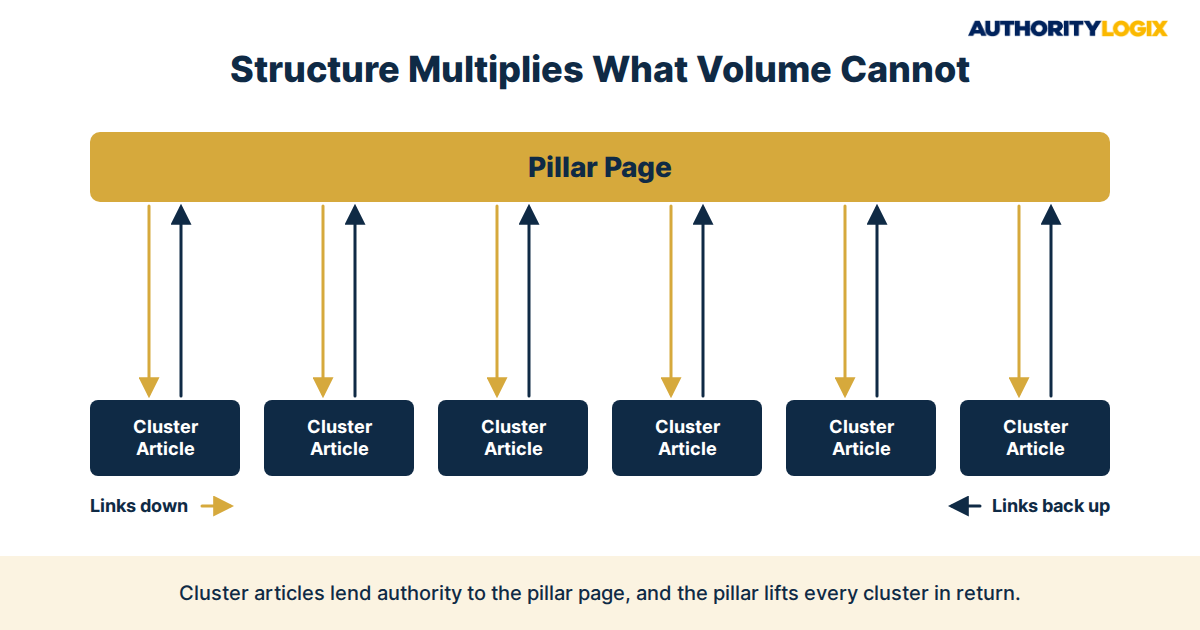
The core building block of a real estate content system blueprint is the pillar-and-cluster relationship. A pillar page is a comprehensive resource on a broad topic — a complete guide to buying in a specific market, a full breakdown of the local investment landscape. A cluster is a set of narrower articles orbiting that pillar, each one answering a specific question the pillar page only touches on. The pillar ranks because of its depth. The cluster pages rank for the long-tail searches the pillar can’t cover in detail, and every cluster page links back to the pillar, reinforcing both.
The relationship runs both directions: the pillar lends its authority to every cluster page that links up to it. And every cluster page that ranks well sends a portion of that authority back to the pillar. A single isolated post has no such relationship to draw on, which is exactly why isolated posts plateau at a fraction of the ranking potential a properly linked cluster achieves.
This is the same architecture behind an authority guide and the insight articles that expand it — a structure most real estate content never adopts, because most firms publish flat, disconnected posts with no hierarchy holding them together. The absence of that hierarchy is rarely a conscious choice — it usually just happens by default, one post at a time, until years of content accumulate with no organizing structure connecting any of it.
Content systems built around pillar-and-cluster architecture consistently outrank firms publishing the same volume of content with no structure connecting it. Structure is the multiplier volume alone cannot replicate.
What a Real Estate Content System Blueprint Actually Means
Broker content publishing strategy is not a posting schedule. It is a decision about which topics deserve pillar-level investment and which deserve a shorter cluster piece, made before any writing starts. Getting this decision right is the actual skill behind a real estate content system blueprint — not writing ability, but editorial judgment about where depth pays off and where it does not. Firms that skip this step end up with a content library that looks productive by volume but has no internal structure — dozens of posts that never reinforce each other, each one starting from zero in search instead of inheriting authority from a parent page.
Pillar pages vs. cluster articles
| Attribute |
Pillar Page |
Cluster Article |
| Scope |
Broad, comprehensive topic |
One specific question within that topic |
| Length |
Long-form, in-depth |
Shorter, focused |
| Job |
Rank for the broad, high-volume search |
Rank for specific long-tail searches |
| Linking |
Links down to every cluster |
Links back up to the pillar |
Source: AuthorityLogix Content Architecture Framework
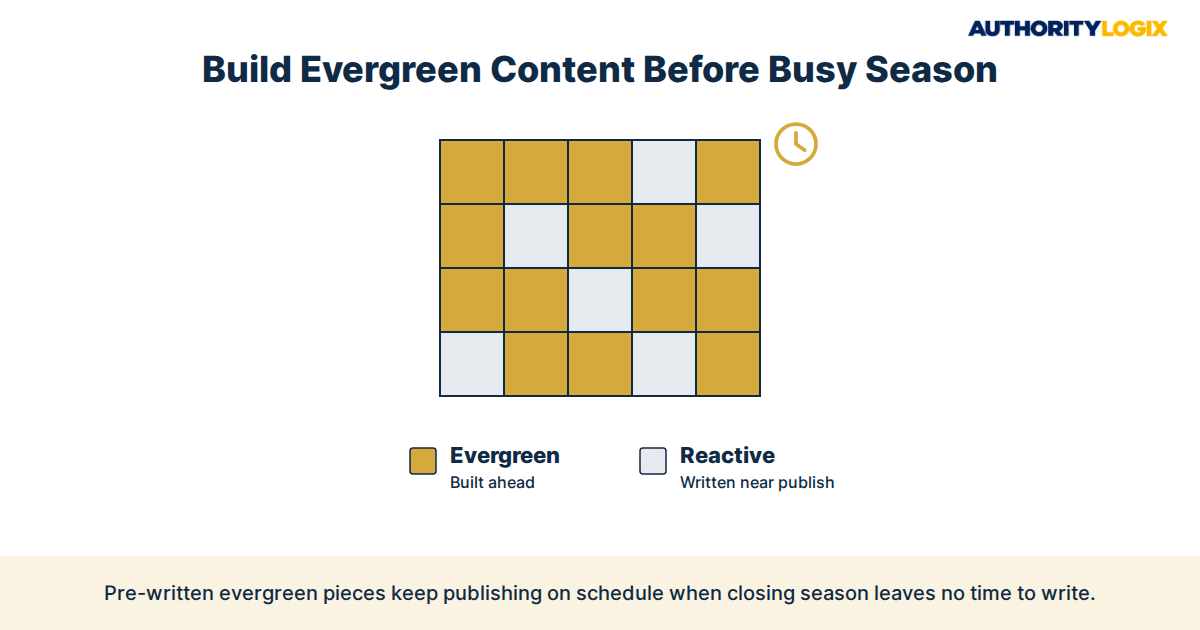
The operational layer of a real estate content system blueprint is the calendar that keeps it running. And an editorial calendar built during a slow month, assuming that pace continues year-round, collapses the moment a busy closing season hits. The calendar itself was never the problem — the assumption behind it was. A realistic calendar accounts for capacity during the busiest month of the year, not the easiest one.
And builds in a buffer of pre-written evergreen content that can run without last-minute writing when there is no time to write anything new. This sounds obvious once stated plainly, but most calendars get built during exactly the wrong month. A slower stretch where writing feels easy and the person building the calendar has no reason to anticipate how different things will feel three months later during peak season.
Publishing systems that separate evergreen pillar content, built in advance during slower periods, from timely reactive content, written closer to publish date, survive busy seasons that break calendars built around a single undifferentiated content stream. The separation is simple in concept and rarely implemented in practice: two content buckets, one built weeks or months ahead of when it publishes and one written close to the moment it goes live, each with its own realistic production timeline instead of one calendar pretending both kinds of content take the same amount of effort.
Content Types That Actually Serve Buyers, Sellers, and Investors
A first-time buyer researching a market wants something different from a seller trying to time a listing, and both want something different from an investor evaluating cash flow across several properties. A single generic blog format serving all three usually serves none of them particularly well — the depth an investor wants overwhelms a first-time buyer, and the reassurance a first-time buyer wants bores an investor comparing deal structures. This mismatch is invisible from the inside — a firm producing a steady stream of generic market content often believes it is serving its full audience, when in reality it is serving the middle of the distribution and losing the buyers and investors at either end who needed something more specific.
Matching format to audience is not about writing three versions of the same post. It’s about recognizing that a market report, a step-by-step guide, and a cash-flow breakdown are different content types serving different intents, and a content system that only produces one type is only serving one segment of the market well.
Investor content built specifically for that audience, distinct from buyer-focused guides, is part of what separates a real content system from a single undifferentiated blog.
The firms that get this right, the kind
our work represents, treat each content type as its own production line with its own research process, not a single template stretched to cover every audience it was never designed for. That specialization is what makes each piece actually land with the audience it was built for.
Agent Content Marketing System Basics: Match Format to Intent
An agent content marketing system works when the format matches where the reader actually is in their process. Someone early in research wants education — how financing works, what a contingency means. Someone close to a decision wants specifics — what’s actually available right now, what similar properties sold for. Serving the wrong stage with the wrong format does not just underperform — it can actively push a reader away, since a first-time researcher confronted with dense deal-structure specifics is likely to leave rather than push through content that was never written for them. A system that only produces early-stage educational content, or only produces late-stage listing-focused content, is missing half the funnel it should be serving.
Content formats matched to buyer, seller, and investor intent
| Content Type |
Best For |
Funnel Stage |
| Market report |
All segments researching timing |
Early — awareness and education |
| Neighborhood or building guide |
First-time buyers, relocating buyers |
Early to middle — narrowing the search |
| Cash-flow or DSCR breakdown |
Investors evaluating deals |
Middle to late — deal evaluation |
| Home value estimate page |
Sellers considering timing |
Late — ready to talk |
Source: AuthorityLogix Content Architecture Framework
Repurposing: One Piece of Content, Eight Distribution Touchpoints
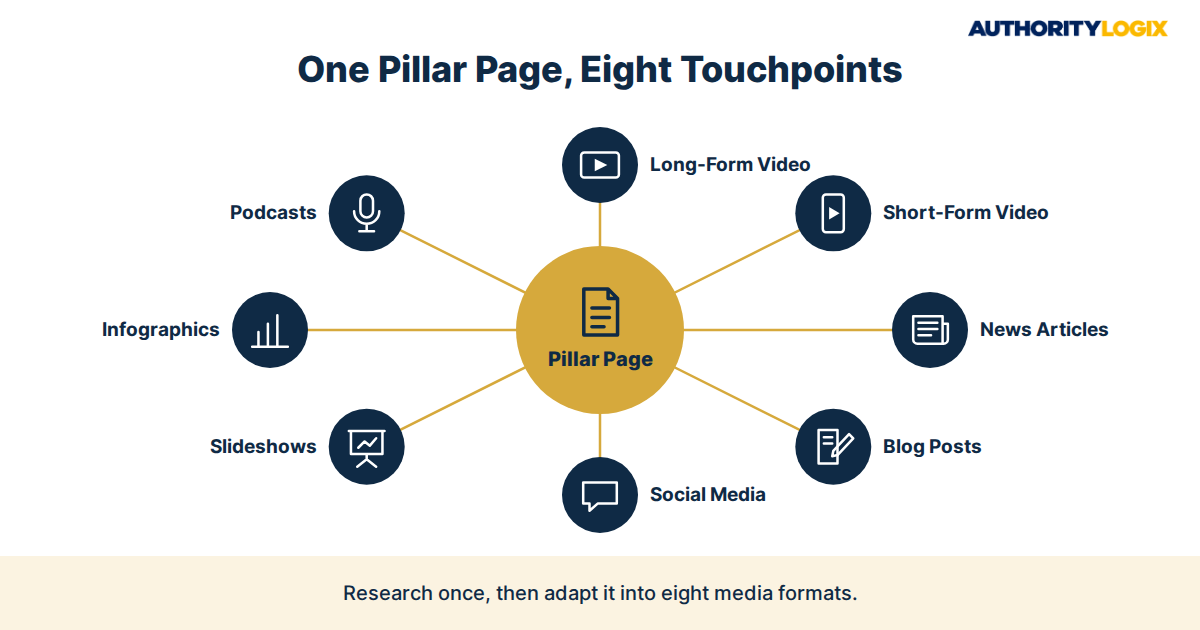
Repurposing is the multiplier layer of a real estate content system blueprint. A single well-researched pillar page can become a long-form video, a short-form video, a news article, a blog post, social media posts, a slideshow, an infographic, and a podcast episode — eight distribution touchpoints from one piece of original research, instead of eight separate pieces of content each requiring their own research from scratch. The research is the expensive part — pulling market data, verifying numbers, structuring the argument.
Once that work is done, adapting it into eight media formats is a fraction of the effort it took to produce the original, which is exactly why repurposing multiplies the return on the initial investment instead of just adding incremental content. Firms that plan for this from the outset get vastly more distribution mileage out of the same editorial effort than firms that write once and publish once.
Authority distribution exists specifically to make sure that mileage actually gets captured instead of left on the table.
Distribution systems built around repurposing treat the pillar page as the source material, not the finished product — everything downstream gets pulled from what the pillar already established, rather than written independently and disconnected from the core research. This sequencing matters: writing the pillar first and repurposing from it produces consistent messaging across every channel, while writing eight pieces independently and hoping they align rarely does.
AI-Assisted Content Without Losing the Human Expertise
Every real estate firm now has access to the same AI tools, which means AI usage alone stops being a differentiator the moment it becomes universal. AI tools can accelerate research, drafting, and repurposing, but the expertise that actually differentiates a firm’s content — the specific market judgment, the deal-structure nuance, the neighborhood-level knowledge — still has to come from the person who actually has it.
The temptation to let AI generate finished content end to end is understandable given how fast it can produce a draft, but a draft is not the same as a differentiated piece of content, and the gap between the two is exactly the market judgment no AI tool has access to. Content that reads as generic, interchangeable with any other firm’s AI output, fails at the one job content is supposed to do: demonstrate expertise a competitor doesn’t have.
The
educational hub a firm builds should reflect that judgment throughout, with AI accelerating the mechanical parts of production — structure, drafting speed, repurposing — while the specific expertise and market judgment stay unmistakably human. Readers, and increasingly AI search tools summarizing local expertise, can tell the difference between content that reflects real judgment and content that was assembled to fill a calendar slot.
Editorial Quality Control: What Gets Published and What Doesn’t
A real estate content system blueprint is only as strong as its weakest published piece, which is why not every draft deserves to be published. A quality control step — checking for accuracy, checking that the piece actually says something a competitor’s content doesn’t, checking that it fits the system rather than existing in isolation — catches content that would otherwise dilute a firm’s authority rather than build it.
This step gets skipped most often under deadline pressure, precisely when it matters most — a rushed, mediocre piece published to hit a calendar date does more damage to a firm’s credibility than simply publishing nothing that week.
Specialized content held to a real editorial bar outperforms a larger volume of unfiltered content nearly every time.
Why us as an editorial partner rather than a content mill comes down to this distinction: volume without a quality bar produces noise, and noise does not build the kind of authority a real estate content system blueprint is supposed to produce. Cutting a firm’s output in half while doubling the editorial standard almost always produces a stronger content library than the reverse.
Measuring Content ROI Beyond Pageviews
Traffic looks like progress on a dashboard, but progress and revenue are not the same thing, and pageviews are the easiest content metric to track and the least connected to revenue. A post that gets ten thousand views and zero inquiries is not outperforming a post that gets three hundred views and two closed deals, no matter what the traffic dashboard suggests.
Traffic dashboards make this mistake easy to fall into, because pageviews update in real time and closed deals take months to materialize, so the vanity metric is always the one available first, and the one that ends up driving decisions by default unless a firm deliberately builds a better measurement system. A real estate content system blueprint needs to track leads generated and deals closed per piece, not just how many people scrolled past it.
This is where content and
lead generation system infrastructure have to connect — content without capture produces traffic with no way to measure downstream value. A pillar page that ranks well but has no capture mechanism attached is a missed opportunity sitting in plain sight, generating visibility without ever converting any of it into something measurable.
The
growth playbook for a firm serious about content ROI treats every pillar page as part of the same funnel the lead generation system depends on, not a separate initiative running in parallel. Treated separately, content rarely gets credit for the leads it actually produces.
Ready to put a publishing system behind your market expertise that agents, brokers and investors find?
Work With Us →
What Most Firms Get Wrong About a Real Estate Content System Blueprint
Straight answers to the questions firm owners actually ask before investing in a real estate content system blueprint. Most trace back to the same handful of concerns about time and quality.
Most of what follows traces back to treating content as a series of individual posts instead of the connected system covered across the
real estate hub of services this playbook is part of. That connection is what separates a playbook from a checklist.
Firms that
educate your market consistently, with content structured to compound rather than published on impulse, are the ones whose libraries keep producing traffic years after individual pieces went live. That consistency is what keeps a content library compounding instead of going stale.
How much content do we actually need to publish to see results?
Less than most firms assume, if it’s structured well. A handful of strong pillar pages with well-built clusters around them outperforms a much larger volume of disconnected posts. Structure matters more than raw output, and a firm publishing half as much with a real hierarchy behind it will usually outrank a firm publishing twice as often with no structure connecting the pieces. Start with the pillars, then fill in clusters over time.
Should we hire a writer, use AI, or do content ourselves?
Most firms end up with some combination — AI or a writer handling structure and drafting speed, the agent or broker providing the specific market judgment that makes the content actually differentiated. Pure AI output with no expert input tends to read as generic and underperforms, while a skilled writer or editor who can extract and structure an agent’s real expertise usually produces the strongest result of the three options. The right mix often shifts over time as a firm’s content library matures and its processes get more efficient.
How do we know if our content is actually a system or just a stream of posts?
Check whether your pieces link to each other in a deliberate hierarchy, or whether each one exists in isolation. If a new visitor lands on one post and has no path to related content on your site, you likely have a stream, not a system — the fix is usually not writing anything new, but going back and building the missing internal links between pieces that already exist. This audit alone often reveals more opportunity than most firms expect. This connects directly to the topic covered in the
authority guide resource.
What’s a realistic publishing cadence for a busy real estate firm?
Consistency matters more than frequency. One well-researched pillar page a month, supported by two or three cluster pieces, sustained over a year, outperforms an aggressive weekly schedule that collapses the first time a closing season gets busy. A cadence you can actually sustain for twelve months beats an ambitious one you abandon after six weeks.
Do older blog posts need to be updated, or is publishing new content enough?
Both matter. A strong older post that has drifted out of date loses ranking over time even without new content diluting it. Refreshing high-performing older pages with current data often produces a better return than writing something entirely new, and it is usually faster to do since the research and structure are already in place. A quarterly audit of your top-performing pages, checking for outdated numbers or stale references, is a small time investment with an outsized return.

Building the System: Turning a Real Estate Content System Blueprint Into Real Estate Firm Content Infrastructure
None of this works as scattered pieces. Pillar pages without clusters rank narrowly. Clusters without a pillar have nothing to reinforce. Repurposing without a source pillar has nothing worth repurposing. A real estate content system blueprint only produces compounding results as a connected structure, with each layer feeding the one above and below it. Firms that try to shortcut this by grabbing one piece of the framework — just pillar pages, or just repurposing, or just a publishing cadence — end up with a partial system that plateaus quickly, because each layer was designed to depend on the others, not to function as a standalone tactic.
A real estate content system blueprint built on fundamentals rather than trends is what separates firms whose content keeps compounding from firms starting over every time a new tactic gets popular, and the gap between those two groups is widening, not narrowing. According to
CMI’s 2026 research, winning marketing teams are doubling down on content fundamentals and using AI to amplify them, rather than treating AI itself as the strategy — the same principle that separates a real content system from a stream of AI-assisted posts with no structure underneath them.
The honest answer is that most firms reading this already have enough market expertise to fill a genuine content system for years, accumulated through deals closed, questions answered, and problems solved that were never written down anywhere a search engine could find them. What’s missing is the real estate firm content infrastructure connecting that expertise to a structure built to compound. If you’re ready to see where your content actually stands, work with us.