Key Takeaways
- A real estate lead generation system is a funnel, not a single tactic — visibility, capture, nurture, and conversion all have to work together or the whole pipeline underperforms.
- Referrals will keep closing deals, but they cap growth at whatever your existing network can produce — an inbound pipeline is what removes that ceiling.
- The offer decides the conversion rate more than the traffic does — a generic “contact us” form converts far worse than a specific, valuable lead magnet.
- Most leads are not ready to talk to an agent the moment they convert — nurture sequences and lead scoring decide which leads get a call today versus in three months.
- Diversifying lead sources protects a pipeline the way diversifying investments protects a portfolio — one channel going quiet shouldn’t stop the whole business.
- Cost per lead is the wrong metric on its own — cost per closed deal is what actually tells a firm whether its lead generation system is working.
A real estate lead generation system exists to answer a question every growing firm eventually runs into: what happens when referrals stop being enough? Referrals are not a strategy. They are a byproduct of past work, and they cap out at whatever your existing network can produce in a given month — which means growth beyond that ceiling requires a different kind of pipeline entirely. That question usually arrives quietly — a slower quarter, a market shift, a few key referral sources who retire or move on — and firms without a pipeline behind their referral network discover the ceiling only after they have already hit it.
Building that pipeline deliberately, so it keeps producing inbound leads independent of who happens to remember you this month, is
what we do. Building a real estate lead generation system before the ceiling arrives, rather than scrambling to build one after, is the difference between a planned transition and a reactive scramble. The firms that make this shift stop treating new business as something that happens to them and start treating it as something they build.
A lead generation system converts best when buyers and sellers already trust the name behind it. If that market authority isn’t in place yet, start there.
Authority Guide →
Why Referrals Alone Can’t Scale a Real Estate Business
Your referral network is a ceiling, not a foundation. It is real, it closes real deals, and it should never be abandoned — but it grows at the pace of your relationships, not at the pace you want your business to grow. A firm doing forty referral deals a year does not suddenly do sixty because it wants to. The network has to expand first, and relationship-based growth is slow by nature. The math is unforgiving: a referral network of a fixed size produces roughly the same number of introductions year over year, absent a deliberate effort to expand it — a firm relying entirely on referrals is capping its own growth without realizing it.
This is not a referral problem. It is an infrastructure problem. Most firms have never built a system that generates first-party leads independent of who happens to remember them this quarter, so when referral flow dips, there is nothing behind it to catch the gap. The firms that feel this gap most acutely are usually the ones who were doing well enough on referrals alone that building a pipeline never felt urgent — right up until the quarter it suddenly did.
Our approach treats inbound lead generation as infrastructure to build once and maintain, not a project to revisit only when referrals slow down.
Inside a Real Estate Lead Generation System: The Funnel Most Firms Never Build
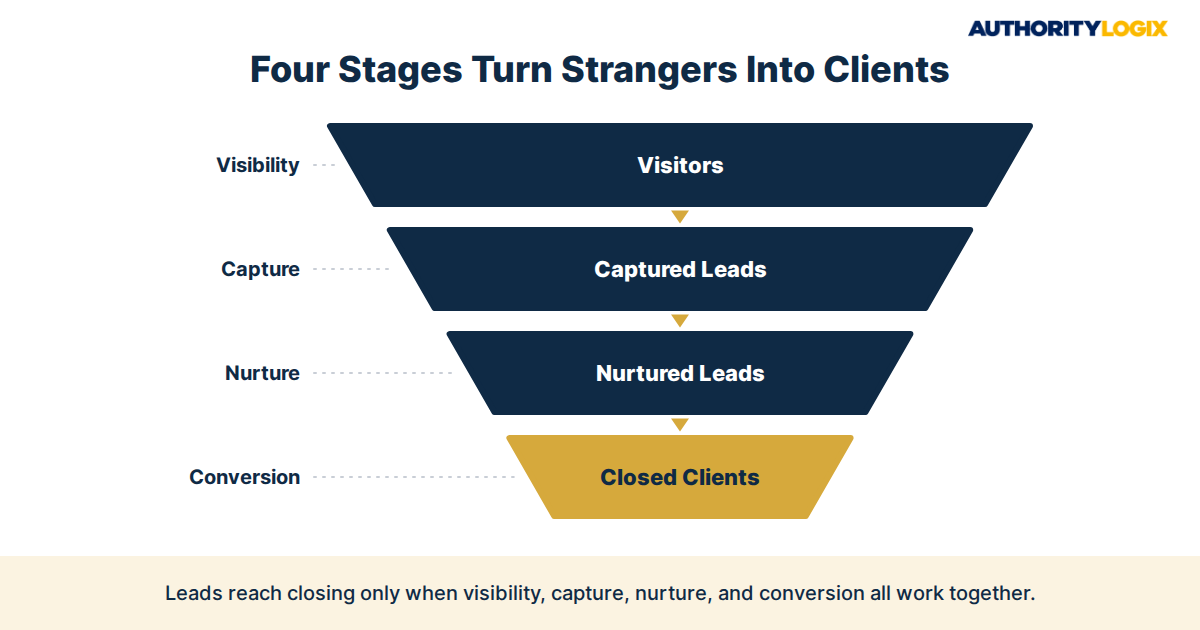
A real estate lead generation system has four stages, and most firms — even ones with a genuinely strong local presence — have only built the first one. Visibility brings a stranger to your site. Capture turns that stranger into a lead with an email or phone number. Nurture keeps that lead engaged until they are ready to act. Conversion turns a ready lead into a client. Firms with a website but no capture mechanism are running a visibility system, not a lead generation system — the traffic arrives and leaves without a trace.
Each stage has its own failure mode, and fixing one without the others rarely moves the needle. High traffic with no capture form produces visitors, not leads. Strong capture with no nurture produces stale contacts nobody follows up with. Good nurture with no scoring wastes an agent’s time chasing leads who are nowhere near ready. The content systems feeding the top of this funnel exist to keep every stage supplied, not just the first one.
This is also where broker lead generation without referrals actually starts to compound. A single well-built funnel stage rarely produces dramatic results on its own, but four connected stages — visibility, capture, nurture, conversion — reinforce each other the same way the
content system behind them does: each new piece makes the next one perform better, not just add to the total. This compounding effect is the entire argument for building the system deliberately instead of adding pieces reactively. A firm that fixes its capture form this quarter and its nurture sequence next quarter, with no coordinated plan connecting the two, ends up with disconnected improvements instead of a functioning pipeline.
What Actually Turns Traffic Into a Real Estate Lead Generation System
Traffic becomes a real estate inbound pipeline only at the point a visitor trades contact information for something they actually want. Everything before that moment is awareness. Everything after it is pipeline. Firms that measure success by traffic alone are measuring the easiest number to move and the least connected to revenue — a doubling of visitors with no change in capture rate produces zero additional clients, just a bigger audience of strangers.
The four stages of a real estate lead generation system
| Stage |
Job |
Common Failure Point |
| Visibility |
Bring a stranger to your site |
No local search or content presence |
| Capture |
Turn a visitor into a lead |
No offer, or a form asking too much too soon |
| Nurture |
Keep the lead engaged until ready |
One follow-up, then silence |
| Conversion |
Turn a ready lead into a client |
No scoring, so hot leads sit in the queue |
Source: AuthorityLogix Lead Generation Framework

Lead Magnets That Actually Convert Buyers, Sellers, and Investors
The offer decides the conversion rate more than the traffic quality does. A generic “Contact Us” form asks a visitor for their information before giving them anything in return, and most visitors are not ready to make that trade this early in their research. A specific lead magnet — a neighborhood market report, a first-time buyer checklist, an investor cash-flow calculator — gives something valuable first, which is why it converts at a meaningfully higher rate.
The best lead magnets solve a narrow, specific problem instead of trying to be broadly useful. “Everything you need to know about buying a home” undersells itself because it promises too much and delivers depth on nothing.
“What your monthly payment actually looks like at three different down payment levels in this market” solves one specific problem completely, and that specificity is exactly what a strong
local SEO playbook is built to drive traffic toward in the first place. The instinct to cover everything comes from a good place — wanting to be genuinely helpful — but breadth and depth trade off against each other in a lead magnet, and depth is almost always what actually converts a specific, motivated visitor into a lead.
Matching the Lead Magnet to the Segment It’s Actually For
A first-time buyer, a move-up seller, and an out-of-state investor are looking for three completely different things, and a single generic lead magnet trying to serve all three usually serves none of them well. Segment-specific offers consistently outperform one-size-fits-all offers, because the visitor immediately recognizes the content was built for someone in their exact situation rather than a generic buyer persona. Building three focused offers instead of one broad one requires more upfront work, but each offer then continues converting its specific segment indefinitely, which makes the additional effort a one-time cost against an ongoing return rather than a recurring expense.
Lead magnets matched to buyer, seller, and investor segments
| Segment |
Lead Magnet Example |
What It Solves |
| First-time buyer |
Down payment and monthly cost breakdown |
Uncertainty about affordability |
| Move-up seller |
Home value estimate with market comparison |
Uncertainty about timing and pricing |
| Out-of-state investor |
Cash-flow and DSCR calculator for the market |
Difficulty evaluating deals remotely |
| Luxury seller |
Confidential off-market buyer network overview |
Privacy concerns about public listing |
Source: AuthorityLogix Lead Generation Framework
From Visitor to Lead: Landing Pages and Capture Systems
A lead magnet promoted on a homepage converts worse than the same lead magnet on a dedicated landing page, because a homepage is trying to do six things at once and a landing page is trying to do exactly one. Strip the navigation, strip the distractions, keep the headline focused on the specific offer, and the form itself short. Every additional field a visitor has to fill out measurably reduces how many complete it.
Publishing systems that treat landing pages as their own content type, distinct from blog posts and service pages, consistently outperform firms that bolt a form onto an existing page and call it a funnel.
The temptation to ask for more information upfront — budget range, timeline, financing status — is understandable, since that information would help qualify the lead immediately. But every field added to a form trades completion rate for information depth. And the better trade in almost every case is a short form now and a qualifying conversation once nurture has warmed the lead up.
Landing page performance is one of the clearest places to see
our work reflected in actual numbers, because unlike brand awareness, a landing page conversion rate is a number you can watch move in real time as specific elements change — the headline, the form length, the offer itself. Small changes compound here in a way they rarely do elsewhere in marketing: a headline rewrite that lifts conversion by a few percentage points, applied across every landing page in the funnel, produces a meaningfully larger pipeline without a single dollar of additional ad spend.
Nurture Sequences: Staying Top of Mind Without Being Annoying
Most leads who download a market report are not ready to list their home or make an offer this week. They are early in a process that might take months, and a firm that stops communicating after the initial download loses that lead to whichever competitor happens to still be in their inbox when they finally are ready. A nurture sequence exists to stay present during that gap without becoming the reason someone unsubscribes.
The
educational hub behind a nurture sequence matters more than the cadence does. A weekly email with genuinely useful market data outperforms a daily email with nothing new to say, because nurture is supposed to build trust incrementally, not just maintain visibility. A lead who trusts the source is a lead who calls that source first when they are finally ready to act. The mistake most firms make is treating nurture as reminder marketing — the same generic check-in message sent on repeat.
When it should function more like a slow-drip version of the same educational content that earned the lead in the first place, gradually deepening trust instead of just staying top of mind. Getting this right takes more editorial effort than a generic drip campaign template. But the payoff shows up months later when a lead who has been quietly reading every email for half a year finally reaches out, already convinced.
CRM and Lead Scoring: Knowing Who to Call First
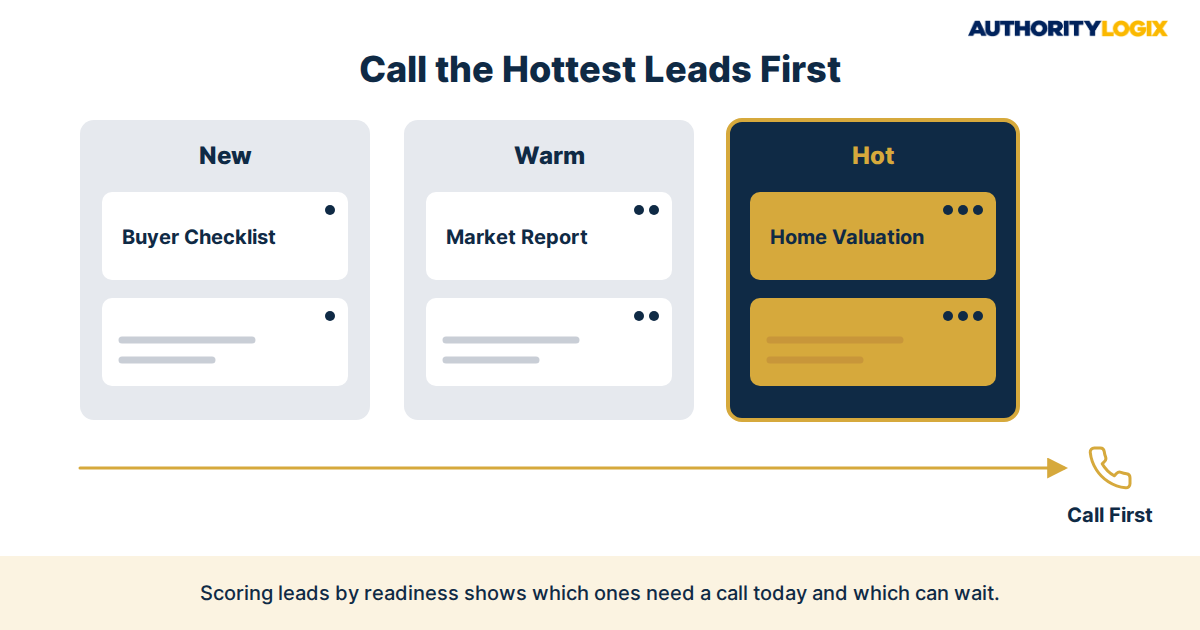
Not every lead deserves the same response speed, and a real estate lead generation system that treats them all identically is leaving conversions on the table. A lead who just downloaded a first-time buyer checklist and a lead who requested a home valuation on their own address are at very different points in their decision. And treating them identically wastes the urgency the second lead actually has. Lead scoring — ranking leads by behavior and readiness signals rather than treating the list as one undifferentiated pool.
Is what makes it possible to know who to call first without guessing. Speed to first contact matters enormously for the highest-intent leads specifically. A lead requesting a home valuation is often ready to talk today. And a firm that takes three days to respond has usually already lost that lead to whoever called first.
This works the same way
authority distribution works for content: the underlying asset only produces results once there is a system directing attention to the right place at the right time. A CRM full of unscored, uncategorized contacts is a list, not a pipeline — the data is all there, but nothing in it tells an agent where to spend the next hour of their day.
Distribution systems built around scoring turn that list into something an agent can actually work efficiently. Calling the hottest leads first beats working down an alphabetical list and hoping the timing happens to line up.
Multi-Channel Lead Sources: Diversifying Beyond One Channel
A pipeline built entirely on one channel is one algorithm update or one platform policy change away from going quiet. Organic search, paid search, social content, and
investor content built for specific niches each reach a different segment of the market at a different stage of intent. And firms that diversify across a few of these consistently outperform firms betting everything on one. This is not a theoretical risk. Platforms change their algorithms, ad costs rise, and policies shift with little warning, and a firm whose entire pipeline runs through one channel has no cushion when that happens.
A firm running two or three channels can absorb a bad month on one of them without the whole pipeline stalling, which is the entire point of diversification in the first place. Diversification is not about hedging against a worst case — it is about making sure an ordinary, expected disruption in any single channel is an inconvenience rather than an emergency.
This does not mean spreading effort evenly across every possible channel. It means identifying the two or three that actually reach your specific buyer, seller, or investor audience and building
specialized content for each of those, rather than diluting the same generic message across every platform that exists. A firm chasing every channel at once usually does all of them at a mediocre level, while a firm that picks two or three and commits to doing each one well tends to outperform on total pipeline volume, not just on any single channel in isolation.
Measuring What Matters: Cost Per Lead vs. Cost Per Closed Deal
A real estate lead generation system succeeds or fails based on how it is measured, and cost per lead is the metric most firms track — it is also the metric most likely to mislead them. A channel producing leads at half the cost of another channel looks like the better investment right up until you check how many of those cheap leads actually close.
A channel with a higher cost per lead but a meaningfully higher close rate can be the more profitable one by a wide margin. This mistake compounds over time because cost-per-lead is easy to measure immediately, while close rate takes months to become visible, and by the time the full picture emerges, a firm may have already shifted its entire budget toward the channel that looked cheaper on day one.
Why us as an infrastructure builder rather than a lead-buying service comes down to exactly this distinction: purchased leads are priced per lead and often close at a fraction of the rate of a first-party inbound lead who found you through content they trusted.
The
growth playbook for a firm serious about pipeline economics tracks cost per closed deal by channel, not just cost per lead, and reallocates budget accordingly. Most agent first party lead system builds skip this discipline entirely in favor of chasing the cheapest lead volume available.
Ready to build an inbound lead pipeline that doesn’t depend on referrals?
Work With Us →
What Most Real Estate Firms Get Wrong About Lead Generation
Straight answers to the questions firm owners actually ask before investing in a real estate lead generation system. Most of these come up before a firm has committed to building anything.
Most of what follows traces back to treating lead generation as a single tactic instead of the connected system covered across the
real estate hub of services this playbook is part of. That connection is what separates a playbook from a checklist.
Firms that
educate your market consistently, rather than only when they need a listing, are the ones whose pipeline keeps producing leads between active campaigns. That steady presence is what keeps the pipeline from running dry between pushes.
Should we buy leads instead of building our own pipeline?
Purchased leads can fill a short-term gap, but they typically close at a lower rate than first-party leads who found you through content they already trusted, and the cost never goes away — you pay for every lead indefinitely. A first-party pipeline costs more to build upfront and less to sustain over time, which is the opposite cost curve of purchased leads.
How many lead magnets do we actually need to get started?
One good one, aimed squarely at your highest-intent audience segment, outperforms five mediocre ones spread across every possible buyer type. Start with a single specific, valuable offer, get the landing page and follow-up sequence right, and expand only once that first one is converting well.
What’s a realistic conversion rate for a real estate landing page?
It varies significantly by offer and traffic source, but a focused landing page with a specific offer and a short form typically converts several times better than a generic contact form on a homepage. The gap between a good landing page and a mediocre one is usually the offer, not the design — a beautifully designed page with a weak offer still underperforms a plain page with a genuinely useful one.
How long should a lead nurture sequence run?
Real estate decisions often take months, so a sequence that stops after two weeks abandons most leads before they are ready. A nurture sequence that runs for several months with decreasing frequency — frequent early, occasional later — keeps the door open without becoming a nuisance, and can be paused or resumed based on engagement signals rather than running on a fixed schedule regardless of whether anyone is opening the emails. This connects directly to the topic covered in the
content systems resource.
Do we need real estate inbound pipeline software, or can a spreadsheet work for lead scoring?
A spreadsheet can work at very small volume, but it breaks down quickly once lead count grows past what one person can track manually. Purpose-built CRM and scoring tools earn their cost back the moment manual tracking starts causing leads to fall through the cracks, which for most growing firms happens faster than expected.
Building the System: Turning a Real Estate Lead Generation System Into a Compounding Pipeline
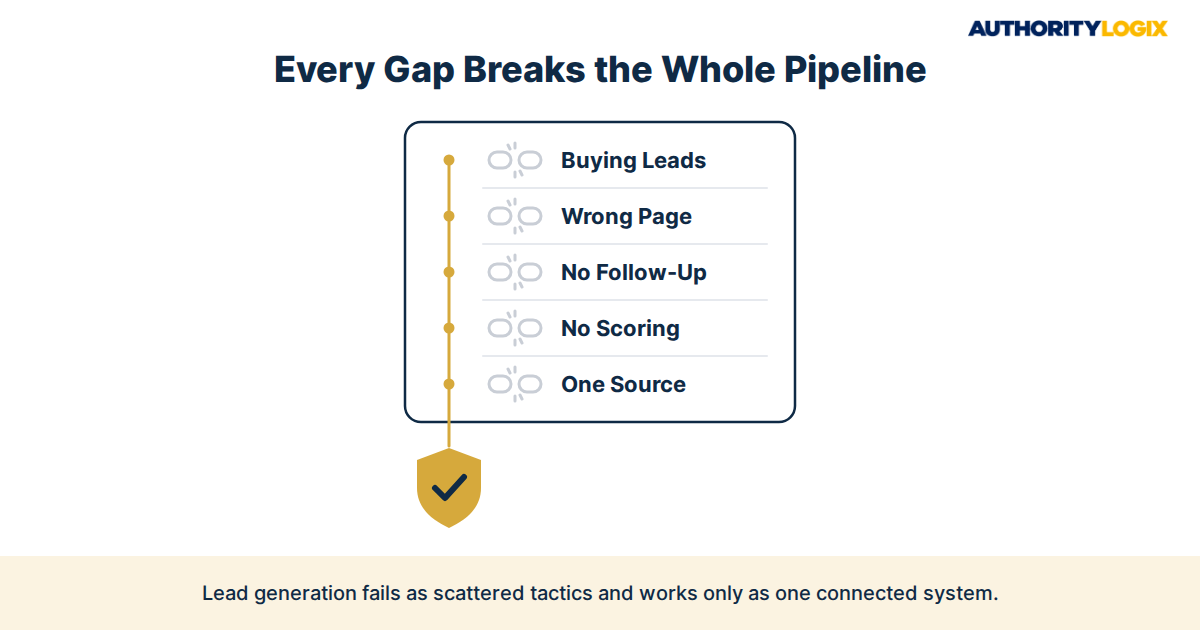
None of the four stages work in isolation. Visibility without capture wastes traffic. Capture without nurture wastes leads. Nurture without scoring wastes an agent’s time. A real estate lead generation system only produces results as a connected whole. Each stage feeding the next, each improvement compounding on the ones before it rather than existing as an isolated fix. This is why piecemeal fixes so often disappoint. A firm adds a lead magnet without fixing its landing pages. Or builds a nurture sequence without ever scoring the leads it produces, and wonders why the pipeline still is not converting.
The fix was real. It just was not connected to the rest of the system. A properly connected real estate lead generation system is worth building once and maintaining, not rebuilding every time referral flow slows down. The firms that treat it this way stop asking whether they need new leads this month and start asking whether their existing system needs a tune-up. A fundamentally different, and far less stressful, question to be asking.
According to the
NAR survey, agents increasingly credit CRM tools and social media among their highest-quality lead sources. That is a signal that firms treating lead generation as scattered tactics are already behind firms treating it as one integrated system.
The honest answer is that most firms reading this already have enough traffic or enough referral volume to build a real pipeline from — what’s missing is the infrastructure connecting visibility to capture to nurture to conversion. If you’re ready to see where your pipeline actually breaks down, work with us.