Key Takeaways
- Local search decides who gets the call before a referral ever happens — Google’s Local Pack appears on the vast majority of local searches, and the firms inside it capture most of the clicks.
- Google Business Profile, not your website, is usually the first impression that decides whether a buyer, seller, or investor picks up the phone.
- Citation consistency and review volume are ranking infrastructure, not busywork — profiles that cross the 100-review mark see lead volume climb well above the market average.
- National portals dominate broad search terms, but neighborhood-specific and hyperlocal content is territory a local firm can occupy in a way Zillow and Redfin cannot.
- AI search tools are becoming a second local search engine, and firms without structured, well-cited content are already losing ground there.
- A real estate local SEO playbook is not a one-time project — it is infrastructure that compounds every month it stays maintained.

A real estate local SEO playbook is not a nice-to-have anymore. It is the difference between being the firm a buyer finds in the first ten minutes of a Google search, and being the firm nobody outside a referral network has ever heard of. Most home buyers interview only one agent before hiring them — 67% of first-time buyers and 76% of repeat buyers, according to the National Association of Realtors’ 2025 Profile of Home Buyers and Sellers — the firm that shows up first in local search is usually the only firm that gets a conversation at all.
For agents, brokers, and investment firms who already have the track record, this should be an easy win. It rarely is. Most built a real reputation the old way — referrals, repeat clients, years in the market — and never built the infrastructure that makes it visible to buyers, sellers, and investors who don’t already know them. Turning that expertise into local search visibility is
what we do.
If your firm has the track record but not the visibility, the gap usually isn’t experience. It’s infrastructure.
Authority Guide →
Why Firms With Real Experience Still Can’t Be Found
Credible but invisible. That is the position most experienced real estate professionals are in without realizing it. You have closed the deals, built the referral base, earned the trust of past clients — and none of it shows up when a stranger searches your market on Google. Referrals are not a visibility strategy. They are a ceiling. Your referral network is a ceiling, not a foundation, and the moment referral flow slows down, there is nothing behind it.
This is not a content-volume problem. Posting more listings, more market updates, or more social content does not fix it, because the underlying issue is structural: search engines rank businesses on signals most agents and brokers never touch — profile completeness, citation consistency, review velocity, and content that actually answers what buyers, sellers, and investors are searching for. Building that infrastructure deliberately is
our approach, the same way it was built for the DSCR investment niche at BKDSCR.com — a full authority platform with 18 pillar pages and 48 SEO-optimized posts that ranks for competitive NYC real estate and DSCR keywords without a dollar of paid advertising.
That distinction matters because most real estate marketing advice treats local visibility as a single tactic — claim your Google Business Profile, ask for a few reviews, call it done. A real estate local SEO playbook treats it as a system with five interdependent parts, each one covered in the sections that follow: the Local Pack itself, the profile that feeds it, the citation layer underneath it, the reviews that reinforce it, and the content that gives it depth. Skip one part and the other four underperform.
None of this requires abandoning what already works. Referrals will keep closing deals for as long as you’re in business, and nothing in a real estate local SEO playbook argues otherwise. The point is that referrals should be one channel among several, not the only channel standing between your firm and its next client. A local SEO playbook for real estate simply gives Google — and increasingly buyers who research before they ever call anyone — a way to find you before they think to ask someone who already knows you.
Inside a Real Estate Local SEO Playbook: The Map Pack Problem
Open Google on a phone and search for an agent, broker, or investment firm in nearly any market, and the first thing that loads is not a list of websites. It is the Local Pack — three business listings with a map, star ratings, and a call button, sitting above every organic result on the page. Local Pack results now appear on the large majority of location-intent searches, and the three listings inside it capture a disproportionate share of the clicks. Position matters inside the pack too: the top listing typically pulls in close to half of all Local Pack clicks, with the second and third positions splitting most of what remains.
That is the real estate local map pack problem in one sentence: if your firm is not one of those three listings, a buyer or seller searching your market on their phone may never see you at all, no matter how many years you have been in business or how strong your reviews are once someone actually finds your profile.
Lead generation systems built around local search have to start here, because everything downstream — inquiries, showings, listing appointments — depends on being inside that first screen.
Winning a spot in the pack is not about a single trick. Google weighs relevance, distance, and prominence together, and prominence is where most real estate professionals lose ground — it is built from the same signals covered section by section in this playbook: profile completeness, citations, reviews, and content depth. Firms that have documented this system and refined it against real client results treat local map pack visibility as infrastructure to maintain, not a project to finish once.
What Actually Moves Real Estate Agent Google Rankings
Real estate agent Google rankings inside the Local Pack respond to a narrower set of signals than most agents assume. Relevance is about whether your Google Business Profile category, description, and website content match what the searcher typed. Distance is fixed — you cannot manipulate how far a searcher is from your listed address. Prominence is the only lever left, and it is built from citation consistency, review count and recency, and how much authoritative content exists connecting your firm to your market.
Firms that treat prominence as a checklist item rather than ongoing infrastructure tend to plateau just outside the pack, visible in search but never in the three listings that actually get clicked. That plateau is invisible from the inside — rankings can look stable in a dashboard while the calls that used to come from search quietly dry up. This connects directly to the topic covered in the
content systems resource.
Local Pack click distribution by position
| Local Pack Position |
Share of Local Pack Clicks |
| Position 1 |
47.2% |
| Position 2 |
24.8% |
| Position 3 |
16.4% |
| “View more” (expanded results) |
11.6% |
Source: Visionary Marketing GSC Crawl 2026
Google Business Profile: The Foundation Most Brokers Get Wrong
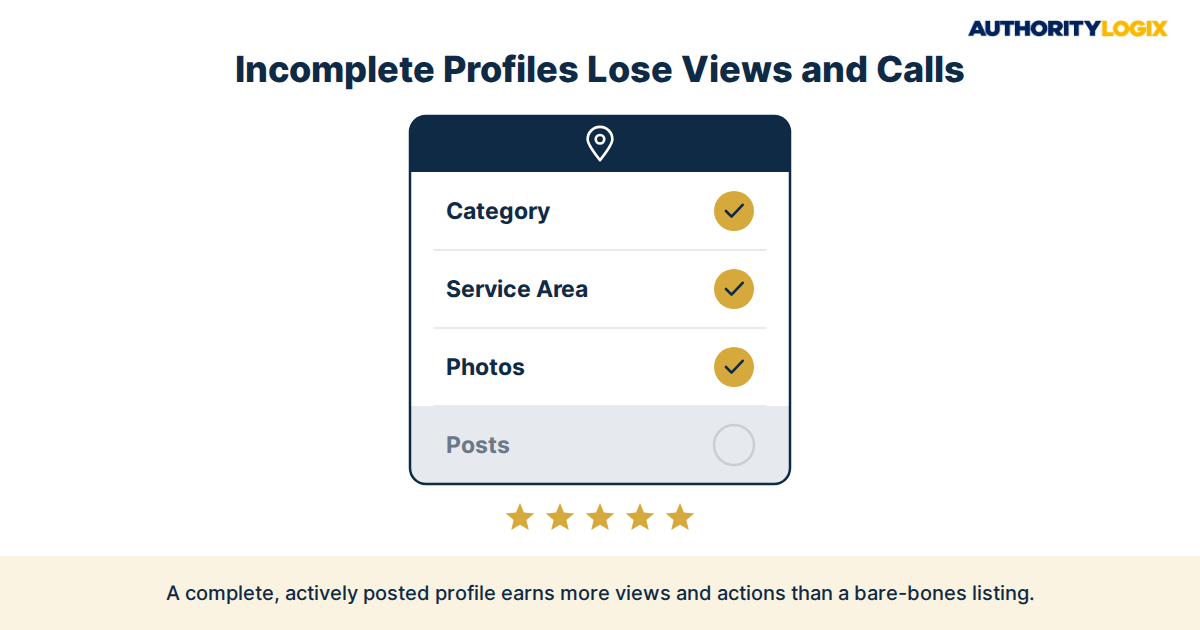
Before a buyer ever reaches your website, they see your Google Business Profile. It is the first impression, and for most real estate firms it is incomplete, inconsistent, or abandoned after initial setup. A profile with real photos, accurate service areas, complete attributes, and an active posting cadence gets measurably more profile views and customer actions than a bare-bones listing — the gap runs into tens of percentage points on both counts.
The category selection alone changes outcomes. “Real Estate Agent” is not automatically the right primary category for a firm that specializes in investment sales, luxury listings, or new construction — the wrong category means Google is matching you to searches that were never going to convert. Content systems built for local search treat the profile itself as a content asset, not an afterthought filled out once during onboarding and never revisited.
Description copy, Q&A answers, and Google Posts should reinforce the same keywords the rest of the
content system is built around. A profile that says something different from the website confuses the relevance signal Google is trying to match, and a real estate local SEO playbook that treats the two as separate projects is working against itself.
Broker Local Search Visibility Starts With the Profile, Not the Website
Broker local search visibility is decided before a searcher ever clicks through to a website. Google surfaces the profile — name, category, rating, hours, service area — directly in search results and on Maps, and a meaningful share of local searchers act on that information without visiting a website at all: they call, they get directions, they message. That means the profile has to carry the same clarity and credibility signals a homepage would, because for a large share of prospects, the profile is the only impression your firm makes.
Citations and NAP Consistency: The Infrastructure Nobody Sees
NAP — name, address, phone number — sounds like a formality until it becomes the reason a firm’s rankings stall. Google cross-references how your business is listed across directories, MLS syndication, brokerage rosters, and review platforms. When the name format, suite number, or phone number varies from one listing to the next, it does not just look sloppy — it actively weakens the trust signal Google uses to confirm your business is real, active, and located where you say it is.
This is unglamorous work, and it is exactly the kind of infrastructure that separates firms that rank consistently from firms that spike and fade. It sits in the same category as
authority distribution — the layer of syndication, consistency, and cross-platform presence that compounds quietly in the background while the content strategy gets the attention. Firms that outsource citation cleanup once and never audit it again typically see drift within a year, as new listings, franchise directories, or address changes reintroduce inconsistency.
A practical starting point is a single audit pass across the handful of places your firm’s information actually lives: your Google Business Profile, your MLS syndication feed, your brokerage’s roster page, and any directory listing collected over the years. Standardize the format once — exact business name, exact suite or unit number, one phone number — and the citation layer of a real estate local SEO playbook stops working against the rest of the system instead of quietly undermining it. Set a recurring quarterly check rather than treating the audit as a one-time fix, since new listings and address changes reintroduce drift on their own schedule, not yours.
Reviews as a Ranking Signal: Why Volume and Recency Both Matter
Reviews function as both a ranking signal and a trust signal, and the two do not move together the way most firms assume. Consumer trust in online reviews now rivals trust in personal recommendations — the gap between the two has nearly closed, and the large majority of consumers read reviews before ever contacting a local business. But recency carries as much weight as volume: a profile with forty reviews from three years ago reads as dormant next to a competitor with fifteen reviews collected in the last quarter.
Why us matters less to Google than whether the market is actively vouching for you right now.
The threshold effect is real and measurable. Profiles that cross the 100-review mark tend to see lead volume climb well above the average for their market, and click-volume on profiles with fifty or more reviews runs several times higher than profiles with fewer than five. According to
BrightLocal’s review survey, the share of consumers who read reviews before contacting a local business has climbed further still, and the use of AI tools like ChatGPT for local recommendations has grown sharply in a single year — a signal covered later in this playbook.
The Real Estate Local Map Pack Rewards Recent Reviews, Not Just High Ratings
A perfect five-star average with no recent activity underperforms a strong-but-imperfect profile with a steady review cadence, both in Local Pack visibility and in click-through rate once a searcher sees the listing. Star rating still matters — profiles below roughly 3.5 stars lose ground fast — but the real estate local map pack rewards firms that treat review generation as an ongoing process tied to every closing, not a one-time push during a slow month.
Star rating and Local Pack click-through impact
| Star Rating Range |
Relative Click-Through |
Consumer Trust |
| 4.5 – 4.9 stars |
Highest CTR of any range |
94% |
| 4.0 – 4.4 stars |
-8% vs. 4.5 |
87% |
| 3.5 – 3.9 stars |
-24% vs. 4.5 |
62% |
| Below 3.5 stars |
-59% vs. 4.5 |
14% |
Source: SearchLab Local SEO Statistics 2026
Neighborhood and Hyperlocal Content: Owning the Searches Zillow Can’t
National portals win the broad searches. They will always outrank an independent firm for a query like “homes for sale” in a major metro, because they have the scale and the domain authority to match. What they cannot do is write with the specificity of someone who actually works a fifteen-block radius every week — the school district boundary that changes value block to block, the co-op board quirks in one building versus another, the construction that is about to affect a specific corridor’s walkability.
Neighborhood-specific landing pages and market reports close that gap.
Investor content built around a specific submarket routinely outperforms generic city-wide pages, because it matches exactly what a buyer, seller, or investor searching that submarket is actually trying to find.
This is also where an
inbound pipeline starts to build itself. Hyperlocal content captures search intent a national portal’s generic listing page was never going to satisfy, and unlike a paid ad, it keeps working long after the page was published — a single well-researched neighborhood guide can rank and generate inquiries for years.

Competing Against National Portals: What Local SEO Can and Can’t Fix
Local SEO will not make an independent firm outrank Zillow or Redfin for every search term in a market. That is not the goal, and content built around that goal usually wastes the effort. The realistic goal is owning the searches that carry the highest intent to actually hire a specific firm — searches with a neighborhood name attached, searches with “agent near me” or “investment firm” attached, searches tied to a specific building, school, or submarket a national portal’s algorithm treats as interchangeable.
BKDSCR.com is the proof this works outside theory. It is a DSCR real estate investment platform built from scratch for the NYC outer-borough investor niche — 18 pillar pages, seven interactive investor tools including a DSCR calculator and stress test, 48 SEO-optimized blog posts, and a 35-page investor lead magnet, built in under eighteen months with zero paid ads. It ranks for competitive DSCR and NYC real estate keywords not by outspending national portals, but by being the most specific, most useful resource for a defined audience those portals were never built to serve.
Specialized content at that level of depth is what makes the difference.
The same logic applies to any real estate niche. A firm cannot out-scale Zillow. It can out-specify it, and
educational hub development — the kind of structured, depth-first content library this playbook is part of — is the mechanism for doing that at scale instead of one blog post at a time.
This is also where the credible-but-invisible gap shows up most clearly. A firm with fifteen years in a submarket knows things about it that no portal algorithm will ever capture — which blocks flood, which buildings have contentious boards, which streets are about to change character because of a single permit filing. None of that expertise helps local search rankings until it gets written down, structured, and published somewhere Google can find it.
AI Search and the New Local Visibility Battlefield
Google’s Local Pack is no longer the only local search surface that matters. AI-generated overviews and conversational tools like ChatGPT are increasingly where local recommendations happen, and early research shows real estate firms cannot assume the businesses that rank in the traditional Local Pack automatically appear in AI-driven results — some studies have found the businesses shown shrink to a smaller, differently ranked set, creating what looks like ranking stability while actual visibility, clicks, and calls quietly decline.
This is not a reason to panic. It is a reason to build content and citations that are structured clearly enough for AI systems to parse and cite, not just written to satisfy a human reader scanning a results page.
Authority distribution systems — syndicated, consistent, cross-platform presence — matter more here, not less, because AI tools tend to draw on the same signals traditional search does, just filtered differently.
Infrastructure compounds. Ads stop. A firm that built local search infrastructure the right way for Google is already most of the way toward AI search readiness; a firm relying on paid visibility has nothing to fall back on when the algorithm shifts again. The path for firms that want to stay ahead of this shift, not react to it after the fact, starts with the same infrastructure covered in this real estate local SEO playbook.
Ready to get your firm found in local search before the big portals take the click?
Work With Us →
What Most Real Estate Firms Get Wrong About Local SEO
Straight answers to the questions firm owners actually ask before committing budget to a real estate local SEO playbook. See the full
FAQ page for questions beyond local search.
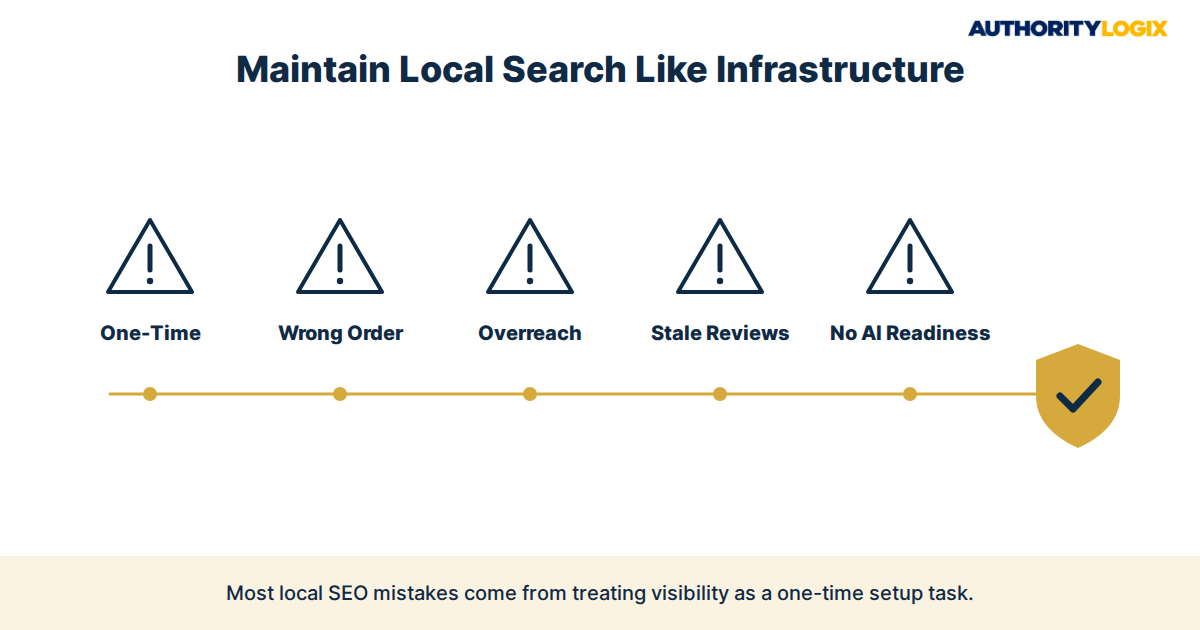
Most of the mistakes below come down to the same root cause: treating local search as a one-time setup task instead of infrastructure that needs upkeep, the same way market education content needs upkeep once it is published. The firms that keep at it past the initial setup are consistently the ones still gaining visibility a year later.
How long does a real estate local SEO playbook take to show results?
Google Business Profile improvements can move Local Pack visibility within weeks. Citation cleanup and review-generation systems typically take one to three months to show measurable ranking movement. Content-driven rankings — the neighborhood pages and market reports that build long-term authority — usually take three to six months to mature, and then keep compounding well beyond that window. The firms that get frustrated and quit at month two are almost always the same firms that would have seen the payoff at month four.
Do we need a new website to fix local search visibility?
Rarely as the first step. Most firms lose more visibility to an incomplete Google Business Profile, inconsistent citations, and thin content than to website design. Fix the foundation first — profile, citations, reviews, hyperlocal content — and evaluate the website separately once those systems are in place, the same order of operations reflected in the client results
our work documents.
Can local SEO actually help us outrank Zillow or Redfin?
Not for broad, high-competition searches. It can win the higher-intent, narrower searches — neighborhood-specific, building-specific, niche-specific — that national portals treat as interchangeable and a local firm can answer with far more depth.
Is Google Business Profile more important than our website for local rankings?
For Local Pack visibility specifically, yes. The profile is what Google surfaces directly in local search and Maps. The website matters more for organic rankings outside the pack and for converting the traffic the profile sends. Both need attention, but the profile is usually the more neglected of the two.
Do we need to worry about AI search yet, or is that premature?
Not premature. Adoption of AI tools for local recommendations has grown fast enough that firms building citation and content infrastructure now, as part of a real estate local SEO playbook, are positioning ahead of competitors who wait for AI search to become the obvious priority. That infrastructure is exactly what
educate your market content depends on to actually reach a wider audience once it is published.
Building the System: Turning a Real Estate Local SEO Playbook Into Compounding Visibility
None of this works as a single project with a finish line. Google Business Profile optimization, citation consistency, review generation, hyperlocal content, and AI search readiness are five parts of one system, and each part reinforces the others — a strong profile without reviews stalls, reviews without citation consistency underperform, content without a complete profile behind it converts poorly. Every piece has a job. Every piece feeds the next, the same compounding logic covered in the
growth playbook.
The honest answer is that most real estate professionals reading this already have the experience and the client results to earn the visibility they’re missing. The missing piece is the infrastructure that makes the market see it, built the same deliberate way BKDSCR.com was built in the DSCR niche — piece by piece, measured against real rankings and real leads, not a generic marketing checklist.
If you’re ready to see where your firm actually stands on local search visibility, work with us. That starting point matters more than most firms assume — a firm chasing every tactic in this playbook at once usually finishes none of them well, while a firm that fixes its profile, then its citations, then its review cadence, then its content, sees each fix reinforce the one before it.