Key Takeaways
- Market authority is not the same thing as experience — Google, AI search, and buyers all judge authority on signals that have to be built deliberately, not assumed from years in the business.
- E-E-A-T — experience, expertise, authoritativeness, trust — is the framework search engines actually use to judge a real estate firm’s authority, and most firms only ever address one of the four.
- Thought leadership content earns outsized trust: a large majority of decision-makers now say it’s a more reliable signal of capability than traditional marketing materials.
- Case studies and proof-of-work outperform claims of expertise, because they let the market verify authority instead of taking a firm’s word for it.
- Authority built through content and citations survives algorithm updates in a way paid visibility never does, because it isn’t rented — it’s owned.
- A real estate authority guide is infrastructure, not a campaign — it compounds for as long as it’s maintained, and erodes the moment it’s abandoned.
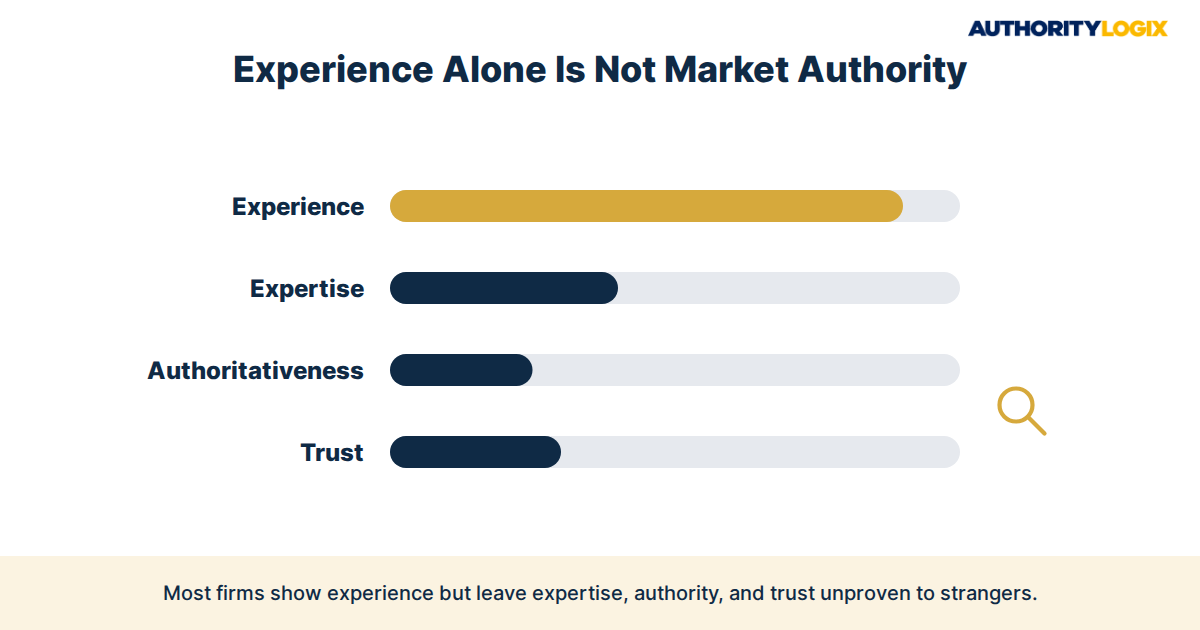
A real estate authority guide exists to answer one question: why should a stranger trust you with the largest financial decision of their life? Years in the business answer that question for people who already know you. They don’t answer it for the buyer, seller, or investor who has never heard your name and is currently scrolling through a search results page deciding who to call first.
Market authority is what closes that gap, and it is built the same deliberate way local search visibility is — through infrastructure, not through claims. Turning real expertise into visible, verifiable authority is
what we do. The two systems reinforce each other: visibility gets a prospect to your profile, and authority is what happens in the few seconds after they arrive, before they decide whether to keep reading or move to the next result.
Authority starts with getting found in the first place. If local search visibility isn’t in place yet, start there.
Local SEO Playbook →
Why Experience Doesn’t Automatically Become Authority
Credible but invisible. Most experienced agents, brokers, and investment firm principals are in exactly this position — real deals closed, real client relationships, real market knowledge — and none of it is legible to a stranger doing research online. Experience is what you have. Authority is what the market can verify without having to take your word for it. The two are related, but one does not automatically produce the other.
The firms that look authoritative online are not necessarily the most experienced ones. They are the ones that took the extra step of documenting what they know in a form Google, AI search tools, and skeptical buyers can actually evaluate.
Our approach treats that documentation step as the whole job, not an afterthought squeezed in between closings.
This matters more now than it did five years ago, because the research phase itself has changed. A buyer used to ask a friend for an agent recommendation and call it done. Now that same buyer runs a search, skims a few profiles, asks an AI assistant what it knows about agents in the area, and arrives at a first conversation already having formed an opinion. A real estate authority guide is what shapes that opinion before you ever get the chance to shape it yourself in person.
The Real Estate Authority Guide Starts With E-E-A-T, Not Volume
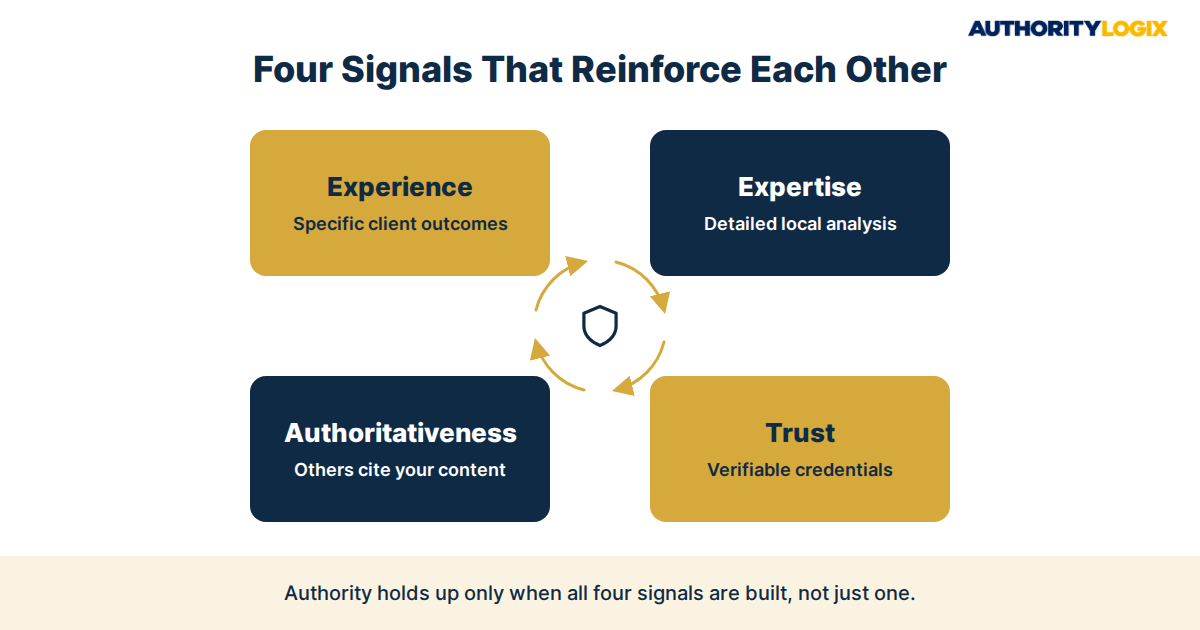
E-E-A-T — experience, expertise, authoritativeness, and trust — is the framework search engines use to judge whether content, and the business behind it, deserves to rank. Most real estate firms address one letter of that framework and assume the other three follow automatically. A bio page claiming twenty years in the business covers experience. It says nothing about expertise demonstrated in public, authoritativeness recognized by others, or trust signals a stranger can verify.
Content systems built around E-E-A-T treat each letter as a separate, addressable problem: expertise gets demonstrated through detailed, specific market analysis instead of generic advice, and authoritativeness gets built through citations, mentions, and a consistent publishing record other sites point back to.
Trust gets built through transparent credentials, real client outcomes, and a
content system that doesn’t disappear the moment a listing closes. Firms that treat trust as a one-time bio update rather than an ongoing content commitment tend to look authoritative for a few months and then quietly fade as the content goes stale.
What Real Estate Agent Market Authority Actually Signals to Google
Real estate agent market authority, from a ranking-signal perspective, comes down to whether other credible sources — sites, publications, directories, even other pages on your own site — treat your content and your business as a reference point worth linking to and citing. A firm with one polished homepage and no supporting content has no authority signal to measure. A firm with a structured library of market analysis, neighborhood guides, and data-backed reporting gives Google — and increasingly AI search tools summarizing local expertise — something concrete to point to.
The practical test is simple: search your own name alongside your market, then search a competitor’s. If nothing distinguishes the results beyond a listing count, neither firm has built real authority yet — both are relying entirely on reputation that exists offline and stays invisible online. The firm that fixes this first captures a disproportionate share of the buyers and sellers who research before they call anyone.
The four E-E-A-T signals and what they look like in practice
| E-E-A-T Component |
What It Actually Requires |
| Experience |
Specific, dated client outcomes and market history — not a generic years-in-business claim |
| Expertise |
Detailed analysis of local market conditions, financing structures, or transaction types most agents don’t cover |
| Authoritativeness |
Other sites, directories, and publications citing or linking back to your content |
| Trust |
Transparent credentials, verifiable reviews, and consistent information across every listing |
Source: Framework adapted from Google Search Quality Rater Guidelines
Credibility Signals Buyers and Sellers Actually Check
Before a prospect ever picks up the phone, they run an informal background check: your Google Business Profile, your reviews, whatever comes up when they search your name alongside your brokerage, and increasingly, what an AI assistant says about you when asked. None of this is under a firm’s direct control the way a listing presentation is, which is exactly why it has to be built deliberately rather than left to chance.
This is where
authority distribution — getting consistent, credible mentions of your firm distributed across the platforms buyers and sellers actually check — matters more than any single piece of content. One strong article on your own site is a claim. The same expertise referenced across several credible sources is a signal.
Consistency across those touchpoints matters as much as the content itself. A firm with a polished website but a half-abandoned Google Business Profile, mismatched information across directories, and no reviews in the last year sends a mixed message no amount of good content can fully offset. Credibility signals get evaluated together, not one at a time, and a gap in any one of them drags down the rest.
Broker Credibility Online Starts Before the First Phone Call
Broker credibility online is decided in the research phase, well before a prospect reaches out — which means the firms that wait until a listing appointment to make the case for their expertise have already missed the moment that mattered most. By the time someone calls, they’ve usually already decided whether to trust you. The job of a real estate authority guide is making sure that decision gets made in your favor before the conversation even starts.
This is a hard adjustment for agents who built their careers on in-person rapport. The instinct is to save the best material — the market knowledge, the negotiation stories, the specific insight — for the meeting where it will land best. Online, that instinct works against you. The insight has to show up earlier, in a form a stranger can find and evaluate without ever meeting you, or the meeting never gets booked in the first place.
None of this means the in-person relationship stops mattering once a prospect calls. It means the relationship now starts online, whether a firm chooses to show up there or not. And the firms that show up deliberately, building a structured
educational hub of content rather than scattered one-off posts, get to shape that first impression instead of leaving it to chance.
Thought Leadership vs. Noise: What Actually Builds Trust
Thought leadership has a credibility problem in real estate, mostly because so much of what gets published under that label is generic market commentary anyone could have written. Real thought leadership is specific enough that it could only have come from someone who actually works the market being described — the kind of
specialized content that demonstrates expertise instead of just asserting it.
The payoff for getting this right is substantial. A large majority of B2B decision-makers now say an organization’s thought leadership is a more trustworthy basis for judging its capability than its traditional marketing materials, and a majority say they’re willing to pay a premium to work with firms that demonstrate it consistently. Real estate buyers and sellers are not a different species of decision-maker — they respond to the same signal, at a smaller and more personal scale.
Firms that have built a documented track record, the kind
our work represents, are the ones that get referred to as the person who really knows this market instead of just another name on a sign. That reputation doesn’t come from one clever post — it comes from a consistent body of specific, credible content accumulated over time. It also compounds in a way paid visibility cannot: each new piece adds to the body of proof instead of replacing the last one, so the case for a firm’s expertise gets stronger with every publication rather than resetting to zero.
How decision-makers respond to genuine thought leadership content
| Behavior |
Share of Decision-Makers |
| Trust it more than traditional marketing materials |
73% |
| Willing to pay a premium to work with the firm |
60% |
| Likely to invite the firm to bid on work |
86% |
| Of those it prompted to research, went on to buy |
23% |
Source: Edelman-LinkedIn B2B Thought Leadership Impact Report
Trust-Building Content at Scale: Market Reports and Data
A single well-researched market report does more for authority than a dozen generic listing announcements, because it demonstrates the kind of analysis a buyer or seller cannot get from a portal’s auto-generated market summary. Building a structured library of this kind of content, rather than publishing it in scattered, one-off pieces, is what turns individual reports into a compounding authority asset.
The results compound in ways a single campaign never does. One luxury agent profiled in
Luxury Presence’s research grew annual sales from $300 million to $660 million over three years, supported by more than 300 first-page Google rankings and roughly 9,000 monthly organic search visitors — a direct result of sustained, structured content investment rather than any single tactic.
That is what an
inbound pipeline built on trust-building content actually looks like at scale, not a one-time spike from a viral post. The visitors and rankings didn’t arrive because of one report — they arrived because the report was one of hundreds, each one adding another entry point for a different search, a different question, a different stage of a buyer’s research.
Real Estate Trust Building Content That Outlasts a Single Algorithm Update
Real estate trust building content that survives algorithm changes has one thing in common: it was built to be genuinely useful to a reader first, and optimized for search second. Content built purely to satisfy a ranking algorithm degrades every time that algorithm changes. Content built to answer a real question a buyer or seller actually has keeps generating trust and traffic regardless of what any single update does to rankings, because the underlying value never depended on the algorithm in the first place.
This distinction shows up clearly in AI search. A generic, keyword-stuffed market summary gives an AI assistant nothing specific to cite. A detailed, well-sourced report — with real numbers, real dates, real named sources — gives it exactly what it needs to quote and attribute. The firms building for AI search readiness now, without waiting for it to become the obvious priority, are the same firms that built genuinely useful content instead of algorithm bait in the first place.
Positioning Above National Portals: Authority Zillow Can’t Buy
National portals have scale, ad budgets, and domain authority no independent firm can match head-on. What they cannot buy is specific, local, verifiable expertise — the kind of judgment that comes from actually closing deals in a submarket, not aggregating listing data about it.
Investor content built around real transaction experience occupies territory a portal’s algorithm-generated page can approximate but never actually own.
This gap is easy to underestimate because portals look comprehensive. They have every listing, every price history, every school rating. What they don’t have is judgment — the kind that tells a buyer which of two similar-looking blocks is actually the better long-term bet, or which contingency clause matters in a specific negotiation and which one is boilerplate. That judgment is exactly what a real estate authority guide exists to make visible. Portals can be comprehensive and shallow at the same time, and buyers increasingly notice the difference once they start comparing a portal listing page to a firm that actually explains the reasoning behind a recommendation.
This is the real competitive opening. A portal can list every property in a market. It cannot tell a buyer which of three similar buildings has the healthier reserve fund, or which streets are quietly appreciating ahead of a rezoning announcement.
Why us as a firm comes down to exactly that kind of judgment, and a real estate authority guide exists to make that judgment visible to people who would otherwise never encounter it.
Case Study Infrastructure: How Firms Prove Authority, Not Just Claim It
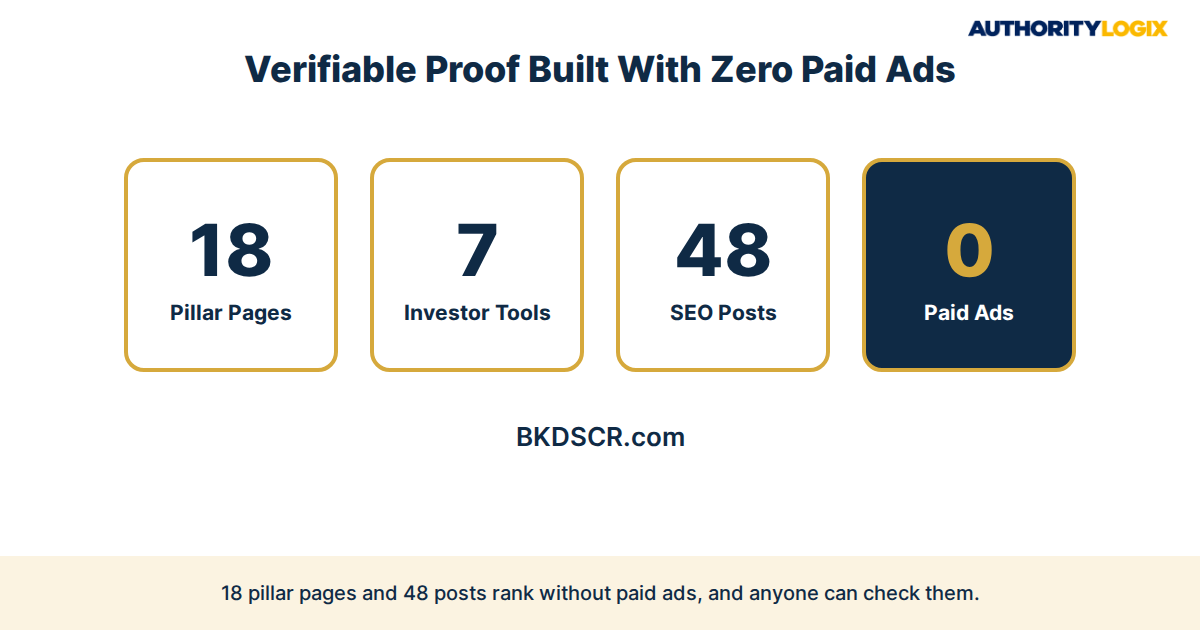
Claims of expertise are cheap. Every agent bio says “trusted advisor” and “deep market knowledge.” Proof is expensive to fake, which is exactly why it works. BKDSCR.com is the clearest example of what proof-of-work infrastructure looks like in practice — an authority platform built from scratch in the NYC outer-borough DSCR investment niche, with 18 pillar pages, seven interactive investor tools, and 48 SEO-optimized posts, ranking for competitive DSCR and NYC real estate keywords with zero paid advertising.
That is not a portfolio piece. It is a documented, verifiable case study any prospect can check independently, which is precisely what separates real authority from a marketing claim. Anyone can visit the site, count the pages, run the keywords, and see the rankings — nothing about the claim depends on taking anyone’s word for it.
Educate your market the same way, with the same level of specificity, and authority stops being something you assert and starts being something a prospect can confirm for themselves before ever picking up the phone.
The same logic scales down to any individual firm, not just a flagship proof-of-concept. A single detailed case study — a specific transaction, a specific problem solved, specific numbers attached — does more for credibility than a dozen vague testimonials. Prospects have learned to discount generic praise. They have not learned to discount a documented, specific story they can independently verify. The specificity is the point: vague praise is easy to write and easy to ignore, while a named building, a real closing date, and an actual number are hard to fabricate and hard to dismiss.
Authority Distribution: Getting the Proof in Front of the Market
Building proof of authority and distributing it are two different jobs, and most firms only do the first one. A brilliant market report that lives only on a firm’s own website reaches whoever already knew to look for it. The same report syndicated across relevant platforms, cited in local publications, and referenced in other content reaches the buyers and sellers who were never going to find your website on their own.
This is the step most firms skip, usually because it’s less satisfying than writing the report itself. Publishing feels like finishing a project. Distribution feels like ongoing work with no clear endpoint, which is exactly why the firms that actually do it consistently pull ahead of the ones that publish just as much good content but let it sit unseen.
Authority distribution systems exist to close that gap — turning one piece of proof into repeated exposure across every channel a prospect might actually encounter it on, rather than betting everything on a single page ranking well. Every piece has a job. Every piece feeds the next.
A market report feeds a citation, a citation feeds a mention, and a mention feeds the next prospect’s background check. The
growth playbook for a firm that wants this compounding effect starts with treating distribution as seriously as the content itself.
Ready to build market authority that outlasts any algorithm change or portal shift?
Work With Us →
What Most Real Estate Firms Get Wrong About Building Authority
Straight answers to the questions firm owners actually ask before investing in a real estate authority guide. The same handful of objections come up in almost every conversation about where to start.
Isn’t authority just a byproduct of doing good work for a long time?
Doing good work is the raw material, not the finished product. Without documentation the market can find and verify, years of good work stay invisible to anyone who doesn’t already know you. That invisibility isn’t a reflection of the work itself — it’s a reflection of nothing having been built to carry that work to the people who would value it. Authority is what happens when that track record gets made legible to strangers, not an automatic result of tenure. Plenty of firms with fifteen years of excellent work look, to an outside search, exactly like a firm that opened last month.
How is a real estate authority guide different from local SEO?
Local SEO gets you found. Authority is what happens after someone finds you and has to decide whether to trust you. Both matter, and they reinforce each other —
lead generation systems tend to underperform without authority signals backing them up, even when visibility itself is strong. A firm can rank first and still lose the call to a competitor with a thinner search presence but a more convincing profile once the prospect clicks through.
It helps, but it isn’t the starting point. A structured library of specific, useful content — market reports, neighborhood analysis, transaction-informed guides — builds authority on its own. Press and third-party mentions accelerate it once the underlying content exists to point to.
How long does it take to build broker credibility online from scratch?
Foundational credibility signals — a complete profile, consistent citations, initial content — can be in place within a month or two. Authority that clearly outranks and outperforms competitors typically takes six months to a year of consistent publishing and
generate leads from that authority compounding well beyond that point.
Can a small independent firm really out-authority a national brand?
Not on brand recognition. On specific, local, verifiable expertise, yes — a national brand’s authority is broad and shallow by design, while a firm that has documented deep knowledge of one market or niche can out-authority a household name on the searches and questions that actually matter to a buyer in that specific market. Depth beats breadth for exactly the searches that lead to a signed client, even when it loses on searches that lead nowhere.

Building the System: Turning a Real Estate Authority Guide Into Compounding Trust
None of the four E-E-A-T signals work in isolation. Expertise without distribution stays invisible. Distribution without genuine expertise behind it collapses the first time someone checks. Trust signals without either one ring hollow. Each signal covers for a weakness in the others only up to a point, and the firms that treat the four as genuinely interdependent — not four separate boxes to check once — are the ones whose authority actually holds up under scrutiny. A real estate authority guide only works as a connected system — content that demonstrates real expertise, distributed consistently enough that the market actually encounters it, backed by proof any skeptical prospect can verify independently.
The honest answer is that most firms reading this already have the expertise required. What’s missing is the infrastructure that makes the market see it, built the same deliberate way BKDSCR.com was built — specific, documented, and provable, not a generic claim of trustworthiness repeated on every page.
If you’re ready to see where your firm’s authority actually stands, work with us. The firms that get this right rarely start by fixing everything at once — they start by identifying the single weakest signal, the one costing them the most trust right now, and building from there.