Key Takeaways
- A real estate growth playbook connects five systems — local SEO, authority, lead generation, content, and distribution — that only compound when they work together, not as isolated wins.
- Growth stalling is rarely a single broken thing. It’s usually one system quietly underperforming while the others compensate for it, until they can’t anymore.
- Scaling from solo agent to team changes what has to be systematized — personal hustle stops being the growth engine and infrastructure has to take over.
- In a commoditized market, competitive differentiation comes from what a firm owns — its content, its data, its infrastructure — not from what it rents through ads or portals.
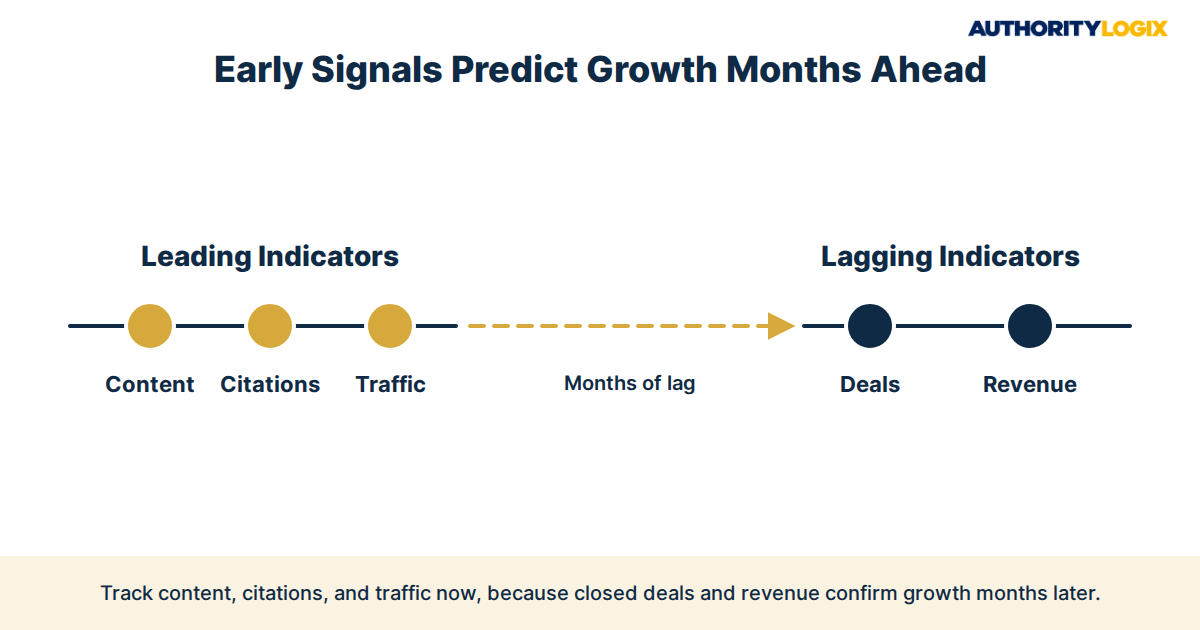
- Leading indicators like content velocity and citation consistency predict growth months before lagging indicators like closed deals show it.
- The firms that scale sustainably know when to invest in infrastructure and when to invest in people, instead of defaulting to headcount for every growth problem.

A real estate growth playbook starts by asking what growth actually depends on — and most firm owners still point to one lever: more agents, more ad spend, a new market. That instinct is understandable, because a single lever is easy to pull and easy to measure. It is also usually wrong. Sustainable growth is the output of several systems reinforcing each other.
And a firm can pull one lever perfectly and still watch its numbers plateau, simply because nothing behind that lever was built to carry the weight. A real estate growth playbook replaces that single-lever instinct with a more accurate one. Growth as the output of a connected system, not the result of any one decision, however appealing that decision feels in the moment.
Connecting those systems deliberately, so growth compounds instead of resetting every time a campaign ends, is
what we do. The firms that scale sustainably are rarely the ones working the hardest in any given month. They are the ones who stopped depending on any single channel for their next client and built infrastructure that keeps producing results with less active effort every year that follows, whether they are personally driving new business that quarter or not.
Growth compounds fastest on top of real market authority. If that foundation isn’t in place yet, start there.
Authority Guide →
Why Growth Stalls Even for Firms Doing Everything Right
The most disorienting kind of growth stall is the one that hits a firm doing everything that is supposed to work — publishing content on schedule, generating leads, closing deals every month. When growth stalls despite visible effort, the cause is almost never one obviously broken thing. It is usually one system quietly underperforming while the healthier systems absorb the strain, right up until they can no longer keep compensating and the whole pipeline feels stuck all at once.
That compensation period is exactly what makes the problem so hard to see from the inside. Everything looks fine on the surface, because the systems that are still working are covering for the one that isn’t, and a firm owner living through it rarely gets a clean signal pointing to the actual weak link. What they get instead is a vague, gnawing sense that things feel harder than they should — usually months before any specific number confirms it.
Our approach starts by mapping the full system before touching any single piece, because fixing the wrong layer wastes effort and leaves the real bottleneck untouched.
Inside a Real Estate Growth Playbook: The Five Systems That Compound Together
A real estate growth playbook connects five systems: local search visibility, market authority, lead generation, content infrastructure, and distribution. This is the actual architecture the term real estate growth playbook is meant to describe, not a loose collection of marketing tactics. None of them work in isolation the way most growth advice implies. Visibility feeds authority, because a prospect has to find you before they can evaluate you.
Authority improves how well leads convert, because trust closes deals that raw traffic alone never will. Content fuels both visibility and authority at once, and distribution multiplies the reach of everything the other four systems produce. Treat any single one of these as a standalone initiative and its return caps out at whatever that system alone can generate. A related breakdown of this is covered in the
content systems guide.
This is the single most common structural mistake growing firms make — not neglecting these systems, but managing them as five separate initiatives with five separate budgets and five separate owners, when their entire value comes from being connected. It is an easy mistake to fall into, because each system genuinely can be built and measured on its own, in a way that looks like real progress on a dashboard even while the parts never actually reinforce each other.
The local SEO playbook gets a firm found in the first place, and that visibility is the raw material every other system in this playbook depends on entirely. Nothing downstream works without it.
Without it, even a well-built
lead generation system has nothing to convert. The strongest capture form and nurture sequence in the world produce nothing if no one ever sees them in the first place.
What Real Estate Agent Authority Growth Actually Looks Like Over Time
Real estate agent authority growth is not linear, and it almost never feels like progress during the months it matters most. A firm building the five-system foundation spends its first several months mostly on infrastructure, with results that stay flat or barely move — and this is exactly the period where most firms lose patience and abandon the approach. The ones who stay the course see results accelerate meaningfully once the systems begin reinforcing each other, which is precisely why firms that quit in the flat early period never reach the compounding phase that would have made the investment worthwhile.
The five systems behind a real estate growth playbook
| System |
Job |
What It Feeds |
| Local SEO |
Get found in search and maps |
Traffic into the lead generation system |
| Market authority |
Build trust before the first call |
Conversion rate on every lead |
| Lead generation |
Turn visibility into a pipeline |
Revenue and closed deals |
| Content infrastructure |
Fuel visibility and authority |
Every other system on this list |
| Distribution |
Multiply the reach of content |
Visibility, authority, and leads together |
Source: AuthorityLogix Growth Systems Framework

From Solo Agent to Team: What Actually Has to Scale
A solo agent’s growth engine is almost always personal — their own hustle, their own relationships, their own name recognition built up over years in a specific market. That engine does not scale simply by hiring more agents who each try to run their own version of the same personal playbook. What actually has to scale is the infrastructure sitting underneath the founder’s success: the content, the systems, and the processes that do not depend on any single person showing up and grinding every single day.
This is the exact transition most solo-to-team growth attempts get wrong. Firms hire agents and quietly expect them to replicate the founder’s personal growth engine from scratch, when the real fix is building shared
educational hub infrastructure every agent on the team can plug into from day one, instead of asking each new hire to rebuild a personal brand with nothing behind them. The payoff shows up in retention as much as in production — agents who join a firm with real shared infrastructure tend to ramp up faster and stay considerably longer than agents dropped into a team with nothing to lean on beyond a listing sheet and a phone number.
Competitive Differentiation in a Commoditized Market
Real estate is commoditized in the sense that matters most to a prospect comparing options: the core service, helping someone buy or sell property, is available from hundreds of providers in any given metro. Differentiation was never going to come from the service itself. It comes from everything surrounding it — the depth of market knowledge a firm actually makes visible, the trust signals a prospect can verify before ever picking up the phone, and the specificity of a firm’s expertise in a particular niche or submarket that a generalist competitor simply cannot match.
A prospect comparing two agents with similar listings and similar experience will choose the one whose expertise they could actually see and verify beforehand, every time, without exception, regardless of how similar the two firms otherwise appear on paper. Visibility of expertise, not the expertise itself, is what tips the decision.
This reality is uncomfortable for firms that built their identity around service quality, because service quality is genuinely hard to differentiate from outside the transaction — every firm claims excellent service, and a prospect doing research online has no reliable way to verify that claim before making contact. Content systems solve this by giving a prospect something to actually evaluate: specific case studies, named transactions, published market analysis they can independently check, rather than a generic testimonial they have no way to confirm.
That kind of accumulated proof, built through a genuine
content system, is one of the few competitive advantages left that a well-funded competitor cannot simply buy their way into on short notice, no matter how large their marketing budget is. Money buys reach; it does not buy a track record.
Broker Compounding Visibility Starts With What You Own, Not What You Rent
Broker compounding visibility depends on owned assets — a website, a content library, an email list, first-party data a firm actually controls — rather than rented visibility like ad placements or portal listings that vanish the instant the payment stops. The distinction is not always obvious month to month, because both kinds of visibility can produce a similar-looking traffic number in any given period. The gap only becomes visible once the spending stops: rented visibility drops to zero immediately, while owned assets keep generating traffic and leads long after the initial investment, which is the entire mechanism that makes compounding possible in the first place.
Owned vs. rented visibility
| Attribute |
Owned Assets |
Rented Visibility |
| Examples |
Website, content library, email list |
Paid ads, portal listings, boosted posts |
| Residual value after spending stops |
Continues generating traffic |
Drops to zero immediately |
| Cost trend over time |
Front-loaded, declines relative to output |
Recurring, scales with volume needed |
| Competitive durability |
Hard for competitors to replicate quickly |
Available to any competitor with budget |
Source: AuthorityLogix Growth Systems Framework
Multi-Market and Multi-Location Growth
Expanding into a new market or adding a second location multiplies the complexity of everything covered so far — not just the headcount required to staff it. A firm that already struggles to keep content and citations consistent in one market will struggle considerably more across three, unless the underlying systems were designed to scale from day one rather than patched together after the expansion was already underway. Content production, citation management, and review generation all scale roughly linearly with location count when handled manually, which means a process quietly consuming ten hours a week in one market can balloon to thirty hours a week across three, without anyone ever deciding that tradeoff on purpose.
Investor content built for one specific market rarely transfers directly to a new one, since the submarket knowledge, the local data, and the neighborhood-level nuance all have to be rebuilt from the ground up for each additional location. This is precisely the part of expansion most firms underestimate when they first budget for growth.
Publishing systems designed with that reality in mind from the start make each subsequent market expansion faster than the one before it, because the process itself improves with practice even though the specific content never carries over. The second market build goes faster than the first, and the third faster still.
Measuring Growth the Right Way: Leading vs. Lagging Indicators
Closed deals and revenue are lagging indicators — they confirm that growth happened, usually months after the work that actually produced it. Content velocity, citation consistency, and organic traffic trends are leading indicators instead, predicting growth before the lagging numbers ever move and giving a firm real advance warning about whether its systems are actually working.
Most firms build dashboards almost exclusively around the lagging numbers, because those are the ones that map most directly to revenue and feel like the ones that matter. That instinct is understandable and also backwards: by the time a lagging indicator shifts, the underlying cause has usually been building for months already, well past the point where early action would have been cheap and easy.
A firm that only tracks lagging indicators finds out something broke months after it actually broke, with no early warning that would have made the fix cheap instead of expensive.
Authority distribution consistency is one of the clearest leading indicators available for catching that kind of drift early, because it reflects whether the underlying visibility system is healthy well before that health — or its absence — ever shows up in a closed-deal count months later.
Watching
distribution systems output tells the same story from a different angle: a drop in distribution activity today reliably predicts a lead slowdown weeks or months before it actually arrives, which is exactly the kind of runway a growing firm needs to correct course before revenue is the number that finally forces the conversation. Leading indicators buy time that lagging indicators never can.
When to Invest in Infrastructure vs. When to Invest in People
A firm hitting a growth ceiling almost always reaches for the same solution first: hire more people. Sometimes that instinct is correct. Just as often, the actual bottleneck is a broken or missing system that no amount of additional headcount will fix, and adding people on top of a broken system tends to produce more of the same underperformance at a meaningfully higher payroll cost. Hiring feels like the safer default because it is proactive, it is a decision a firm owner can make unilaterally without waiting on anyone else, and it produces an immediate sense of forward motion — even in cases where the underlying problem never actually gets touched.
The diagnostic question worth asking before any hire is simple, even if it rarely gets asked out loud: is the current team capacity-constrained, or is it system-constrained? Most firm owners default to assuming the former without ever genuinely checking, largely because a capacity problem is the more comfortable diagnosis to reach for — it implies the team is already doing everything right and simply needs more hands.
Our work with growing real estate firms consistently finds the second cause more often than owners expect walking in.
The full case for that is on our
why us page, but the short version is straightforward: fixing the underlying system first usually makes the eventual hire more productive too, rather than dropping a capable new person into a process that was already quietly broken. Sequence matters more than most firms assume.
Avoiding the Common Growth Traps
The most common growth trap is chasing a new tactic the moment growth slows, instead of taking the time to diagnose which existing system actually broke. A firm that abandons a working content strategy because results plateaued temporarily, in favor of some unrelated new tactic, usually loses more ground than it gains. Plateaus are frequently just a normal part of the compounding curve, not proof that the strategy failed.
This trap is especially common among firms that follow marketing trends closely, since there is always a shinier new tactic being promoted somewhere. And the temptation to chase it is strongest at exactly the moment. A plateau — when staying patient with the current approach would actually have paid off.
Specialized content built around a firm’s actual niche helps sidestep a second, related trap: importing generic growth advice from a completely different industry or market that was never built around how real estate specifically works. Real estate runs on its own transaction cycles, its own trust dynamics, and its own referral patterns, and advice designed for a different business model rarely transfers as cleanly as it promises to.
The firms that
generate leads most sustainably tend to be the ones that avoided both traps at once. They stayed patient through the plateaus and specific instead of generic, even while a louder, shinier tactic was being promoted everywhere else in the industry that month.
Ready to build the compounding visibility that lets your firm grow without buying more leads?
Work With Us →
What Most Real Estate Firms Get Wrong About Growth
Straight answers to the questions firm owners actually ask before investing in a real estate growth playbook. Most of what follows traces back to the same root cause: treating growth as a single lever to pull, instead of the connected system covered across the
real estate hub of services this playbook is part of.
How long does it take to see results from a real estate growth playbook?
The first few months are largely infrastructure-building with limited visible payoff, which is exactly the stretch where most firms lose patience and quit. Compounding results typically become visible somewhere between month four and month eight, then accelerate meaningfully beyond that point as the five systems start reinforcing each other. The firms that quit in month two are almost always the same firms that would have seen the payoff by month five.
Should we focus on one growth system at a time, or build all five together?
Sequencing genuinely matters, but total isolation doesn’t work either — a strong lead generation system with zero visibility feeding it simply has nothing to convert. The practical approach is establishing baseline visibility and authority first, then layering in lead generation, content, and distribution as that foundation solidifies. Trying to build all five at full intensity at once usually spreads a firm’s effort too thin to do any single one of them well.
Is hiring more agents the fastest way to grow a real estate firm?
Only if the current team is genuinely capacity-constrained rather than system-constrained. Adding headcount on top of a broken lead generation or content system usually just produces more of the same underperformance at a higher payroll cost, without ever addressing what was actually holding growth back in the first place.
How do we know if a growth plateau is normal or a sign something is actually broken?
Check the leading indicators — content output, citation consistency, organic traffic trend — before assuming the strategy has failed. If those are still healthy, a temporary plateau in closed deals is usually just the normal lag between leading and lagging indicators, not a signal to abandon the approach. If the leading indicators have declined as well, that combination is a genuine signal worth investigating immediately. This connects directly to the topic covered in the
local SEO playbook resource.
What’s the biggest mistake firms make when expanding to a new market?
Assuming that content and authority built for one market automatically transfers to another. Submarket knowledge, local data, and citation consistency all have to be rebuilt for each new location — the infrastructure and process can transfer cleanly, but the specific content almost never can. Firms that budget time and resources for this rebuild up front tend to expand far more smoothly than firms that assume the second market will be just as easy as the first.

Building the System: Turning a Real Estate Growth Playbook Into Real Estate Firm Long Term Growth Strategy
None of the five systems produce compounding growth in isolation. Visibility without lead generation wastes traffic that never gets captured. Lead generation without authority behind it underconverts. Content without distribution reaches nobody beyond the people who already knew to look for it.
A real estate growth playbook only works as a fully connected structure, with each system feeding the next and every incremental improvement compounding on the ones that came before it. That is exactly why firms that try to shortcut the process by grabbing just one system in isolation, whether that’s SEO alone or content alone or lead capture alone, tend to end up with a partial playbook that plateaus quickly, because each piece was designed to depend on the others rather than function as a standalone tactic.
The broader market backdrop makes this patience worth having. According to
NAR’s 2026 forecast, existing-home sales are projected to rise meaningfully as rates ease and inventory improves — and a real estate firm long term growth strategy built on owned infrastructure is positioned to capture a disproportionate share of that recovery, while firms still relying on rented visibility will find themselves competing for the same shrinking pool of paid placements everyone else in the market is bidding on at the same time.
The honest answer is that most firms reading this already have the market knowledge and the client results to fuel real growth. What’s genuinely missing, in almost every case, is the connected system that turns those isolated wins into something that actually compounds. If you’re ready to find out which system is quietly holding your growth back, work with us.