

Key Takeaways
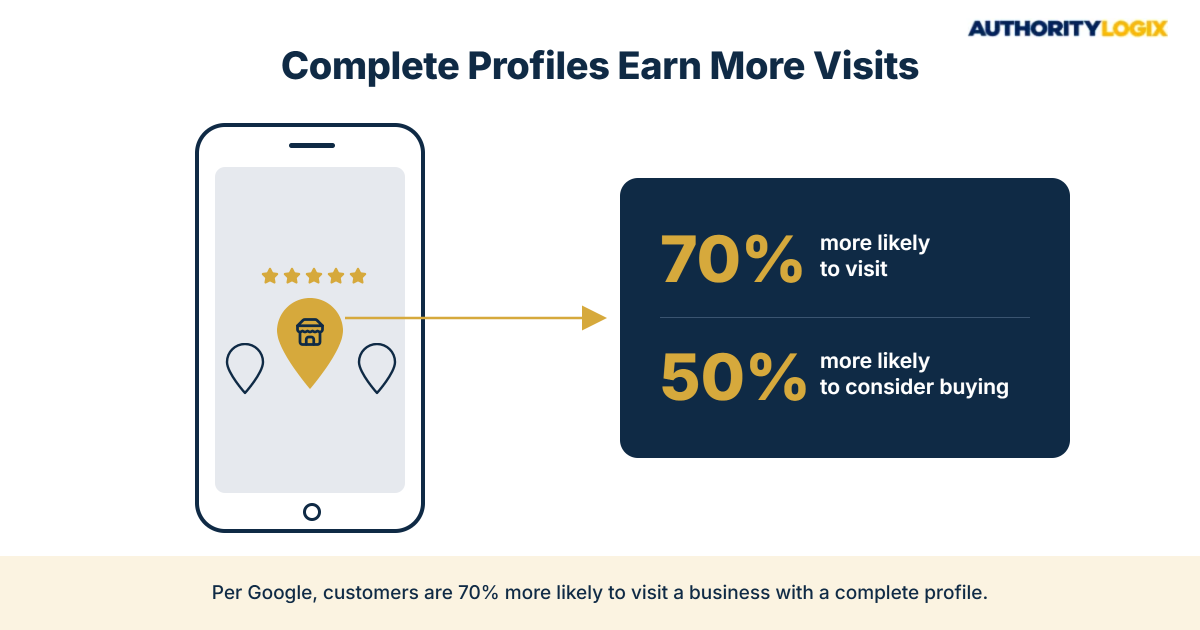
- Customers are roughly 70% more likely to visit and 50% more likely to consider purchasing from businesses with complete Google Business Profile listings.
- Profiles with a large, steady base of reviews attract meaningfully more website visits than thinly-reviewed profiles.
- Regularly updated profiles tend to earn more views than profiles left untouched after setup.
- A complete, active profile can drive far more direct phone calls than an incomplete one.
- Google’s ranking model weighs proximity, relevance, and prominence — and prominence is the only one an agent actually controls.
- Most agents complete Google Business Profile for real estate agents setup once and never touch it again, which is exactly why competitors who maintain theirs pull ahead.
Table of Contents
A Google Business Profile real estate agent setup is treated, in practice, as a one-time task: claim it, add a photo, move on. That single decision is why so many agents show up in a Google search for their own name but never show up in the map pack for “real estate agent near me.” Google Business Profile for real estate agents is not a directory listing. It is a ranking asset that either compounds in your favor every month or quietly falls behind while a competitor’s does the opposite. Most of what separates the two outcomes is whether anyone treated the profile as infrastructure worth maintaining.
If your Google Business Profile has not been touched since the day you set it up, it is very likely working against you right now.
Google Business Profile for Real Estate Agents: The Foundation of Local Search
Google’s local ranking model runs on three inputs: proximity, relevance, and prominence. Proximity is fixed and there is nothing you can do to change it. Relevance and prominence are where the actual competition happens, and Google Business Profile is the single asset that carries the most weight across both.
This is why real estate local search lead statistics keep pointing back to the same asset. local search statistics already showed that a large share of real estate leads begin with a local search moment, and Google Business Profile is frequently the first thing that search moment surfaces. An agent invisible there is invisible at the exact point their next client is deciding who to call.
None of this is specific to any brokerage model — solo agents, small teams, and larger firms across the real estate hub all compete on the same map pack, judged by the same three inputs. Google Business Profile for real estate agents rewards consistent effort over size — a smaller firm that maintains its profile actively will often outrank a larger one that has not touched theirs in a year.
What a Complete Profile Actually Requires
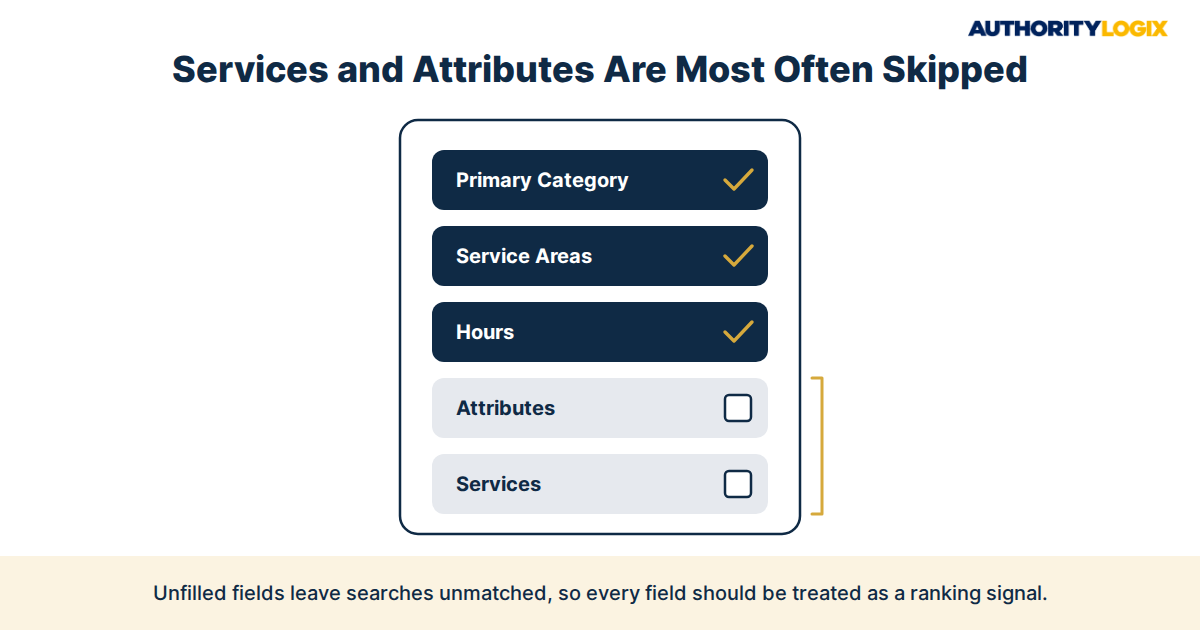
A complete Google Business Profile for real estate agents is not a profile with a photo and a phone number — every available field needs to be filled out accurately: category, service areas, hours, attributes, description, and services. Google rewards completeness because a fully populated Google Business Profile for real estate agents gives it more data to match against what someone actually typed.
| Profile Field | Why It Matters |
|---|---|
| Primary category | The single strongest ranking signal in the entire profile |
| Secondary categories | Captures additional searches the primary category alone would miss |
| Business description | Gives Google keyword context beyond what the category field alone provides |
| Service areas | Matches the profile to searches from surrounding neighborhoods, not just the pinned address |
| Attributes | Signals specific business details Google can match against filtered searches |
| Photos | Supplies an image-based ranking signal most agents never touch again after setup |
The Real Estate Google Listing Setup Most Agents Skip
The real estate Google listing setup most agents skip is services and attributes, not the basics. Name, address, and phone number get filled in during the initial claim. Specific service listings, secondary categories, and business attributes are the fields that separate a generic listing from one Google can confidently match to a specific search.
This shows up constantly in content systems built for real estate firms — agents whose website content is genuinely specific but whose profile still describes them in the vaguest terms Google could use. The real estate Google listing setup that actually converts treats every field as a ranking opportunity, not a formality to click through.
What Broker GBP Optimization Actually Covers
Broker GBP optimization goes further than an individual agent’s setup, because a brokerage often manages multiple profiles across agents and locations at once. Consistency across those profiles — matching categories, descriptions, and hours — keeps Google confident about the brokerage’s overall footprint rather than treating each listing as unrelated.
A brokerage handling investor content for a niche should reflect that specialization in the profile’s categories and description, not just the website. The two channels need to say the same thing, because Google increasingly checks them against each other. Broker GBP optimization done well means every agent’s individual profile reinforces the brokerage’s overall category and market focus, rather than each one describing the business slightly differently.
The Categories and Attributes Most Agents Get Wrong
Primary category selection is one of the strongest ranking signals in the entire profile, and it is also the field agents get wrong most often. “Real estate agent” is rarely the most specific option available, and Google rewards specificity over a broad, generic category that technically applies but does not actually describe what the agent focuses on.
Secondary categories compound this mistake. An agent who only sets a primary category and skips the secondary options is leaving relevant search matches on the table that Google would otherwise have surfaced. A firm serious about this level of detail is usually the same firm with a genuine authority guide behind its broader marketing, not a firm treating the profile as an afterthought.
Business name consistency is the other place this breaks down. A profile name that does not exactly match the name on the website and other citations confuses Google’s matching, and that shows up as weaker rankings even when every other field is correct. This is precisely the kind of gap why AuthorityLogix exists to close for firms that already have the substance but not the visibility infrastructure.
Why Verification and Consistency Matter More Than They Seem To
An unverified Google Business Profile for real estate agents does not appear in the map pack, regardless of how complete every other field is. Verifying a Google Business Profile for real estate agents is not optional, and it is not always fast — postcard, phone, or video verification can take from minutes to a couple of weeks depending on the method.
NAP consistency — name, address, and phone number matching exactly across the profile, website, and every citation — is one of the quieter ranking factors, and one of the easiest to accidentally break. A single old citation with a previous phone number or a slightly different business name can undercut consistency signals Google is actively checking.
This is the infrastructure work behind a Google Business Profile for real estate agents that the educational hub exists to explain in detail, because it is unglamorous and directly responsible for a meaningful share of agents who never crack the map pack despite otherwise solid marketing. Most of that gap comes down to follow-through, not talent.
A firm’s what we do approach to visibility starts here, not with content or ads. Google Business Profile for real estate agents only compounds once these foundational pieces are actually in place and staying consistent over time.
Not sure where your Google Business Profile actually stands against the agents you are competing with in the map pack?
Google Business Profile for Real Estate Agents: Why the Setup Sequence Matters
Google Business Profile for real estate agents rewards a specific setup sequence: verify first, complete every field, then layer in reviews, posts, and photos as ongoing maintenance, not one-time tasks. Agents who reverse this order end up with a profile that looks active but is still missing the foundational signals Google weighs most heavily.
Reviews matter, but not in isolation. Profiles with a large, steady base of reviews see meaningfully more website visits than thinly-reviewed profiles, and that advantage compounds when reviews arrive consistently rather than in one bulk request sent to a client list. Google’s ranking model reads recency as a genuine signal, not just review count on its own.
A firm’s lead generation system behind a Google Business Profile for real estate agents should already account for review requests as a standard step in every closed transaction, because the profile that keeps accumulating recent reviews is the profile that keeps climbing. A profile with two hundred reviews and nothing in the last year quietly loses ground to a newer competitor who is actively requesting them.
Why an Agent Local Google Map Pack Position Depends on More Than Reviews
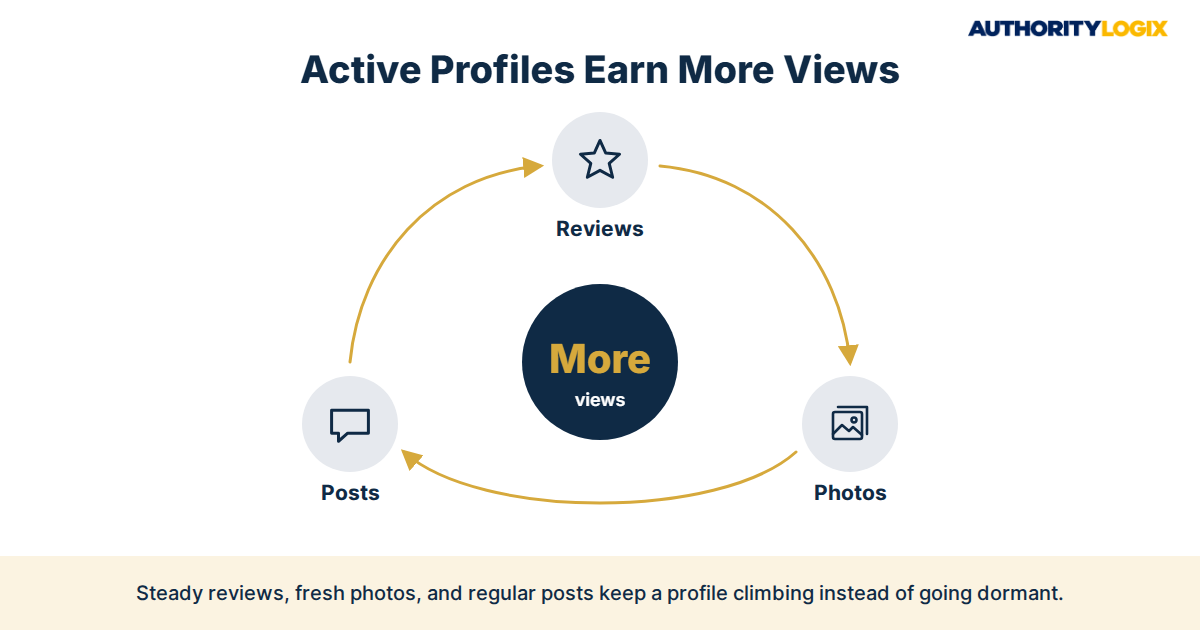
An agent local Google map pack position depends on posting activity and photo volume just as much as review count, and this is the part of maintenance most agents skip once setup is done. Regularly updated profiles tend to earn more views than profiles left untouched, and Google Posts specifically signal an active, maintained listing rather than an abandoned one.
Photos carry more ranking weight than most realize. A profile with a substantial, refreshed photo library consistently outperforms one with stale listing photos from years ago, since Google’s systems extract signal from image content, not just text fields. An agent local Google map pack ranking is rarely won on any single factor — it is the accumulation of all of them together.
Distributing that same content and those same updates through authority distribution keeps the profile active without requiring a separate, manual posting habit that most agents realistically will not maintain on their own for more than a few weeks. That consistency is what separates a profile that keeps climbing from one that quietly stalls.
Engagement signals — posting frequency, review response time, and updated photos among them — help separate a profile that looks actively managed from one that looks dormant. That distinction alone explains why two similarly complete profiles can perform very differently in the map pack.
Building that maintenance into a content build process is what keeps it from depending on someone remembering to log in. A system that runs on habit outperforms one that runs on willpower every time.
Turning Profile Visibility Into a Lead Pipeline
A fully optimized Google Business Profile produces calls, clicks, and message inquiries — but none of that turns into a client without a system to follow up on it. A complete Google Business Profile for real estate agents can drive far more direct phone calls than an incomplete one, and every one of those calls needs an answer, not a missed-call notification that sits for a day.
This is where a content system and a Google Business Profile for real estate agents need to work together rather than as separate initiatives. The profile drives the initial contact; the content behind the website it links to is what convinces that contact the agent is worth calling back if the first call gets missed.
Google Business Profile Real Estate Agent Setup: From Click to Booked Appointment
Google Business Profile for real estate agents only produces revenue once a click, call, or message converts into a booked appointment, and that conversion step is where most of the profile’s real value quietly gets lost. Message inquiries through the profile deserve the same urgency as a phone call, and most agents treat them as an afterthought precisely because they arrive through a channel that feels less immediate than a ringing phone.
lead generation systems built around fast response time to every channel — not just calls — capture leads that a slower competitor’s profile is currently losing. A profile generating strong traffic is wasted infrastructure if nobody on the other end responds quickly enough to convert it.
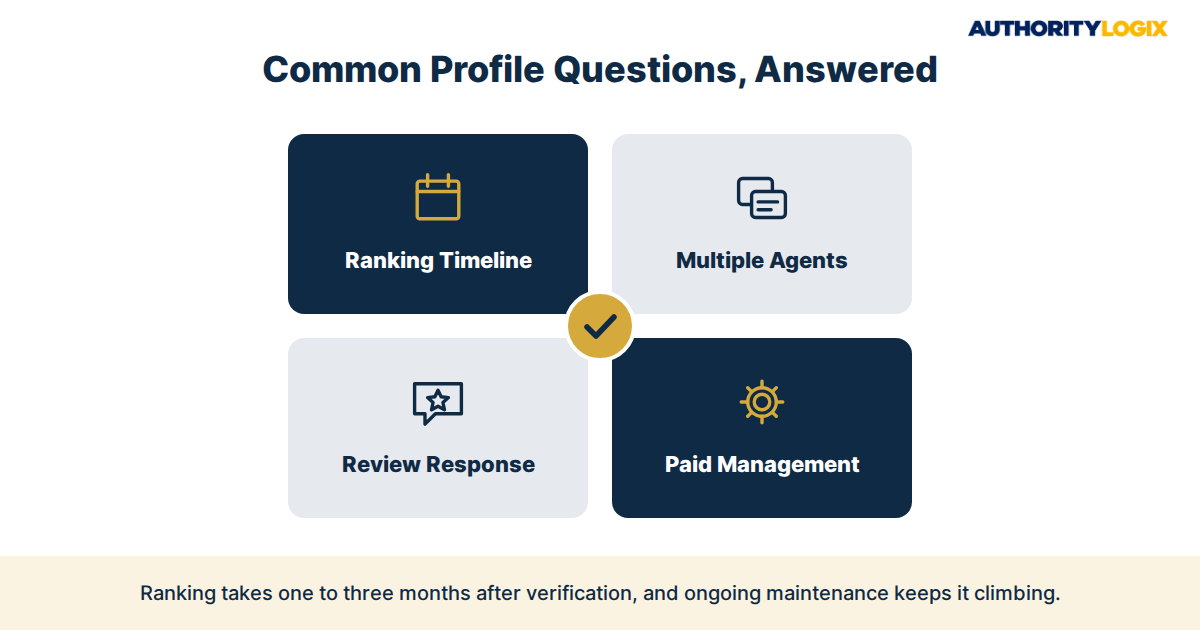
Common Questions About Google Business Profile for Real Estate Agents
How long does it take for a new Google Business Profile to start ranking?
Verification alone can take a few days to a couple of weeks depending on the method. After verification, meaningful ranking movement for a Google Business Profile for real estate agents typically takes another one to three months as Google accumulates signal from reviews, posts, and consistent activity on the profile.
Do multiple agents at the same brokerage need separate profiles?
Generally, yes. Each agent operating as their own point of contact should have their own verified Google Business Profile for real estate agents, while the brokerage itself maintains a separate one — both need to stay consistent in name, category, and service area. This connects directly to the topic covered in the local search statistics resource.
Does responding to reviews actually affect ranking?
Yes. Review response time is one of the engagement signals Google’s local ranking systems track, and profiles that respond to reviews consistently signal active management in a way that silently accumulated reviews alone do not.
Is it worth paying for Google Business Profile management if the basics are already done?
It depends on whether the basics are actually being maintained. A Google Business Profile for real estate agents that is complete but static — no new reviews requested, no posts, no fresh photos — is not capturing the ongoing ranking benefit that active Google Business Profile management for real estate agents is specifically built to provide.
Where This Fits Into a Long-Term Local Search Strategy
Google Business Profile for real estate agents is not a standalone tactic — it is the entry point to a larger growth playbook most agents build piece by piece without ever connecting the pieces on purpose. The profile gets someone to notice a firm exists. Everything after that first click depends on infrastructure the profile alone cannot provide.
Firms that treat the profile as finished the day it gets verified plateau just outside the map pack, visible but never in the three listings that get clicked. Firms that treat it as ongoing infrastructure are the ones still climbing a year later, while the first group wonders why their rankings look stable but the calls keep slowing down.
A look at our work shows what that ongoing maintenance actually looks like once it is built out properly, rather than left as a one-time setup task from years ago. The difference between the two approaches shows up within months, not years.
Firms starting from zero should pair Google Business Profile for real estate agents work with the lead capture systems that make sure every call, message, and click the profile generates actually gets followed up on. Google Business Profile for real estate agents works best as one piece of a connected system, not a task to check off once and forget.
Want a Google Business Profile set up the way most brokers skip, so local buyers and sellers find you first?