

Key Takeaways
- Real estate agent presence vs platform is not a matter of degree — a presence is a static website that exists on its own, while a platform connects that website to a CRM, content, and lead nurture as one working system.
- The website-only era is over. Agents need integrated systems where website behavior, CRM data, marketing campaigns, and lead nurture share information rather than operating as disconnected tools.
- Firms running an integrated platform see marketing leads convert to transactions at roughly two to three times the industry average compared to firms relying on a standalone website alone.
- A presence looks finished the day it launches. A platform is never finished, because it keeps accumulating data, content, and connections that a static site structurally cannot — the core of the real estate agent presence vs platform distinction in a single line.
- Owning a standalone website has real appeal, but it often means coordinating several disconnected vendors instead of one system where every piece reinforces the others.
- Converting a presence into a platform does not require replacing the website. It requires connecting what already exists to the systems a presence was never built to talk to.
Table of Contents

Real estate agent presence vs platform is the distinction most agents never make, and it explains why two websites that look equally polished can produce wildly different results. A presence is a website that exists — professional, branded, technically fine — and stops there. A platform is the same website connected to a CRM, a content engine, and a lead nurture system that all share data and reinforce each other. One is a business card. The other is infrastructure.
If your website looks professional but leads still fall through the cracks after the first inquiry, that’s the presence-versus-platform gap showing up in your pipeline.
Real Estate Agent Presence vs Platform: Why the Distinction Actually Matters
This distinction rarely gets named out loud in real estate marketing conversations. Everyone in the industry has seen both versions play out in practice, even without a shared vocabulary for the difference.
Two firms can spend the same amount on their websites and end up with dramatically different results. The reason almost never shows up in a side-by-side design comparison, no matter how carefully that comparison is done. This connects directly to the topic covered in the local search statistics resource.
Real estate agent presence vs platform sounds like a semantic distinction until the actual business impact becomes visible. This is real estate agent presence vs platform in miniature: a presence generates a visitor, maybe a form fill, and then relies entirely on the agent remembering to follow up manually with no supporting system behind them. That single point of failure is where most real estate agent presence vs platform outcomes actually get decided.
This is exactly the gap local search statistics already pointed to: a visitor arriving from a local search deserves a system that captures and nurtures them, not a static page that hopes they call. That expectation gap is where the real estate agent presence vs platform distinction starts to cost real money. The traffic was never the hard part; what happens after the click is.
Firms across the real estate hub increasingly compete on this exact real estate agent presence vs platform distinction. A smaller firm running a genuine platform can out-convert a larger competitor running an expensive but disconnected presence, since conversion depends on the system, not the budget behind the design.
What a Real Estate Agent Presence Actually Is (And Isn’t)
Most agents genuinely believe they already have a platform. That confidence usually lasts right up until someone asks a specific question about what actually happens after a lead form gets submitted.
A real estate agent presence is a website that exists, looks professional, and technically functions — but stops there, which is precisely the boundary a real estate agent presence vs platform comparison is drawn around. It does not talk to a CRM, does not feed a nurture sequence, and does not get smarter about a visitor the second time they return.
A firm’s Google Business Profile often reveals the same real estate agent presence vs platform gap in miniature. A complete, active profile drives real visibility, but if the website behind it is just a static presence, that visibility dead-ends the moment a visitor clicks through and finds nothing waiting for them.
Building the connective layer a presence is missing is what content systems are designed to produce. Content is frequently the first piece that actually links a website to an ongoing relationship with a prospect, rather than a one-time visit that leaves no trace.

| Factor | Presence | Platform |
|---|---|---|
| Website exists | Yes | Yes |
| Connected to CRM | No | Yes |
| Feeds a nurture sequence | No | Yes |
| Learns from visitor behavior | No | Yes |
| Content tracked to pipeline impact | No | Yes |
| Typical lead-to-transaction conversion | Baseline | Higher than baseline |
Broker Digital Authority Platform: The Difference in Practice
Vendors selling individual tools rarely explain how their tool is supposed to connect to anything else a firm already owns. That silence is part of why so many firms end up with a pile of disconnected pieces instead of an actual platform.
This is where the real estate agent presence vs platform conversation usually gets concrete. “Platform” as a word gets used loosely across the industry, often without any clear definition attached to it at all. This idea is explored further in the neighborhood landing pages resource as well.
A broker digital authority platform is not a bigger or more expensive website — it is a website that has been connected to the other systems a real estate business actually runs on. Cost and connection are not the same investment, even though they often get confused. The size of the platform matters far less than how well its pieces talk to each other.
What a Broker Digital Authority Platform Actually Connects
A broker digital authority platform typically connects at minimum a CRM, a content system, and a lead capture mechanism, so that a visitor’s behavior on the website actually informs what happens next in the relationship. This is the real estate agent presence vs platform test applied concretely to one specific firm’s technology stack. None of these pieces working in isolation produces the same result as all three working together.
This is precisely where Zillow comparison research already showed a related dynamic. A portal’s scale comes from connected systems working at massive volume, and a firm’s own platform applies that same principle at a scale that actually fits one business.
A firm’s neighborhood pages become genuinely more valuable inside a connected platform. A visitor reading about one neighborhood can be tracked and nurtured toward a relevant next step, rather than simply leaving the page with no record the visit ever happened.
A local SEO playbook built for a connected platform performs differently than the same playbook applied to a standalone presence. The traffic it generates actually gets captured and nurtured, instead of arriving and leaving with no record it ever happened.
Agent Website vs Marketing Platform: The Data Behind the Gap
Opinions about marketing tend to be cheap and plentiful in real estate. A hard number carries more weight than another framework or another buzzword ever could.
Numbers tend to settle arguments that framing alone cannot. This is one of those cases where the actual data makes the real estate agent presence vs platform distinction impossible to dismiss as mere semantics. The backlink strategy resource covers this same idea from a related angle.
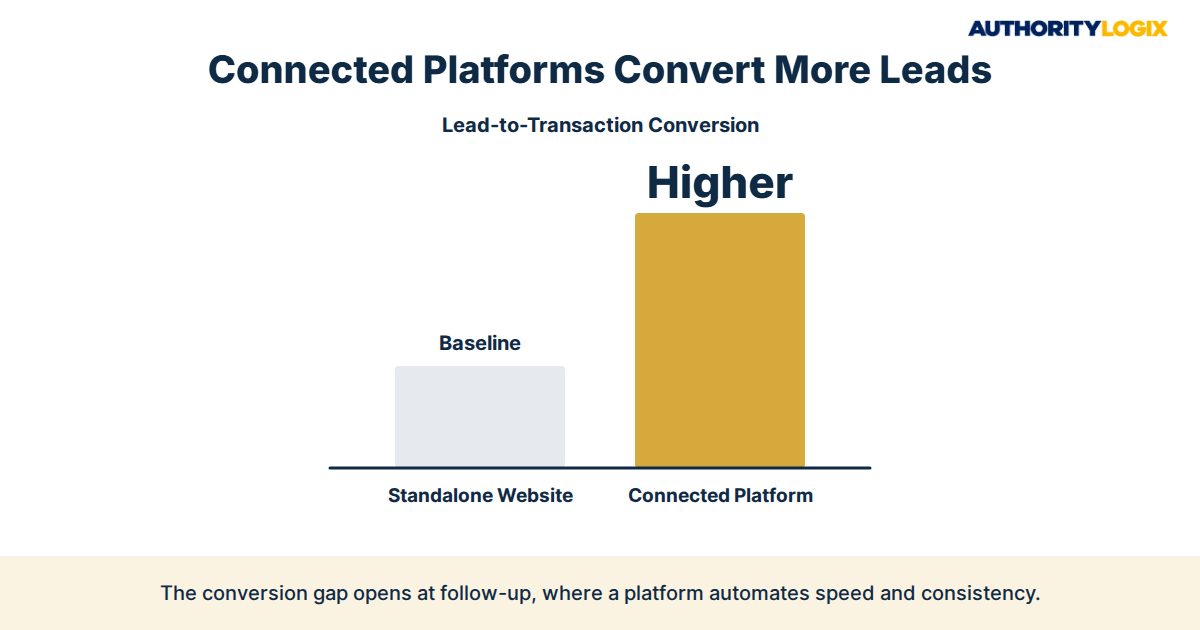
Agent website vs marketing platform is not a close comparison once actual conversion data enters the picture. Firms running an integrated platform see marketing leads convert to transactions at roughly two to three times the industry average compared to a standalone website operating alone.
Real Estate Agent Presence vs Platform: The Conversion Data
Real estate agent presence vs platform outcomes diverge specifically at the follow-up stage, which is exactly where the conversion gap actually originates. A presence loses leads to slow or inconsistent follow-up; a platform automates enough of that follow-up that speed and consistency stop depending on any one person remembering to act.
Firms with connected marketing, CRM, and content systems tend to outperform firms running the same tools as disconnected point solutions. The gap holds even when the individual tools themselves are comparable in quality on paper.
A backlink strategy built inside a real estate agent presence vs platform framework compounds differently than one built for a standalone presence alone. Earned links can be tracked back to actual pipeline impact rather than treated as an isolated SEO metric with no visible business outcome attached to it.
Not sure whether your current website is actually a connected platform or just a well-designed presence?
Real Estate Digital Platform Strategy: What Connects the Pieces
Strategy is the word most often skipped entirely in this conversation. Most firms rush straight to tools and vendors before anyone actually decides what the platform is supposed to accomplish in the first place. This connects directly to the topic covered in the investor content resource.
Real estate digital platform strategy, done correctly, starts with data, not design — deciding what information should flow between the website, the CRM, and the content system before worrying about how any individual page looks. Design without that underlying data strategy just produces a better-looking presence.
Why Real Estate Digital Platform Strategy Starts With Data, Not Design
Real estate digital platform strategy that starts with design first, ahead of the real estate agent presence vs platform question, tends to produce exactly what most agents already have: a polished presence with no memory of past visitors and no system connecting one interaction to the next. Data architecture has to come before visual polish, not after it.
A genuine authority gap closes faster once this data layer exists, since a platform can tell which content actually moved a visitor forward and which content just sat there unread. Content built inside a connected platform can be tracked, tested, and improved based on actual visitor behavior instead of guesswork about what might eventually work.
A firm handling investor content alongside residential content should build both on the same underlying real estate agent presence vs platform architecture, rather than treating one audience as a platform and the other as an afterthought. Duplicating a disconnected presence for a second audience only doubles the original problem instead of solving it.
A niche authority strategy layered onto this same platform compounds faster than it would on a standalone presence. Specialized content actually gets tracked and nurtured here, instead of disappearing into an unconnected page with no memory of who read it.
Common Questions About Real Estate Agent Presence vs Platform
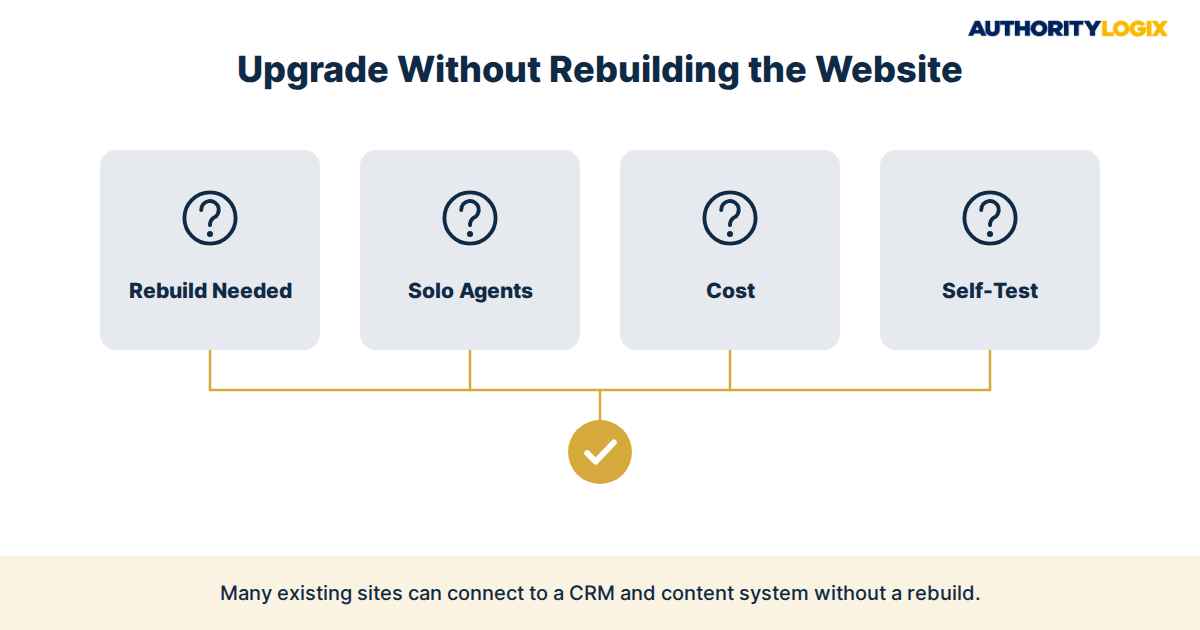
Does upgrading from a presence to a platform mean rebuilding the website?
Not necessarily — many existing websites can be connected to a CRM and content system without a full rebuild, though a badly outdated site sometimes makes a rebuild the faster path either way.
Is a platform only worth it for larger teams or brokerages?
No — solo agents benefit just as much, if not more, since a connected platform automates follow-up work a solo agent has the least spare time to do manually.
How much does converting a presence into a platform typically cost?
It varies widely depending on the existing website and desired integrations, but the ongoing return usually comes from conversion improvements rather than the platform itself being cheap. A related breakdown of this is covered in the Google Business Profile guide.
Can a firm tell whether it currently has a presence or a real platform?
A simple test: if a lead who fills out a form receives nothing beyond a single manual follow-up email, and nothing about their visit informs future content or outreach, that is a presence, not a platform.
Agent Website vs Marketing Platform: Same Domain, Different Function
Agent website vs marketing platform often means literally the same domain name, which is exactly why the distinction is so easy to miss from the outside. The difference lives entirely in what happens behind the page, not in how the page itself looks.
Distributing content through authority distribution only compounds properly once a platform exists to capture and nurture the traffic that distribution generates. Sending visitors to a page that cannot remember they ever arrived wastes most of the value distribution was supposed to create.
Turning a Presence Into a Platform Without Starting Over
Firms often delay this fix for years. It sounds like a bigger project than it actually turns out to be, once the work gets scoped out properly by someone who has done it before.
The good news in any real estate agent presence vs platform gap is that closing it rarely means starting from zero. That assumption is often the biggest misconception standing between a firm and the fix it actually needs.
Real estate agent presence vs platform conversion rarely requires replacing the website itself. It requires connecting what already exists to a CRM, a content system, and a lead nurture sequence the presence was never built to talk to in the first place.
A educational hub built during this transition gives the newly connected real estate agent presence vs platform system something genuinely useful to nurture visitors with. Launching the technical connections with no content actually flowing through them wastes the infrastructure before it ever produces anything.
A lead generation systems approach layered onto this same platform is what actually captures the leads a presence was quietly losing all along. The technical connection alone does not automatically improve follow-up without a system deliberately built around it.
Real Estate Agent Presence vs Platform: Where This Fits Into a Long-Term Strategy
Everything covered up to this point points toward one practical conclusion. It is worth stating directly here, rather than leaving it implied across seven separate sections.
Real estate agent presence vs platform is not a one-time upgrade decision — it is an ongoing architecture choice that shapes how every future marketing investment performs. A platform makes every subsequent tool and campaign more effective; a presence keeps each new investment isolated from the last.
A firm’s what we do should already reflect this platform-first thinking. Building isolated tools on top of a disconnected presence just adds more pieces that still do not talk to each other, no matter how good each individual piece looks.
A review of our work shows what a genuinely connected real estate platform looks like once presence and infrastructure have actually merged into one working system. It rarely looks dramatic from the outside, which is exactly why most firms underestimate the difference.
Ready to turn an online presence into a platform that actually generates business?