

Key Takeaways
- A link from a local news site with modest domain authority is worth more for local rankings than a link from a much larger national real estate blog, because Google weighs local relevance heavily.
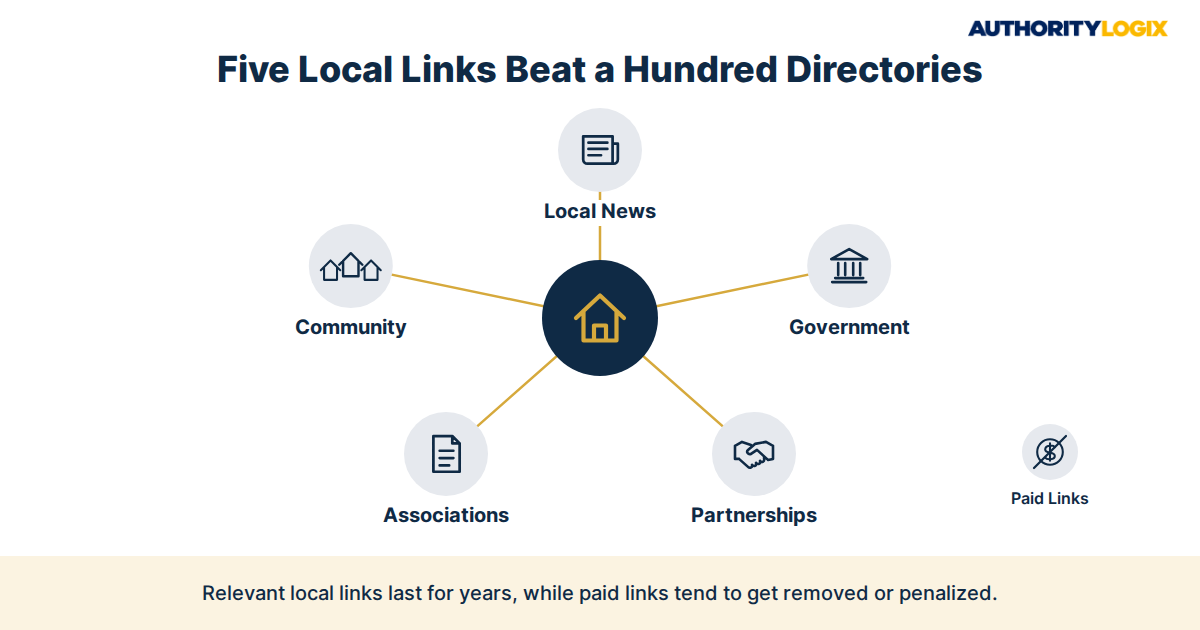
- Five high-quality local links from news sites, government pages, and community organizations tend to outperform a hundred generic directory submissions.
- Paid links get removed or penalized over time. Links earned through genuine relationships and real content tend to stay live for years.
- Realtor association memberships, MLS profiles, and local board listings are backlink opportunities most agents already qualify for and simply never claim.
- Comprehensive neighborhood guides and original local market data are the content types that earn links without any outreach at all.
- The right measure of backlink progress is referring domain growth and ranking movement, not a raw link count that can be inflated cheaply and worthlessly.
Table of Contents
A real estate agent backlink strategy built around buying links is not really a strategy at all — it is a shortcut that stopped working years ago and now actively invites a penalty. Google has gotten far better at spotting links that look manufactured, and the agents still buying them are trading short-term convenience for long-term risk. The agents actually dominating page one are not doing anything mysterious. They are earning links through relationships, real content, and community positioning that a paid link can never replicate, and that gap only widens the longer a firm keeps taking the shortcut instead.
If your current approach to backlinks is a directory submission service or a Fiverr gig, that spend is very likely doing more harm than good.
Real Estate Agent Backlink Strategy: Why Paid Links Don’t Work Anymore
Every real estate agent backlink strategy conversation eventually runs into the same old advice, most of it written for a different era of search. A real estate agent backlink strategy has to start from an honest premise instead: backlinks remain one of Google’s strongest ranking signals, but the era of “more links equals more rankings” ended a long time ago. Search engines have gotten much better at recognizing patterns that look manufactured, and a real estate agent backlink strategy built on volume alone now reads as a red flag rather than a strength to whoever is evaluating the site.
This is exactly the kind of foundational shift local search statistics already pointed to for any real estate agent backlink strategy: visibility now depends on signals Google actually trusts, not signals that can be purchased in bulk. A cheap batch of directory links does nothing to change where a buyer’s search actually lands, no matter how large the batch or how confidently it was sold.
Firms across the real estate hub building a real estate agent backlink strategy compete on the same signals regardless of size. A handful of genuinely earned local links can outperform a much larger link count built from low-quality sources, since Google increasingly discounts volume that does not carry real relevance.
What Actually Counts as a Quality Backlink for Real Estate
Real estate agent backlink strategy conversations tend to obsess over raw authority scores, when relevance is actually the stronger signal for local search. Within any real estate agent backlink strategy, a local link with modest domain authority from a local news site or community organization is often worth more for local rankings than a much larger national real estate blog, because Google weighs local relevance heavily for local search results.
A firm chasing the biggest possible link, rather than the most relevant one, is optimizing for the wrong variable entirely. That mistake is easy to make when a link-building vendor pitches authority scores as the only number that matters. Bigger is not automatically better once relevance enters the equation.
Why Agent SEO Backlinks Earned Through Relationships Outlast Paid Ones
As part of a genuine real estate agent backlink strategy, agent SEO backlinks earned through relationships — a chamber of commerce listing, a sponsorship mention, a local partnership — tend to stay live for years, because the organization linking has an ongoing reason to keep that page as it is. A paid link has no such reason and often disappears or gets penalized once the pattern is noticed.
A firm’s Google Business Profile presence and its real estate agent backlink strategy reinforce each other in a way most agents never connect. Both signal the same underlying local legitimacy to Google, just through different channels, and strength in one tends to compound the value of the other.
Building genuine content worth linking to is what content systems are built to produce, and it is the layer most agent websites skip while chasing link counts through shortcuts instead. A single well-built resource can earn more real links over time than months of outreach for a mediocre one.

| Backlink Source | Value and Risk Profile |
|---|---|
| Local news / community org link | High relevance, strong local ranking signal, tends to last for years |
| Realtor association / MLS link | Easy to claim, credible source, most agents already qualify |
| National real estate blog link | High authority score but weaker local relevance signal |
| Generic directory submission | Low impact individually; volume rarely compensates for low relevance |
| Paid / purchased link | Highest risk — subject to detection and penalty, rarely lasts |
Real Estate Agent Backlink Strategy: The Earned-Link Playbook
Five high-quality local links from news sites, government pages, and community organizations tend to outperform a hundred generic directory submissions, both in ranking impact and in how long they last. Directory submissions rarely get removed, but they also rarely move a ranking either, since Google has long since learned to discount that particular pattern. Quality and relevance do more work than sheer volume ever did, even in the old link-building playbook.
Real Estate Agent Backlink Strategy: The Data Behind Local vs National Links
A real estate agent backlink strategy built around local sources consistently outperforms a real estate agent backlink strategy chasing national real estate blogs and directories, because Google’s local ranking systems weight geographic relevance as heavily as the link’s raw authority score. A modest local link often does more for local rankings than a much bigger national one.
This is precisely the gap a genuine educational hub closes for firms that already have the local relationships but have never turned them into actual backlinks. Most agents have more linkable local relationships than they realize; they simply never asked.
According to Ahrefs’ link research, data-driven studies and free online tools are among the most reliable link magnets — the kind of content other sites want to reference because it genuinely helps their own readers. A comparison built around real, original local data is exactly the kind of resource other local sites want to cite.
A comparison built on real market data — the same discipline behind the Zillow comparison research — is exactly the kind of original resource other local sites want to cite. Nobody has to be asked to link to something genuinely useful.
A firm’s neighborhood pages can become linkable assets in their own right. A genuinely comprehensive neighborhood guide is useful reference material a local blog, school website, or community group might cite on its own, with no outreach required at all.
Broker Link Building SEO: Where the Easy Wins Actually Are
The gap between what a firm could easily claim and what it actually has claimed online is usually much larger than owners realize. Broker link building SEO, as part of a broader real estate agent backlink strategy, does not have to start from zero, and it rarely requires the large budget most firms assume it does. Realtor association memberships, MLS profiles, and local board listings are backlink opportunities most agents already qualify for and simply never claim, because updating a directory profile feels too small to bother with.
What Broker Link Building SEO Actually Requires
In practice, what broker link building SEO actually requires is not a large budget — it is a checklist: confirming every association membership includes a working link, every MLS profile is complete, and every local business partnership already in place is reflected online instead of only offline. None of this costs money to fix; it only costs the time to actually go through and check every listing.
A genuine authority guide behind any real estate agent backlink strategy is what turns a one-time cleanup into an ongoing habit. New memberships, sponsorships, and partnerships keep arising, and each one is a small, legitimate link opportunity if someone remembers to claim it before it gets forgotten.
A lead generation system built on top of this same relationship network, feeding directly back into the broader real estate agent backlink strategy, benefits twice over — once from the backlink itself, and again from the referral relationships that produced it in the first place. The two are rarely separate efforts in practice, and treating them as one saves real effort.

Not sure how many of your existing local relationships have actually been turned into real backlinks yet?
Content That Earns Links Without Outreach
Most firms treat outreach as the only way to build links, which is exactly why content-earned links stay underused. In any real estate agent backlink strategy, the easiest backlink to earn is the one nobody has to ask for, because the content itself gives another site a genuine reason to link. This is the entire logic behind treating content as an asset rather than an expense. Original local market data, comprehensive guides, and useful tools earn links passively in a way that generic blog posts never do.
A content system built around a genuine real estate agent backlink strategy treats every major piece of content as a potential linkable asset from the start, rather than hoping a generic post accidentally earns a link later. That intention changes what gets published and how much research goes into it before it ever goes live.
A firm handling investor content alongside residential content, as part of the same real estate agent backlink strategy, should apply this same linkable-asset thinking to both. Original investment data and rental market analysis are exactly the kind of specific, citable research other sites want to reference, the same way a good neighborhood guide is.
Distributing that content through authority distribution widens the pool of people who ever see it well enough to consider linking to it. A great resource nobody sees earns exactly as many backlinks as a mediocre one nobody sees — none at all.
Common Questions About Real Estate Agent Backlink Strategy
Is it ever safe to pay for backlinks as a real estate agent?
Generally, no. Google’s algorithms have gotten significantly better at detecting paid link patterns, and the penalty risk usually outweighs whatever short-term ranking boost a paid link might provide.
How many backlinks does a real estate website actually need?
There is no fixed number — a handful of genuinely high-quality, relevant local links typically outperforms a website with hundreds of low-quality ones, so the target should be relevance and quality rather than a specific count.
Do social media links count as backlinks for SEO purposes?
Most social media links are technically “nofollow” and do not pass the same ranking value as a standard link, though they can still drive real traffic and visibility that indirectly supports search performance.
How long does it take to see ranking results from a real link building effort?
Meaningful movement from a genuine real estate agent backlink strategy typically takes three to six months, since Google needs time to discover, evaluate, and factor in new links before their effect on rankings becomes visible. This connects directly to the topic covered in the local SEO comparison resource.

Measuring Real Estate Website Domain Authority the Right Way
Real estate website domain authority gets treated as a scoreboard by agents who have never actually looked at how the number is calculated, and that misunderstanding drives a lot of wasted effort. Real estate website domain authority is not something to chase directly, since it is a third-party estimate rather than a metric Google itself uses. It is a useful directional signal, but it should never become the actual goal of a backlink strategy.
How Real Estate Website Domain Authority Actually Builds
Real estate website domain authority actually builds from the same inputs as rankings themselves: relevant referring domains, real traffic, and content genuinely worth linking to. Chasing the score directly, without those underlying inputs, produces a number that moves without any real ranking benefit behind it.
For a real estate agent backlink strategy, the right measure of progress is referring domain growth and ranking movement for the terms that actually matter, not a raw link count that can be inflated cheaply and just as easily identified as manufactured. Steady, gradual link growth reads as natural; a sudden spike reads as exactly what it usually is.
A firm’s what we do should already track these more meaningful metrics as standard practice. Reporting a vanity domain authority number that looks good on a slide says very little about actual search performance if the underlying inputs were never real.
Where This Fits Into a Long-Term Local Search Strategy
The firms still asking whether backlinks matter in 2026 are usually the same firms that never built a real one. A real estate agent backlink strategy is not a one-time campaign — it is an ongoing habit built into how a firm already operates, not a separate project bolted on top of it. The growth playbook behind that habit treats link earning as one connected system alongside content and local visibility, not an isolated tactic.
Firms that treat backlinks as a checklist item finished once plateau exactly where their existing link profile already puts them. Firms that keep earning links through every new relationship, sponsorship, and piece of content keep pulling ahead of competitors who stopped looking for opportunities.
why AuthorityLogix explains why that combination of earned authority and consistent execution actually produces compounding results over time. Consistency is what separates a real backlink profile from a handful of links earned once and never revisited.
A review of our work shows what a genuinely built-out backlink profile looks like once that combination is in place. It rarely looks dramatic from month to month, which is exactly why most firms underestimate how far ahead it eventually puts them.
Ready to build real authority links without paying for a single one?