


Key Takeaways
- Zillow ranks for an enormous volume of keywords, but its own brand name outranks generic terms like “houses for sale” — meaning most of that traffic never touches a local, hyperlocal search at all.
- Zillow’s and Redfin’s traffic has flattened or slipped, even as portal-driven lead costs kept climbing.
- Zillow Premier Agent leads run an estimated $139–$223 each and are often routed to one or two other agents in the same ZIP code.
- Boutique and niche-focused real estate firms compete on hyperlocal keyword targeting the portals structurally cannot match at scale.
- A real estate firm local SEO vs Zillow strategy wins by being specific where the portal has to stay generic.
- Local search is not a smaller version of the portal fight — it is a different fight the portals are not built to win.
Table of Contents
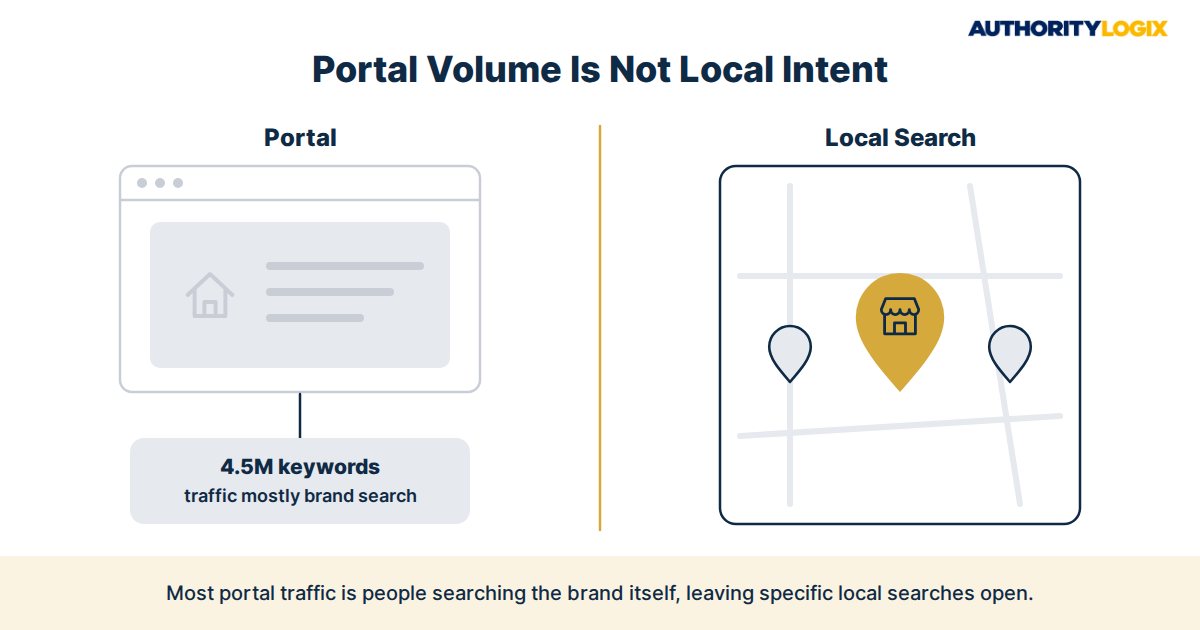
Real estate firm local SEO vs Zillow sounds, on paper, like an unwinnable fight. Zillow ranks for an enormous volume of keywords and pulls more than 230 million visits a month, according to Semrush. Look closer, though, and the picture changes: Zillow’s own brand name is a more popular search term than “houses for sale,” which means most of that enormous traffic number is people searching for Zillow itself, not for a specific local investment opportunity.
A real estate firm local SEO vs Zillow strategy does not need to beat Zillow at being Zillow. It needs to own the specific, local searches Zillow was never built to answer in the first place, and that gap is larger than most firms realize until they actually look for it.
If your firm is trying to out-market Zillow instead of out-specific it, the approach needs to change before the budget does.
Real Estate Firm Local SEO vs Zillow: Why the Portals Win by Default
In the real estate firm local SEO vs Zillow comparison, portals win the searches they were built to win: broad terms, brand-name searches, and general property browsing across an entire metro or state. That is a real advantage, and pretending otherwise wastes energy a smaller firm cannot afford to waste. It is also a narrower advantage than the traffic numbers suggest, because volume and buyer intent are not the same thing.
This is the real estate firm local SEO vs Zillow gap that local search statistics already pointed to: a large share of real estate leads now start with a local search moment, not a portal browse. In a real estate firm local SEO vs Zillow comparison, a firm invisible in that specific local moment is losing the exact prospects who are closest to acting, not the browsers who were never going to call anyway.
Firms across the real estate hub compete on this same local ground regardless of size, which is precisely why a well-built local presence can outperform a much larger, better-funded portal for the searches that actually convert into a call. Scale helps a portal win volume; it does not help it win specificity.
Portal traffic is not the growth story it once was. Zillow’s and Redfin’s traffic has flattened or slipped, even as lead costs on either platform kept climbing. A shrinking, more expensive channel is not the safe default it used to be.
What Zillow and Redfin Actually Rank For
In the real estate firm local SEO vs Zillow comparison, Zillow and Redfin dominate generic, high-volume terms: property type searches, city-wide listing browses, and their own brand names. Those searches carry enormous volume and comparatively low buyer or investor intent, because someone typing “homes for sale in [city]” could be a year away from acting or simply curious about the market.
What Beating Zillow in Local Search Actually Requires
Winning the real estate firm local SEO vs Zillow fight — what beat Zillow local search real estate results actually require — does not come from out-ranking the portal on its own generic terms. They come from owning the specific, neighborhood-level and scenario-specific searches — “DSCR investment property [neighborhood],” “multi-unit deals near [submarket]” — that a national portal has no reason to build dedicated content around.
A firm’s Google Business Profile presence is one of the first places this specificity shows up, because Google surfaces local business listings for exactly the kind of geographically narrow query a portal’s generic city page cannot match. The two work together, not in competition with each other.
The economics reinforce the point: Zillow Premier Agent leads run an estimated $139 to $223 each based on agent-reported pricing, and are often routed to one or two other agents in the same ZIP code. A local search inquiry that arrives through owned local rankings costs nothing per lead and is not split with a competitor before the first call even happens.
Winning the real estate firm local SEO vs Zillow comparison means building that specificity into an actual content library — not just a handful of pages — is what content systems are built to produce, and it is the layer most investment firms skip entirely while they focus on the listings themselves. A library beats a handful of pages the same way a body of work beats a portfolio piece.

| Factor | National Portal | Local Investment Firm |
|---|---|---|
| Coverage scale | Every market nationwide, at a generic level | One or two markets, covered in real depth |
| Content specificity | Templated listing pages | Neighborhood and scenario-specific content |
| Local credibility signals | Cannot carry a locally recognized name or history | Community involvement, local case studies, reviews |
| Lead cost | $139–$223 per lead, often shared with competitors | No per-lead cost once rankings are established |
| Site control | Locked to the portal’s template and rules | Full control over structure, metadata, and linking |
Real Estate Firm Local SEO vs Zillow: How Investment Firm Rankings Actually Get Built
In the real estate firm local SEO vs Zillow comparison, investment firm Google rankings do not come from a single tactic. They come from the accumulation of specific signals: consistent local citations, a Google Business Profile matched to the firm’s actual niche, and content that answers the exact questions a local investor is typing into the search bar. None of these individually moves much, but together they compound into something a portal’s generic template was never built to replicate.
A genuine authority guide behind that real estate firm local SEO vs Zillow accumulation is what separates a firm building real local rankings from one publishing scattered pages hoping something sticks. The difference shows up within months, in exactly the searches a portal’s generic pages were never specific enough to capture in the first place.
Real Estate Firm Local SEO vs Zillow: The Metrics That Actually Move
Real estate firm local SEO vs Zillow is not measured in overall traffic, since no local firm will out-traffic a national portal and does not need to. It is measured in map pack appearances for specific local terms, in organic rankings for scenario-specific queries, and in the calls and inquiries those rankings actually produce.
This is precisely the real estate firm local SEO vs Zillow gap why AuthorityLogix exists to close — firms that already have the local expertise but have never built the infrastructure that makes Google, and the investors searching on it, actually see that expertise. Waiting for a portal’s generic listing to somehow surface that expertise on its own has never worked and is not going to start now.
Local Signals National Portals Cannot Replicate
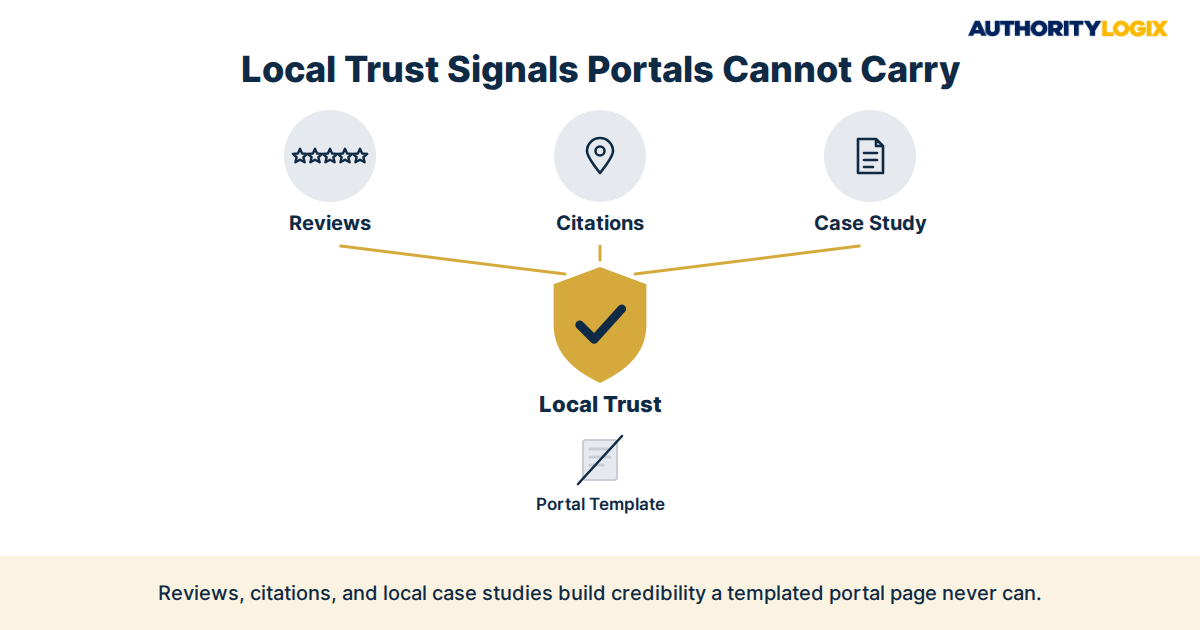
The real estate firm local SEO vs Zillow gap starts here: a portal’s listing page is, by design, the same template applied to every property in every market it operates in. It cannot carry the specific local credibility signals — community involvement, market-specific case studies, a locally recognized name — that Google increasingly weighs for exactly this kind of query.
How Investment Firm Google Rankings Compound Over Time
Investment firm Google rankings compound the same way any local authority signal compounds. Each new piece of locally specific content, each new citation, and each new review adds to a pattern Google recognizes as a genuinely established local presence, not a page that happened to rank once and was never followed up on.
The educational hub behind that pattern is what keeps it growing instead of stalling after the first few pieces get published. A scattered handful of posts never reaches the density of coverage a real local authority signal actually requires to hold its position.
A firm’s what we do in the real estate firm local SEO vs Zillow fight should be built around this compounding logic from day one, rather than treating local content as a one-time project finished once a handful of pages go live. The firms still climbing a year later are the ones who never stopped adding to it.
Not sure how your firm’s local rankings actually compare to the portals and the competitors already ahead of you?
Content Depth: The Advantage Portals Structurally Can’t Match
This is where the real estate firm local SEO vs Zillow gap widens: a national portal cannot publish deep, scenario-specific content for every submarket it operates in — the economics do not support it at that scale. A local investment firm, by contrast, only has to go deep in the one or two markets it actually serves, which makes comprehensive coverage genuinely achievable rather than a theoretical advantage.
A real lead generation system built for the real estate firm local SEO vs Zillow fight captures the local investor who searched a specific enough question that no portal page was ever going to answer completely. That specificity is exactly what separates a lead who is ready to talk from one who is still generally browsing listings with no real timeline in mind.
Distributing that content consistently through authority distribution is what keeps the real estate firm local SEO vs Zillow coverage compounding rather than sitting untouched after publication. A single published page without ongoing distribution rarely reaches the audience it was actually written for.
Firms with full control over site structure, metadata, and internal linking are positioned for stronger organic performance — infrastructure decisions a templated portal listing was never designed to allow. That control is the entire advantage a locally-owned site has over a rented spot on someone else’s platform, and it is the advantage every real estate firm local SEO vs Zillow strategy ultimately depends on.
Building that infrastructure through a deliberate content build process is what separates a firm that owns its rankings from one renting visibility from a platform it does not control. Ownership compounds; rented visibility disappears the day the rent stops.
Turning Local Rankings Into Investor Inquiries
A niche real estate firm competing in the real estate firm local SEO vs Zillow fight has one structural advantage a portal cannot copy: it only has to be the obvious answer in one or two specific markets, not every market in the country at once. That narrower focus is what makes genuine local dominance achievable on a fraction of a portal’s budget, and it compounds faster than a national footprint ever could in any single submarket.
Winning that fight only matters if the firm converts the resulting visibility into an actual conversation with an investor. In the real estate firm local SEO vs Zillow fight, a content system that ranks well but has no clear next step for the visitor is generating traffic without generating a pipeline, which is a wasted version of the same infrastructure a competitor is using correctly.
Why a Broker Outrank National Portals Strategy Starts Locally
A broker outrank national portals strategy does not start with trying to beat Zillow at its own generic game. It starts locally, with the specific searches a portal cannot specialize in, and expands outward from that base once the local rankings are genuinely established and producing real inquiries.
lead generation systems built around fast follow-up on these specific, high-intent local inquiries capture investors that a slower-moving portal lead queue — often shared with two or three competing agents — is currently losing to whoever responds first. Speed on a warm local lead matters more than volume on a cold shared one, especially when the competing agent gets the same lead at the same moment.
Common Questions About Beating Zillow and Redfin in Local Search
Can a real estate firm actually outrank Zillow in Google search results?
For broad, generic terms, rarely. For specific, local, and scenario-based searches — the ones an actual local buyer or investor is typing — yes, and it happens more often than most firms expect once the local content and citations are genuinely built out.
How long does it take to see local rankings move against portal competition?
Meaningful movement on specific local terms typically shows up within three to six months of consistent content and citation work, well before a firm would ever compete with a portal on broad, high-volume terms. This connects directly to the topic covered in the authority distribution resource.
Is it worth paying for Zillow Premier Agent leads while building local SEO?
Many firms run both during the transition, since portal leads can fill the gap while organic local rankings compound. The goal over time is reducing dependence on shared, paid leads as owned local visibility takes over more of the pipeline.
Do local investment firms need a different SEO approach than residential agents?
The mechanics are similar, but the specific search terms differ — investors search for deal criteria, coverage ratios, and market data rather than school districts and open houses, so the content has to be built around investor-specific scenarios.

Where This Fits Into a Long-Term Strategy to Outrank National Portals
The real estate firm local SEO vs Zillow question does not have a finish line — it is not a campaign with an end date — it is infrastructure that keeps compounding as long as a firm keeps building on it. The growth playbook behind that infrastructure treats local search as one connected system, not a standalone project finished once the first pages rank.
Firms that stop chasing the real estate firm local SEO vs Zillow gap after the first wave of rankings plateau exactly where a portal’s generic content already covers the basics. Firms that keep building specific, local depth keep pulling further ahead of both the portals and the competitors who stopped too early.
A look at our work shows what that sustained local build actually looks like in practice. It rarely looks dramatic month to month, which is exactly why most firms underestimate how far ahead it puts them after a year or two.
That same infrastructure extends naturally into investor content built specifically for the audience a portal’s generic listing page was never written for. Investors research differently than retail buyers, and content built around that difference is what actually earns their call.
Ready to get found in your market before Zillow and Redfin claim the search?