

Key Takeaways
- Real estate content calendar ideas should come from actual buyer and seller questions, not generic industry topics that could apply to any market.
- HubSpot’s own research found the median business that blogs generates 67% more leads than one that doesn’t.
- Buyers and sellers need different content tracks — a single generic topic list applied to both wastes the specificity that actually drives engagement.
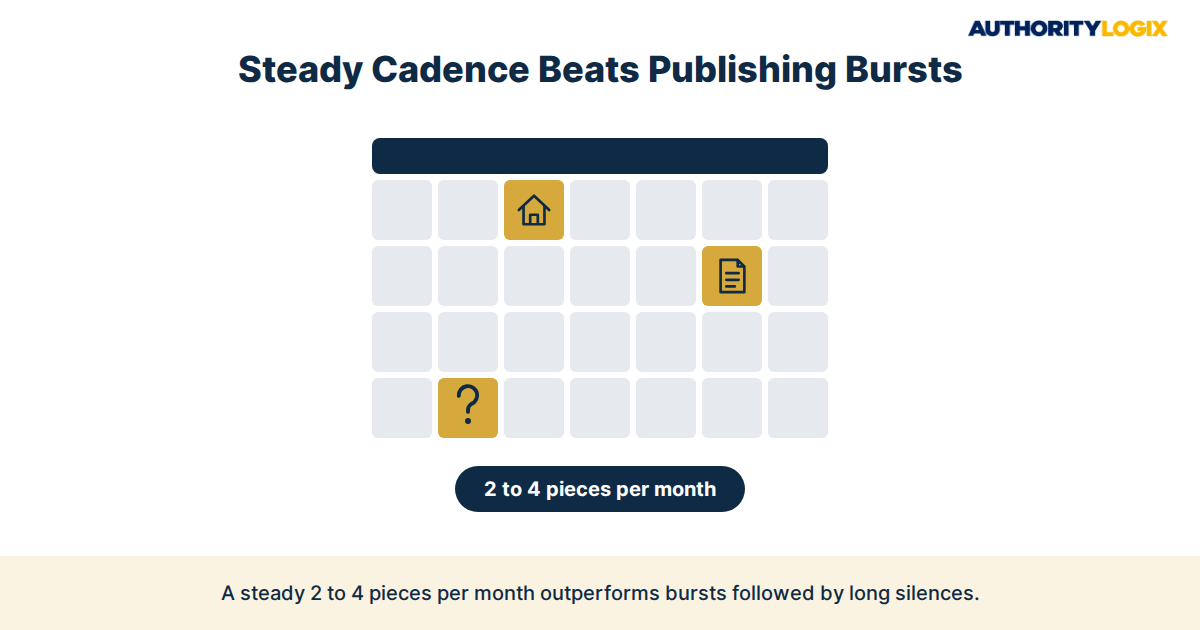
- A consistent, moderate publishing cadence outperforms sporadic bursts of high-volume content followed by long silences.
- The best real estate content calendar ideas often come directly from the questions clients ask in person — those are proof a real search demand already exists.
- Most agents run out of ideas within a few months because they never built a repeatable system for generating new topics.
Table of Contents
Real estate content calendar ideas run out fast when an agent starts from a blank page every month, guessing at topics instead of pulling from a real, repeatable source. Real estate content calendar ideas that actually convert come from the questions buyers and sellers are already asking — not from generic industry roundups that could describe any market in the country. The difference between a calendar that sustains itself and one that dies out after a few months almost always comes down to where the topics originate.
This is not about publishing more content for its own sake. It is about building a system that reliably produces real estate content calendar ideas month after month, so an agent never has to face that blank page wondering what to write about next. Volume without a repeatable source behind it eventually stalls, usually right around the point an agent has exhausted every obvious topic they could think of off the top of their head.
Why Real Estate Content Calendar Ideas Need a Plan, Not Just a Blog
HubSpot’s own research found the median business that blogs generates 67% more leads than one that doesn’t. But that lift only shows up with consistent publishing — a blog with a handful of scattered posts performs about the same as having no blog at all. Real estate content calendar ideas need a plan behind them precisely because consistency is what produces the results, not any single post. A firm chasing that 67% lift with a single well-written post and no follow-up is misreading what actually produced the number in the first place.
The content systems that turn scattered blog posts into an actual asset depend on having a reliable pipeline of topics — real estate content calendar ideas generated ad hoc, one month at a time, rarely sustain the publishing frequency that produces measurable results. A repeatable topic-generation process is what keeps that pipeline full even in slow months, which is the entire point of treating real estate content calendar ideas as a system rather than a monthly scramble to fill space.
The website structure that houses this content also matters — even the best real estate content calendar ideas underperform if the resulting pages have nowhere logical to live inside the site’s existing hierarchy. Structure and topic selection have to work together closely for either one to pay off fully, and real estate content calendar ideas built without that structural awareness underperform no matter how good the writing is.
The Real Estate Content System Blueprint covers the full infrastructure a content calendar is built on.
Agent Blog Topics Buyers Sellers Actually Search For
Agent blog topics buyers sellers actually search for rarely resemble the generic “5 Tips for Buying a Home” post that fills so many real estate blogs. Buyers and sellers each have specific, practical questions at different stages of their decision, and agent blog topics buyers sellers respond to are the ones that answer those specific questions directly rather than skating across the surface of the topic. A post that genuinely answers one narrow question in depth almost always outperforms a broad post that gestures at ten questions without fully answering any of them, which is exactly the principle real estate content calendar ideas should be built around from the start.
What Buyers Want to Read Before They Call: Real Estate Content Calendar Ideas That Work
Buyers search for neighborhood-specific information, financing questions, and practical process questions — how long does closing take, what does an inspection actually cover, what should a first-time buyer expect at each stage. Agent blog topics buyers sellers respond to on the buyer side almost always answer one of these specific, practical questions rather than offering broad market commentary. First-time buyers in particular tend to have a long list of process questions they are too embarrassed to ask out loud, which makes this category especially reliable for generating new topics. A blog post that answers one of these unspoken questions often gets more genuine engagement than any market-commentary piece could. This connects directly to the topic covered in the authority guide resource.
What Sellers Want to Read Before They List
Sellers search for valuation questions, timing questions, and preparation questions — what is my home actually worth right now, is this a good time to sell, what repairs are worth making before listing. Content built around these seller-specific questions consistently outperforms generic “how to sell your home” content that could apply to any market at any time. A seller weighing whether to list this spring or wait until fall wants a specific, current answer, not a timeless generalization about market cycles. Answering that question with actual local data, updated each season, is exactly the kind of specific content that keeps a real estate publishing calendar feeling current rather than stale.
| Audience | Common Question Types |
|---|---|
| Buyers | Neighborhood, financing, process |
| Sellers | Valuation, timing, preparation |
Broker Content Planning Strategy: Building the Calendar
A broker content planning strategy that alternates deliberately between buyer content, seller content, and neighborhood-specific content keeps a calendar balanced rather than accidentally skewed toward whichever audience is easiest to write about in a given month. Broker content planning strategy should map roughly a quarter of topics at a time, leaving room to adjust based on what actually performs. An agent who mostly works with sellers, for example, will naturally gravitate toward seller topics unless the calendar deliberately forces balance across all three categories. That imbalance often goes unnoticed for months and quarters, since each individual post seems perfectly reasonable on its own.
The lead magnet strategy that turns blog readers into leads connects directly to a broker content planning strategy — planning topics in isolation, disconnected from the site’s broader lead capture system, tends to produce content that ranks for nothing in particular and converts even less. Every planned topic in a real estate content calendar should have a clear answer for what a reader does next after finishing it.
The why us page covers why AuthorityLogix treats content planning and lead capture as a single connected system rather than two separate projects handled by two separate teams. Splitting the two apart entirely is a common reason a broker content planning strategy produces traffic without producing any real leads.
The neighborhood landing pages that anchor a broker content planning strategy give geography-specific topics an obvious home, which is often the single easiest category of real estate content calendar ideas to generate consistently month after month. Every neighborhood a firm serves is effectively a renewable source of new topics.

Real Estate Publishing Calendar Cadence That Works
A real estate publishing calendar built around two to four pieces of content per month is sustainable for most agents, and a consistent cadence at that volume outperforms sporadic bursts of eight posts followed by three silent months. A real estate publishing calendar that starts strong and then goes quiet loses most of the compounding benefit consistent publishing was supposed to produce in the first place. Search engines and readers both reward consistency over time far more than they reward a single impressive burst of activity.
The local search statistics confirm this pattern — search visibility built through a real estate publishing calendar compounds gradually over many months, and a gap in publishing shows up eventually as a gap in the traffic that content was generating. Consistency, not volume, is the variable that predicts long-term results.
Where Content Calendar Ideas Actually Come From
The best real estate content calendar ideas often come directly from the questions clients ask in person during showings, consultations, and closing conversations. If three different buyers asked the same question last month, that question is proof of real demand — and it belongs on the content calendar before the memory of it fades. Keeping a running note on a phone during client conversations is often the single most reliable content-generation habit an agent can build.
The educational hub system is where these client-question-driven topics eventually live, organized so a future prospect asking the same question can find the answer without ever picking up the phone first. That self-service answer is often what convinces a hesitant prospect to reach out at all.
The authority guide covers why answering real client questions publicly, with the agent’s name attached, builds more credibility than generic content ever could — a prospective client can see the agent has actually handled this exact situation before. That specific proof of experience is worth more than any generic claim of expertise.
Not sure what your content is actually missing to convert visitors into leads.
What Most Agents Get Wrong About Real Estate Content Calendar Ideas
They rely entirely on generic industry topics
Real estate content calendar ideas pulled from generic “top 10 tips” lists that could apply to any market rarely rank or convert, because they answer no one’s specific situation. A generic topic list is easy to write and easy to find on any competitor’s site, which is exactly why it rarely differentiates a firm from anyone else publishing similar content. The backlink strategy that builds organic authority works because it is specific and locally relevant — the same principle applies directly to content topic selection.
They run out of ideas within a few months
An agent generating real estate content calendar ideas from memory alone typically exhausts their obvious topics within three or four months, at which point the calendar either goes quiet or starts filling up with the same generic filler that never performs particularly well. The local SEO comparison covers how much sustained, consistent content actually matters for competing against national portals — a calendar that runs dry after a few months never builds the volume needed to compete.
The industry hub covers how real estate content calendar ideas connect to every other system a firm depends on — content, local search, and lead generation all rely on a calendar that keeps producing new, specific topics rather than running dry after the obvious ones are used up. None of those systems can compensate for a content pipeline that has simply stopped producing.
Where the Calendar Fits Inside the Full Content System
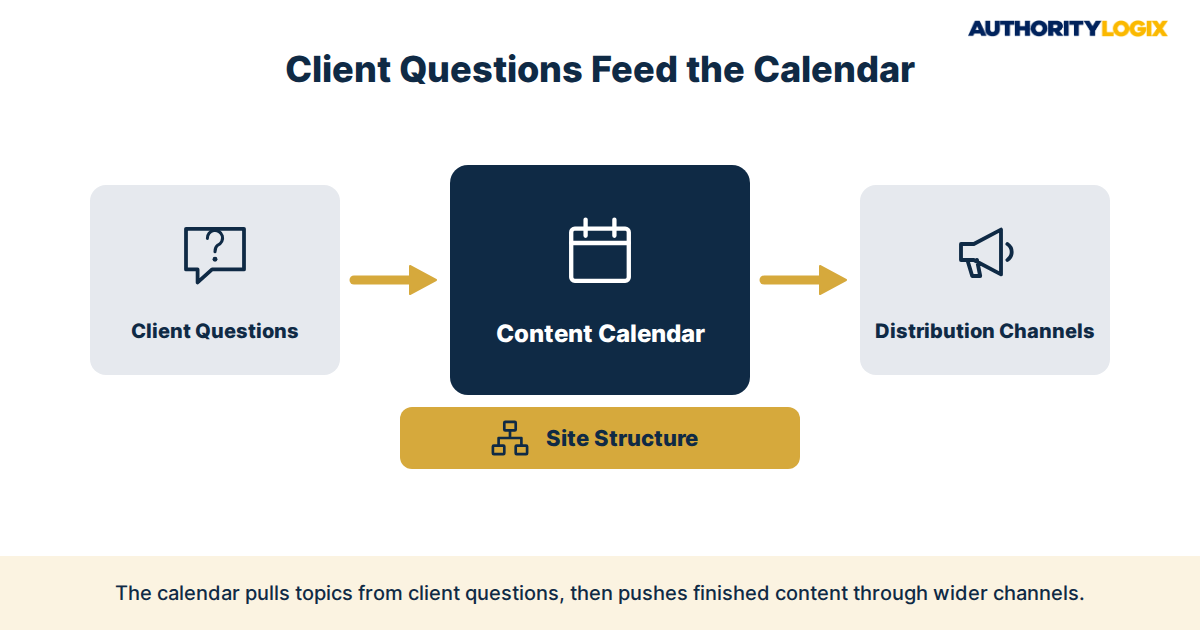
A real estate content calendar never operates in isolation — it is fed by client questions, organized by site structure, and distributed through channels beyond the blog itself. Treating the calendar as a standalone task disconnected from the rest of a firm’s content system produces content that never quite fits anywhere. Real estate content calendar ideas that emerge from this connected system consistently outperform ones generated in a vacuum, disconnected from everything else the firm is already doing.
The authority distribution layer extends every piece of calendar content beyond the blog itself, sharing it through channels where prospective clients also spend time — a real estate content calendar that only lives on one page of the website reaches a fraction of its potential audience. Extending its reach costs little once the content itself already exists.
The growth playbook treats a well-run real estate content calendar as permanent infrastructure — refined over time, never abandoned, and increasingly valuable the longer it runs. That growing value is exactly what a firm loses every time the calendar goes quiet for a few months.
Questions Agents Ask About Content Planning
The our approach page covers how content planning gets evaluated over time, but most agents are weighing a few specific, practical questions before committing to a real estate content calendar.
How far in advance should we plan topics?
A quarter at a time is usually enough for real estate content calendar ideas — far enough ahead to stay organized, close enough to adjust based on what is actually resonating with readers. Planning a full year of real estate content calendar ideas far in advance often means committing to topics that no longer make sense by the time they are scheduled to publish.
Should we write about market conditions or stick to evergreen topics?
Both — a mix of timely market commentary and evergreen how-to content covers both the readers searching right now and the ones who find the content months or even years later through organic search. Evergreen content tends to do the heavier long-term lifting, since market commentary has a naturally short shelf life once conditions shift and change again. A related breakdown of this is covered in the content systems guide.
What if we genuinely run out of things to write about?
Go back to actual client conversations from the past month — the questions clients ask in person rarely run out, even when an agent’s own memory of blog topics does. This single habit alone has rescued more stalled content calendars than any brainstorming session or generic topic list ever could, since it draws directly from questions with proven, real-world demand.

Want a content calendar that tells you exactly what to publish and when, with the publishing handled for you?
Building Your First Calendar: Where to Start
Write down every question a client asked in the last thirty days, then sort those questions into buyer, seller, and neighborhood categories. That list alone is usually enough real estate content calendar ideas to cover the next quarter, without needing to invent a single generic topic from scratch. Repeating this exercise every quarter turns topic generation into a habit rather than a recurring source of stress every time the calendar needs refilling.
The what we do page outlines how this topic-generation habit fits into the broader content system a firm is building. Most agents already have more usable real estate content calendar ideas sitting in their memory of recent client conversations than they realize — the missing piece is usually just writing them down before they fade.