


Key Takeaways
- Real estate website page speed SEO decides whether a buyer, seller, or investor sees your listing load or taps back to the portal first.
- Google’s web.dev guidance sets a good Largest Contentful Paint at 2.5 seconds or less, measured at the 75th percentile of page loads.
- Google Search Central states that Core Web Vitals are used by its ranking systems, while still putting the most relevant content first.
- The 2025 Web Almanac from HTTP Archive found that only 48% of mobile websites have good Core Web Vitals, against 56% on desktop.
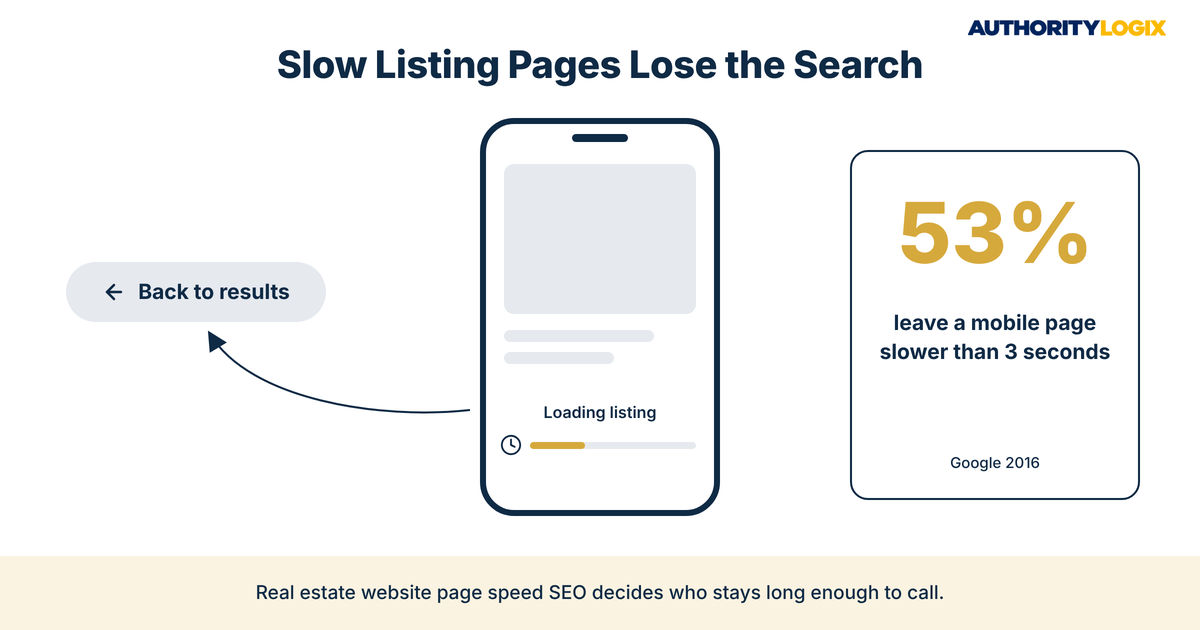
- Google research published in 2016 found 53% of mobile site visits are abandoned when a page takes longer than three seconds to load.
- Real estate website page speed SEO is an infrastructure job: lighter photos, leaner IDX setups, fewer plugins, and fast templates.
Table of Contents
How Real Estate Website Page Speed SEO Affects Who Sees Your Listings
Real estate website page speed SEO is the part of search most agents never see, because it plays out in the two or three seconds between a tap and a loaded page. You can know every street in your market and still lose the buyer to a portal because your listing page stalled on a phone. That gap between earned credibility and what visitors experience is the problem the AuthorityLogix real estate industry hub is built around.
The cost shows up twice. Google measures how real visitors experience your pages and its ranking systems use those measurements, while the visitors make their own judgment in seconds. Real estate website page speed SEO sits exactly where those two judgments meet: a slow page ranks with a handicap and converts with a bigger one.
Speed is not a standalone project, though. A fast site with nothing worth reading still ranks for nothing, which is why the publishing side covered in the content system matters as much as the technical side. Real estate website page speed SEO makes sure the work you publish gets seen, read, and acted on instead of abandoned mid-load.
The Real Estate Local SEO Playbook shows where real estate website page speed SEO fits inside the full local visibility system — from profile and reviews to the technical foundation underneath.
Broker Website Core Web Vitals: LCP, INP, and CLS in Plain Terms
Broker website core web vitals are three measurements Google uses to describe how a page feels to a real visitor. Google’s Search Central documentation on page experience states plainly that “Core Web Vitals are used by our ranking systems,” and its Core Web Vitals page says good results align with what its core ranking systems seek to reward. For real estate website page speed SEO, that settles whether speed counts.
The first metric, Largest Contentful Paint, measures how long the biggest visible element takes to appear — on a listing page, usually the main property photo. According to Google’s web.dev LCP guidance, sites should strive for a Largest Contentful Paint of 2.5 seconds or less, measured at the 75th percentile of page loads.
Interaction to Next Paint (INP) measures how quickly the page responds when someone taps a filter, opens a gallery, or submits a showing request. According to web.dev, 200 milliseconds or less is good and anything above 500 milliseconds is poor. Cumulative Layout Shift (CLS) measures how much the page jumps while it loads, with a web.dev target of 0.1 or less for at least 75% of page visits.
| Metric | What It Measures on a Real Estate Site | Good Threshold (web.dev) |
|---|---|---|
| Largest Contentful Paint (LCP) | How fast the main listing photo or headline appears | 2.5 seconds or less |
| Interaction to Next Paint (INP) | How fast the page reacts to a tap, click, or keypress | 200 milliseconds or less |
| Cumulative Layout Shift (CLS) | How much the layout jumps while loading | 0.1 or less |
Why Real Estate Website Page Speed SEO Now Includes INP
INP officially replaced First Input Delay as a Core Web Vital on March 12, 2024, according to web.dev, and it looks at click, tap, and keyboard interactions across the whole visit. For real estate website page speed SEO, that change matters because property sites are interactive by nature — search filters, map panning, gallery swipes, and payment calculators.
Buyers and sellers search, filter, compare, and come back, and the local search behavior behind those visits rewards sites that respond instantly at every step. A broker website core web vitals report that looks fine on the homepage can hide a sluggish search results page.
Fixing this is rarely a single setting. Sites where speed is the default, not a yearly cleanup, are part of the visibility infrastructure behind what we do for real estate firms. Real estate website page speed SEO holds up best when the platform, the templates, and the content all share that standard.
Speed also shapes trust. A layout that jumps before a visitor can tap “schedule a showing” quietly downgrades your credibility, and the trust signals described in the authority guide only work if the page holds still long enough for anyone to notice them. A stable page reads as a professional operation.

Agent Website Load Time Rankings: What Slow Pages Cost in Leads
Agent website load time rankings are only half the cost of a slow site. The other half is the visitor who does find you and leaves before the page finishes. Google research published in 2016 found that 53% of mobile site visits are abandoned when a page takes longer than three seconds to load, and Google/SOASTA research from 2017 found that the probability of a mobile visitor bouncing increases 113% as load time goes from one second to seven seconds.
That data is from 2016 and 2017, but the behavior it describes has not reversed: a buyer scrolling listings on a phone has no patience for a spinner, and the portal is one tap away. For real estate website page speed SEO, three seconds works as a practical ceiling.
Deloitte’s Milliseconds Make Millions study, conducted with 55 and commissioned by Google, tracked 37 leading European and American brand sites and published its findings in 2020. For lead generation sites, a 0.1-second improvement in mobile site speed produced a 21.6% improvement in the number of users who progressed to the form submission page, along with a 7% increase in page views.
A real estate website is a lead generation site in every practical sense. The form is a showing request, a home valuation, or an investor consultation, and the lead generation infrastructure behind it only works when visitors actually reach that form. That is where real estate website page speed SEO turns into revenue.
Agent website load time rankings and conversion rates move together, which is why speed belongs inside the pipeline plan rather than beside it. The full lead generation system maps how a visitor becomes a conversation, and real estate website page speed SEO keeps that path from leaking at the very first step.
Not sure whether real estate website page speed SEO is costing your firm rankings and showing requests? The RE Authority Gap Assessment shows where your site’s speed, structure, and content are weakest and what to fix first.
Why IDX Feeds, Photo Galleries, and Plugins Slow Real Estate Sites
Real estate websites are heavier than most small-business sites by design. A single listing can carry dozens of photos, a map, a virtual tour, a payment calculator, and a live IDX feed pulling data from the MLS. Each piece is reasonable on its own; stacked together on a template nobody audited, they become the reason real estate website page speed SEO fails.
Photos are usually the first problem. The 2025 Web Almanac from HTTP Archive found that on mobile, 76% of pages have an image as their Largest Contentful Paint element. On a listing page, that image is usually the main property photo, so an uncompressed upload sets your LCP.
The Usual Real Estate Website Page Speed SEO Culprits
The pattern repeats across agent, team, and brokerage sites. Check these causes first:
- Full-resolution listing photos uploaded without compression or modern image formats
- Photo galleries that load every image at once instead of as the visitor scrolls
- IDX search widgets and iframes that pull heavy scripts onto every page
- Chat, pop-up, and lead-capture plugins stacked on top of each other
- Map and virtual tour embeds without set dimensions, which push content around as they load
- Themes packed with sliders, animations, and features the site never uses
Plugins deserve special attention because they pile up quietly. Every chat tool or pop-up promises more leads, and each one adds scripts that compete for the same few seconds, which hurts INP as much as load time. A clean site structure works the other way: fewer, purpose-built pages that each do one job and load only what that job needs.
The lasting fix is a system, not a one-time cleanup. Photos get compressed before upload, galleries load as the visitor scrolls, embeds get reserved space, and new pages come from templates already tuned for speed. Real estate content systems that bake those rules into publishing keep real estate website page speed SEO from sliding backward every time someone adds a listing.

How to Check Real Estate Site Performance Google Uses for Ranking
Real estate site performance Google uses for ranking comes from real visitors, not from a test you run once. Google’s PageSpeed Insights documentation explains that its real-user data is powered by the Chrome User Experience Report (CrUX) and reflects the previous 28-day collection period. Its lab data comes from a Lighthouse test on one simulated device with fixed network conditions, so the two sets of numbers can differ.
That difference trips up a lot of agents new to real estate website page speed SEO. A poor lab score on a Tuesday afternoon does not tell you what your visitors lived through last month, while the field data does. The sequence in how we build starts from field data for exactly that reason, then uses lab tests to find which elements to fix.
Reading a Real Estate Website Page Speed SEO Report Without a Developer
You do not need to read code to get a useful picture. Run your homepage, one listing page, and one search results page through PageSpeed Insights, and read the field data section at the top before anything else. Then open the Core Web Vitals report in Google Search Console to see whether the problem sits on a few pages or across the whole site.
Pay attention to the page types that carry the most weight for your business. A market report or buyer guide inside an educational hub often ranks for more searches than any single listing, and if that template is slow, real estate website page speed SEO is losing ground on your best long-term asset. Fix the templates that matter most first.
Then set a cadence for real estate website page speed SEO. Check monthly, after any new plugin or theme update, and after adding a new page type to the site. The broader real estate resource library covers the content and local search side of the system; speed keeps the rest of it visible.

Real Estate Website Page Speed SEO Mistakes and Common Questions
Most agents and brokers with slow sites are not careless. Most are working from outdated assumptions or advice written for a different kind of website. These are the real estate website page speed SEO questions that come up most often.
Will a perfect speed score push my site to the top of Google?
No. Google’s own page experience documentation says its search “always seeks to show the most relevant content, even if the page experience is sub-par,” and that there is no single signal. Real estate website page speed SEO removes a handicap; it does not replace relevant, useful pages.
My website vendor says the site is fast. Should I trust that?
Ask for field data, not a screenshot of a desktop lab test. A vendor demo usually shows the best page on a fast connection, while buyers visit your slowest page on a phone. If the vendor cannot show passing broker website core web vitals for listing and search pages, their real estate website page speed SEO claim is unverified.
Can I fix speed and skip content?
Speed without substance gives Google a fast page with nothing to rank. The pages that earn rankings — market analysis, buying guides, and investor content built on real deal knowledge — are what speed is supposed to protect. Real estate website page speed SEO and content work as a pair, not as alternatives.
Does speed matter for pages I share on LinkedIn or in email?
Yes, because every shared link lands on the same site. When authority distribution sends a market update to LinkedIn, an email list, or a syndication partner, the click still has to load before anyone reads a word. A slow landing page wastes the reach you worked to earn.
How quickly will rankings respond to real estate website page speed SEO fixes?
CrUX field data reflects the previous 28-day collection period, so improvements take weeks to show up in the numbers Google reports. Ranking movement depends on everything else on the page too, and no one can honestly promise a position. What a faster site does guarantee is that speed stops subtracting from the work you already do.
Ready to turn a slow real estate website into a fast, structured platform that loads, ranks, and converts the buyers, sellers, and investors already searching your market?
What Speed Fixes Can and Cannot Do for Your Rankings
Speed fixes can stop a site from losing visitors it already earned, and they can remove a ranking disadvantage in competitive local searches. They cannot make an empty site authoritative. The growth playbook lays out how visibility compounds over time, and real estate website page speed SEO is the foundation that lets each new page contribute instead of stalling.
BKDSCR.com, the AuthorityLogix proof-of-concept in the NYC outer-borough DSCR niche, was built with that order in mind: 18 pillar pages, 7 interactive investor tools, and 48 SEO-optimized blog posts on a platform designed to carry them. It ranks for competitive DSCR and NYC real estate keywords with zero paid ads. That build is our approach in practice — structure, content, and speed planned together instead of patched later.
The honest answer is that most agents and brokers already have the expertise buyers and sellers are looking for. What is missing is the infrastructure that lets the market see it, and real estate website page speed SEO is the first layer of it. Fix the speed, keep publishing with purpose, and the rest of the system finally gets a fair chance to work.