


Key Takeaways
- A financial services CRM strategy is the operating plan for how every inquiry is captured, owned, answered, and followed up — the software is only the container.
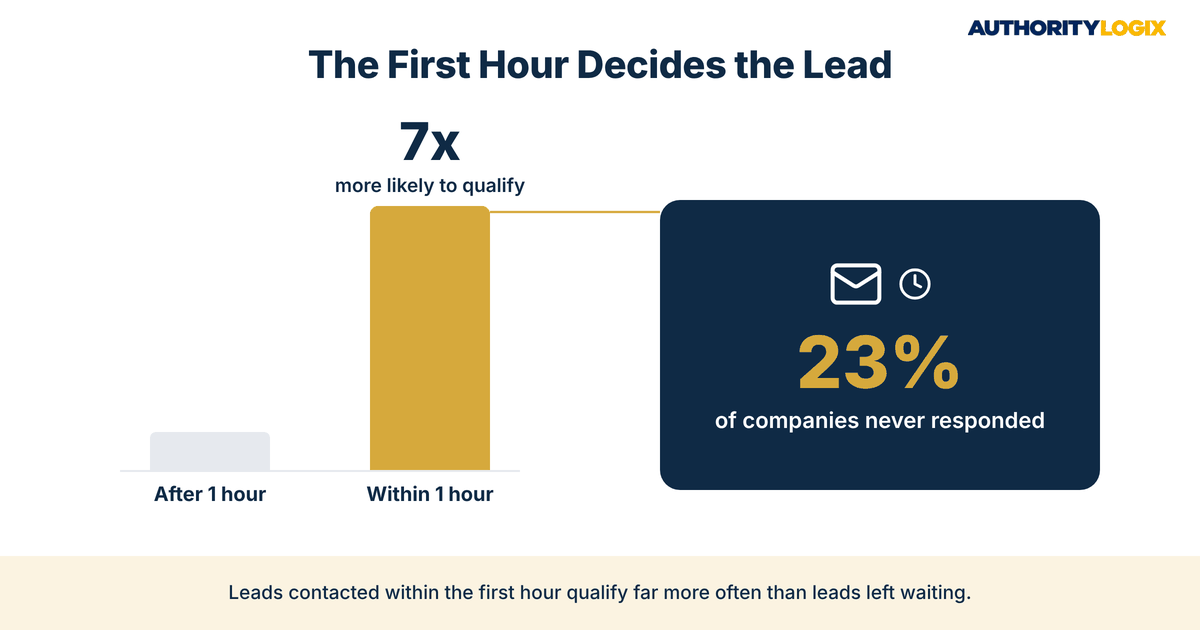
- Harvard Business Review research found that firms contacting a web lead within an hour were nearly 7 times as likely to qualify it, and its audit of 2,241 U.S. companies found that 23% never responded at all.
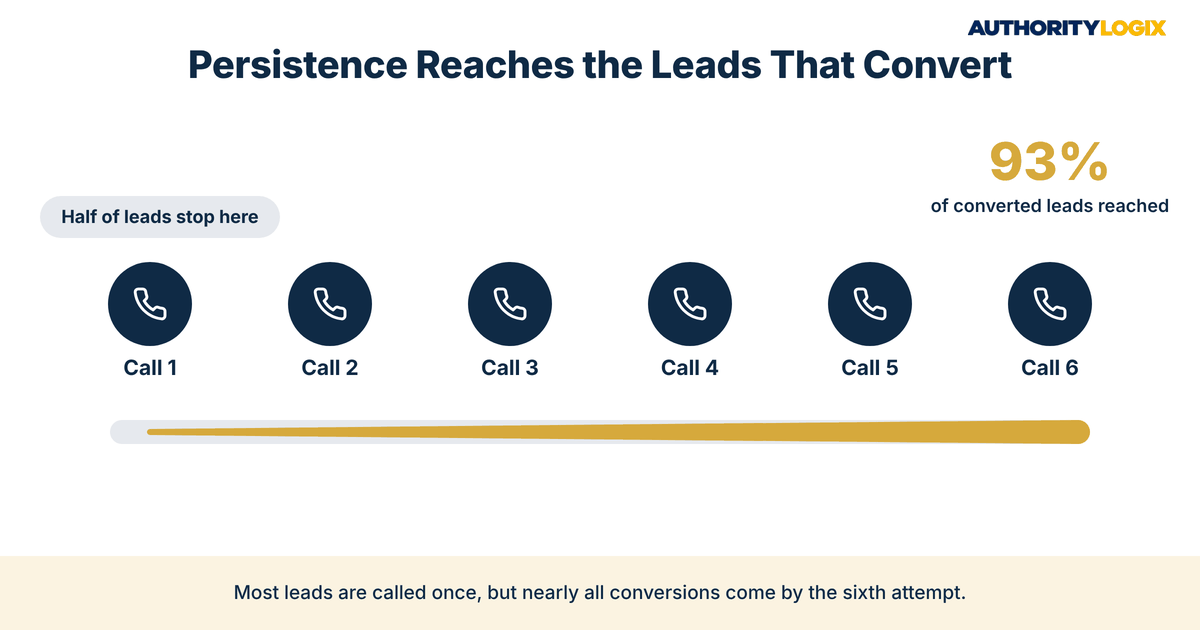
- Mortgage CRM lead management depends on speed first and persistence second: Velocify data on nearly 3.5 million leads showed 93% of converted leads were reached by the sixth call attempt.
- Advisor CRM follow-up has to match a decision cycle measured in months, which calls for planned educational touches rather than repeated “just checking in” messages.
- Lender lead nurturing CRM workflows run on triggers and owned content, so follow-up keeps happening while the loan officer is busy closing.
- Measure a financial services CRM strategy in pipeline terms — speed to contact, contact rate, stage conversion, and source-to-close — not in records stored.
Table of Contents
A financial services CRM strategy decides whether the lead your firm earned, bought, or was referred ever becomes a client conversation. Most lenders and advisors have a follow-up problem before they have a lead problem — inquiries land in an inbox, a loan officer gets to them after a closing, and the prospect has already spoken with someone else. Without a financial services CRM strategy, the system meant to protect every inquiry runs on memory.
This article treats a financial services CRM strategy as infrastructure rather than software: one connected system where response speed, persistence, and useful content work together, with an automated email nurture sequence carrying the prospects who are not ready yet. The sections below cover the research, the workflows, and the numbers.
Why a Financial Services CRM Strategy Protects Every Lead
The clearest evidence on follow-up comes from Harvard Business Review’s 2011 study, “The Short Life of Online Sales Leads.” Researchers audited 2,241 U.S. companies by submitting web inquiries and timing the replies. Among firms that answered within 30 days, the average first response took 42 hours, and 23% of companies never responded at all. Firms that made contact within an hour were nearly 7 times as likely to qualify the lead as firms that waited even one hour longer.
Financial services buyers hold firms to a high standard. In Salesforce’s Connected Financial Services Report, which surveyed 6,058 financial services customers across 12 countries, 62% said they would switch providers if they felt treated like a number, and 73% said they expect companies to understand their unique needs. That is the expectation your follow-up is measured against, and the Salesforce research library tracks how it keeps shifting.
Slow follow-up costs more than one lead, because it tells a prospect how the firm will likely handle their loan file or portfolio, which is why responsiveness belongs beside reviews, credentials, and published expertise in a trust framework like the one in the authority guide. A financial services CRM strategy is where that first impression gets shaped.
A financial services CRM strategy is not a software purchase. It is the operating plan under the platform: who owns each inquiry, how fast it is answered, what happens on day two and day twenty, and where the lead goes when the answer is “not yet.” Each system on the AuthorityLogix services hub feeds that plan.
The Financial Services Lead Generation System covers how a financial services CRM strategy connects to first-party pipeline, from the first inquiry to the booked conversation.
Mortgage CRM Lead Management From First Touch to Close
Mortgage CRM lead management has two jobs: answer fast, then keep trying. For a financial services CRM strategy, the research on both is consistent. The 2007 Lead Response Management study by James Oldroyd of MIT and InsideSales.com found that the odds of contacting a lead dropped 100 times when the first call came at 30 minutes instead of 5, and the odds of qualifying that lead dropped 21 times.
Where a Financial Services CRM Strategy Starts: The First Five Minutes
Mortgage-specific data points the same way. In a LeadQual test reported by National Mortgage Professional, more than 350 internet leads went to over 130 lenders, and only 40% received a phone response within 24 hours. LeadQual also reported that the first lender to make contact had a 238% higher close rate on that lead. The CFPB’s National Survey of Mortgage Borrowers found that fewer than 25% of borrowers applied with more than one lender or broker.
Speed wins the first conversation. Persistence wins the rest. Velocify’s analysis of nearly 3.5 million leads found that 93% of converted leads were reached by the sixth call attempt, while an earlier Velocify study found that half of all leads were called only once. A financial services CRM strategy that stops after one voicemail leaves most of its pipeline unworked.
| Follow-Up Benchmark | Finding | Source |
|---|---|---|
| Contact within one hour | Nearly 7x as likely to qualify the lead | Harvard Business Review, 1.25 million leads |
| Companies that never responded | 23% | Harvard Business Review, 2,241 companies |
| Calling at 5 minutes vs 30 minutes | 100x higher odds of contact | MIT / InsideSales.com Lead Response Management study |
| Lenders phoning back within 24 hours | 40% | LeadQual test of 130+ lenders |
| First lender to make contact | 238% higher close rate | LeadQual test of 130+ lenders |
| Converted leads reached by the sixth call | 93% | Velocify, nearly 3.5 million leads |
For wholesale and DSCR lenders, the same discipline applies to broker relationships. A broker who hears nothing for a day sends the next file elsewhere, so the CRM rules behind a working broker pipeline mirror the borrower side: fast acknowledgment, a named owner, and a scheduled next touch. A financial services CRM strategy for brokers compounds across dozens of future files.
A financial services CRM strategy also needs somewhere to send people. When a borrower is three months out, the right follow-up is a useful answer, and that answer should live in an educational hub on your own site where every visit can be tracked. Mortgage CRM lead management works best when each nurture message points back to content the firm owns.
Advisor CRM Follow-Up That Respects the Long Decision Cycle
Advisor CRM follow-up runs on a different clock. A household choosing an advisor is weighing trust, fees, and the hassle of moving accounts, and that decision rarely happens in a week. The speed rule still applies to the first reply, but in a financial services CRM strategy for advisors what follows has to be patient and useful.
The source of a lead should set its cadence. A prospect who found you through a referral or a search for a specific question arrives with context, and organic leads of that kind usually respond to depth rather than urgency. A purchased lead often arrives with no context and needs a faster qualification step first.
Many advisory firms fall back on the “just checking in” email, which says nothing. Advisor CRM follow-up that earns a reply uses a planned sequence — a relevant market note, a short explainer on a question they asked, a webinar invitation — each logged before the next call.
Producing those touches on schedule is a publishing problem as much as a CRM problem. Firms that run follow-up from a library of compliance-approved pieces keep sequences current without rewriting them, which is the work content systems are built to handle. Every message still goes through compliance review, and nothing promises performance.
A financial services CRM strategy for an advisory practice is less about speed after day one and more about relevance over months. The advisor who stays useful is usually the one still in the conversation when the household moves.
Not sure where your firm’s follow-up is losing leads? The FS Authority Gap Assessment shows where your financial services CRM strategy and the content behind it have gaps, and what to build first.
Lender Lead Nurturing CRM Workflows That Run Without You
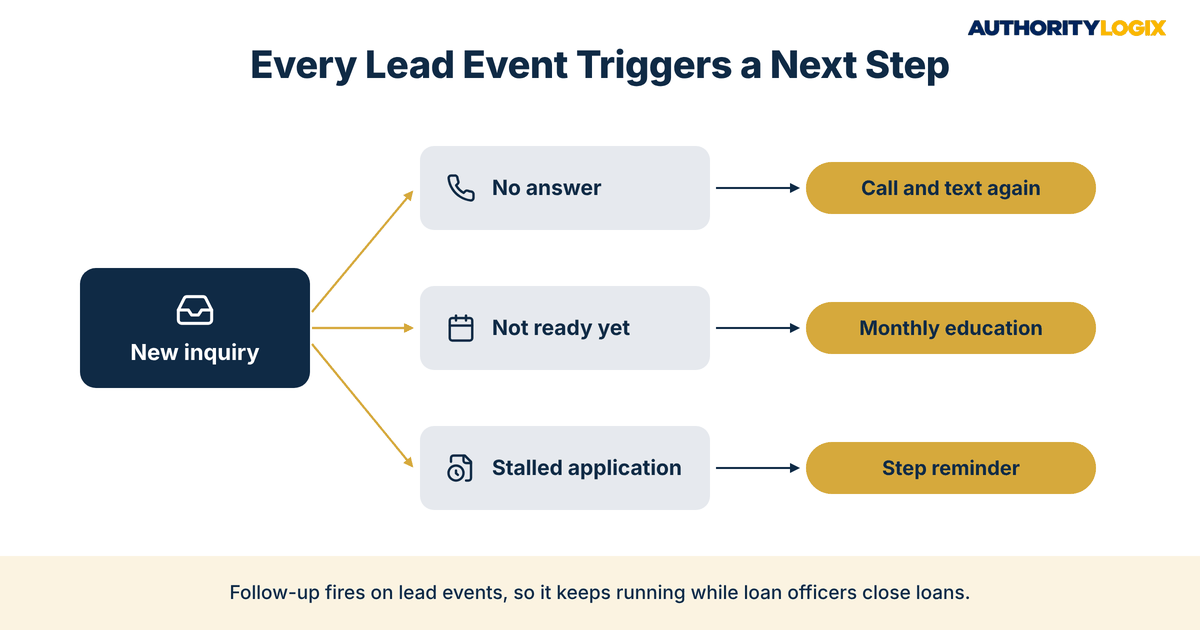
A lender lead nurturing CRM setup is where a financial services CRM strategy earns its keep, because the loan officer is too busy to think about it. The workflow should fire on events, not memory: a form submission triggers a reply and a call task, and a missed call triggers a text and a second attempt. Every piece has a job. Every piece feeds the next.
Building a Financial Services CRM Strategy Around Triggers
Each trigger below maps a lead event to a defined response. Written down, these rules become the backbone of a financial services CRM strategy that does not depend on any one person remembering.
- New inquiry: instant acknowledgment, a named owner, and a call task inside five minutes
- No answer: a second call and a text the same day, then a set attempt schedule through the following week
- Not ready yet: a long-term nurture track with monthly educational content
- Application started but stalled: a reminder sequence tied to the missing step
- Closed loan: a review request, a referral ask, and an annual check-in
- Lost to a competitor: a tagged reason and a scheduled check-in before the next rate or life change
The long-term track is where lender pipelines quietly die. A borrower who was not ready in March may be ready in September, and the lender still sending useful content gets the call. Those prospects also keep searching on their own, so the pages your nurture emails link to should rank for the same questions — the territory covered in the SEO playbook.
In a financial services CRM strategy, nurture content has to be accurate, current, and readable by non-professionals. Rate-environment explainers, program comparisons, and scenario walk-throughs written by people who understand lending are the core of finance content that holds attention across a six-month sequence. A lender lead nurturing CRM track full of generic newsletters trains prospects to stop opening.
Measuring a Financial Services CRM Strategy in Pipeline Terms
Most CRM reports count records, which is the wrong unit. A financial services CRM strategy should be measured by what happens to leads between first touch and closed business, and by which sources produce the leads that actually close.
| Pipeline Metric | What It Tells You | Warning Sign |
|---|---|---|
| Speed to first contact | Whether the first-hour window is being used | Median response over 60 minutes |
| Contact rate | Share of leads that reach a real conversation | Most leads logged with a single attempt |
| Stage conversion | Where leads stall between inquiry, application, and close | One stage losing far more than the others |
| Nurture reactivation | How many “not yet” leads come back | Long-term track never re-engages anyone |
| Source-to-close | Which channels produce closed business | Spend concentrated in low-close sources |
Source-to-close is the financial services CRM strategy metric that changes budgets. When a firm sees which sources close, spending stops being guesswork, and if leads from its own educational pages close well, the content system stops looking like a cost and starts looking like the most dependable part of the pipeline. That requires every lead to carry its source into closed-loan reporting.
Measure the visibility side too. Branded searches, return visits from nurture emails, and inquiries that mention an article or podcast all show whether authority distribution is warming prospects before they ever enter the CRM. Tag those leads separately to see whether familiar prospects need fewer touches.
Review these numbers monthly, not annually. A financial services CRM strategy that is checked once a year will drift, because habits change and sequences go stale before anyone notices.
Financial Services CRM Strategy Mistakes That Lose Leads Quietly
None of these failures look dramatic. Leads leak out through small gaps that nobody owns, and these are the financial services CRM strategy mistakes and questions that come up most.
Mistake: Buying the CRM and calling it a strategy
Software without rules is a database. The platform matters less than the decisions behind it — owner, response time, attempt schedule, nurture tracks, and reporting. Firms that write the plan first get a working system, and the CRM should be designed as one stage of a wider lead generation system rather than a standalone purchase.
Mistake: Letting referrals bypass the CRM
Referred leads feel warm, so they often go straight to a loan officer’s phone and never get logged. That breaks source reporting and removes the safety net. Your referral network is a ceiling, not a foundation — and an untracked referral pipeline is a ceiling you cannot even measure.
Is speed more important than persistence?
Both matter. The first hour decides whether you reach the prospect at all, while the attempt schedule decides whether you reach the ones who did not pick up the first time. Finding out which half is failing is usually the first step in what we do with a financial firm’s pipeline.
How much automation is too much?
Automation should handle timing and reminders, while people handle conversations. Ten automated emails without a human call read as spam to someone weighing a mortgage or an advisor. That balance is set during the build, and it is a core part of how we build follow-up for lenders and advisors.
Does a small firm need a formal financial services CRM strategy?
A two-person shop needs one more than a large firm, because no one else catches what falls through. The plan can be simple — a response-time rule, a six-attempt schedule, and one nurture track — but it has to be written down and followed every time.

Want every lead followed up on time, every time? We’ll connect your CRM to the content and sequences that keep prospects moving.
Follow-Up Is Infrastructure, Not Memory
Every firm in this space has lost a client because a competitor called back first, and that loss rarely shows up in a report. A financial services CRM strategy makes it visible. Fixing it is part of a wider shift from referral-only growth to systems that compound, the subject of the growth playbook.
The proof standard for that shift is practical. BKDSCR.com, the AuthorityLogix proof-of-concept in the NYC outer-borough DSCR niche, was built with 18 pillar pages, 7 investor tools, and 48 blog posts, and it generates inbound leads with zero paid ads. Every inquiry still depends on follow-up, and that connected build is why it works as a model for lenders and advisors.
The honest assessment is that most firms do not need more leads first. They need to stop losing the ones they already have, and that takes a written financial services CRM strategy — response rules, persistence, nurture content, and reporting connected into one system. If you would rather have that built than patched, you can work with us to map it.
Your expertise already earned the inquiry. Your financial services CRM strategy decides whether you keep it.