

Key Takeaways
- Organic leads close at far higher rates than outbound and purchased leads — a gap in conversion efficiency that compounds in favor of firms with inbound infrastructure.
- The close rate gap is not about lead volume. It is about intent. A prospect who found your firm through educational content or organic search has already self-qualified — they know what they need and they chose to engage.
- Purchased leads arrive cold, shared across multiple lenders or advisors simultaneously, and pre-disposed to price shop rather than evaluate expertise. The conversion math on shared aggregator leads can run to thousands of dollars per funded loan.
- Financial services SEO delivers a 1,031% ROI over three years according to First Page Sage — a figure that reflects the compounding nature of inbound infrastructure: the content keeps ranking and generating leads long after the initial investment is made.
- The firms winning the organic lead game in 2026 are not just publishing content. They have built a connected system: educational hub, lead capture layer, email nurture sequence, and distribution infrastructure that turns published content into a self-running pipeline.
- Switching from lead buying to lead building is not a one-quarter decision. It is a 6–12 month infrastructure commitment — but the firms that make it stop writing checks to aggregators and start compounding an asset they own.
Table of Contents

Organic vs purchased leads financial services firms weigh is not a debate about marketing philosophy — it is a math problem with a clear answer. SEO leads close at a much higher rate. Outbound and purchased leads close at a much lower rate. That is a wide gap in conversion efficiency, and it does not narrow as the market gets more competitive. It widens. Every month a financial firm buys leads from an aggregator is a month it is not building the SEO playbook that produces leads it does not have to keep paying for.
For financial services firms specifically — mortgage companies, DSCR lenders, financial advisors, and financial services firm principals — the gap is even more consequential because the buying decision for financial services is high-trust, high-consideration, and research-driven. A prospect who found your firm through educational content has already made a judgment: they believe you know what you are talking about. A prospect sold to you by an aggregator has made no such judgment. They are comparison shopping, and you are one of several firms they contacted in the same hour.
The authority guide covers the trust architecture that makes inbound leads convert at a fundamentally different rate than purchased ones. This article focuses on the conversion math — what the numbers mean for financial firms still writing checks to lead vendors — and on the infrastructure that produces organic leads that close at far higher rates than anything you can buy.
The complete framework for building a self-running inbound pipeline is in the Financial Services Lead Generation System — the parent resource for every article in this category.
What the Organic vs Purchased Lead Gap Actually Means for Financial Firms
The gap between organic and outbound close rates is not a marketing projection. To understand what they mean for a financial services firm, run the math on two scenarios: one firm buying 100 leads per month from a mortgage aggregator, and one firm generating 100 leads per month through organic search and educational content.
The Purchased Lead Math
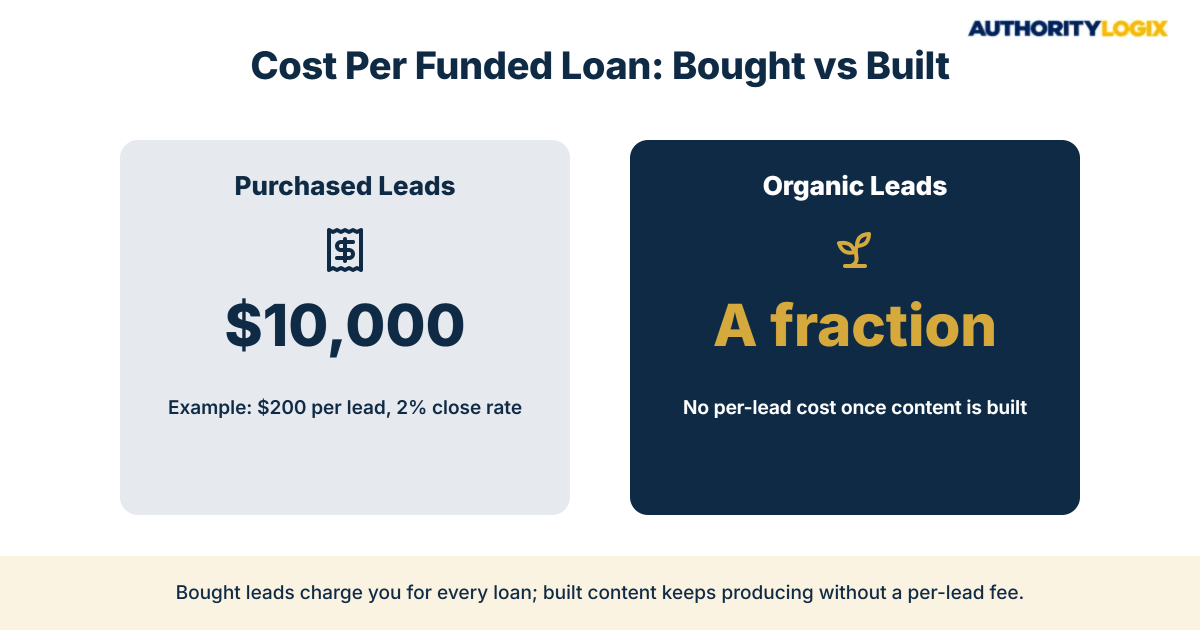
Shared aggregator leads run about $30–$100 per lead on LendingTree and an estimated $100–$200 on Bankrate, according to HousingWire’s 2026 mortgage lead guide. At the low conversion rates typical of shared leads — which are often sold to several lenders at once — a firm can need dozens to hundreds of leads to close one loan. At $75 average CPL and 1% conversion, 100 leads at $7,500 yields one closed transaction. In that example, the cost per funded loan lands at $7,500 before any follow-up overhead, CRM costs, or loan officer time is factored in. The FS industry hub covers the full economic picture of financial services marketing infrastructure; this conversion gap is the central argument for building rather than buying.
The Organic vs Purchased Leads Financial Services Math
A firm generating 100 organic leads per month through inbound infrastructure — educational content, SEO-ranked resource pages, lead magnets, and email nurture — closes 14–15 of them. The incremental cost per lead after the infrastructure is built approaches zero. No per-lead fee. No vendor contract. No competing lenders working the same list. The prospect came to you, found your content credible, and made a considered choice to engage. That is what the higher organic close rate reflects: self-qualified intent. The credibility gap article documents why firms with real expertise still lose to newer competitors who have built inbound infrastructure — and why conversion rate is the place that gap shows up first.
| Metric | Purchased Leads (Aggregator) | Organic Leads (Inbound) |
|---|---|---|
| Close rate | Low | Substantially higher |
| Leads needed to close 1 deal | Many | Far fewer |
| Avg. cost per lead | $30–$200 per lead (HousingWire) | Falls as content compounds |
| Cost per funded loan (est.) | High, and rising with lead costs | A fraction of purchased-lead cost |
| Exclusivity | Shared with several lenders | Exclusive — chose you specifically |
| Stops when you stop paying | Yes | No — compounds over time |
Why Purchased Leads Fail Financial Services Firms at a Structural Level
The low close rate for purchased leads is not a performance problem that better salespeople or faster follow-up can solve. It is a structural consequence of how purchased leads are generated and sold. When a prospect fills out a form on LendingTree or Bankrate, they are not expressing a preference — they are broadcasting a need. That broadcast goes to multiple lenders simultaneously. The prospect is now fielding calls from 3–8 companies. Speed-to-lead matters, but price-shopping has already begun. The content systems that separate competitive financial firms from commoditized ones are built on a different premise: the prospect should find you through educational content that establishes expertise before the first contact is ever made.
There is a second structural problem. Purchased lead costs in financial services have risen while conversion rates have fallen — a compression dynamic reported by mortgage marketing specialists tracking the lead vendor market. The firms most exposed to this compression are the ones most dependent on aggregators. Every price increase from a lead vendor is a direct hit to margin.
Every conversion rate decline means the same spend produces fewer closed loans. The search statistics on how borrowers and financial clients initiate their buying journey show that most prospects research professionals online before making contact. Which means the organic search channel reaches the same prospects the aggregators do, earlier in the decision process, at a fraction of the ongoing cost.
How Organic Leads Are Built for Financial Services Firms
Organic lead generation for financial services firms is not a content volume play. It is a system build. The firms generating organic leads at scale in 2026 have assembled connected infrastructure where every layer has a job: SEO-ranked educational content attracts the right audience, a lead capture mechanism converts that audience into identifiable prospects, and a follow-up sequence converts prospects into conversations. Volume without that infrastructure is just noise — a mortgage company that publishes 50 blog posts with no lead capture mechanism and no follow-up system is not generating organic leads. It is generating traffic with no commercial return.
The local SEO layer is particularly relevant for mortgage companies and DSCR lenders with a defined geographic market. Local search intent — borrowers searching for lenders in a specific metro, investors searching for DSCR programs in a specific state — is high-qualification intent. A lender who ranks for “DSCR lender [city]” is capturing a prospect at the moment of active search, with no intermediary vendor extracting a fee.
The educational hub architecture that supports local SEO performance is built around topic clusters organized by borrower scenario and geography. Each cluster delivers specific answers to the questions borrowers and investors are actually searching for, not generic financial content.
According to First Page Sage, financial services SEO delivers 1,031% ROI over three years — the fourth highest ROI of the 19 industry verticals they track. That figure reflects the compounding dynamic that separates inbound infrastructure from any paid channel: a ranked article generates leads in month 6, month 12, month 24, and month 36, from the same initial content investment. A purchased lead generates one shot at one contact, at full cost, every time.
Not sure where your firm’s lead generation infrastructure stands relative to what organic performance requires? The FS Authority Gap Assessment is the starting point.
The Compounding Advantage: Why Organic Lead Infrastructure Widens the Gap Over Time
The close rate advantage of organic leads is meaningful from day one. But the more significant competitive advantage is what happens over time. Paid lead costs increase with market competition. Purchased leads deliver no residual value — when the spend stops, the leads stop. Organic lead infrastructure compounds: each article that ranks drives traffic indefinitely, each resource page that earns backlinks builds domain authority that lifts every subsequent page.
And each lead magnet that captures email addresses builds a list that generates revenue from every follow-up campaign. The AI search dimension adds a further compounding layer. Educational content that ranks in Google is increasingly the same content cited by AI platforms when users query financial topics. And firms with published educational depth are building AI citation eligibility alongside organic search presence.
The compounding math on financial services SEO is what First Page Sage’s 1,031% three-year ROI figure captures. Year one of organic lead infrastructure is the most expensive on a per-lead basis — the content is being created, the SEO is being built, the lead capture system is being tested. By year two, cost per lead drops substantially as existing content ranks and drives traffic without additional investment. By year three, the same infrastructure that cost $X to build is generating leads at a per-unit cost that makes purchased leads economically indefensible. The lead generation architecture that enables this compounding is not one piece — it is a connected system where content, SEO, lead capture, and nurture all reinforce each other.
What It Really Costs to Keep Buying Leads Long-Term
The full cost of purchased lead dependency is rarely calculated correctly because firms account for CPL but not for what they are failing to build while they are buying. A mortgage company that spends $10,000 per month on lead vendors for three years has spent $360,000. It has zero compounding infrastructure to show for that spend — no ranked content, no email list built from educational engagement, no brand authority that survives the cessation of spend. The moment the budget is cut, the pipeline dries up overnight. The content system that generates inbound leads costs less than that $360,000 to build — and continues generating leads after the build is complete.
There is also an opportunity cost that does not appear on any marketing invoice. While a financial firm is running purchased leads at low close rates, its competitors who are building inbound infrastructure are building domain authority, email subscriber lists, AI citation eligibility, and Google Business Profile reviews — compounding assets that get more valuable with time. The finance content layer is where this authority is built: scenario-specific articles, borrower guides, lender explainers, and market commentary that positions the firm as the credible source in its niche before a prospect ever submits a contact form.

The Infrastructure Behind Organic Lead Generation for Financial Services
Organic lead generation does not happen because a firm publishes content. It happens because a firm has built the connected infrastructure that converts content into identifiable, engaged prospects. The specific components that make up that infrastructure in financial services are distinct from what works in other industries — because financial services buyers evaluate trust signals, credential depth, and specificity of expertise before they engage. A generic financial blog does not produce organic leads. A compliance-aware, scenario-specific, credential-attributed educational hub does.
The E-E-A-T guide covers the trust architecture Google applies to financial content — and it maps directly to what makes organic financial services leads convert at higher rates. Google’s Expertise-Experience-Authoritativeness-Trustworthiness framework for YMYL (Your Money, Your Life) content is essentially a conversion framework: the same named authorship, credential display, and cited data that earns Google’s trust is what earns the prospect’s trust and closes the loop from first contact to engaged lead.
Firms that have built this infrastructure effectively in financial services share a consistent structural pattern. Educational content is organized by borrower scenario or client profile — not by product features or rate tables. Lead capture is positioned around tools and guides that deliver immediate value: DSCR calculators, affordability estimators, investor qualification checklists. Follow-up sequences are built around the educational content the prospect engaged with, not generic nurture. And the growth playbook for each vertical connects all of these layers into a system that runs without requiring the firm’s principals to be personally present at every touchpoint.
What Most Firms Get Wrong About Organic vs Purchased Leads Financial Services
They treat content as a task, not a system
Publishing a blog post occasionally is not content infrastructure. The firms that generate organic leads at scale publish on a structured cadence, organized by topic cluster, anchored to a keyword architecture that targets the specific searches their ideal clients are running. The DSCR lenders who build broker-facing authority on organic channels publish guideline explainers, program updates, and market commentary that brokers follow for intelligence — not one-off articles that live in isolation on a website no broker has bookmarked.
They skip the lead capture layer
Traffic without lead capture is a readership, not a pipeline. Financial firms that have not built lead capture mechanisms — downloadable guides, scenario-specific checklists, qualification tools — are generating organic search traffic that bounces without any commercial return. The advisor content framework covers how educational publishing converts reader trust into captured leads — but only when the infrastructure to capture that trust is present on the page when the reader arrives.
They build content without distribution
A well-written article that no one sees is not an asset — it is a file. The firms generating organic leads that close at higher rates do not rely solely on Google to surface their content. They distribute through LinkedIn, through email lists built from prior lead captures, through syndication networks that amplify reach beyond organic search alone. Volume without infrastructure is just noise. The E-E-A-T signals that Google uses to rank financial content — named authorship, credential display, external citations, consistent topical depth — are also the signals that make distributed content credible when it reaches an audience through channels other than search.

Ready to replace purchased leads with organic leads that close at several times the rate?
Where to Start the Organic vs Purchased Leads Financial Services Transition
The transition from purchased lead dependency to organic lead infrastructure is not a budget replacement — it is a phased build that runs alongside existing lead buying while organic traction develops. Most financial services firms see meaningful organic lead volume emerge at 9–12 months post-launch of a full inbound system. The firms that start that build today are the ones operating with a self-running inbound pipeline in 2027. The ones still evaluating in 2027 are 12 months further behind the competitors who started.
The build starts with an honest audit of what exists. Most financial firms have a website that functions as a digital brochure — no SEO-ranked content, no lead capture, no educational depth. The gap between that starting point and a functional inbound lead pipeline is real but not as wide as it appears when the build is approached systematically. The authority distribution layer — the mechanism that gets published content in front of the right audience through LinkedIn, syndication, and multi-channel reach — is typically what accelerates organic traction from the baseline. Without distribution, even strong content takes longer to rank and generate leads. With distribution, each piece of content works across multiple channels simultaneously.
The honest answer on timeline: a financial services firm that commits to building organic lead infrastructure today should expect to reduce its purchased lead dependency meaningfully within 12 months and largely eliminate it within 24. That is a slower payoff than dialing for leads on a Monday morning. It is a fundamentally different asset class — one that the firm owns, that gets more valuable over time, and that does not disappear when a vendor raises prices or a platform changes its algorithm. When you’re ready to build, work with us is the starting point.