


Key Takeaways
- Financial services AI search content is written and structured so AI Overviews, ChatGPT, and Perplexity can extract it, trust it, and cite it — not just rank it.
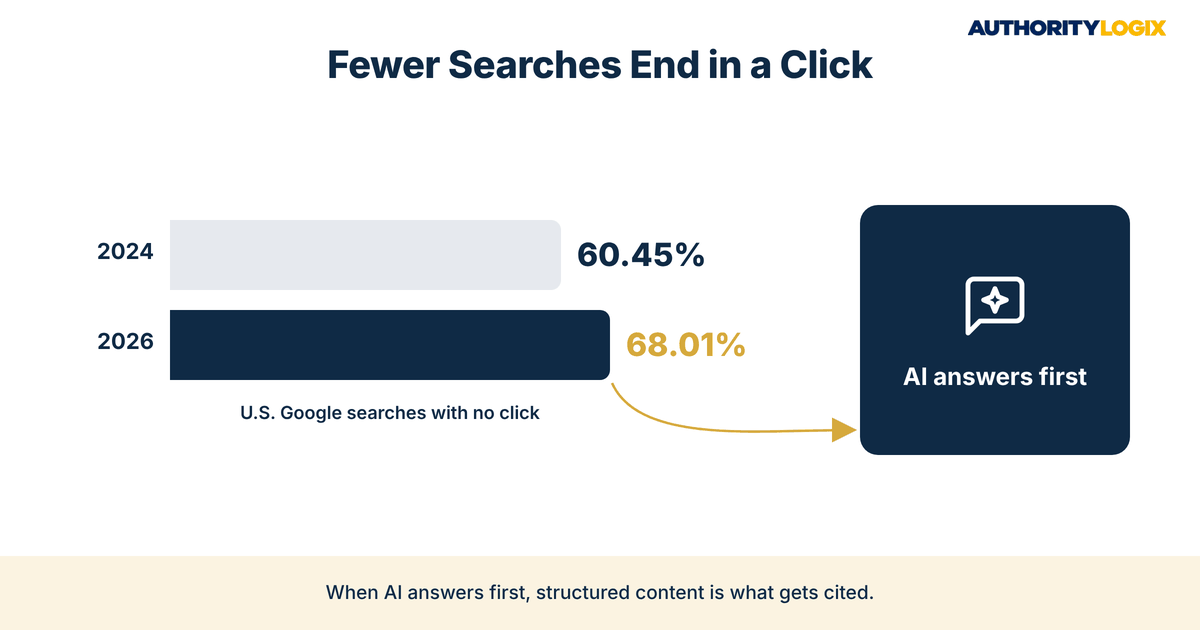
- SparkToro’s 2026 clickstream study, reported by Search Engine Land, found that 68.01% of U.S. Google searches ended without a click, up from 60.45% in 2024.
- Pew Research Center found users clicked a traditional search result in 8% of visits when an AI summary appeared, versus 15% when none appeared.
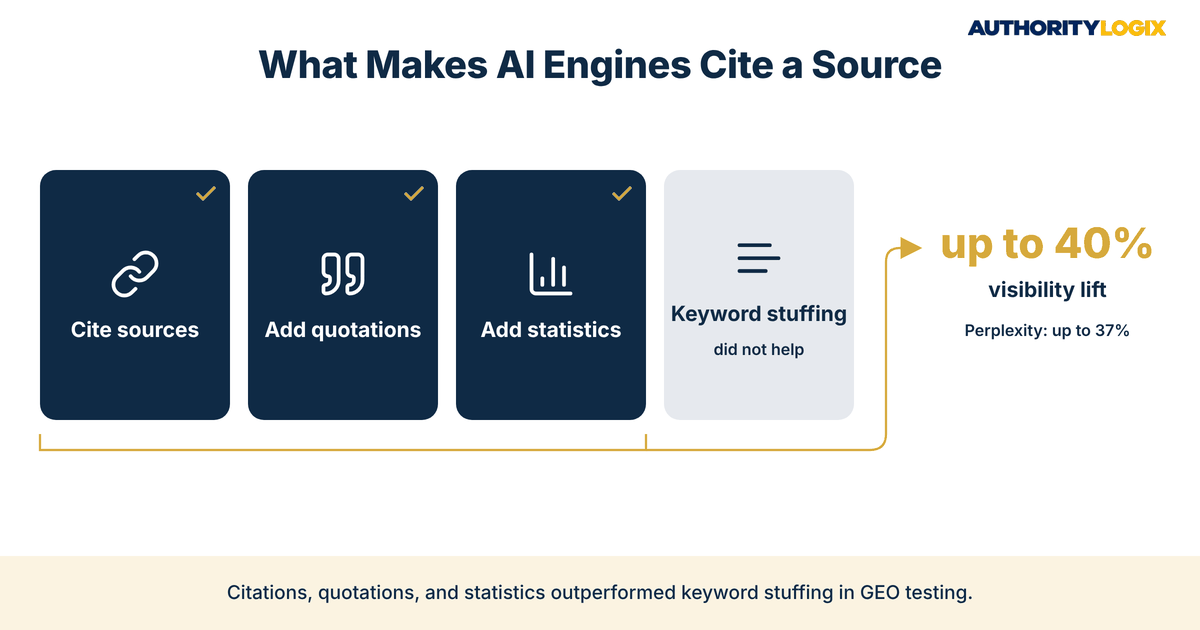
- The GEO research paper found that adding citations, quotations, and statistics raised a source’s visibility in generative engine answers by up to 40%, while keyword stuffing did not help.
- Ahrefs found only 38% of pages cited in AI Overviews also ranked in the top 10, so financial services AI search content has to earn the citation on structure, not rank alone.
- Fixing financial services AI search content is structural: answer-first sections, named expertise, consistent entity signals, and a connected library where every page supports the next.
Table of Contents
Why Financial Services AI Search Content Needs Its Own Structure
Financial services AI search content is the layer most lenders and advisors have never built, even though their borrowers and clients are already asking AI engines the exact questions those firms answer every day. You have spent years earning credibility through real deals and real client relationships. The shift in how advisors and lenders get discovered through AI search means that credibility now has to be readable by a machine before a person ever sees it.
The numbers explain the urgency. According to SparkToro’s 2026 clickstream study, built on Similarweb data and reported by Search Engine Land, 68.01% of U.S. Google searches ended without a click between January and April 2026, up from 60.45% in 2024. The same report notes that AI Overviews now appear on more than 20% of Google searches and that click-through rates fall by nearly 60% when they do.
Pew Research Center reached a similar conclusion from real browsing data. Users clicked a traditional search result in 8% of visits when an AI summary appeared, compared with 15% when no summary appeared, and only 1% of visits included a click on a link inside the summary itself. That small slot is where financial services AI search content now competes, and it rewards structure far more than volume.
None of this replaces traditional search. The ranking foundation laid out in the SEO playbook still matters, because AI engines draw heavily from pages they can already find and trust. What changes is the format of the financial services AI search content sitting on that foundation — whether a machine can lift a clean, accurate answer from it in seconds.
For lenders and advisors, the stakes are higher than in most industries. Google treats financial topics as Your Money or Your Life content, which means engines are cautious about which sources they repeat on loans, retirement, or investing. Firms that want to see how structure, content, and distribution fit together can start at the financial services hub, where each system is mapped to the problem it solves.
The Financial Services Content System lays out the full compliance-aware publishing blueprint that AI-ready pages are built on.
Mortgage Generative Engine Optimization GEO: How Citations Are Chosen
Mortgage generative engine optimization GEO is the practice of shaping pages so AI engines select them as sources when they assemble an answer. The term comes from a research paper by researchers at Princeton University and IIT Delhi, who built a benchmark of 10,000 queries to test what makes a generative engine cite one source over another. Their headline finding was direct: the right optimization methods raised a source’s visibility in generated answers by up to 40%.
The methods that worked best were not technical tricks. Adding citations to credible sources, quotations from relevant experts, and specific statistics produced the strongest gains, and on Perplexity — a live engine — the improvements reached up to 37%. Keyword stuffing, the old SEO habit, did not help. For financial services AI search content, that is useful news, because the winning moves are the same ones a compliance-aware firm should already be making.
What Financial Services AI Search Content Signals to an Engine
An engine choosing between two mortgage pages is effectively asking which one is safer to repeat. Pages that show who wrote them, what experience stands behind them, and where every number comes from pass that test far more often, which is why the E-E-A-T standard Google applies to financial content maps so closely to AI citation behavior. Authorship, sourcing, and accuracy are no longer polish. They are selection criteria.
Isolated pages rarely win citations on their own. Engines look for sources that cover a subject in depth across many connected pages, so a single DSCR explainer carries less weight than a structured library of related answers. That is the job of an educational hub: a topic-organized set of pages, internally linked, that tells a machine your firm covers the subject end to end rather than once in passing.
Advisor AI Overview Content That Gets Extracted
Advisor AI overview content works when each section can stand alone as an answer. AI Overviews and chat engines pull passages, not whole pages, so a section that buries its answer in the fourth paragraph loses to a competitor who states it in the first sentence. The structure that gets extracted is predictable: a question-style heading, a direct two-sentence answer, then the supporting detail and the named source.
The Answer-First Format for Financial Services AI Search Content
Write every major section so its first two sentences could be quoted on their own without losing accuracy. Follow with context, a named source for any number, and a short list or table only where the information is genuinely comparative. Financial services AI search content demands the same discipline good financial writing always has, applied with a machine reader in mind.
| Structure Element | What the Engine Extracts | Financial Services AI Search Content Example |
|---|---|---|
| Question-style H2 or H3 | The query the section answers | “What credit score does a DSCR loan require?” |
| Two-sentence direct answer | A quotable passage | Plain answer first, qualifiers and exceptions second |
| Named source for every statistic | Evidence it can attribute | “According to Pew Research Center…” in the same sentence as the number |
| Author byline and credentials | Who stands behind the claim | Loan officer or advisor bio with licensing details on every page |
| Comparison table | Structured facts it can restate | Loan types, timelines, or document checklists side by side |
| FAQ block | Short answers to follow-up questions | Five to eight real buyer questions per page |
Mortgage companies already hold most of the raw material for this. Loan officer bios, licensing details, years in market, and real scenario explanations are the E-E-A-T signals engines look for, yet they usually sit on an About page instead of on the content itself. Moving them onto every educational page is one of the fastest structural changes a firm can make.
The real challenge is consistency at volume. One well-structured page of financial services AI search content proves little to an engine, but sixty pages built on the same answer-first template, the same sourcing rules, and the same author attribution create a pattern it can trust. Holding that pattern steady is what dedicated content systems are designed to do, because a template that lives only in one writer’s head disappears the first week that writer is busy.
Not sure whether AI engines can read and cite your financial services AI search content today? The FS Authority Gap Assessment shows where your structure is weak and what to build first.
Lender Perplexity ChatGPT Visibility Through Entity Signals
Lender Perplexity ChatGPT visibility depends on whether those engines recognize your firm as one distinct, consistent entity. ChatGPT alone reached 900 million weekly active users in February 2026, according to OpenAI figures reported by TechCrunch, and a growing share of those conversations involve money. J.D. Power research reported by the ABA Banking Journal found that 51% of consumers said they use AI for financial advice or information, with another 27% considering it.
Chat engines build their picture of who you are from every place your firm appears. If your firm name, address, licensing, and specialty read differently on your website, your Google Business Profile, your LinkedIn page, and the directories that list you, the engine has no confident picture to cite. Consistency across those sources is the entity signal, and it matters as much as any single page of financial services AI search content.
Third-party mentions carry extra weight here. When a trade publication, a podcast, or a local business journal names your firm alongside a specialty, engines gain independent confirmation of what your own site claims, and that pattern is the backbone of the authority guide approach. Credentials you hold privately do nothing for an engine. Credentials the market repeats in public do.
Your own pages still need to state the entity clearly. Each page of financial services AI search content should name the firm, the author, the markets served, and the loan products or advisory services in plain language rather than in a footer. That is what purpose-built finance content looks like in practice — expert-written pages that answer the buyer’s question and quietly confirm who answered it.

Turning Financial Services AI Search Content Into Inbound Inquiries
A citation is only valuable if the reader who follows it finds a clear next step. Pew’s data showed that only 1% of visits involved a click on a link inside an AI summary, so the readers who do click arrive with unusual intent. They have already read a summary, judged your firm worth checking, and landed on your page to confirm it.
That reader should never land on a dead end. Every page built as financial services AI search content needs a relevant calculator, checklist, guide, or consultation offer that matches the question the reader asked, which is how a lead system turns an AI referral into a client conversation. The offer should fit the stage of the question, not push a rate quote on someone still learning the basics.
Citations also compound when the same expertise appears in more places. Syndicating your core financial services AI search content through press releases, podcasts, and industry publications gives engines more independent sources that point back to your firm. Structured authority distribution is what turns one strong article into a dozen confirming signals across the web.
BKDSCR.com, the proof-of-concept platform AuthorityLogix built in the NYC outer-borough DSCR niche, shows what this foundation looks like in a live market: 18 pillar pages, 7 interactive investor tools, and 48 SEO-optimized blog posts, built with zero paid ads. Every page answers a specific investor question and points to a tool or a next resource. That connected structure is the raw material AI engines need to understand what a firm actually knows.
Financial Services AI Search Content Mistakes Firms Make
Most firms that try to adapt their financial services AI search content make the same handful of errors. Each one is fixable, and each one comes from treating AI engines like the old page of ten blue links.
Mistake: Writing for the algorithm instead of the buyer
Some firms respond by packing their financial services AI search content with question phrases and repeated keywords. The GEO research found keyword stuffing did not improve visibility, and engines keep getting better at spotting pages written for machines rather than people. Write for a skeptical borrower or client first, then structure the page so the machine can follow it.
Can AI search replace our other lead channels?
No, and it should not be treated that way. AI citations add a discovery layer on top of search, referrals, and direct outreach, and the firms that benefit most connect all of them through one lead generation framework rather than chasing each channel separately.
Mistake: Hiding the author and the source
Unsigned pages with unsourced numbers are the easiest for an engine to skip. In a Your Money or Your Life category, an anonymous claim about rates or retirement is a liability for the engine as much as for the firm. Put a named, credentialed author on every page of financial services AI search content and name the source of every figure.
Mistake: Assuming top rankings guarantee a citation
Ahrefs analyzed 863,000 keywords and found that only 38% of pages cited in AI Overviews also ranked in the top 10 for the same query, down from 76% in its earlier study. Ahrefs cautions that the two datasets are not directly comparable, but the direction is clear. Ranking still helps, yet an engine will cite a lower-ranked page when it answers the question more cleanly.
How do we know where our firm stands today?
Start by asking the engines directly. Run the ten questions your best clients ask most often through ChatGPT, Perplexity, and Google, record which firms get named, and compare that list against your own pages. That gap analysis is part of what we do at the start of every client build, because the fix depends on what the engines currently see.
How long does it take to restructure an existing site?
It depends on the size of the library and the state of the existing pages. Most firms start by rebuilding their twenty highest-value pages into answer-first financial services AI search content, then extend the template to every new page as it is published. Sequence matters more than speed, and the order behind how we build never changes: foundation, structure, then distribution.

Want your firm cited when prospects ask AI tools for answers? We’ll structure your content so it gets quoted and linked.
Structured for Machines, Written for Buyers
The firms cited most over the next few years will not be the ones publishing the most. They will be the ones whose financial services AI search content is accurate, signed, sourced, and connected, so every engine that reads it reaches the same conclusion about who the expert is. That long-term view sits at the core of the growth playbook, where structure is treated as an asset that compounds rather than a campaign that ends.
None of this asks you to become someone you are not. The expertise already lives in your loan officers, advisors, and principals, and the work is translating it into financial services AI search content engines can read and repeat. That translation is exactly why it works for firms that have spent years being credible but invisible.
The honest answer is that most lenders and advisors already know more than the pages AI engines are quoting today. The missing piece is the structure that lets those engines see it. If you want that structure built deliberately rather than improvised page by page, the place to start is to work with us.