


Key Takeaways
- Financial advisor AI search visibility is now a distinct channel — separate from Google organic rankings — and the advisors building for it now are accumulating a citation advantage their competitors are not measuring.
- According to Bain research, 80% of consumers now rely on zero-click answers for at least 40% of their searches, meaning the AI answer is the first and often only impression a prospect gets of the financial advisors it mentions.
- A growing share of B2B research queries now start in ChatGPT, Perplexity, Gemini, or Claude rather than Google — and one in four affluent households plans to use AI tools when searching for an advisor.
- AI systems do not recommend based on paid placement. They cite based on verifiable authority — structured content, third-party mentions, entity consistency, and credentialed authorship.
- The content infrastructure that earns AI citations in financial services is the same infrastructure that builds E-E-A-T and organic search authority — the two systems feed each other.
- The advisors who are not optimizing for AI search visibility now will spend 2027 competing against competitors who have been accumulating AI citation authority for two years.
Table of Contents

Why Financial Advisor AI Search Visibility Is the New Front Line of Client Acquisition
Financial advisor AI search visibility has moved from a forward-looking concern to a present-tense competitive reality. When a high-net-worth prospect types a question about retirement income advisors in their city into ChatGPT or Perplexity, the response does not list ten blue links. It synthesizes an answer and names two or three advisors or firms. The advisors named in that answer have a first-mover trust advantage that no amount of retroactive SEO can recover in the same conversation. The authority guide makes clear that the same credibility signals that rank content in traditional search — E-E-A-T, credential display, authoritative citations — are the signals AI systems evaluate before including a financial professional in a generated answer.
The scale of the shift is no longer a projection. According to Bain research, 80% of consumers now rely on zero-click answers for at least 40% of their searches. Adobe Analytics found that traffic to U.S. retail websites from generative AI sources increased by 1,200% between July 2024 and February 2025. For financial advisors whose websites were generating meaningful organic traffic 18 months ago, this is not a future problem — it is an active one. The prospects they once captured through Google search are increasingly receiving AI-generated answers that either include or exclude them, with no opportunity to recover within that interaction.
The most actionable data point for financial advisors comes from Wealthtender’s 2025 study of 500 affluent households: one in four plans to use ChatGPT, Gemini, or other AI tools when searching for an advisor. Among those who receive a personal referral to an advisor, nearly all still research that advisor before reaching out — Wealthtender found 96% would research an advisor even if highly recommended. The referral that used to be the safest warm introduction now passes through an AI validation step.
The advisor who does not appear credibly in that AI validation step is losing referral conversions they never knew they were at risk of losing. The full picture of how borrowers and clients find financial professionals online is covered in the mortgage search statistics guide — the behavioral data that anchors every visibility investment decision.
The Financial Services SEO Playbook covers the full search and AI visibility infrastructure for financial advisors and mortgage companies — from traditional rankings through AI citation eligibility.
How AI Search Engines Select Financial Advisors to Cite
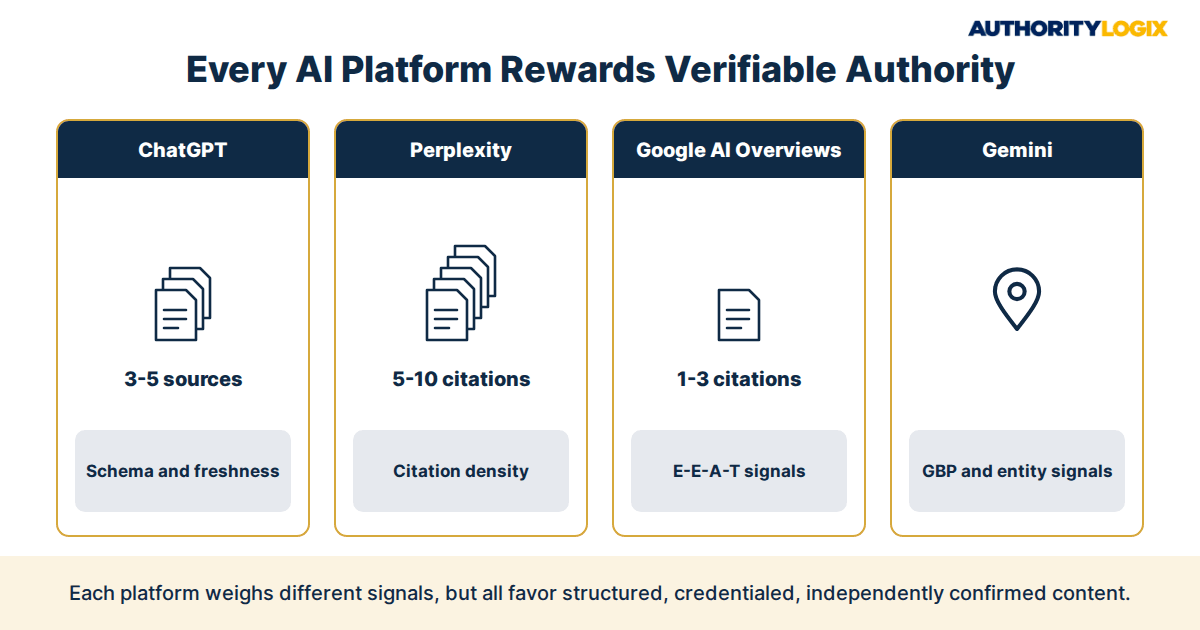
Understanding financial advisor AI search visibility requires understanding how AI engines select their sources — because the selection logic is fundamentally different from Google’s ranking algorithm. Google ranks pages. AI engines synthesize answers from sources they evaluate for trust, specificity, and extractability. A financial advisor who has optimized their website for Google rankings but not for AI citation eligibility may rank on page one of Google and not appear in a single AI-generated answer about their specialty. The content systems infrastructure that serves both goals simultaneously is the only architecture that compounds across both channels.
| AI Platform | Primary Source Logic | Citation Pattern | Key Signal for Financial Advisors |
|---|---|---|---|
| ChatGPT Search | Bing index + OpenAI retrieval ranking | 3-5 sources per answer; strong branded site bias | Content freshness, schema markup, direct answer structure |
| Perplexity | Custom hybrid index; real-time crawl | 5-10 citations per answer; lower domain bias | Citation density in content, factual specificity, fast-loading structured pages |
| Google AI Overviews | Google’s own index; E-E-A-T weighted | 1-3 citations; strong YMYL standard for financial content | E-E-A-T signals, credentialed authorship, schema markup |
| Gemini | Google knowledge graph integration | Favors Google entity signals, GBP, structured data | Google Business Profile, Person schema, verified credentials |
The common thread across all four platforms is verifiable authority. AI systems applying YMYL standards to financial content are not selecting the advisor with the most blog posts. They are selecting the advisor whose content is structured for extraction, whose credentials are machine-readable, whose entity data is consistent across third-party sources, and whose content contains specific, cited claims rather than generic marketing assertions. The authority distribution system covers how AI citation eligibility is built into the content distribution workflow from the point of publication.
One finding from Wealthtender’s research is particularly instructive: when asked to describe its own ranking factors, ChatGPT said it downweights testimonials on advisor websites because they are curated by the advisor. Independent third-party reviews and mentions carry dramatically more weight. McKinsey’s 2025 analysis found that brand websites supply only about 5 to 10% of the sources AI models use to generate answers. The financial services hub covers how third-party citation building connects to the broader authority infrastructure.
The Five Infrastructure Components That Produce Financial Advisor AI Search Visibility
Financial advisor AI search visibility is not produced by a single optimization tactic. It is the output of five infrastructure components that work together — each one strengthening the others and building a cumulative authority signal that AI systems evaluate across multiple data sources. Any one alone produces marginal results. The combination is what makes an advisor consistently citable. The lead generation system connects AI citation visibility to pipeline conversion — because the prospect who encounters the advisor in an AI answer is among the highest-intent prospects in the acquisition funnel.
The Machine-Readability Components of Financial Advisor AI Search Visibility
1. Credentialed Authorship — Making Expertise Machine-Readable. AI systems evaluating YMYL financial content look for verifiable author credentials before including content in a citation. An article attributed to “the team at XYZ Advisory” carries no E-E-A-T signal for AI extraction. The same article attributed to a named CFP with a linked CFP Board profile, a Person schema entry, and a dedicated author page that connects name to credentials carries a verifiable expertise signal that AI systems can retrieve and confirm. This is the difference between citable and uncitable content for financial services. The lead generation infrastructure that converts AI-referred prospects depends on the advisor’s content being credentialed enough to earn the citation that produces the referral.
2. Structured Content Format — Building for Extraction. AI engines extract specific passages and data points from content — they do not summarize entire articles the way a human reader does. Research from Kevin Indig’s Growth Memo found that 44% of ChatGPT citations come from the first 30% of a piece of content. This means the structure of a financial advisor’s content determines citation eligibility as much as the substance. The content system documents the specific content structures that produce AI citation eligibility: direct answer formatting, FAQ sections with FAQPage schema, data tables with cited statistics, and clear heading hierarchies that allow AI systems to identify and extract the answer to a specific query.
3. Schema Markup — Making Entity Data Machine-Readable. Schema markup translates a financial advisor’s credentials, location, services, and professional affiliations into machine-readable format that AI systems can retrieve and verify. Four schema types are foundational for financial advisor AI search visibility: Person schema on author pages, Organization schema at the site level, FAQPage schema on resource content, and LocalBusiness schema with FinancialService type. The educational hub architecture integrates schema deployment into the content production workflow so every piece of content published contributes to the schema stack rather than requiring retroactive markup.
The Trust and Freshness Signals That Sustain AI Search Visibility
4. Third-Party Citations and Entity Consistency. The most structurally important factor in financial advisor AI search visibility is third-party citations — mentions of the advisor’s name, credentials, and firm in sources the AI system treats as authoritative. McKinsey’s 2025 analysis found that brand websites supply only about 5 to 10% of the sources AI models use to generate answers. Third-party citation sources that carry weight with financial AI systems include CFP Board and FINRA BrokerCheck listings, independent advisor directories like Wealthtender and NAPFA, local news coverage of market-specific expertise, and financial planning publications. The growth playbook covers how third-party citation building connects to the long-term authority compounding strategy.
5. Content Freshness and Specificity. AI systems weight content recency heavily for financial queries — Seer Interactive’s 2025 study found that nearly 65% of AI bot hits target content less than one year old. For financial advisors, a content library built three years ago and not updated since is losing AI citation eligibility at the same rate the content ages out of the recency window. The finance content service maintains the update cycle that keeps financial advisor content within the recency window AI systems prefer — including systematic refresh of statistics, regulatory citations, and market data as conditions change.
Not sure whether your current content and schema infrastructure is earning AI citations for your advisory practice? The FS Authority Gap Assessment identifies the specific gaps.
What Financial Advisors Get Wrong About AI Search Visibility
The same misunderstandings that delayed advisors from building traditional SEO infrastructure are now delaying AI citation infrastructure — and the cost of the delay compounds in the same way. The same sequencing applies to local visibility: the local SEO foundation that drives Map Pack rankings is what AI systems draw on when surfacing advisors in geographically relevant queries.
Assuming Google rankings transfer to AI citations.
A financial advisor who ranks on page one of Google has built search infrastructure for Google’s ranking algorithm. That infrastructure overlaps with AI citation requirements but does not produce them automatically. A firm can rank first on Google and appear in zero AI answers if its content is not structured for extraction, its author credentials are not schema-marked, and its entity data is not consistent across third-party sources. The what we do audit identifies exactly this gap — the advisors with strong Google presence and zero AI visibility — because the correction is specific and buildable.
Publishing volume without building for extraction.
Volume without structure does not produce AI citations. An advisor who publishes frequently in paragraph-heavy prose with no schema markup, no FAQ sections, no credentialed author attribution, and no third-party citations is building a content library that AI systems cannot extract from reliably. The GEO (Generative Engine Optimization) literature is consistent: factual density, direct answer structure, and cited statistics in the first 30% of content are the highest-ROI optimization tactics for AI citation eligibility. See how we build for how the AuthorityLogix content production workflow builds extraction-ready content from the brief stage.
Treating AI search as a future concern.
One in four affluent households already starts their advisor search on an AI tool. The channel is not emerging — it is active. Every month a financial advisor does not build AI citation infrastructure is a month their competitors with citation authority accumulate a compounding lead. The advisors who were building E-E-A-T and structured content in 2022 are the advisors whose content AI systems are citing in 2026. Waiting until 2027 to start means competing against two years of accumulated citation authority from advisors who started earlier. The E-E-A-T guide covers the credibility infrastructure that feeds both traditional search rankings and AI citation eligibility — the two channels now share the same underlying trust signals.

Building Financial Advisor AI Search Visibility: The Practical Sequence
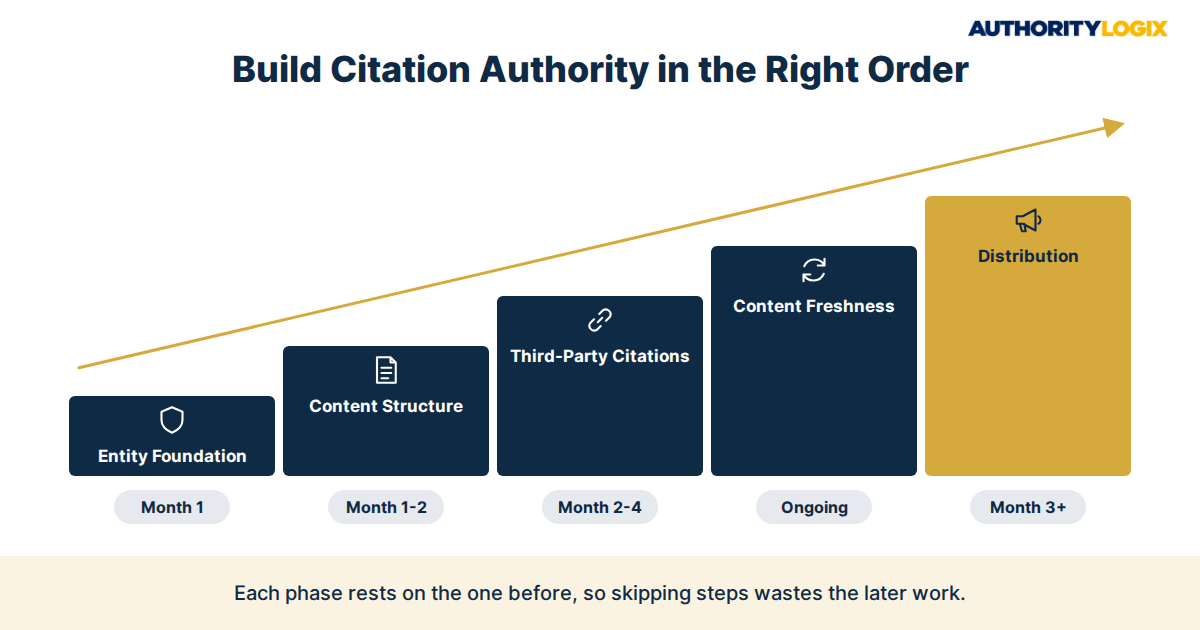
The build sequence for financial advisor AI search visibility follows a specific order because each component builds on the one beneath it. Getting the sequence wrong produces partial results — schema markup on uncredentialed content is wasted, and third-party citations pointing to content that is not structured for extraction produce visibility without conversion. For advisors with a physical office, a fully optimized GBP setup is step one — local authority feeds directly into the entity foundation AI systems evaluate.
| Build Phase | What Gets Built | Timeline | Output |
|---|---|---|---|
| Entity Foundation | Author pages with Person schema, Organization schema, credential display, NMLS/CRD attribution | Month 1 | AI-verifiable entity: advisor is machine-readable and credential-confirmed |
| Content Structure | FAQ sections with FAQPage schema, direct-answer formatting, data tables, cited statistics | Month 1-2 | Content is extractable: AI systems can retrieve specific answers |
| Third-Party Citations | CFP Board, FINRA BrokerCheck, independent directories, bylined financial publications | Month 2-4 | External authority: AI systems see independent confirmation of advisor expertise |
| Content Freshness | Regular update cycle for statistics, regulatory citations, market data | Ongoing | Sustained citation eligibility: content stays within AI recency window |
| Distribution | Press syndication, LinkedIn publishing, additional third-party entity signals | Month 3+ | Citation velocity: each external mention adds to the authority stack AI systems evaluate |
This is the infrastructure AuthorityLogix builds for financial advisory clients — entity foundation first, content structure second, third-party citations third. Each phase builds on the one beneath it, and the combination is what produces consistent AI citation visibility rather than occasional mentions. The advisors who have not built it are operating with the same credibility gap that keeps experienced professionals invisible while newer competitors lead in AI and traditional search.
Ready to get your advisory firm cited in AI search before your competitors are?
The Advisor Who Gets Cited Is the Advisor Who Gets the Meeting
Financial advisor AI search visibility will not replace referrals, Google rankings, or the relationship-based trust that financial services has always required. It will supplement all three — by ensuring that when a prospect validates a referral using an AI tool, or begins their search independently using an AI engine, the advisor who has built the infrastructure appears and the one who has not does not. If your firm is ready to build that infrastructure, work with us is the starting point.
Most financial advisors in any given market have not built AI citation infrastructure. Their content is not structured for extraction. Their credentials are not schema-marked. Their entity data is inconsistent across directories. They have no presence in the independent directories that AI systems treat as authoritative for financial professionals. Each of these gaps is correctable — and each one corrected compounds with the others to produce the AI search visibility that produces the first mention, the first meeting, and the first client relationship that began in an AI answer. Learn more about why it works through the AuthorityLogix proof-of-concept before deciding whether to build.