


Key Takeaways
- Real estate home valuation tool leads start with the question that comes before every listing: what is my home worth.
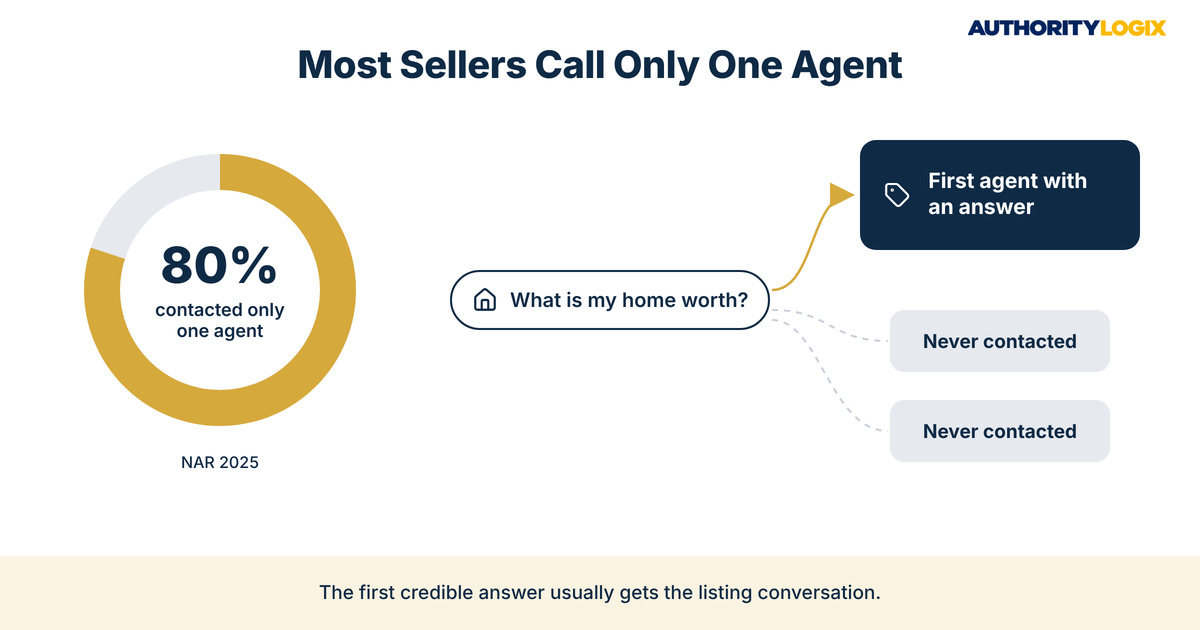
- NAR’s 2025 Profile of Home Buyers and Sellers found 80% of recent sellers contacted only one agent, so the first credible answer matters.
- The same report found 66% of sellers used a referred agent or one they had worked with before.
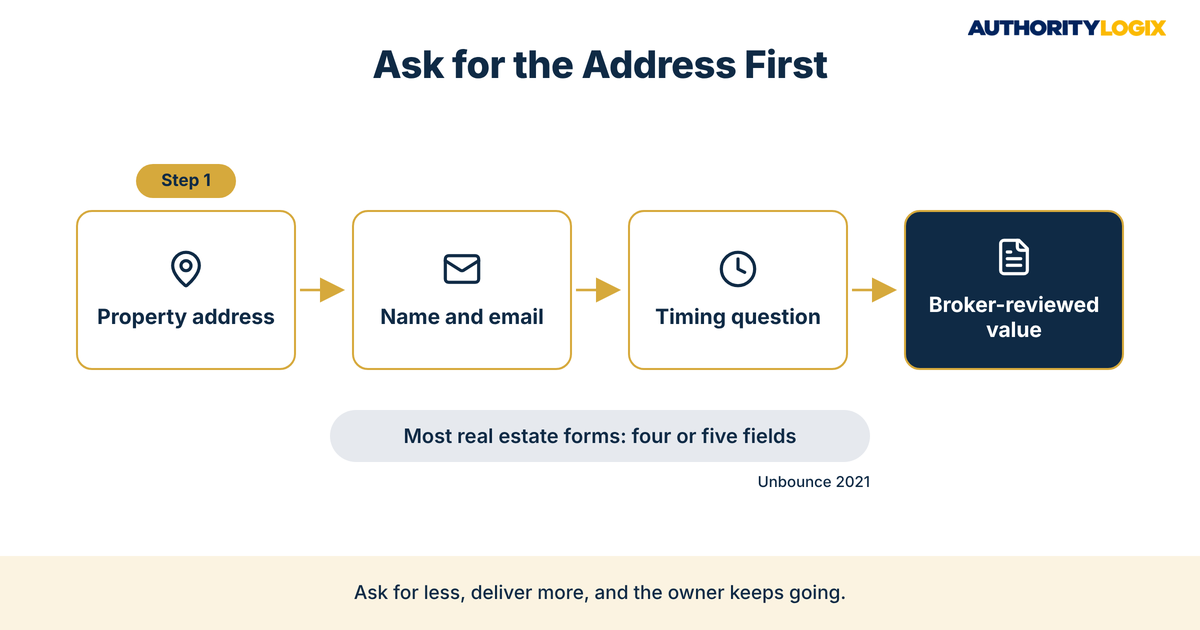
- Unbounce’s 2021 real estate benchmark page says most real estate forms have four or five fields, and longer forms correlate with lower conversion rates.
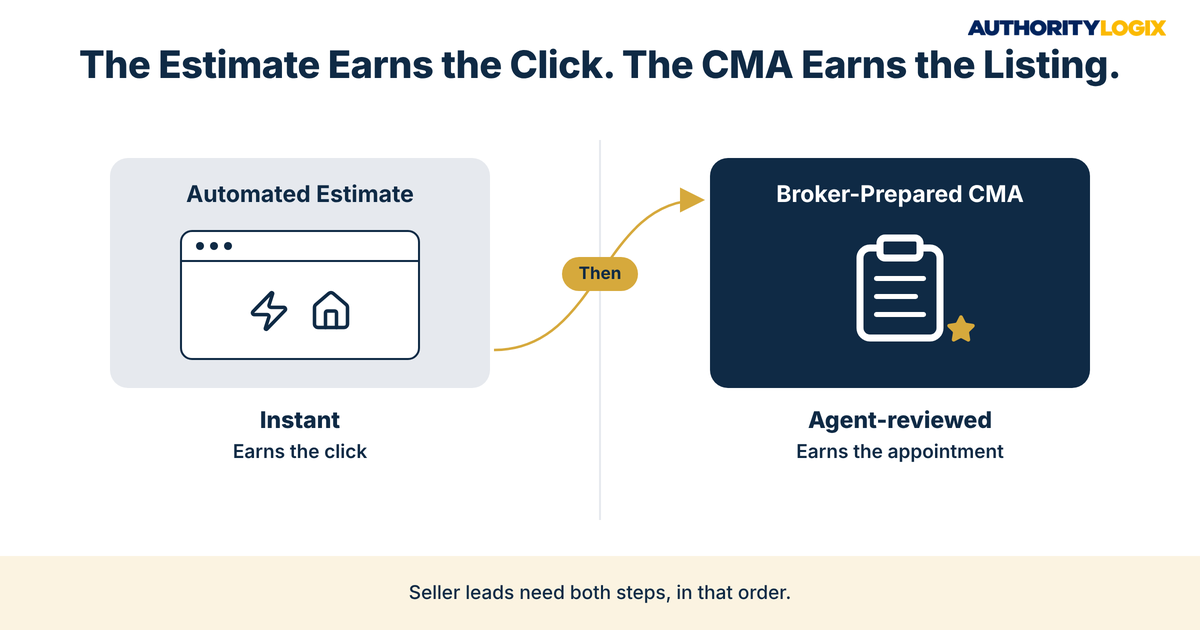
- An automated estimate earns the click; a broker-prepared CMA turns real estate home valuation tool leads into appointments.
- Real estate home valuation tool leads grow through neighborhood pages, timed follow-up and local search, not a homepage widget.
Table of Contents
Why Real Estate Home Valuation Tool Leads Outperform Generic Contact Forms
Real estate home valuation tool leads start with a question every homeowner eventually asks — what is my place worth right now — and the agent who answers it first is usually the one who gets the listing conversation. You may know the price history of every block in your market, yet a homeowner thinking about selling will still type that question into Google before calling anyone. For most real estate firms, the website answers with a contact form that offers nothing and asks for everything.
That is the credible but invisible gap in its plainest form. The expertise to price a home sits in your office, but the homeowner never sees it, because the only invitation on the page is “Contact us.” A valuation tool reverses the exchange: the owner gets something useful about their address, and you get a name, a property and a reason to follow up.
NAR’s numbers show why that first exchange carries so much weight. The 2025 Profile of Home Buyers and Sellers found that 91% of sellers sold with the help of an agent, and that 80% of recent sellers contacted only one agent before choosing. Sixty-six percent used an agent who was referred to them or one they had worked with before — 37% through a friend, neighbor or relative and 29% returning to an agent they had used in the past.
| Seller Finding | NAR 2025 Profile | What It Means for Real Estate Home Valuation Tool Leads |
|---|---|---|
| Agents contacted | 80% contacted only one agent | The first credible contact usually wins the listing |
| Referral or past agent | 66% — 37% via friend, neighbor or relative; 29% used a past agent | Real estate home valuation tool leads open the channel referrals do not reach |
| Agent-assisted sales | 91% sold with an agent | Owners still want an agent — the open question is which one |
| Time in home | Median of 11 years, a record high | An owner’s last pricing conversation may be a decade old |
Read those numbers together and the logic of seller lead generation gets simple. If four out of five sellers talk to only one agent, the job is to become that one agent before the homeowner picks up the phone. Real estate home valuation tool leads do exactly that by meeting the owner at the pricing question, often months before a referral would.
Form design matters as much as the offer. Unbounce’s 2021 benchmark page for real estate says most real estate forms have four or five fields, and that longer forms correlate with lower conversion rates. The same page calls any real estate conversion rate over 2.6% a leading one, and a page built for real estate home valuation tool leads should ask for as little as possible.
A valuation offer is the clearest seller-side example of the rules in the lead magnet strategy for real estate: give real value, ask for little and make the next step obvious. Real estate home valuation tool leads outperform generic forms because the owner knows what they get in return.
The Real Estate Lead Generation System shows where real estate home valuation tool leads fit inside a full inbound pipeline — from the first estimate to the signed listing agreement.
How a Broker Home Value Lead Magnet Turns Curiosity Into a Listing Conversation
A broker home value lead magnet works because it matches where the homeowner actually is. Most owners checking their value are curious, not committed — weighing a refinance, a move in a year or two, or what a neighbor’s house sold for. A tool that answers that curiosity reaches the owner long before they interview agents.
The tool is only the front door. Behind it sits the market material that gives the estimate context — recent sales and price movement — which is why valuation pages belong inside a broader content system rather than standing alone. Real estate home valuation tool leads convert into conversations more readily when the homeowner lands on a page that already demonstrates local pricing knowledge.
What a Broker Home Value Lead Magnet Should Ask For
Keep the form short and order the fields the way the owner is comfortable giving them. The address comes first because it is the one detail the homeowner wants to hand over, and a single timing question does more qualifying work than a stack of required fields.
- Property address first, with autocomplete
- Name and email, asked only after the address is confirmed
- Phone number as optional, with a note on how it will be used
- One timing question: just curious, selling within a year, or selling soon
- A promise of what comes next: an instant range now, a broker-reviewed value to follow
What the owner sees after submitting matters as much as the form itself. A results page that explains the estimate, shows recent nearby sales and offers a broker review turns a visitor into a conversation. That page is valuation content, and it deserves the same care as a listing presentation, because for real estate home valuation tool leads it is the first presentation the owner sees.
Agent Seller Lead Home Valuation Follow-Up: What Happens After the Estimate
Agent seller lead home valuation follow-up is where most tools fail, and it is rarely the software’s fault. An owner who requested an estimate on Sunday and heard nothing until Wednesday may already have found another agent. When NAR finds that 80% of sellers contact only one agent, speed is not a courtesy. It is the whole contest.
The follow-up should prove expertise, not chase the owner. Instead of three calls in a day, send a short broker note on what drives value on that street and an offer to walk the property. That shift from pursuit to proof is the core idea in the authority guide, and it is what separates real estate home valuation tool leads that convert from ones that unsubscribe.
The Follow-Up Tracks After a Valuation Request
A working sequence runs on the timeline the owner sets. The timing answer on the form decides which track real estate home valuation tool leads enter, and each track has a different job.
- Selling soon: a same-day call, then a broker-prepared CMA and a property visit
- Selling within a year: monthly neighborhood sales updates and a quarterly pricing check-in
- Just curious: a quarterly value update for their address
- Every track: a reply path to a real person, never a no-reply inbox
Long-cycle owners are where most of the value hides. A homeowner who was curious in March may be ready by fall, and the agent whose name reached that inbox every month gets the call. Staying in front of them takes a distribution plan that puts market updates on email, LinkedIn and local publications on a schedule, so agent seller lead home valuation follow-up keeps working without manual chasing.
Not sure whether your site is capturing real estate home valuation tool leads or losing them at the form? The RE Authority Gap Assessment shows where your valuation offer, follow-up and local visibility are weakest.
Real Estate CMA Tool Lead Generation vs Automated Estimates
Automated estimates are good at one thing: answering instantly. Zillow describes its own Zestimate as a free starting point for understanding what a home may be worth, and states plainly that it is not an appraisal and cannot be used in place of one. That candor is useful, because it shows exactly where the agent’s role begins.
Real estate CMA tool lead generation adds the layer an algorithm cannot: an agent’s read on condition, renovations, layout and the micro-market a few blocks away. The automated number earns the click. The broker-prepared CMA earns the appointment, and real estate home valuation tool leads need both, in that order.
| Factor | Automated Estimate | Broker-Prepared CMA |
|---|---|---|
| Speed | Instant, on screen | Delivered after an agent reviews the property |
| What it weighs | Public records and recent sales data | Comparable sales plus condition, upgrades and street-level knowledge |
| What it earns | The click and the contact details | The listing appointment |
| Owner’s next step | Compare it with other online numbers | Meet the agent who prepared it |
| Role in real estate home valuation tool leads | Capture | Conversion |
Owners also want to understand the number, not just receive it. Pages that explain how comparable sales are chosen and why similar homes price differently give the owner a reason to trust your range over a portal’s. Housing that material in an educational hub means real estate home valuation tool leads land next to answers the owner was going to search for anyway.
Small landlords and investors use valuation tools too, often to decide whether to hold, refinance or sell a rental. For them, a useful estimate includes rent levels and income, not just sale comps — the kind of investor content that extends real estate CMA tool lead generation to two-to-four-family and small multifamily listings, not only single-family homes.
Scaling Real Estate Home Valuation Tool Leads Across Neighborhoods
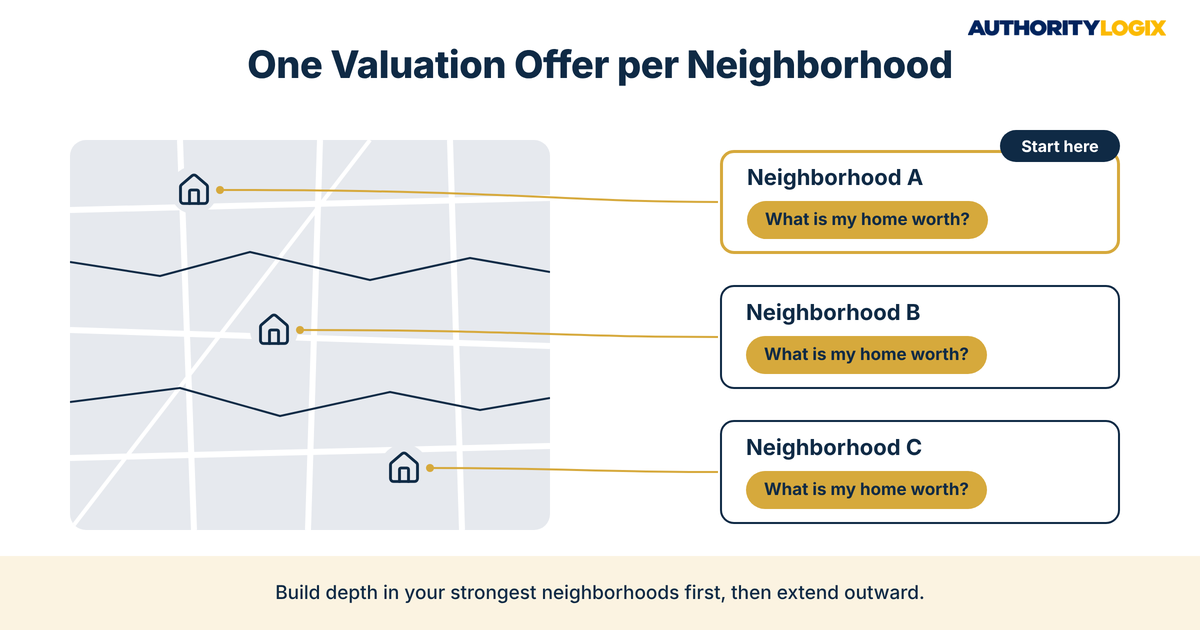
One valuation page tucked into a homepage captures whoever happens to find it. Scaling means placing the offer where owners already look for local pricing, which is on neighborhood pages that report recent sales, price movement and housing stock for each area you serve. A homeowner reading about sales on their own streets is the warmest audience a valuation tool will ever get.
Those pages should describe the market, never the people. Sale prices, days on market and building types belong on them; descriptions of who lives in an area or who it is “right for” do not.
Building Real Estate Home Valuation Tool Leads Into Every Neighborhood Page
Each neighborhood page should carry its own valuation offer, worded for that area, so it reads as local in a way a generic widget never can. Unbounce’s same 2021 real estate data found that search engines drove 60.0% of visitors to form-fill pages. That is why the ranking work in the local SEO playbook decides how many real estate home valuation tool leads each page can produce.
The rollout order matters. Start with the neighborhoods where you have the most closed sales and the deepest knowledge, then extend outward. Depth first and breadth second is how we build seller pipelines, because a thin page for every zip code produces neither rankings nor trust.
BKDSCR.com, the AuthorityLogix proof-of-concept in the NYC outer-borough DSCR niche, shows the same principle on the investor side. Its 7 interactive investor tools — including a DSCR Calculator, Cash Flow Analyzer and ROI Analyzer — sit inside 18 pillar pages and 48 SEO-optimized blog posts, and the platform generates inbound leads with zero paid ads. Tools capture leads when the content around them has earned the visit.
Mistakes That Turn a Valuation Tool Into a Spam Magnet
Most valuation tools that disappoint are not short on submissions. They are short on real owners, because the setup invites junk entries and treats every entry the same. These are the questions firm owners ask most often once the first batch of real estate home valuation tool leads comes in.
Why are so many valuation leads fake or unreachable?
Usually because the tool hands over the full estimate before asking for anything, so visitors type a fake email to close the box. Show an instant range first, then offer the broker review for verified contact details.
Should every valuation lead get a phone call right away?
No. Calling a “just curious” owner three times in a day is how a valuation tool earns a reputation as a trap. Let the timing answer decide who gets a call, and real estate home valuation tool leads that are ready will raise their hands.
Is a third-party valuation widget enough on its own?
A rented widget can collect contact details, but it rarely ranks and often routes the owner’s data through someone else’s branding. Building the tool, the pages around it and the follow-up as one owned system is what we do for real estate teams that are tired of renting their lead flow. Owned infrastructure keeps working after a subscription would have lapsed.
Do valuation tools create Fair Housing risk?
The tool itself is neutral, but the content around it is not automatically safe. Keep every page and email about prices, sales activity and the property, and have your broker review templates before they go live.
Where should a team start before building the tool?
Start with the related guides on lead magnets, neighborhood pages and local search, which sit together in the AuthorityLogix real estate resource library. Reading them first means the real estate home valuation tool leads that arrive land in a system ready for them.
Ready to turn your pricing expertise into a valuation system that captures seller leads, follows up on each owner’s timeline and books listing appointments?
What Seller Lead Volume Really Looks Like in the First Year
The honest picture of year one is uneven. The first months bring a trickle of real estate home valuation tool leads, mostly curious owners, while neighborhood pages earn rankings. As pages mature and follow-up tracks fill, owners who requested a value months ago start to call. No one can promise a number of listings, and anyone who does is guessing.
What does compound is the asset. Every neighborhood page, market update and answered question keeps producing real estate home valuation tool leads after it is published, which is the long-term logic in the growth playbook: visibility that keeps working while the agent is busy closing. Infrastructure compounds. Ads stop.
That is also why our approach starts with a firm’s existing expertise rather than a new software purchase. The CMAs and street-level reads your agents already carry are the raw material, and the system puts that knowledge in front of owners when they ask what their home is worth.
The honest answer is that most agents and brokers already know what homes in their market are worth better than any algorithm does. What is missing is the infrastructure that lets homeowners find that knowledge before they find someone else. Real estate home valuation tool leads are simply what happens when that infrastructure is in place.