


Key Takeaways
- DSCR lender educational hub content is a structured, interlinked library of investor resources, and it is how a specialist lender shows Google and AI search tools that it owns the subject.
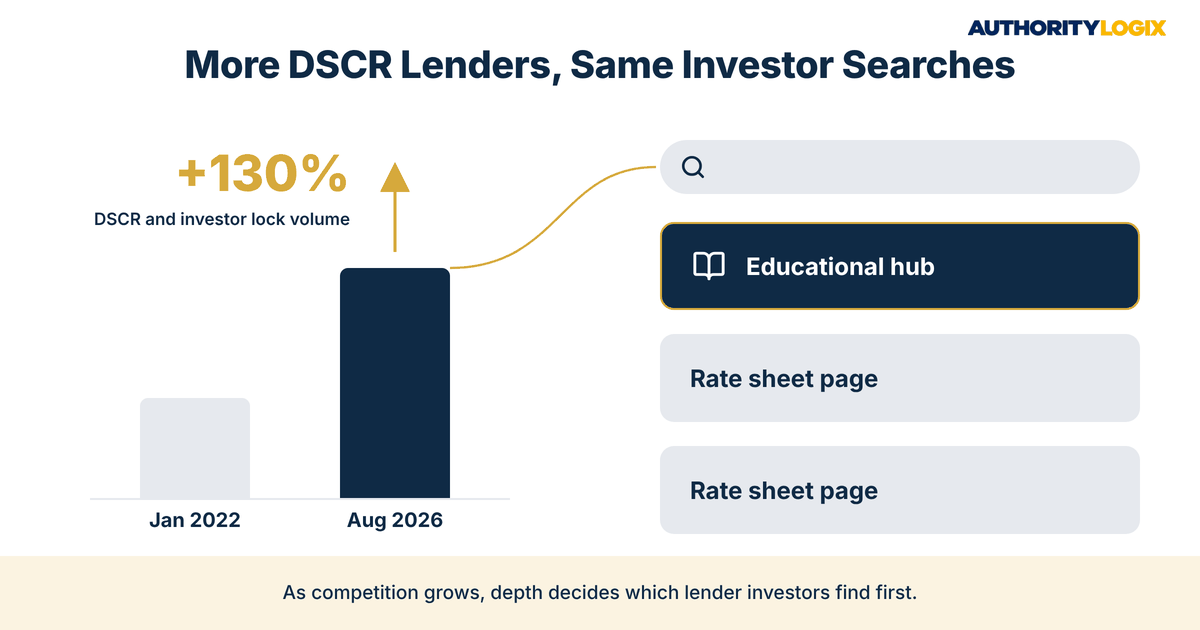
- Optimal Blue estimates reported by HousingWire show DSCR and investor loan lock volume grew 130% from January 2022 to August 2026, so more lenders now compete for the same investor searches.
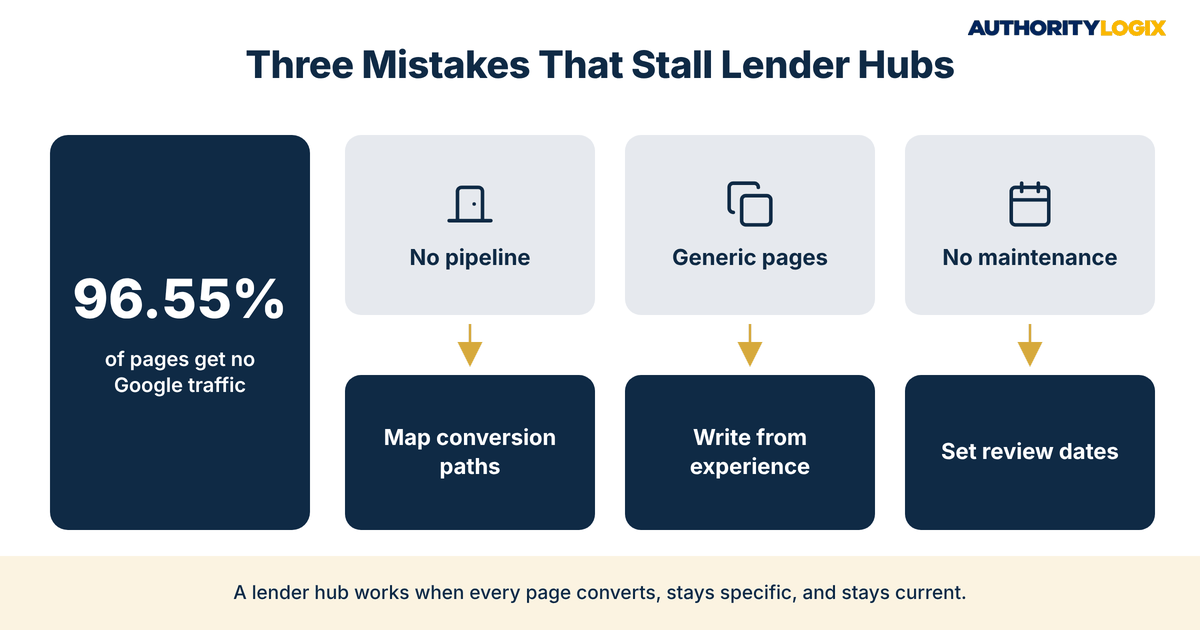
- Ahrefs found that 96.55% of pages get no organic traffic from Google. Publishing alone does not create visibility — depth and structure do.
- A DSCR content authority strategy builds depth before breadth: one complete topic cluster of DSCR lender educational hub content outperforms dozens of disconnected posts.
- DSCR lender educational hub content produces leads only when every page answers a real investor or broker question and connects to a clear next step.
- Generic lenders cannot copy this quickly, because real depth takes months of focused building.
Table of Contents
DSCR lender educational hub content is the difference between the lender investors find while researching a deal and the lender they never hear about. You have spent years underwriting rental properties and earning broker trust. Yet when an investor searches how a debt service coverage ratio is calculated, the results belong to someone else. That gap is not about expertise — it is about infrastructure, and it usually shows up in the same places as weak broker marketing: thin pages, no depth, and nothing worth sharing.
Credible but invisible is the pattern. Most DSCR lenders have a rate sheet page, a program page, and a contact form, but no library of answers proving they understand the investor’s world better than the national lender running ads on the same keywords. This article lays out how that library gets built and why it compounds.
Why DSCR Lender Educational Hub Content Builds Topical Authority
Topical authority is the working judgment search engines make about which site is the reliable source on a subject. As explained in Ahrefs research, it means a site is recognized as the go-to expert on a topic because it covers the full range of related queries, not one keyword at a time. For a DSCR lender, the subject is narrow and deep: coverage ratios, rental income documentation, short-term rental underwriting, entity vesting, prepayment structures, and portfolio refinancing.
The pressure to build that depth is rising. According to Optimal Blue estimates reported by HousingWire in September 2026, DSCR and investor loan lock volume grew 130% between January 2022 and August 2026. Between August 2022 and August 2026, investor and DSCR loans climbed from 22% to 35% of non-QM production. More lenders are chasing the same investors, and the lenders who show up during research are the ones with DSCR lender educational hub content worth finding.
This is where DSCR lender educational hub content earns its place. Search engines and AI answer tools favor sites that cover a subject completely over one-off posts. The search fundamentals in the SEO playbook apply directly here. A DSCR lender also holds an advantage most financial firms do not: a tightly defined audience asking a predictable set of questions.
Generic lenders — national shops that list DSCR as one product among twenty — rarely build for that audience. Their content is wide and shallow because their business is wide and shallow. A specialist that organizes its expertise into connected systems, the way the AuthorityLogix services hub organizes financial services visibility, gives Google and investors a clear reason to treat it as the authority. That organization is the asset, and DSCR lender educational hub content is how it becomes visible.
DSCR lender educational hub content is one layer of a larger publishing system. The Financial Services Content System lays out the full compliance-aware blueprint for lenders and advisors.
DSCR Content Authority Strategy: Depth Before Breadth
A DSCR content authority strategy starts with a decision most lenders skip: what DSCR lender educational hub content will cover completely before it covers anything else. Scattered topics dilute the signal. Ahrefs notes that a niche subject may need 15 to 20 well-connected pieces before a site is recognized as an authority, while broader subjects can need 50 or more. DSCR is a niche, which is good news, because the finish line is visible.
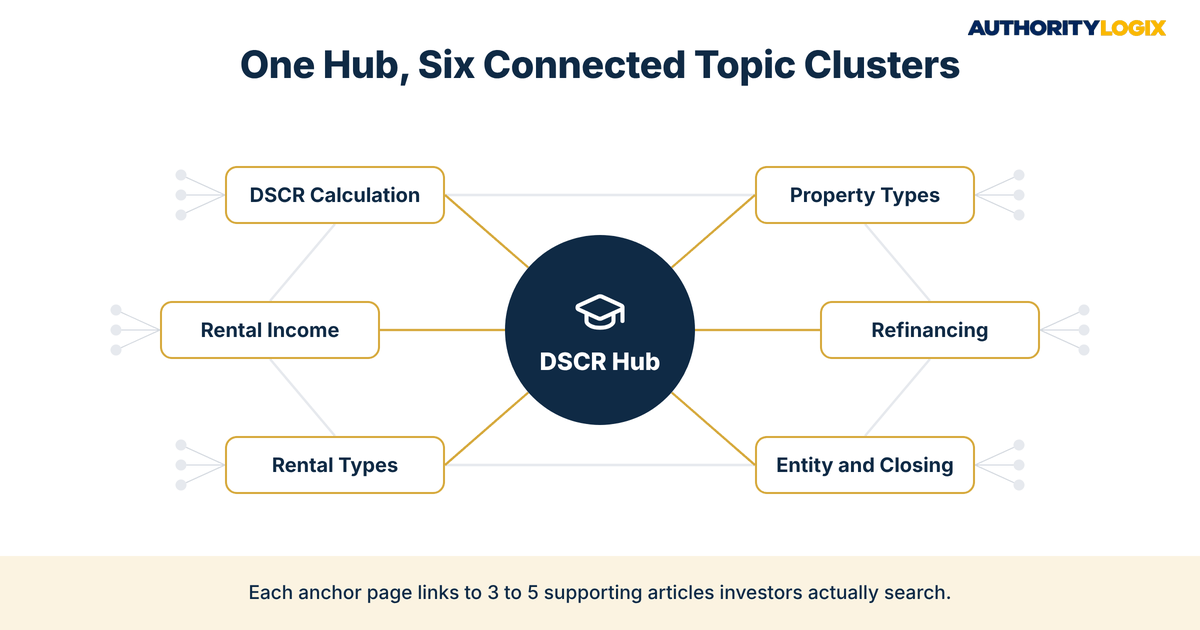
The structure that works is a hub-and-spoke model. Each core subject gets one comprehensive anchor page, and supporting articles go deeper on the sub-questions investors actually ask. Those anchor pages work the way pillar pages do across financial services: they define the topic, link down to every supporting piece, and collect the authority those pieces earn.
What separates a hub from a blog is organization. A blog is a chronological feed, and posts get buried under newer posts within weeks. A purpose-built educational hub is organized by topic, so an investor reading about short-term rental income sees the related guides right beside it. Google reads that same structure as evidence of depth, which is why DSCR lender educational hub content is planned as clusters rather than as a stream of posts.
Mapping the First DSCR Lender Educational Hub Content Cluster
The first cluster should match the questions investors ask most often before they apply. A practical starting set covers six subjects, each with one anchor page and three to five supporting articles:
- How the DSCR ratio is calculated and what lenders typically review
- Qualifying with rental income instead of personal tax returns
- Long-term, short-term, and mid-term rental considerations
- One-to-four unit and small multifamily property types
- Cash-out and portfolio refinancing scenarios
- LLC vesting, entity documentation, and closing timelines
That is roughly 24 to 36 pages, which sits right inside the range Ahrefs describes for niche authority. Built in sequence and linked correctly, that set of DSCR lender educational hub content becomes a library a generic lender would need months of focused work to match.
Building a DSCR Lender Resource Library Investors Return To
A DSCR lender resource library is the visible form of the hub — the place an investor bookmarks, a broker forwards to a client, and an AI tool cites when someone asks a DSCR question. The test is simple: would an experienced investor come back to it before the next deal.
BKDSCR.com shows what this looks like in a live market. Built as the AuthorityLogix proof-of-concept in the NYC outer-borough DSCR niche, it carries 18 pillar pages, 7 interactive investor tools including a DSCR Calculator and a Stress Test, and 48 SEO-optimized blog posts. It generates inbound leads with zero paid ads, and it was built in under 18 months. The full case study walks through how that platform was structured, page by page.
Tools matter more than most lenders expect. An investor who runs a deal through a calculator on your site spends time with your brand at the exact moment they are evaluating financing. A static article informs, but a tool turns DSCR lender educational hub content into a working session — and it gives the investor a reason to return before the next acquisition.
None of this holds together without a production process behind it. A DSCR lender resource library needs a publishing cadence, a compliance review step, a refresh schedule, and an internal linking standard. Those are content systems problems, not writing problems, and they are why most lender libraries stall after the first dozen posts.
The broader data supports that read. In the Content Marketing Institute’s B2B outlook for 2025, based on 980 respondents, 45% said their organization lacks a scalable model for creating content, and only 29% rated their strategy extremely or very effective. Lenders are not short on expertise. They are short on the system that turns expertise into DSCR lender educational hub content that is published, organized, and kept current.
Not sure how your DSCR lender educational hub content compares with the lenders ranking above you? The FS Authority Gap Assessment shows where your library is thin and what to build first.
DSCR Educational Content Depth That Generic Lenders Skip
DSCR educational content depth is where the specialist pulls away. A generic lender’s DSCR page is usually one short page: a definition, a minimum ratio, and a contact button. A specialist’s version explains the calculation with worked examples, shows how lenders commonly treat short-term rental income, and links to every related question. Same keyword, very different signal.
Depth also matters because DSCR topics fall under what Google’s Search Quality Rater Guidelines call Your Money or Your Life subjects — topics that can affect a reader’s financial well-being. For those topics, raters are told to weigh experience, expertise, authoritativeness, and trust heavily. A thin page from a lender with no visible expertise struggles under that standard. Detailed DSCR lender educational hub content written from real underwriting experience is exactly what those guidelines describe.
Experience is the piece generic lenders cannot fake. An underwriter who has reviewed hundreds of rental appraisals knows which questions investors get wrong, and that knowledge belongs on the page. The trust signals covered in the authority guide — named authors, credentials, real scenarios, transparent processes — become far more convincing when the page itself demonstrates that experience in detail.
That depth has to be written by someone who understands both lending and search. Investor-facing pages need accurate terminology, compliance-aware phrasing, and a structure built around how people actually search. Specialized finance content development exists for that reason, because general writers produce general pages.
The comparison below shows where the gap usually sits. Each row is a place where DSCR educational content depth turns into ranking signals and investor trust.
| Element | Typical Generic Lender DSCR Page | DSCR Lender Educational Hub Content |
|---|---|---|
| Coverage | One short product page | Anchor page plus 3 to 5 supporting articles per topic |
| DSCR calculation | Definition and a minimum ratio | Worked examples across property and rental types |
| Internal links | Points only to the contact form | Connects every page across the full topic cluster |
| Author expertise | No named author | Named lending professional with visible credentials |
| Investor tools | None | Calculators and stress tests tied to the articles |
| Freshness | Published once, rarely updated | Reviewed on a set refresh schedule |

Turning DSCR Lender Educational Hub Content Into Investor and Broker Leads
Traffic without a next step is a library with no front desk. DSCR lender educational hub content earns its keep when each page connects the reader to an action that fits their stage: a calculator for the investor still running numbers, a scenario checklist for the investor comparing lenders, and a direct consultation for the investor with a property under contract.
Those conversion points should be mapped before the pages are published, not bolted on later. Under a first-party lead system, every article becomes an entry point: the article answers the question, a related tool or download captures the contact, and a follow-up sequence keeps the lender present until the investor is ready. The CMI data points the same way — 74% of B2B marketers in that survey said their content generated demand or leads.
Why Brokers Use DSCR Lender Educational Hub Content Too
Brokers are the second audience. A broker deciding which lenders get the next deal wants evidence that the lender understands complex scenarios and explains them clearly. A deep library gives brokers something to forward to their own clients, which turns DSCR lender educational hub content into a referral asset that carries your name into conversations you are not part of.
Reach extends further when the content travels beyond your own domain. Syndicating key guides, earning coverage in investor publications, and adapting hub articles for LinkedIn all multiply the places an investor meets your expertise. Putting the hub in front of investors who have not found it yet is the job of authority distribution, and it works only when the hub underneath is worth visiting.
What DSCR Lenders Get Wrong About Educational Hub Content
Most lenders who start building DSCR lender educational hub content stop before it works. The mistakes are predictable, and each one has a structural fix.
Is a blog the same as a DSCR lender resource library?
No. A blog organizes posts by date, so older answers sink out of sight. A resource library organizes pages by topic and links them together, which is what tells search engines the site covers a subject completely.
How many pages of DSCR lender educational hub content does a lender need?
Ahrefs suggests a niche subject may need 15 to 20 well-connected pieces, with significant movement often taking 6 to 12 months. The connections matter as much as the count, because each linked page strengthens the others.
Mistake: treating the hub as a traffic project instead of a pipeline
A hub that ranks but never converts becomes an expensive reading room. Every page needs a defined path to a tool, a download, or a conversation. Connecting the library to structured lead generation is what turns readers into borrowers and brokers into repeat partners.
Mistake: publishing generic content written for every lender
If a page could appear on any lender’s site without edits, it adds nothing to your authority. Ahrefs found that 96.55% of pages get no organic traffic from Google at all. Building investor-specific depth from a lender’s own underwriting experience is what we do for financial firms, because that experience is the one asset a competitor cannot copy.
Mistake: building pages with no maintenance plan
DSCR content references program details, documentation requirements, and market conditions that change. A hub full of stale pages loses trust, so each page needs an owner and a review date from day one. Refresh cycles sit in the plan alongside the publishing schedule — that is part of how we build every library, not an afterthought.
Ready to build the educational hub DSCR investors return to before they borrow? We’ll plan and produce it around the questions they ask.
Why DSCR Lender Educational Hub Content Is the Moat Generic Lenders Cannot Cross
Depth is the moat. A national lender can outspend a specialist on ads, but it cannot quickly build DSCR lender educational hub content that reflects years of DSCR underwriting experience in a specific market. That gap tends to widen over time, which is why the growth playbook treats educational infrastructure as a long-term growth asset rather than a campaign.
Authority compounds. Every page you add strengthens the pages already published, every investor who uses a tool becomes a potential lead, and every broker who forwards a guide extends your reach. The reasoning behind why it works is the same reasoning behind every build in this library: infrastructure keeps producing long after the initial work is done.
The honest assessment is this: most DSCR lenders already have the expertise their investors are searching for. What they lack is DSCR lender educational hub content structured to put that expertise in front of investors at the moment of research. If you want help building it, you can work with us — but the first step is deciding to build depth before breadth.