


Key Takeaways
- Financial services pillar page strategy is the specific implementation of topic cluster architecture for mortgage companies, DSCR lenders, and financial advisory firms — each operating in a YMYL (Your Money, Your Life) environment where Google’s topical authority evaluation is more rigorous than for most industries. Sites with topic cluster architecture tend to show stronger search visibility than those without.
- A pillar page for financial services covers a broad program or planning topic comprehensively — 3,000–4,000 words — and links to 5–10 cluster articles that each address a specific scenario within that topic. The pillar ranks for competitive head terms; the cluster articles rank for long-tail scenario queries. Together they build the topical authority neither could achieve alone.
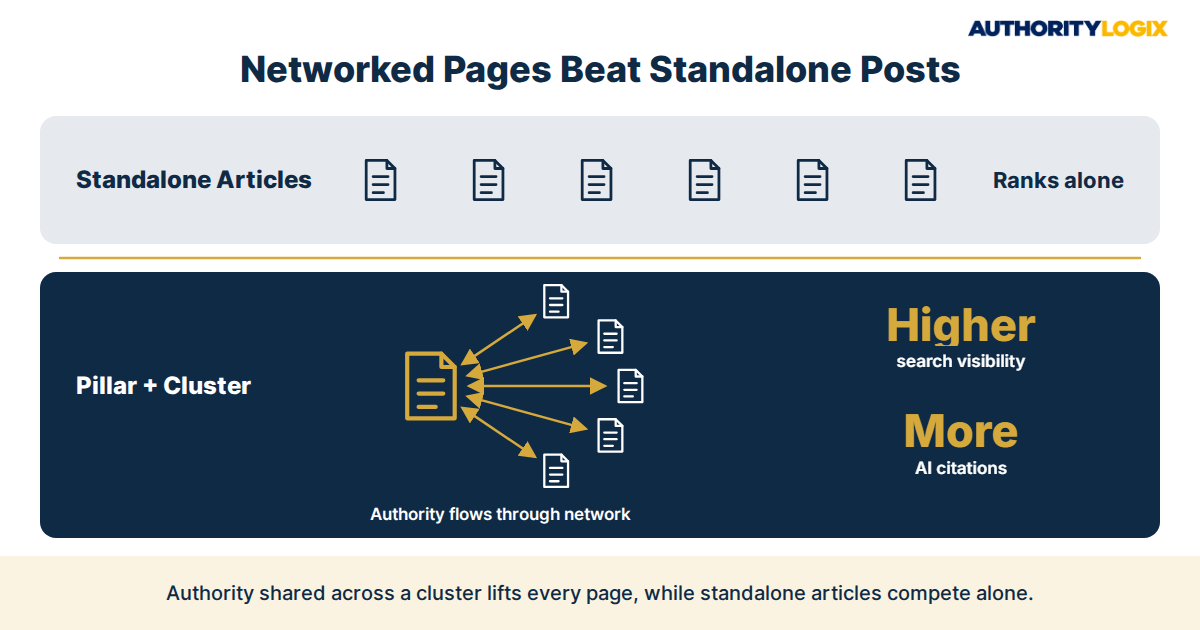
- Topic clusters tend to earn more AI citations than standalone posts, and brands with many interconnected pages on a topic tend to be cited more than single-article publishers. For financial services firms building visibility in AI search, cluster architecture is not optional — it is the structural prerequisite for AI citation eligibility.
- Internal linking is the mechanism that makes the pillar/cluster model work. Without bidirectional links connecting cluster articles to their pillar page, the cluster does not exist in Google’s site model — the pages are islands. With those links in place, PageRank flows through the network and every page in the cluster benefits from the authority earned by every other page.
- Anchor text in internal links is a semantic signal, not a decoration. Short, descriptive anchor text — “DSCR coverage ratio requirements,” “self-employed mortgage qualification” — tells Google what the linked page covers. Generic anchors (“click here,” “learn more”) waste the signal entirely.
- BKDSCR.com demonstrates the financial services pillar/cluster model at production scale: 18 pillar pages organized into 6 topic clusters, each with associated scenario cluster articles, all bidirectionally linked. The result is a site that ranks for competitive DSCR and NYC real estate head terms and dozens of long-tail scenario queries simultaneously — from the same content investment.
Table of Contents
Financial services pillar page strategy is the content architecture that converts a collection of articles into a topical authority platform. And for financial services firms operating in Google’s YMYL (Your Money, Your Life) content category, it is the architecture that determines whether a site ranks for anything competitive at all. Google’s evaluation of financial content applies a higher trust standard than most industries. It assesses expertise, experience, authoritativeness, and trustworthiness across an entire site’s topical footprint, not just on individual pages.
A mortgage company that publishes 30 unconnected articles on loosely related mortgage topics signals breadth without depth — the opposite of topical authority. A mortgage company that publishes 5 pillar pages each surrounded by 6 scenario cluster articles, all bidirectionally linked, signals deep expertise on 5 specific topics. Which is what earns rankings for competitive head terms. The SEO playbook covers the organic search strategy; this article covers the specific pillar/cluster architecture that financial services firms need to implement it.
The performance data on pillar page and topic cluster strategy is consistent and substantial. Sites implementing topic cluster architecture tend to show stronger search visibility than those without. Topic clusters tend to drive more organic traffic than unconnected content, and organizations that restructure around cluster architecture commonly report improved rankings across their targeted keywords.
And in 2026, the AI dimension has added further compounding. Brands with many interconnected pages on a topic tend to earn more AI citations than single-article publishers, and clustered content tends to be cited more often than standalone posts. For financial services firms building visibility in both Google and AI search, the pillar/cluster model is not a content marketing refinement — it is the foundational infrastructure.
The authority guide covers why published expertise is the primary trust signal for financial services firms competing for borrower and broker attention. This article covers the mechanics — how to build a pillar page, how to structure the cluster around it, how internal linking makes the architecture work, and how the system applies specifically to the audiences financial services firms target.
The complete content architecture framework — pillar page design, cluster structure, and publishing cadence — is in the Financial Services Content System.
Why Pillar Pages Work — and Why Standalone Articles Don’t
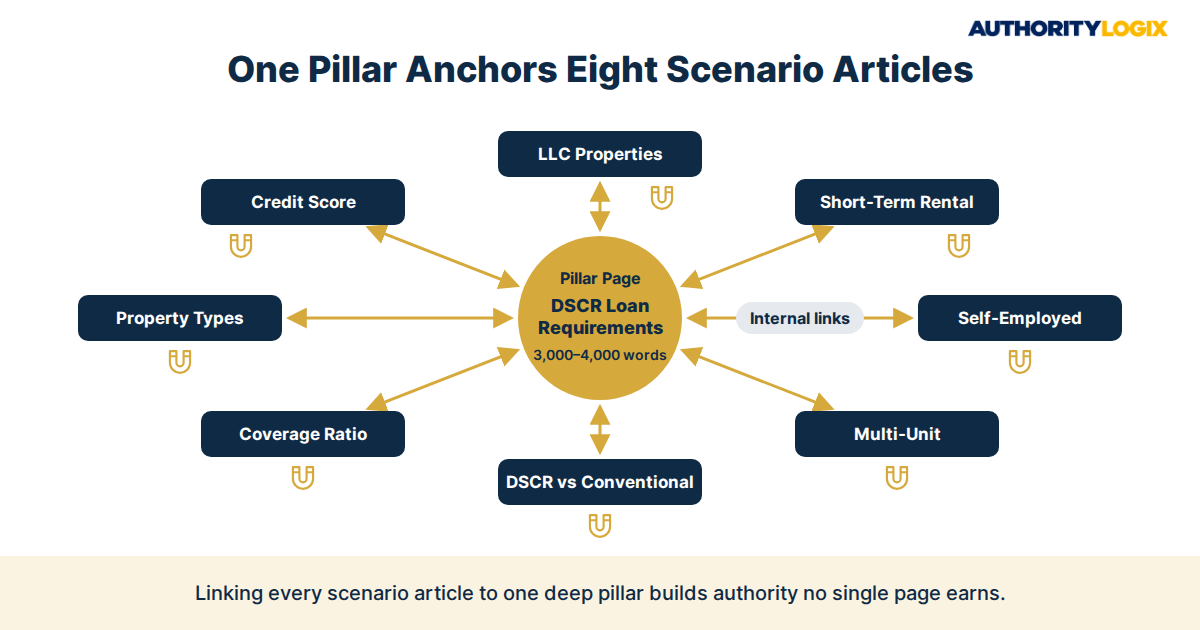
Google does not rank pages in isolation — it evaluates pages in the context of the site they belong to. A standalone article on “DSCR loan requirements” published on a site with no other DSCR content carries less authority than the same article on a site with a comprehensive DSCR pillar page and eight supporting cluster articles, all bidirectionally linked. The cluster signals topical depth; the standalone page signals a single data point.
Financial services firms that have been publishing blog posts on their loan programs for years without cluster architecture have been producing standalone data points. Articles that rank weakly, earn no authority from adjacent articles, and produce no compounding SEO value over time. The FS industry hub covers the economic picture of financial services digital authority — and the content architecture is the structural foundation that makes any authority accumulation possible.
The pillar page solves a problem that no single article can: it demonstrates that the firm knows everything worth knowing about a specific topic. A pillar page on DSCR loan requirements covers coverage ratio calculation, eligible property types, documentation requirements, qualification criteria for different borrower types. And the scenarios where DSCR outperforms conventional financing — comprehensively, at 3,000–4,000 words. It is the resource a borrower or broker would bookmark as their go-to reference on this topic.
That depth is what Google’s YMYL trust evaluation rewards. And that depth is what earns the head term ranking (“DSCR loan requirements”) that the individual cluster articles cannot compete for on their own. The credibility gap between firms with pillar pages and firms without them is the gap between firms whose content earns authority and firms whose content earns nothing despite the effort of publishing it.
Building a Financial Services Pillar Page: What It Must Cover
A financial services pillar page is not a long blog post. It is a permanent, comprehensive resource that the firm intends to maintain and update as programs and market conditions change. The distinction matters: a blog post is written for the moment, a pillar page is built for the long term. For a DSCR lender, the pillar page on DSCR loan requirements should be the page that answers every question a borrower or broker would bring to a first conversation about DSCR.
Comprehensively, in one place, with links to cluster articles that address each specific sub-question in greater depth. The search statistics on mortgage borrower behavior confirm that the majority of organic search intent in financial services is question-based and scenario-specific. The pillar page addresses the head term question, and the cluster articles address the scenario questions that follow from it.
The structural requirements for a financial services pillar page are specific. At 3,000–4,000 words, it covers the topic comprehensively without requiring trigger-term disclosures. Educational content that explains how programs work, what borrowers need to qualify, and how to evaluate program fit does not require Regulation Z advertising disclosures. The page must carry named authorship with credentials (NMLS ID for licensed professionals, CFP or CFA designation for advisors) to satisfy Google’s E-E-A-T evaluation for YMYL content.
It must cite authoritative external sources where statistics and claims appear. And it must include a Table of Contents to aid navigation and earn Table of Contents SERP features. The content systems that support pillar page production for financial services firms build all of these requirements into the pillar page template. So the structural compliance is built in rather than applied inconsistently at the review stage.
Designing the Topic Cluster: How Many Articles and Which Scenarios
A topic cluster for a financial services firm has one pillar page and 5–10 cluster articles. The pillar page covers the broad topic; the cluster articles each address one specific sub-question or scenario within that topic. The number of cluster articles is determined by the number of distinct, searchable scenarios within the pillar topic — not by an arbitrary target. A DSCR topic cluster might have 8 cluster articles. DSCR for LLC-titled properties, short-term rental DSCR, self-employed DSCR qualification, multi-unit property DSCR, DSCR vs conventional for investors, DSCR coverage ratio calculation, DSCR property type eligibility, and DSCR credit score requirements.
Each of these is a specific, searchable scenario that a borrower or broker would research separately. The E-E-A-T guide covers why each cluster article must also carry named authorship and credential attribution. The same YMYL trust standard applies to cluster articles as to pillar pages, and a cluster article that lacks these signals weakens rather than strengthens the cluster’s overall authority profile.
The cluster article for each scenario covers that scenario specifically, thoroughly, and with the scenario-matched lead magnet positioned inline to capture the visitor at peak relevance. A cluster article on DSCR for LLC-titled properties answers: how does LLC title affect DSCR qualification, what documentation is required for LLC-titled properties, what lenders look for in LLC financials, and how to structure the deal for maximum eligibility.
At 1,500–2,500 words, it is comprehensive enough to satisfy the scenario-level searcher but not so broad that it competes with the pillar page for the head term. The educational hub architecture that organizes this cluster at the site level ensures that every cluster article within a topic is contextually adjacent in the site navigation — making the topical relationship visible to both Google’s crawler and to the reader navigating between articles.
| Content Type | Word Count | Query Type | Internal Links |
|---|---|---|---|
| Pillar Page | 3,000–4,000 | Head term — broad topic query | Links to all cluster articles; links to related pillar pages |
| Cluster Article | 1,500–2,500 | Long-tail — specific scenario query | Links back to pillar; links to 1–3 related cluster articles |
| Lead Capture Page | 300–600 | Conversion — resource download or tool | Links to cluster article origin; links to pillar |
Internal Linking: The Mechanism That Activates the Pillar/Cluster Model
How Internal Linking Activates a Financial Services Pillar Page Strategy
Internal linking is not optional in a pillar/cluster architecture — it is the mechanism that makes the model work. Without it, the pillar page and cluster articles are isolated pages that happen to cover related topics. With it, they form a topical authority network where PageRank flows through every link in both directions, every page benefits from every other page’s authority earnings, and Google’s crawler can understand the topical relationship between pages from the link structure alone — without relying on human-authored descriptions. The website structure article covers the three-tier architecture in full; this section covers the internal linking rules that make that architecture function as a topical authority network.
Linking Rules for a Financial Services Pillar Page Strategy
The linking rules for a financial services pillar/cluster model are specific and non-negotiable. Every cluster article links back to its pillar page — this is the most important link in the model. The pillar page links to every cluster article in its cluster. Cluster articles that are contextually adjacent — DSCR for LLC-titled properties and DSCR for self-employed borrowers share significant topical overlap — link to each other.
The links are bidirectional wherever the topical relationship warrants it. No cluster article is published without the return link to its pillar page. The lead generation infrastructure that depends on cluster article traffic to fill the capture layer cannot function if cluster articles do not rank. And they do not rank if internal links do not connect them to the topical authority of the pillar.

Publishing the Cluster: Sequence and Cadence
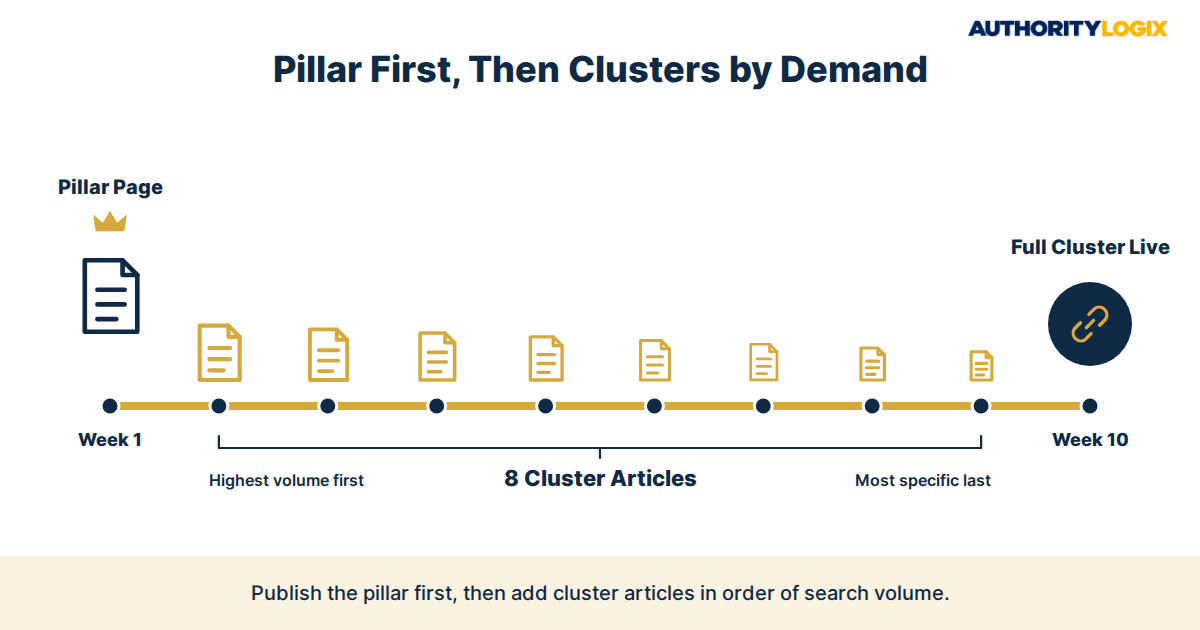
The sequence in which a financial services firm publishes its pillar/cluster architecture matters for both SEO and for the internal linking structure. The pillar page should be published first — before any cluster articles — because the cluster articles need to link back to a pillar page that already exists. A cluster article that links back to a pillar page that has not been published yet is linking to a 404 page. Once the pillar page is live, cluster articles should be published in order of search volume.
The scenario with the highest organic search demand first, working down to the most specific long-tail scenarios. This sequence ensures that the most traffic-generating cluster articles are live and linking to the pillar as early as possible in the topical authority build. The content calendar framework maps this sequence into a monthly publishing schedule. Ensuring that the pillar/cluster build follows the correct order and does not orphan cluster articles by publishing them before the pillar exists.
Cadence for cluster article publishing should be sustainable within the firm’s compliance review workflow. For most financial services firms, one cluster article per week is achievable without breaking the compliance review bottleneck. At that cadence, a full cluster of 8 articles is built over 8 weeks, and the pillar page plus full cluster is complete within 10 weeks of starting the build. The finance content infrastructure that produces these cluster articles on a consistent cadence — building topic-specific, scenario-accurate, credential-attributed content that passes compliance review at scale — is what makes the 10-week cluster build achievable rather than aspirational.
Not sure which topic clusters to build first for your financial services website? The FS Authority Gap Assessment maps the gaps and identifies the highest-priority clusters.
What Most Firms Get Wrong About Financial Services Pillar Page Strategy
They build the pillar page as a service page, not a resource
A service page explains what the firm offers. A pillar page explains how the topic works, what borrowers or clients need to know, and where to find more specific information. In the cluster articles linked from the pillar. A service page that describes “Our DSCR Loan Program” with bullet points on features and a contact form is not a pillar page.
It earns no traffic from borrowers who do not already know the firm, it builds no topical authority, and it provides no foundation for a cluster architecture. The lead magnet strategy for financial services firms positions the lead capture mechanism within educational content. Not on service pages — precisely because research-phase borrowers arrive through educational content, not through service descriptions.
They publish cluster articles before building the pillar
Cluster articles published before their pillar page are orphans — they have no anchor to link back to, no authority network to join, and no topical framework that tells Google they belong to a coherent cluster. The authority marketing framework for DSCR lenders is explicit about build sequence: pillar first, cluster articles second. A cluster article published before its pillar page is a standalone page that cannot participate in the authority network until the pillar is built and the return link is added. Every week the pillar does not exist is a week the cluster articles are accumulating no network authority.
They use generic anchor text on every internal link
Generic anchor text — “click here,” “learn more,” “read this article” — tells Google nothing about the topic of the linked page. Descriptive anchor text — “DSCR coverage ratio requirements,” “self-employed LLC borrower qualification,” “short-term rental DSCR program” — tells Google exactly what the linked page covers and reinforces the topical relationship between the linking and linked pages. The AI search dimension amplifies this: AI platforms extract topic signals from the same anchor text and linked page relationship that Google uses. Descriptive anchor text that is also used in AI responses makes a financial services firm’s content appear in AI citations for those exact terms. Generic anchor text contributes nothing to either Google rankings or AI citation eligibility.
Ready to build the pillar pages and topic clusters that make your firm’s expertise rank?
How BKDSCR.com Demonstrates a Financial Services Pillar Page Strategy
BKDSCR.com is AuthorityLogix’s proof-of-concept platform built from scratch in the NYC outer-borough DSCR real estate investor niche. The site operates 18 pillar pages organized into 6 topic clusters, each cluster with associated scenario cluster articles, all bidirectionally linked. The pillar pages cover the six major DSCR topic areas the site targets. DSCR loan requirements, NYC investment property financing, DSCR for self-employed borrowers, multi-unit property DSCR, short-term rental investment, and BRRRR strategy with DSCR financing. Each pillar page links to its cluster articles; each cluster article links back to its pillar and to contextually adjacent cluster articles within the same cluster.
The result is a content network that ranks for competitive DSCR head terms and dozens of long-tail scenario queries simultaneously. From the same content investment that most competing sites cannot replicate without building the same architecture. The growth playbook for financial services firms treats BKDSCR.com as the proof-of-work demonstration that the pillar/cluster model produces compounding organic authority in a live, competitive, CFPB-supervised lending market.
The authority distribution layer that amplifies BKDSCR.com’s content — LinkedIn posts linking to new cluster articles, email broadcasts to the subscriber list, syndication placing articles on platforms the target audience already reads — is what accelerates organic authority from the baseline. The content architecture is the foundation; distribution is what fills it with traffic faster than organic search ranking alone would produce.
Together, the pillar/cluster model and the distribution layer build the compounding inbound pipeline that financial services firms need to compete — organic traffic that grows without growing cost, from content that earns authority instead of renting it. When you’re ready to build, work with us is the starting point.