


Key Takeaways
- Financial advisor case study marketing turns problems your firm has already solved into documented, compliant proof that a skeptical prospect can evaluate before the first call.
- Wealthtender’s 2025 survey of households earning over $100,000 found 96% would still research an advisor even if that advisor came highly recommended, and only 36.4% consider testimonials on an advisor’s own website important.
- Demand Gen Report’s 2022 Content Preferences Survey found 40% of B2B buyers rank case studies among the most valuable research content, and 44% rate them most valuable in the middle of a decision.
- The SEC Marketing Rule permits testimonials and endorsements with required disclosures, and the SEC’s December 2025 Risk Alert shows examiners are checking whether those disclosures are clear and prominent.
- Strong financial advisor case study marketing documents the situation, the decision process, and the planning approach — never promised or implied investment results.
- Financial advisor case study marketing converts only when it sits inside a connected system of pages, search visibility, and distribution, not inside a forgotten PDF.
Table of Contents
Financial advisor case study marketing exists because skeptical prospects no longer take a firm’s word for anything. You may have twenty years of planning experience, a strong referral base, and clients who would vouch for you without hesitation. The prospect evaluating your firm tonight sees none of that unless it is documented somewhere they can find it. The AuthorityLogix case study on building an authority platform starts from the same premise: proof that cannot be seen does not exist for the buyer.
That gap is the core problem for most advisory firms. They are credible but invisible — respected inside their network and unreadable to anyone outside it. Financial advisor case study marketing closes the gap by showing, in concrete terms, what working with the firm looks like before a prospect commits an hour to a meeting.
Why Financial Advisor Case Study Marketing Converts Skeptical Prospects
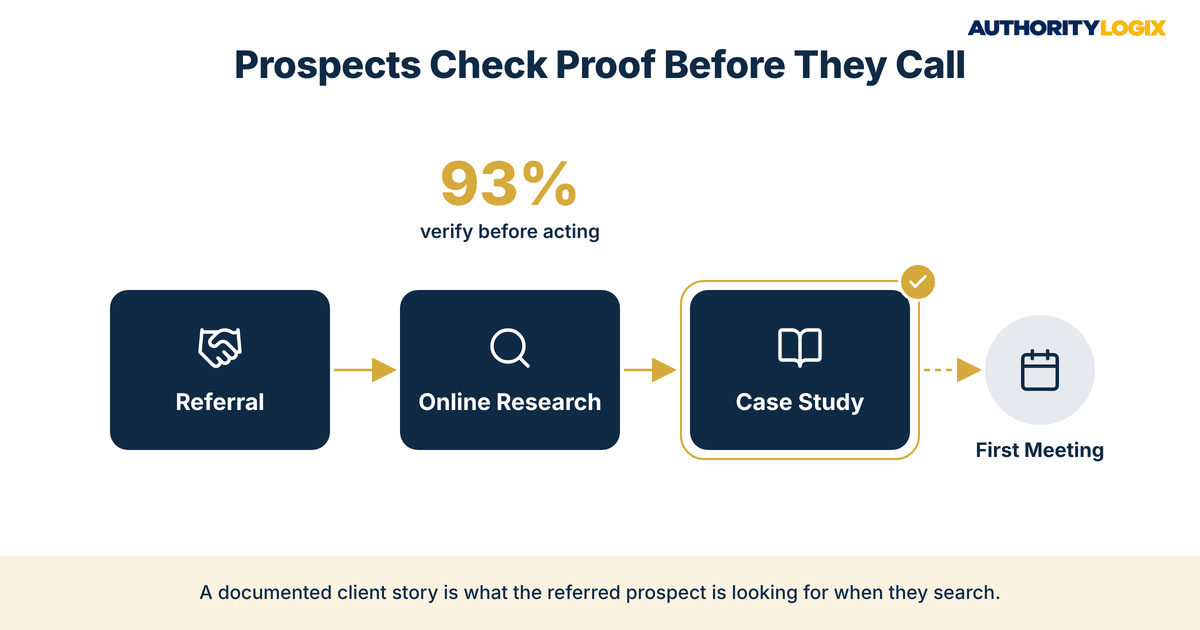
Prospects arrive skeptical for good reason. CFP Board’s 2025 survey on financial misinformation found 93% of Americans verify financial advice they find online before acting on it. The same instinct applies to choosing an advisor: people check, compare, and look for evidence that a firm has handled situations like theirs.
Wealthtender’s 2025 study of 500 U.S. households earning over $100,000 shows how deep that checking goes. Ninety-six percent said they would still research an advisor even if that advisor came highly recommended, and 97% plan to contact more than one advisor before hiring. Referrals start the conversation. Online evidence decides who gets the meeting.
Search is where that evidence gets found. Wealthtender found 49.8% of respondents plan to use search engines like Google to find an advisor, nearly the same share (49.2%) that plan to use referrals from professionals such as accountants or attorneys. Financial advisor case study marketing that ranks for the questions your prospects already search is doing the work the SEO playbook describes — meeting buyers at the moment they are deciding whom to trust.
Financial advisor case study marketing converts because it answers the question a skeptical prospect cannot ask directly: have you solved my problem before? A biography lists credentials. A services page lists offerings. A case study walks through a real situation, the questions it raised, and how the firm approached it. That format is part of every system on the services hub, because it turns expertise into something a stranger can evaluate.
The Financial Services Authority Guide shows where case studies fit inside the full system of trust signals that move skeptical prospects toward a first conversation.
RIA Case Study Content: What a Compliant Case Study Includes
Good RIA case study content is not a success story with the numbers filled in. It is a structured account of a client situation, written so a prospect in a similar position recognizes themselves in it. Most firms skip that structure, which is a large part of the credibility gap between what advisors know and what prospects can see.
The Four Parts of Financial Advisor Case Study Marketing That Works
Every effective case study in financial advisor case study marketing follows the same four-part structure. The structure matters more than the writing style, because it is what lets a prospect map the story onto their own life.
- The situation: who the client was in general terms — a business owner approaching a sale, a physician with concentrated stock, a widow inheriting a portfolio — with identifying details removed.
- The tension: the decision or risk they faced and why it was hard to resolve alone.
- The process: the questions the firm asked, the planning steps taken, and the trade-offs discussed.
- The outcome in plain terms: what changed for the client in clarity, structure, or confidence — described without performance claims or promises.
The fourth part is where most RIA case study content goes wrong. Firms want to show results, and results in this industry usually mean returns. A case study that leads with returns invites performance-advertising requirements, looks like cherry-picking, and asks the prospect to believe a number rather than understand a process.
Process-driven financial advisor case study marketing also lasts longer. A planning story about coordinating a business sale with an estate plan stays relevant for years, while a return figure dates the moment markets move. Grouped by situation inside an educational hub, these stories become a library prospects can browse by the problem they face.

Advisor Social Proof Strategy Under the SEC Marketing Rule
Any advisor social proof strategy for an SEC-registered firm runs through Rule 206(4)-1, the Marketing Rule. The SEC adopted it on December 22, 2020, replacing an advertising rule first adopted in 1961 that had effectively barred testimonials. Firms had to be in full compliance by November 4, 2022.
What the Marketing Rule Means for Financial Advisor Case Study Marketing
The rule permits testimonials and endorsements, but with conditions. Required disclosures include whether the person is a current client, whether they were compensated, and any material conflicts, and those disclosures must be clear and prominent. A case study that quotes a client describing their experience with your firm is a testimonial, so the same conditions apply.
Examiners are paying attention. The SEC Division of Examinations issued a Risk Alert on December 16, 2025 noting that advisers often failed to meet testimonial and endorsement conditions. Disclosures were sometimes buried in captions, hashtags, or hyperlinks, and some firms adopted policies they did not consistently apply. That is not legal advice — it is the reason every case study belongs in your compliance review workflow before it goes live.
The practical answer is an advisor social proof strategy built on documented process rather than client praise. A narrative written by the firm, describing a situation and an approach, keeps the focus on how you think. It sits naturally beside the educational content that already builds trust with prospects researching on their own. For most RIAs, this is the safest form of financial advisor case study marketing.
Consistency is the second requirement of financial advisor case study marketing. One compliant case study is a page. Twelve compliant case studies, reviewed through the same workflow and published on a schedule, are an asset. That repeatable process is what content systems are designed to deliver, so compliance review becomes a step rather than a bottleneck.
Financial Firm Proof Points That Replace Testimonials
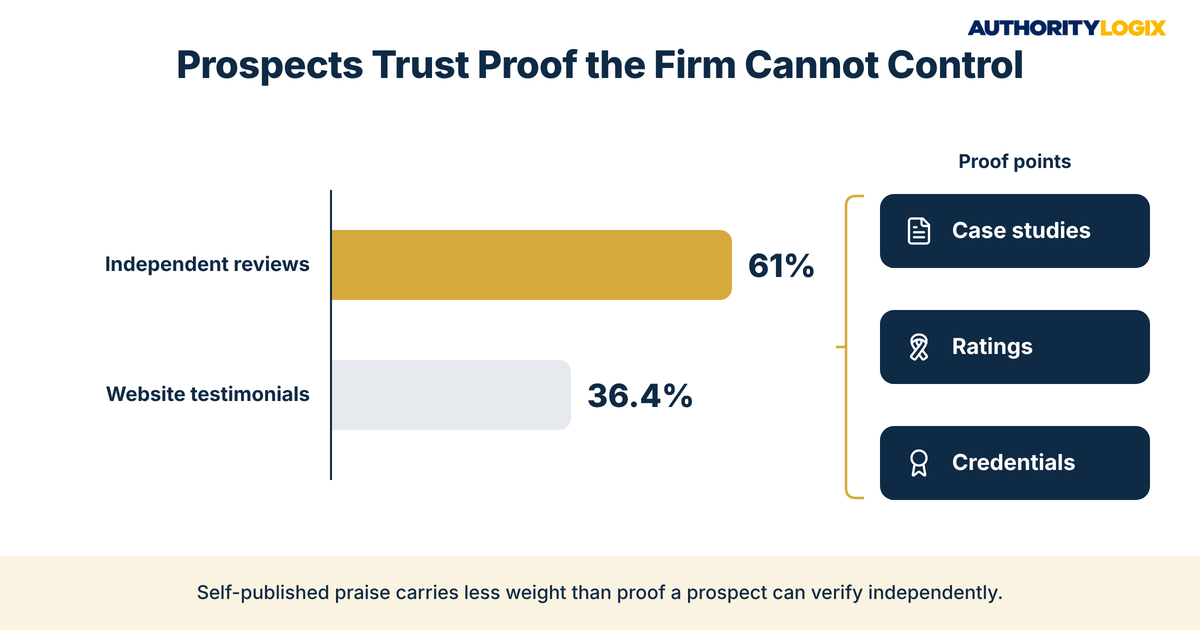
Testimonials are only one kind of proof, and they are not the kind prospects trust most. Wealthtender found that only 36.4% of affluent households consider testimonials on an advisor’s own website important, while about 61% consider positive reviews on independent websites essential. Prospects discount what a firm says about itself and look for proof the firm cannot easily control.
That makes financial firm proof points broader than quotes. In financial advisor case study marketing, credentials, published process, verifiable registration records, third-party recognition presented with required disclosures, and documented planning frameworks all count as proof. A content system built around those elements gives a prospect several independent reasons to believe the firm, rather than one quote they may not trust.
| Proof Point | What the Prospect Sees | Compliance Consideration |
|---|---|---|
| Process-driven case study | How the firm approaches a situation like theirs | Avoid performance claims; review as advertising |
| Client testimonial | A client’s own words about the experience | Client status, compensation, and conflicts disclosed clearly |
| Independent reviews | Feedback the firm does not control | Rule conditions apply if the firm adopts or promotes them |
| Third-party ratings and awards | Outside recognition | Methodology due diligence and required disclosures |
| Published planning framework | The firm’s method, stated openly | Educational framing, no implied outcomes |
| Credentials and registration records | Verifiable expertise | Keep listings consistent with official records |
Financial firm proof points work best when each one points to the next. A case study links to the planning framework it illustrates, and the framework links to the credentials behind it. Writing those connections in is the job of finance content development — turning scattered proof into a sequence a prospect can follow.
Research from Demand Gen Report supports the format behind financial advisor case study marketing. In its 2022 survey, case studies ranked among the top content types for research, tied with webinars at 40% and behind only research reports at 43%. Buyers trust content that shows work, not content that describes it.
Not sure where your firm stands on case studies and proof points? The FS Authority Gap Assessment shows which trust signals prospects can find today and which ones are missing.
Distributing Financial Advisor Case Study Marketing Where Prospects Decide
A case study nobody finds converts nobody. Most firms publish one on a page buried three clicks deep, mention it once in a newsletter, and wonder why it produced nothing. Distribution is where financial advisor case study marketing either compounds or stalls.
Prospects decide in several places: search results, LinkedIn, the firm’s own website, and increasingly AI assistants, which 25.4% of Wealthtender respondents plan to use to find an advisor. Each case study should be summarized for LinkedIn, linked from relevant planning pages, and syndicated where it can be cited. That is the work of authority distribution — placing proof wherever the decision is being made.
Turning One Case Study Into a Month of Proof
In financial advisor case study marketing, one well-built case study can supply weeks of publishing with purpose. The underlying story stays the same; the format changes for each channel. Every derivative still goes through compliance review, but the review is faster because the source has already been approved.
- A full case study page on the website, linked from the matching service or planning page.
- A LinkedIn article that walks through the tension and the process in the advisor’s own voice.
- Three short LinkedIn posts, each built on one question the case raised.
- A short email to prospects who downloaded a related guide.
- An FAQ entry that answers the core question the case study resolves.
Each derivative also needs a next step. A prospect who reads a case study and recognizes their own situation should find a clear path to a guide, an assessment, or a conversation. Connecting financial advisor case study marketing to that path is what a lead system does, so proof turns into a client conversation instead of a dead end.
What Advisory Firms Get Wrong About Case Studies
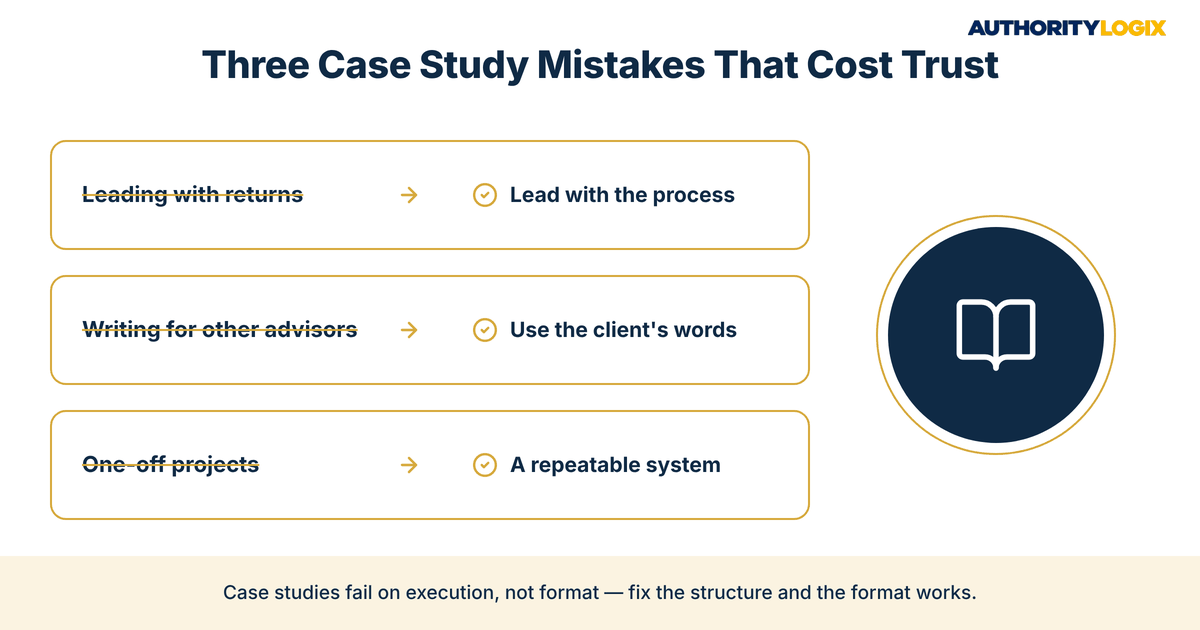
Most firms that try financial advisor case study marketing stop after two or three case studies, convinced the format does not work. The format usually works fine. The execution is where it breaks down, and the same mistakes appear across advisory firms of every size.
Mistake: Leading with investment returns
Return figures are the fastest way to turn a case study into a compliance problem and a credibility problem at the same time. They trigger performance-advertising requirements and invite comparison with every index a prospect can look up. Lead with the decision and the process, and let the prospect draw their own conclusions about competence.
Mistake: Writing the case study for other advisors
Industry shorthand reads as expertise to peers and as noise to prospects. A business owner does not search for “concentrated position diversification strategy.” They search for what to do with company stock before a sale. Financial advisor case study marketing should be written in the words your prospect uses.
Question: How many case studies does a firm need?
Start with one case study for each core client type you serve. A firm focused on business owners, physicians, and pre-retirees needs at least three, then adds more as new situations repeat. Tying each one to a lead generation path keeps the library growing for a reason rather than for volume.
Question: Can a case study use real client names?
Most firms anonymize, describing the client by situation rather than identity, and that is usually the safer default. If a client is quoted or named, testimonial conditions and disclosures apply, and your compliance team should approve the final version. Building that review into the workflow is part of what we do for financial firms.
Mistake: Treating case studies as one-off projects
A case study written once, published once, and never connected to anything else is a cost with no return. The firms that see results treat financial advisor case study marketing as a recurring program with a template, a review step, and a distribution plan. You can see that sequence in how we build authority platforms, where each piece is planned before it is written.
Want client stories that prove your value and stay compliant? We’ll turn your results into case studies prospects can trust.
Proof Beats Promises: The Honest Case for Financial Advisor Case Study Marketing
Financial advisor case study marketing is not a shortcut. It takes client situations worth documenting, a compliance workflow that does not stall, and the patience to build a library over months. The growth playbook treats it as one of the longest-lasting assets a firm can build, because a good case study keeps working long after it is published.
The approach is the one AuthorityLogix used on its own platform first. BKDSCR.com was built with 18 pillar pages, 7 investor tools, and 48 blog posts, with zero paid ads, to show expertise rather than claim it. That is why it works: documented proof, connected and distributed, gets found and evaluated without the founder in the room.
The honest assessment is that most advisory firms already have the stories. They have solved hard problems for real clients and earned the trust that came with it. What is missing is the financial advisor case study marketing structure that turns those stories into proof a skeptical prospect can find and believe. Authority compounds once that structure exists, and if you want help building it, work with us is where that conversation starts.