

Key Takeaways
- The financial services firm credibility gap is structural, not a content volume problem — experience alone does not create online visibility.
- Newer competitors rank ahead of 20-year veterans because they built visibility infrastructure first: optimized websites, educational content, and authority distribution systems.
- Veteran advisor online invisibility costs firms in referral ceiling, missed inbound leads, and market authority that never compounds.
- The mortgage company authority gap closes when firms build topical depth, consistent publishing, and a connected content system — not by posting more.
- High-growth financial firms prioritize thought leadership development at nearly twice the rate of no-growth peers, according to Hinge Marketing research.
- The lender online presence problem is solvable with a system build — infrastructure that compounds month over month rather than resetting with each campaign.
Table of Contents
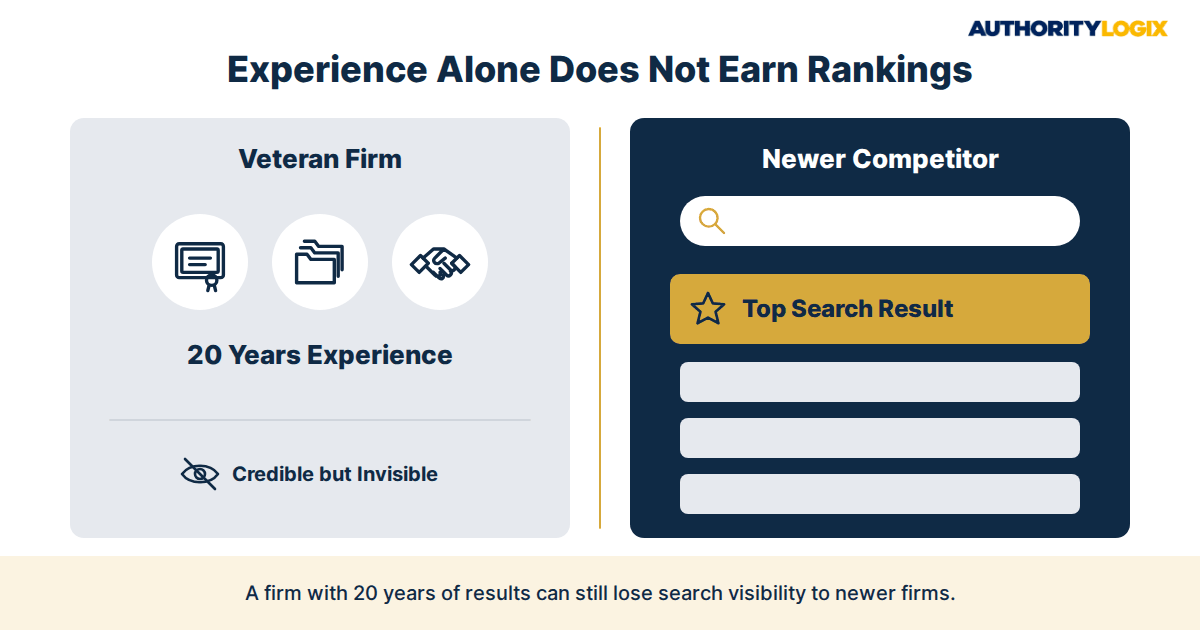
The financial services firm credibility gap is one of the most frustrating realities in this industry: a firm with two decades of deals, relationships, and proven results gets outranked online by a competitor who opened their doors three years ago. You have done the work. You have the track record. And yet when a potential borrower, broker, or client runs a search, the firm that shows up first is not you. It is someone who figured out the SEO playbook before you did. This article explains why that gap exists, what it costs firms that ignore it, and what the infrastructure fix actually looks like — without the agency pitch or the vague advice to post more consistently.
The authority guide for financial services firms covers the full credibility-building framework — trust signals, content infrastructure, and how it all converts.
What the Financial Services Firm Credibility Gap Actually Means
The financial services firm credibility gap is the distance between the expertise a firm has earned and the authority the market can actually see. A firm can have 20 years of closed loans, a spotless record, and deep relationships in their market — and still be completely invisible to anyone who does not already know them. That is the gap. And it is not a competence problem. It is a structural visibility problem.
The FS industry hub serves mortgage companies, DSCR lenders, financial advisors, and financial services firm principals who face this exact dynamic. The firms we work with are not inexperienced. They are credible but invisible — and that distinction matters, because the fix is not more hustle. It is the right infrastructure.
Most financial services marketers use content marketing as part of their strategy, yet relatively few describe their programs as mature or highly effective, according to industry reporting. The implication is clear: volume without infrastructure is just noise. What separates visible firms from invisible ones is not effort — it is architecture. The search statistics on how borrowers and clients find financial professionals online make that visibility cost concrete — the majority of decisions begin with a search before any firm interaction.
Why Newer Financial Services Firms Win Online Against Veteran Competitors
Newer firms do not win because they are better at the work. They win because they built visibility infrastructure before you did. A firm that launched five years ago and immediately invested in a structured content systems approach — publishing educational content, building topical authority, optimizing for search — now has years of compounding signal working in their favor. The gap between you and that firm grows every month they publish and you do not.
The Compounding Advantage of Early Infrastructure
An educational hub built three years ago has three years of organic backlinks, indexed pages, topical depth, and search ranking history behind it. Google rewards consistency and authority over time — particularly in YMYL (Your Money or Your Life) categories, which include all financial services content. A newer firm that built early has a compounding advantage a late-starting veteran cannot close overnight.
High-growth financial services firms prioritize thought leadership development at nearly twice the rate of no-growth peers — 31.4% versus 16.7%, according to Hinge Marketing’s study of 210 accounting and financial services firms. Those firms grew at 33.2% on average, 3.7 times faster than the average growth cohort in the same study. Expertise matters. But expertise distributed through visible infrastructure matters more.

The Structural Problem Behind Veteran Advisor Online Invisibility
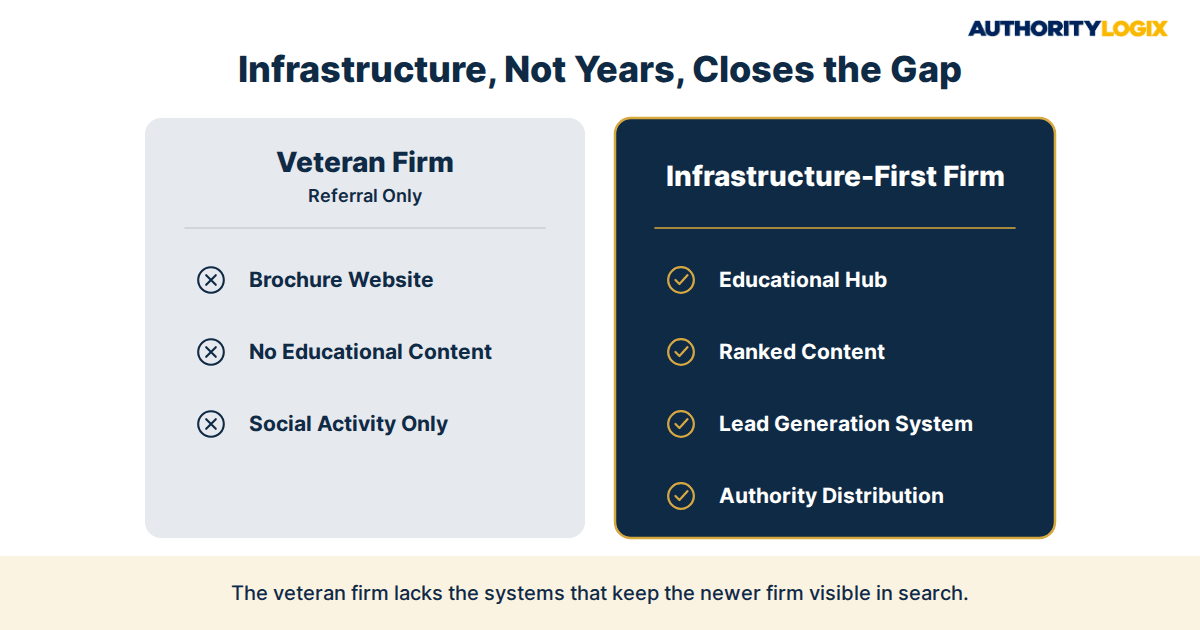
Veteran advisor online invisibility is not a mystery. It has a clear structural cause: the business was built on referrals, relationships, and reputation — all of which are real and valuable and completely invisible to search engines, AI platforms, and any client who finds you through a keyword rather than a handshake. Referral networks are ceilings, not foundations. The moment you hit your network’s natural limit, the pipeline stops growing. For lenders, the gap is most visible in local search — the local SEO system that drives Map Pack rankings is one of the first infrastructure pieces newer competitors build and most veteran firms have not.
A structured lead generation system solves this by building a first-party pipeline that does not depend on who you know. But most veteran firms have not built one because they have never needed to — until the referral network slows, a key relationship exits, or a younger competitor starts showing up in search results their clients are using.
Why Referral Dependence Amplifies the Gap
Firms that run entirely on referrals have no compounding visibility asset. Every new client requires a relationship to activate it. There is no infrastructure working in the background generating inbound leads, no finance content ranking for the questions their ideal clients are asking, no educational platform building trust before the first call. Visibility infrastructure is what closes the gap between what a firm knows and what the market can see.
Not sure where your firm stands on the credibility gap? The FS Authority Gap Assessment identifies exactly where your visibility infrastructure is missing.
What Visibility Infrastructure Looks Like for Financial Services Firms
Closing the mortgage company authority gap requires building systems, not publishing isolated content. Every piece has to connect to the next. A blog post that does not link to a service page, a lead magnet that does not feed a sequence, a social post that does not connect to a deeper resource — these are disconnected tactics, not infrastructure. Infrastructure is what happens when every piece has a job and every piece feeds the next. For mortgage lenders, that system starts with a fully optimized GBP setup — the local authority layer that feeds Map Pack rankings, review signals, and AI citation eligibility simultaneously.
| Infrastructure Layer | What It Does | What Visibility It Produces |
|---|---|---|
| Content System | Consistent educational publishing across your areas of expertise | Topical authority, organic search rankings, reader trust before the first call |
| Educational Hub | A permanent resource library organized by topic and buyer question | AI citation eligibility, long-tail keyword coverage, compounding traffic |
| Lead Generation System | Lead magnets, sequences, and pipelines that convert visitors into contacts | First-party pipeline that operates independently of referrals |
| Authority Distribution | Syndication of content across channels and platforms | Brand presence beyond your own website, broader market reach |
| Service Pages | Clearly defined pages for each service, location, and audience segment | Local search visibility, commercial keyword rankings, clear conversion paths |
A complete content system for a financial services firm typically includes consistent blog or article publishing, a structured resource library, pillar pages targeting high-value keywords, and a distribution mechanism that pushes content beyond the firm’s own website. None of these pieces work as well in isolation as they do when they are connected.
The lead generation layer is where visibility converts to pipeline. Without it, traffic stays anonymous. With it, the firm captures contact information from people who are already pre-qualified by the content they consumed to get there.
Authority distribution ensures that content does not stay trapped on the firm’s domain — it gets syndicated, cited, and found wherever the target audience is looking. Every piece has a job. Every piece feeds the next.

How Long It Actually Takes to Close the Credibility Gap
This is the question most firms ask and most agencies avoid answering directly. Financial services SEO operates on longer timelines than other categories because Google applies higher scrutiny to YMYL content — accuracy, authorship, and credibility signals all weigh more heavily here than on a retail site. Firms with an established web presence but under-invested content programs can realistically double organic traffic in 12 months. Firms starting from a thin content base should expect meaningful organic growth between months 7 and 12, with compounding results in year two. The timeline question also applies to AI search — the advisors building citation infrastructure now are the ones AI systems will be referencing 18 months from now.
The growth playbook for financial services firms maps out how authority compounds over time. The honest answer is that infrastructure built today is what generates inbound leads 6, 12, and 24 months from now. Content published today ranks and generates leads six months from now — which means the cost of waiting is higher than most firms realize when they are still comfortable with their referral pipeline.
The financial services industry continues to devote a meaningful share of its marketing budget to content. Firms that made that shift early are already compounding. The firms still debating the investment are falling further behind every quarter they wait.
Understanding what we do at AuthorityLogix starts with this timeline reality. We do not promise overnight rankings. We build infrastructure that compounds — and that compounding is what makes the investment durable rather than one more campaign that stops generating results the moment you stop paying for it.
What Most Veteran Financial Services Firms Get Wrong About Online Visibility
The Financial Services Firm Credibility Gap Mistakes Most Firms Make
Mistake 1: Treating the Website as a Brochure. Most financial services firms built their website as a digital business card — services listed, phone number visible, a few paragraphs about the team. That website does nothing in search. It has no educational depth, no topical authority, no inbound conversion mechanism. A brochure site is invisible to anyone who does not already know the firm name. And that is exactly the audience that matters most for growth. A brochure site also fails E-E-A-T evaluation — Google quality raters score financial websites on named authorship, credential display, and content depth, none of which a static services page provides.
Mistake 2: Conflating Activity With Infrastructure. Posting on LinkedIn three times a week is activity. It is not infrastructure. When the posting stops — and it always does — the visibility stops with it. Infrastructure compounds after you stop touching it. A well-built why us case study page, a resource library article ranking for a competitive keyword, a lead magnet driving weekly email list growth — these work without daily attention. Activity requires constant input. Infrastructure returns value after the build.
Mistake 3: Waiting for the Right Moment. The right moment to build visibility infrastructure is not when the referral pipeline slows. By that point, the firm is already behind — and catching up under revenue pressure is harder than building from a position of strength. The lender online presence problem is easier to solve before it becomes urgent. Every month of delay is a month of compounding advantage the competitor who started early accumulates.
Frequently Asked Questions About the Financial Services Credibility Gap
Why do newer advisors outrank established firms online?
Because newer firms often built visibility infrastructure from the start — optimized websites, educational content libraries, and search-focused publishing — while established firms relied on referrals and reputation. Google rewards topical authority and consistent publishing, not years in business.
How long does it take to close the mortgage company authority gap?
Firms with an existing web presence but thin content programs typically see meaningful organic growth between months 7 and 12 of a structured content program. The compounding effect accelerates in year two. Starting from nothing extends the timeline, but the compounding math still favors starting now over waiting.
Can a financial services firm build online authority without paid ads?
Yes. BKDSCR.com — built entirely on organic infrastructure — ranks for competitive DSCR and NYC real estate keywords, generates inbound leads, and has done so without paid advertising since launch. The build took 18 months and required consistent publishing, a structured educational hub, 18 pillar pages, and a full authority distribution system. Zero paid ads. The model is replicable. Learn more about our build process for a full breakdown of the system.
What is the first step for a veteran firm trying to close the credibility gap?
A visibility audit that maps where your firm currently ranks, which keywords your ideal clients are searching, and where your content infrastructure is missing. That audit identifies the highest-priority gaps — usually the website architecture, the absence of educational content, and the lack of a lead capture mechanism — and sequences the build from there.
Ready to close the credibility gap that keeps your veteran firm invisible online?
The Infrastructure That Closes the Financial Services Firm Credibility Gap
The honest answer is that most financial services professionals reading this already have the expertise. The credibility is there. The track record is real. The missing piece is the infrastructure that makes the market see it — a content system that builds topical authority month over month, an educational hub that captures search traffic before the first conversation, a lead generation layer that converts anonymous visitors into identifiable prospects.
Credible but invisible is the condition. The visibility system is the fix. If you are a veteran firm watching newer competitors lead in search results you belong in, the gap is structural — and structural problems have structural solutions.
The next step is to understand exactly where the gap is widest for your firm. The FS Authority Gap Assessment maps your current visibility position against the five infrastructure layers that close it. If your firm is ready to move from referral dependence to a compounding inbound system, work with us is the place to start that conversation.