


Key Takeaways
- Financial advisor lead qualification works best before the first call — your website and content should do most of the filtering, not your calendar.
- The Kitces Research 2026 marketing study puts the median advisor client acquisition cost at $2,551, so every unqualified meeting carries a real price.
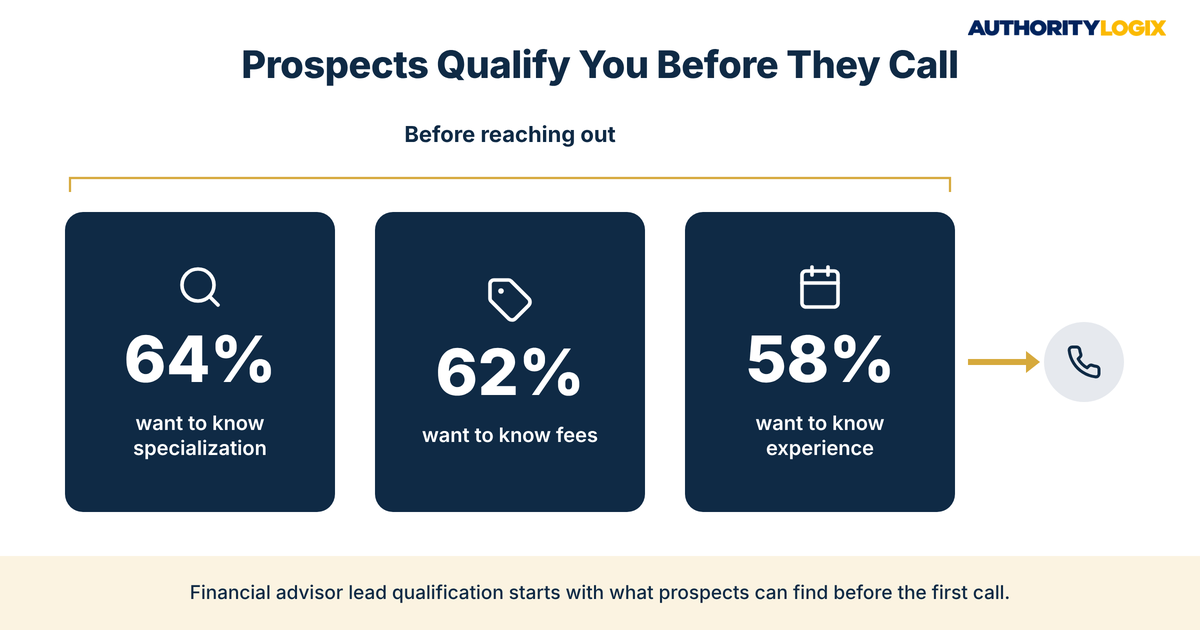
- Prospects are already screening you: 64% want to know an advisor’s specialization and 62% want to know fees before reaching out, according to Wealthtender’s August 2025 study of $100K+ households.
- RIA qualified lead generation depends on visible signals — a named niche, published minimums, and intent-based actions — not on raw lead volume.
- Kitces found niche practices pay $0.06 in referral marketing cost per dollar of new revenue versus $0.23 without a niche, which is advisor ideal client attraction in measurable form.
- Financial advisor lead qualification is a system: content that filters, a website that qualifies, and a compliant scoring process that routes the right prospects to you.
Table of Contents
Financial advisor lead qualification is the problem most advisory firms only notice after their calendar fills with the wrong people. You have spent years building real expertise, a defined planning process, and a client base that trusts you — yet the inquiries that do arrive are often too small, too early, or simply shopping for a free second opinion. The fix is rarely more leads. It is a system that tells the right prospects they belong and quietly tells the wrong ones they do not.
Financial advisor lead qualification starts long before a discovery call. The pages a prospect reads, the lead magnets they choose to download, and the questions your website asks all shape who raises a hand. This article walks through where qualification actually happens and how to build it into infrastructure you own.
Why Financial Advisor Lead Qualification Starts Before the First Call
Most advisors treat financial advisor lead qualification as a conversation: a 30-minute intro call about assets, goals, and timeline. By then, the expensive part has already happened. In the Kitces Research 2026 marketing study of 506 advisors, the median client acquisition cost was $2,551, down from $3,800 in 2024 — and every meeting with a prospect who was never a fit adds time to that number without adding a client.
Prospects are qualifying you at the same time. Wealthtender’s August 2025 study found that before reaching out, 64% of affluent investors want to know an advisor’s areas of specialization, 62% want to know the fee structure, and 58% want to know years of experience. Your job is to make sure that homework leads to a clear yes or a clear no.
That is why financial advisor lead qualification is really a visibility question. If your specialization, fees, and process are hard to find, the serious prospect moves on and the casual one books a call anyway. Trust signals do much of the sorting, a point the authority guide develops in detail, because a prospect who already believes you are the right specialist arrives at the first meeting pre-qualified.
What Financial Advisor Lead Qualification Actually Measures
Strip away the jargon and financial advisor lead qualification answers four questions. Is this person a fit for the clients you serve, do they have a need you solve, are they ready to act in a reasonable timeframe, and can they engage at your fee level? For an advisory firm, fit and readiness matter more than a raw asset number.
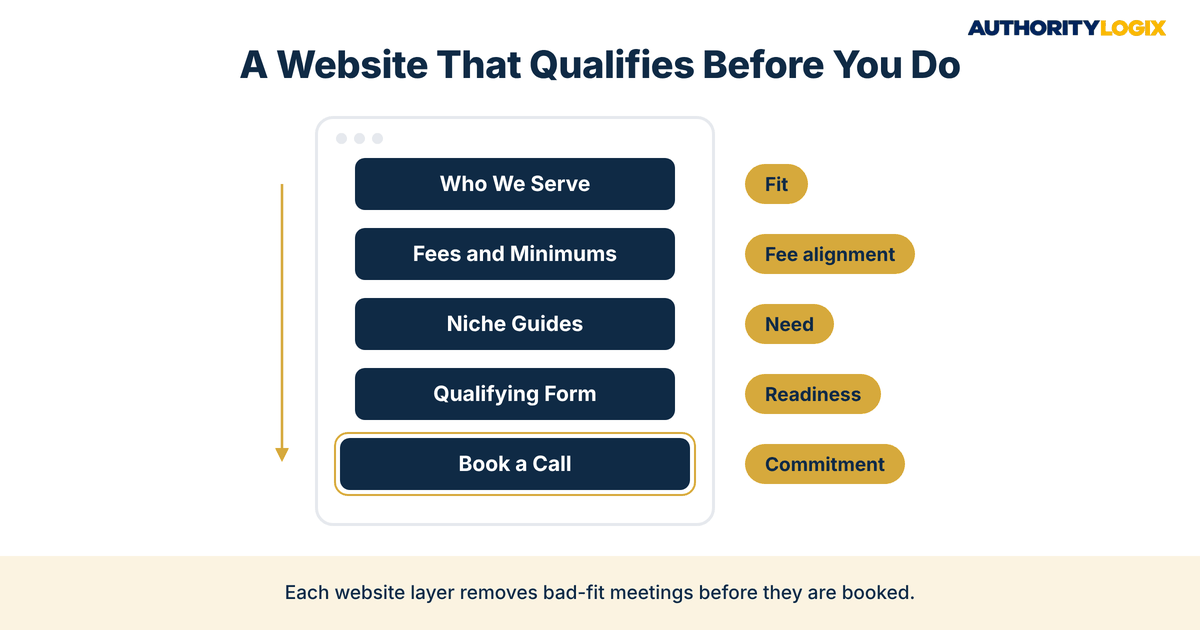
Each of those questions can be answered partly by infrastructure before a human gets involved. Fit is signaled by your niche pages, need by the content a prospect consumes, readiness by the action they take, and fee alignment by what you publish about minimums. Every system on the AuthorityLogix services hub maps to one of those jobs, and none of them works well in isolation.
The Financial Services Lead Generation System covers the full first-party pipeline behind financial advisor lead qualification, from the first page view to the booked meeting.
RIA Qualified Lead Generation: Signals That Separate Buyers From Browsers
RIA qualified lead generation is not about collecting more contact records. It is about reading the signals a prospect gives off before they ever speak with you. Some signals are explicit, such as a completed form that answers a question about investable assets. Others are behavioral, such as which pages someone reads, how often they return, and whether they open what you send.
B2B research shows how far buyers go on their own. Coverage of 6sense’s 2024 Buyer Experience Report in Demand Gen Report found that buyers are nearly 70% through their purchasing process before they engage a seller, initiate first contact 80% of the time, and already have a preferred vendor 81% of the time. Wealth management is not enterprise software, but financial advisor lead qualification follows the same pattern: most of the decision is made before a prospect reaches out.
Buyer Signals Worth Tracking in RIA Qualified Lead Generation
The signals below separate prospects who are moving toward a decision from those who are still browsing. Together, they show who deserves a fast, personal response.
- Return visits to service, fee, or process pages within a short window
- A download of a planning guide tied to a specific life event, such as retirement or a business sale
- A form submission that answers an asset range or situation question honestly
- A click on a booking link after reading an article end to end
- A reply to a follow-up email with a specific question about their situation
Browser signals look different: a single visit to a market commentary page or a free-tool download with no follow-up activity. Each group needs a different path. Browsers belong in an email nurture sequence that keeps educating them until their own timing changes, while buyers deserve a same-day reply from a person.
The richest financial advisor lead qualification signals come from education. A prospect who reads three articles on retirement income planning for business owners is telling you exactly who they are. Organizing that material inside an educational hub makes those reading paths visible, which turns content into a qualification tool rather than a library nobody tracks.

Advisor Ideal Client Attraction Through Content That Filters
Advisor ideal client attraction starts with a decision most firms avoid: writing down who you are not for. Generalist content attracts generalist inquiries. When every article speaks to everyone with money to invest, the young saver with a small 401(k) and the business owner preparing an eight-figure exit read the same page and book the same call.
The Kitces data puts a number on focus. Practices with a clear niche showed a client referral revenue acquisition cost of $0.06 per dollar of new revenue versus $0.23 for practices without one. Clearly articulating an ideal client profile was associated with an additional 0.7 percentage points of client growth.
Content built for financial advisor lead qualification names the client in the headline, describes their situation in their own words, and states what the engagement looks like. A page written for physicians five years from retirement will not appeal to a 25-year-old saver, and that is the point. Each filtering page then needs a defined next step, because a lead funnel without a qualifying stage simply moves the wrong people faster.
Consistency matters as much as focus. Publishing that depth around a single ideal client requires content systems that plan topics by client stage, keep compliance review in the workflow, and make sure every piece points somewhere. Volume without infrastructure is just noise.
This is where financial advisor lead qualification and content planning become the same job. If your editorial plan lists topics by keyword alone, it will attract whoever searches those words. If it lists topics by the questions your ideal client asks at each stage, it attracts that client and filters out most of everyone else.
Not sure where your firm stands on financial advisor lead qualification? The assessment shows which visibility gaps are letting unqualified prospects through.
Financial Firm Prospect Qualification Built Into the Website
Financial firm prospect qualification works best when the website does it quietly. A prospect should be able to learn who you serve, how you charge, what the process looks like, and what happens after they reach out — without asking. Every one of those answers removes a bad-fit meeting from your calendar before it is booked.
Visibility comes first, because a qualifying website no one finds qualifies no one. The Wealthtender research found that 50% of affluent investors plan to use search engines to find an advisor and 25% plan to use AI tools such as ChatGPT or Gemini. The structure that earns those rankings, from niche pages to topical clusters, is mapped out in the SEO playbook for financial firms, and it doubles as the structure that qualifies.
Then the pages themselves have to handle financial advisor lead qualification. That means plain-language fee and minimum disclosures, a who-we-work-with page that names specific client situations, and process pages that explain what the first 90 days look like. Writing that material accurately for a regulated audience is specialized finance content work, because the same page has to persuade, filter, and stay inside compliance lines.
Website Elements That Carry Financial Advisor Lead Qualification
The table below shows how common website elements contribute to qualification and what happens when each one is missing. The value comes from having all of them work together so a prospect reaches the booking page already filtered.
| Website Element | Role in Financial Advisor Lead Qualification | Without It |
|---|---|---|
| Ideal client page | Names the situations you serve and the ones you do not | Every visitor assumes they are a fit |
| Fee and minimum disclosure | Sets financial expectations before contact | Fee conversations happen on the first call |
| Niche content cluster | Attracts prospects with a specific, defined need | Generic traffic and generic inquiries |
| Qualifying intake form | Captures asset range, situation, and timeline | Calendar fills with unscreened meetings |
| Booking page with pre-call questions | Confirms readiness and prepares the meeting | Discovery calls repeat the same basics |
Kitces also found that predominantly AUM-based firms above $250,000 in revenue typically hold minimums around $500,000. Publishing your number, or at least a range, is the fastest filter most firms skip. Prospects below it self-select out, and prospects above it arrive knowing they belong.
Scoring and Routing Financial Advisor Lead Qualification Without Losing Compliance
Once signals are visible, financial advisor lead qualification needs a simple scoring model. A points system that weighs fit (asset range, situation, location), intent (pages read, tools used, return visits), and readiness (booking clicks, direct questions) is enough to sort inquiries into three groups: book now, nurture, and refer out.
The broader marketing world is making the same shift. Demand Gen Report’s 2025 Demand Generation Benchmark Survey, as reported by DesignRush, found that 55% of B2B marketers named improving MQL-to-opportunity conversion as a top-three goal, and 31% wanted to move away from lead volume toward higher-quality leads. Advisory firms face the same trade-off with smaller numbers, which makes every misrouted prospect more expensive.
Compliance has to be built into the routing, not added afterward. The SEC Marketing Rule governs how registered investment advisers use testimonials, endorsements, and performance information, and FINRA Rule 2210 governs communications with the public for broker-dealer firms. Any automated follow-up a lead receives is a communication, so it belongs inside the same review workflow as the rest of your content system, with approved templates and a record of what was sent.
Routing also covers the prospects you do not take. A respectful referral elsewhere protects your reputation, and many of those people will remember you later. Over time, the content you syndicate through authority distribution keeps your name in front of them, so a poor fit today can become a qualified inquiry later.
What Advisors Get Wrong About Financial Advisor Lead Qualification
The mistakes are usually about sequence, and they show up across firm sizes. These are the questions and misreads that come up most often when advisors start tightening financial advisor lead qualification.
Are more leads always better?
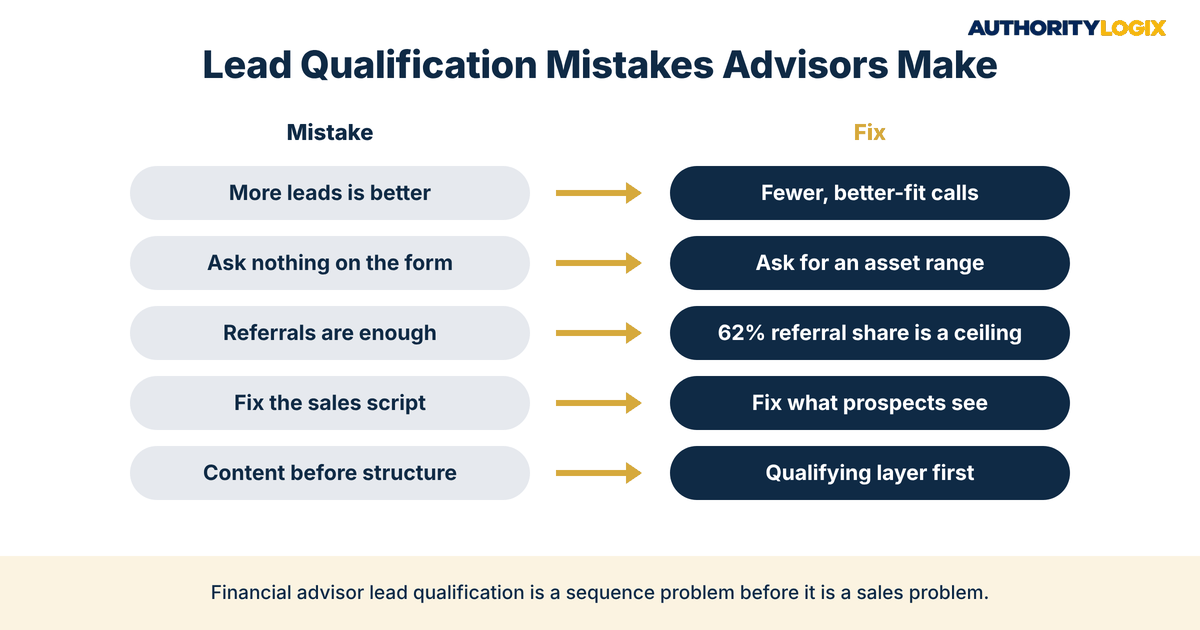
No. More unscreened inquiries usually means more wasted meetings. The goal of financial advisor lead qualification is fewer first calls that convert at a higher rate, not a fuller calendar.
Should we ask about assets on the first form?
Asking for a range, rather than an exact figure, is usually enough to filter without putting off serious prospects. The question works best inside broader lead generation infrastructure where the prospect has already read your fee page, so it feels expected rather than intrusive.
Can referrals replace a qualification system?
Referrals pre-qualify better than almost any other channel, which is why Kitces found the typical practice gets 62% of new clients from them. The risk is dependence: high-growth practices in the same study drew only about one-third of new client revenue from referrals, compared with 80% for other firms. Your referral network is a ceiling, not a foundation.
Is lead qualification just a sales process problem?
Treating it that way is the most common mistake. A better script on the intro call cannot fix a website that attracts the wrong people, which is why what we do starts with an audit of what prospects see before they ever contact the firm.
How long does a qualification system take to build?
The core pieces — an ideal client page, fee disclosure, a qualifying form, and a short nurture sequence — can usually be in place within a few months. Niche content takes longer to compound. That order is deliberate in how we build client systems, with the qualifying website layer coming before content volume.
Want prospects who arrive already qualified? We’ll build the pages and content that answer the screening questions before the first call.
Fewer Leads, Better Clients: The Honest Case for Financial Advisor Lead Qualification
Financial advisor lead qualification will never feel as exciting as a spike in inquiries. It shows up as quieter weeks with better meetings, more first calls that turn into clients, and less time explaining your fees to people who were never going to pay them. Over a longer arc, the growth playbook for financial firms shows how that focus becomes a practice that grows without adding hours.
The reason it holds up is structural. Infrastructure you own keeps filtering after you stop paying for attention, and every page, form, and email has a specific job. That is why it works for advisors who already have the expertise: the credibility was always there, and the system finally lets the right prospects see it.
The honest answer is that most advisors do not have a lead problem. They have a qualification problem hiding inside a visibility problem, and both are solved by the same infrastructure. If you want that system built around your ideal client, you can work with us to map it out, starting with who you actually want to serve.