


Key Takeaways
- Most financial services websites let the large majority of visitors leave without converting — not because the firm lacks credibility, but because there is no lead capture mechanism positioned to exchange immediate value for contact information before the visitor leaves.
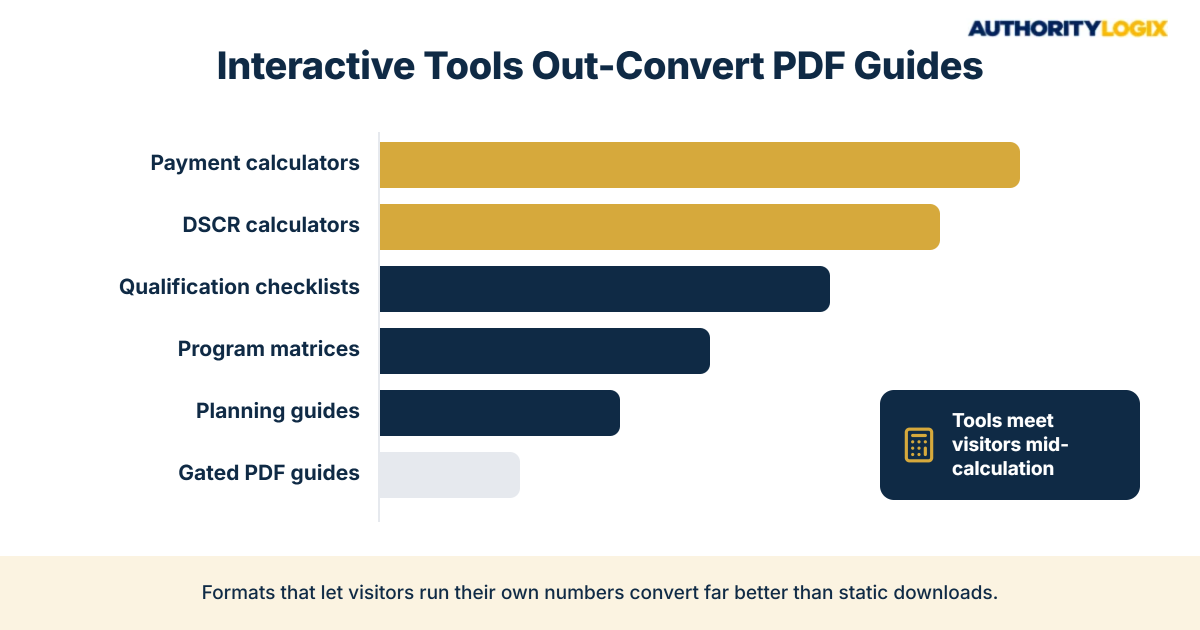
- Interactive tools — DSCR calculators, affordability estimators, qualification checklists — tend to convert at meaningfully higher rates for mortgage and financial services audiences than gated PDF guides.
- Financial services lead magnet strategy is not about giving away generic content. The magnets that convert are scenario-specific: they solve the exact problem the visitor is researching at the moment they arrive, not a general problem the firm thinks they might have.
- A lead magnet without a follow-up sequence is a download, not a lead. The firms converting captured contacts into booked calls have an email nurture sequence that delivers additional educational content tied to the magnet the prospect downloaded.
- Email marketing is among the strongest channels for converting financial services B2B leads — which is why the email list built from lead magnet captures is the most valuable marketing asset a financial firm owns.
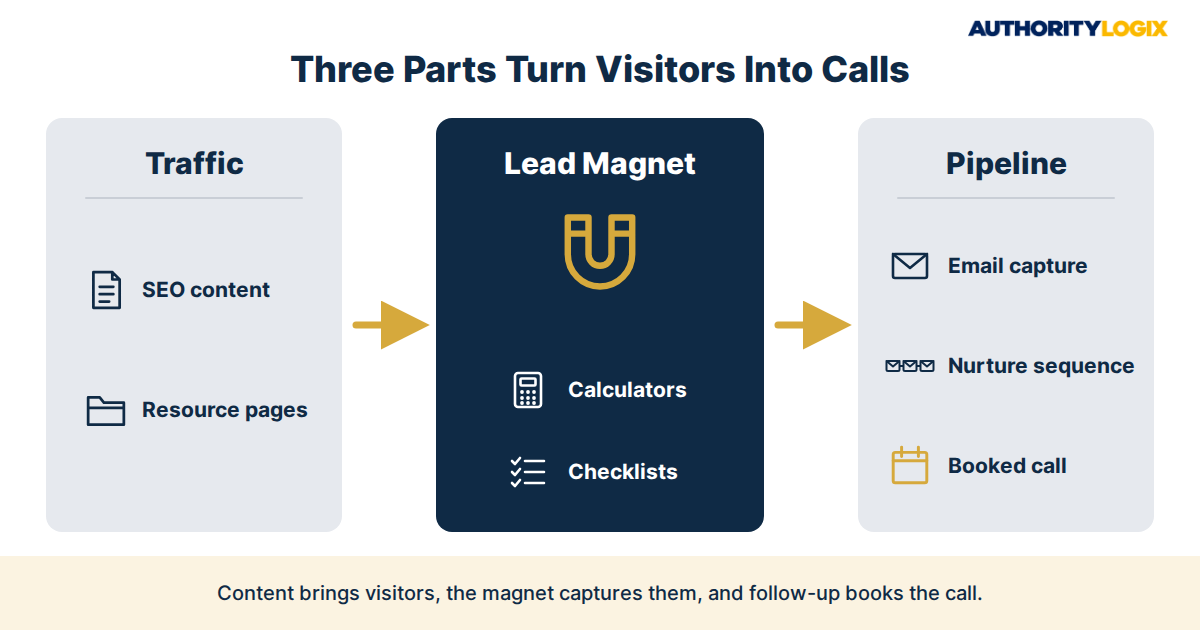
- The lead magnet is one component of a connected inbound system. Without SEO-ranked content driving traffic to the page, and without a nurture sequence converting the captured email into a conversation, the magnet produces downloads but not pipeline.
Table of Contents
Financial services lead magnet strategy starts with a problem most financial firms do not want to admit: their website converts almost no one. Traffic arrives, reads a page or two, and leaves — anonymously, permanently, and without any way for the firm to follow up. The average conversion rate for finance websites sits around 6.3%, according to Ruler Analytics, which means roughly 94 out of every 100 visitors who arrive with genuine interest walk away without a trace. The SEO playbook that drives traffic to a financial services site does its job — but without a lead capture mechanism positioned to exchange immediate value for a visitor’s contact information, that traffic produces no pipeline.
The solution is not a contact form at the bottom of the page. Contact forms capture one type of visitor: the one who has already decided they want to talk to you. Every financial services firm already has a contact form, and every financial services firm knows it converts sporadically at best. A lead magnet captures a different — and far more numerous — type of visitor: the one who is actively researching, has found the firm credible enough to spend time on the page, and will exchange their contact information for something that helps them right now. That is the population that converts into booked calls when the infrastructure to capture and nurture them is in place.
The authority guide covers how credibility is built before a prospect ever reaches a lead magnet. This article covers the magnet itself — what formats convert for financial services audiences, how to position them for maximum capture rate, and how to connect the captured contact to a follow-up sequence that produces booked calls rather than dormant email addresses.
The complete inbound pipeline framework — lead magnets, nurture sequences, and the full conversion architecture — is in the Financial Services Lead Generation System.
Why Most Financial Services Websites Don’t Convert — and Why a Contact Form Isn’t the Fix
The conversion problem on financial services websites is structural, not cosmetic. A firm can redesign its site, improve its copy, and add more service pages. And still convert only a small fraction of visitors if it has not solved the fundamental question every visitor is asking silently. “What do I get if I give you my information right now?” A contact form answers that question with nothing.
It asks for information and offers only the vague promise that someone will be in touch. That exchange works for one type of prospect — the one who has already made a decision. It does not work for the prospect who is still in the research phase, which is where most organic traffic lives.
The FS industry hub covers the full economic picture of financial services inbound marketing. The lead capture gap is the most costly invisible problem in that picture: a firm that generates 1,000 monthly visitors and converts 1.5% captures 15 leads. The same firm with a well-positioned lead magnet converting at 8% captures 80 leads from the same traffic. That difference — 15 contacts per month versus 80 — compounds dramatically over 12 months and produces a fundamentally different business outcome, with no increase in traffic spend required.
The root cause is the credibility gap problem in a different form. A visitor who lands on a financial services website from organic search has found a firm they do not already know. They are evaluating. The contact form says: “trust us enough to give us your number before we’ve given you anything.” A lead magnet says: “here is something useful right now — in exchange, let us stay in touch.” For the research-phase prospect, that is a completely different conversation — one that converts at a fundamentally different rate.

What Makes a Financial Services Lead Magnet Actually Convert
The Financial Services Lead Magnet Strategy Factor That Matters Most: Specificity
The single most important factor in lead magnet conversion for financial services is specificity. A magnet that promises to solve a specific, named problem for a specific, defined audience converts. A magnet that promises general value to anyone who might be interested does not.
“The Complete Guide to Mortgages” converts at a fraction of the rate of “The DSCR Investor Qualification Checklist for Self-Employed Borrowers in New York.” The former is generic. The latter speaks directly to a person who knows they are self-employed, knows they are looking at DSCR, and knows they are in New York — and who will trade their email address for a checklist that tells them exactly where they stand before they waste anyone’s time on a call.
The content systems that generate the traffic landing on financial services resource pages are built around topic clusters organized by scenario — and the lead magnet at the bottom of each page should match the scenario of the content above it. A visitor reading an article about DSCR loan requirements for self-employed borrowers is not interested in a generic mortgage guide. They are interested in a DSCR qualification checklist or a cash flow analysis tool. The magnet that matches the content converts; the generic magnet positioned on the same page does not.
Format: The Second Factor in a Financial Services Lead Magnet Strategy
The second factor is format. Interactive tools and scenario-specific calculators tend to convert at higher rates than static PDF guides — particularly for financial audiences who are actively trying to run numbers. A mortgage calculator, a DSCR coverage ratio tool, or a retirement income estimator captures a visitor at the moment of active calculation, not after they have finished their research.
The search statistics on financial services buyer behavior confirm the pattern. Borrowers and financial clients who search for calculators and scenario tools are further along in the decision process, and they convert into clients at higher rates than visitors arriving on general information pages.
The Lead Magnet Formats That Convert for Each Financial Services Audience
Not every lead magnet format performs equally across financial services audiences. The format that converts a DSCR investor audience is structurally different from the format that converts a financial advisory prospect, which is different again from what converts a mortgage company’s referral partner audience.
Mapping the right format to the right audience is where most financial services lead magnet programs fail — firms default to a single format (usually a PDF guide) applied uniformly across every page, rather than matching format and content to the specific scenario and audience at each entry point. The organic leads framework covers why self-qualified inbound leads convert at far higher rates than purchased leads — and the specificity of lead magnet format is a direct driver of that self-qualification.
| Audience | Highest-Converting Format | Example | Est. Conversion Rate |
|---|---|---|---|
| DSCR / Real Estate Investors | Interactive calculator | DSCR Coverage Ratio Calculator | 12–20% |
| Mortgage / Purchase Borrowers | Affordability / payment tool | How Much House Can You Afford Calculator | 15–25% |
| Self-Employed / Non-QM Borrowers | Qualification checklist | DSCR Qualification Checklist for Self-Employed Borrowers | 8–18% |
| Financial Advisory Prospects | Scenario guide / planning framework | Retirement Income Planning Guide for Business Owners | 4–8% |
| Broker / Referral Partners | Program matrix / lender guidelines sheet | 2026 DSCR Program Matrix: LTV, DSCR Minimums, Property Types | 6–12% |
| General Financial Services Visitors | Gated PDF guide | The 7-Step Checklist for Choosing a Lender | 2–4% |
The educational hub architecture that supports these lead magnets organizes content by scenario — every article in the hub targets a specific borrower type, investor scenario, or planning situation, and the lead magnet at the bottom of each article matches that scenario exactly. That alignment between content and magnet is what produces the higher end of the conversion ranges above rather than the lower end.
Placement and Conversion: Where to Put Lead Magnets on a Financial Services Website
Placement determines whether a well-designed lead magnet performs or disappears. The most common placement mistake in financial services is positioning the lead magnet at the bottom of a long article, where it is seen only by the small percentage of visitors who scroll all the way through. The visitors most likely to convert — those who arrived on a specific scenario page from organic search, spent time reading, and found the content credible — often leave before reaching the bottom. The magnet needs to appear at multiple points in the content flow, not only at the end.
The highest-converting placement pattern for financial services lead magnets puts the capture point within the content itself. Embedded inline after a section that makes the specific problem concrete and quantifiable. A DSCR article that walks through how coverage ratio is calculated should offer the DSCR calculator at the moment the reader understands what calculation they need to run, not after four more sections of reading.
That inline placement captures the visitor at peak engagement. The AI search visibility framework reinforces this. The same content depth that earns AI citation is what produces the engagement signals — time on page, scroll depth, return visits. That indicate a visitor has found the content genuinely useful and is ready to exchange contact information for more.
Form length is the second placement variable that determines capture rate. A three-field form — first name, email, and one qualifying question — consistently outperforms longer forms for financial services lead magnets. The qualifying question (loan type, investment geography, AUM range) does double duty: it reduces form completion friction by showing the visitor that the follow-up will be relevant to their specific situation, and it routes the captured contact to the correct nurture sequence automatically. The lead generation architecture that handles this routing is what transforms lead magnet downloads from a list-building exercise into a pipeline-building system.
Curious where your firm’s current lead capture infrastructure stands? The FS Authority Gap Assessment identifies the gaps and maps the build sequence.
The Follow-Up Sequence That Turns Downloaded Contacts Into Booked Calls
A lead magnet that captures an email address and triggers no follow-up is not a lead generation system — it is a list-building exercise. The contacts sit in the CRM, receive nothing, and eventually go cold. The financial services firms that convert lead magnet captures into booked calls have a follow-up sequence that begins within minutes of the download and delivers additional value tied directly to what the prospect downloaded. The content system that supports this sequence organizes educational content by scenario — so the follow-up emails for a DSCR calculator download differ entirely from the follow-up for a retirement planning guide download.
The sequence structure that produces booked calls for financial services firms follows a consistent pattern. Email one delivers the magnet and confirms the content match — “here is the DSCR checklist you requested, and here is what it covers.” Email two goes deeper on the problem the magnet addressed — a follow-up article, a case framework, or a market data point that adds context.
Email three introduces the firm’s approach to solving the problem — not a sales pitch, but a specific explanation of how the firm works with this exact type of client. Email four is the call invitation — direct, low-pressure, and framed around the prospect’s specific situation rather than the firm’s capabilities. The finance content layer is what makes this sequence credible: each email contains specific, useful information that reinforces the expertise the visitor originally found on the resource page.

What Most Firms Get Wrong About Financial Services Lead Magnet Strategy
They build the magnet before they build the traffic
A lead magnet with no traffic is a file on a landing page no one visits. The E-E-A-T guide covers the SEO trust architecture that produces the organic traffic financial services lead magnets need to perform. The correct build sequence is: establish the content and SEO infrastructure that drives qualified visitors to specific scenario pages, then position the lead magnet on those pages to capture the visitors the content attracts. Building the magnet first and hoping to drive traffic to it through paid ads is the expensive path — it works only as long as the ad spend continues, and it typically produces lower-intent visitors than organic search traffic does.
They use one magnet for every page
A single lead magnet positioned site-wide misses the specificity that drives conversion. The firms generating meaningful lead magnet capture rates in financial services have scenario-matched magnets: the DSCR article gets the DSCR calculator, the local market article gets the neighborhood cap rate report, the advisor content page gets the retirement planning scenario guide. The DSCR lenders who build broker-facing inbound authority deploy program matrix sheets and guideline summaries as their lead magnets on broker-targeted content — not generic mortgage guides that any lender could produce.
They treat the download as the conversion event
Downloads are not pipeline. A downloaded checklist that generates no follow-up sequence produces one marketing metric — download count — and zero business outcomes. The advisor content framework is explicit on this point: educational content builds trust before the first meeting, and the lead magnet is the mechanism that exchanges that trust for a contact — but only the follow-up sequence converts the contact into the meeting. Firms that celebrate download counts without tracking booked calls from those downloads are measuring activity, not results.
Ready to build lead magnets that turn your website visitors into booked calls?
Building a Financial Services Lead Magnet Strategy That Works From Day One
The fastest path to a working lead magnet for a financial services firm is not the most creative one — it is the most specific one. Start with the question: what is the single most common thing the firm’s best clients needed to know before they were ready to have a first conversation? That question-answer gap is the lead magnet. A DSCR lender whose best clients consistently asked “do I qualify for this program?” before the first call should build a qualification checklist. A financial advisor whose best clients consistently asked “am I saving enough?” before engaging should build a retirement readiness assessment. The magnet that answers the pre-conversation question is the one that captures the pre-conversation prospect.
The growth playbook for each financial services vertical connects lead magnet strategy to long-term business development — the email list built from a year of consistent lead magnet captures is a direct-access audience that no algorithm controls and no vendor can take away. BKDSCR.com, AuthorityLogix’s own proof-of-concept platform built in the NYC outer-borough DSCR investor niche, demonstrates this precisely: the 35-page DSCR investor guide deployed as the site’s primary lead magnet captures qualified investors at the moment of active research and routes them into an email automation sequence tied to the investor tools and market content on the site.
The build does not need to be complicated to work. One scenario-specific lead magnet, positioned on the highest-traffic content page, connected to a four-email follow-up sequence — that is the minimum viable lead capture system for a financial services firm. The authority distribution layer that amplifies the content driving traffic to that page — LinkedIn posts linking to the resource, syndication expanding reach beyond organic search — is what accelerates lead magnet performance once the core system is in place.
The firms that wait until the full system is perfect before launching the first magnet never launch. Start with the one page that gets the most organic traffic, build the scenario-matched magnet for that page, and connect it to a follow-up sequence.
The honest answer is that most financial services firms already have the expertise their best clients need — the missing piece is the infrastructure that captures interested visitors before they leave and converts them into conversations. When you’re ready to build, work with us is the starting point.