


Key Takeaways
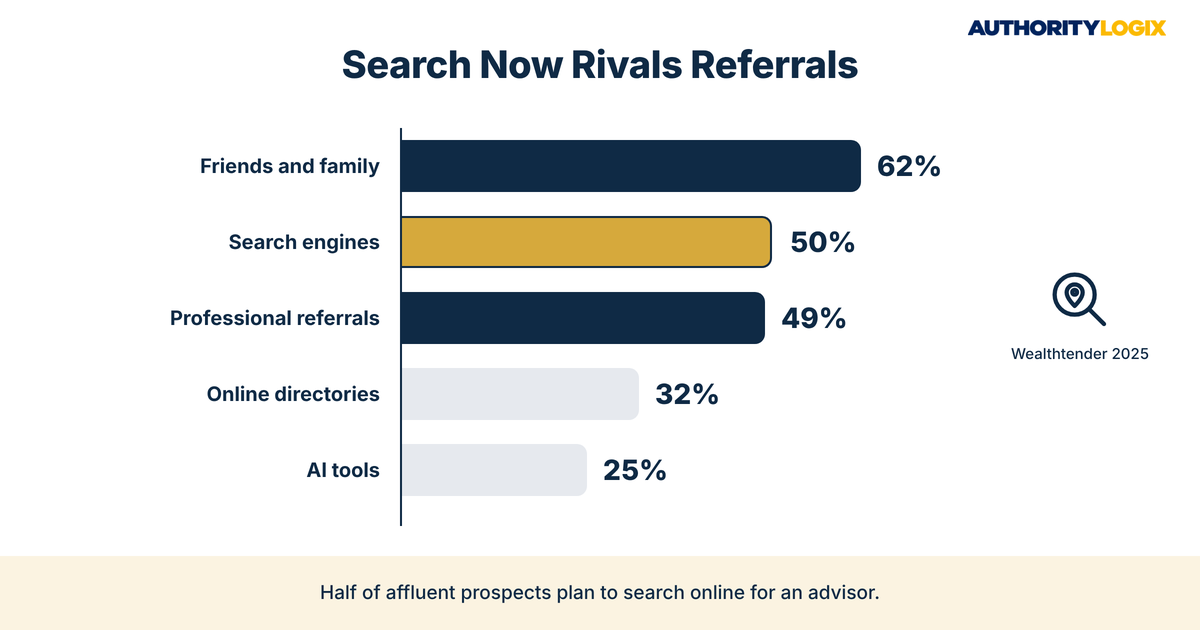
- Financial advisor local search is where affluent prospects build their shortlist. Wealthtender’s 2025 survey of households earning over $100,000 found that half use search engines to find an advisor, close to the 62% who ask friends and family.
- Referral or not, financial advisor local search shapes the decision: before they call, prospects check the firm name, the reviews, the specialization, and the fee structure.
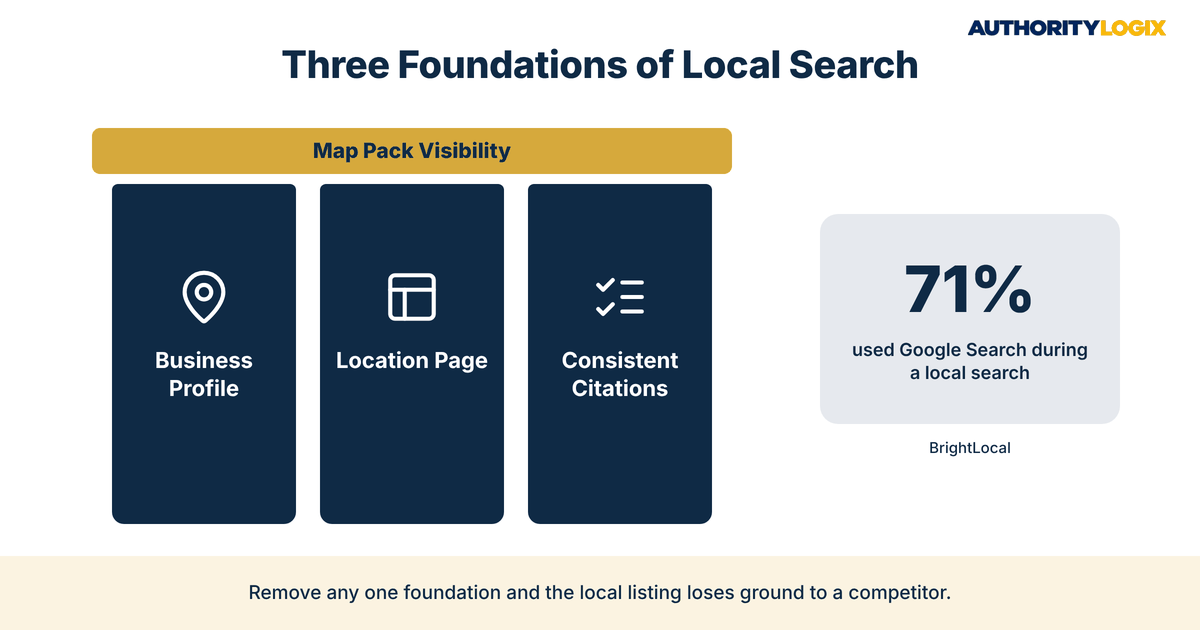
- RIA local SEO rests on three foundations: a complete Google Business Profile, a dedicated page for each office location, and consistent citations across directories.
- A financial advisor near me search usually happens on a phone. BrightLocal found that 73% of local searches start on mobile, and 75% of searchers use more than one channel.
- Wealth manager local visibility now reaches past the map pack into AI tools, professional directories, and educational pages that answer wealth questions for a specific city.
- The SEC Marketing Rule permits client reviews when the required disclosures are in place, so the compliance question is how to run a review program, not whether to have one.
Table of Contents
Why Financial Advisor Local Search Decides Who Gets the First Meeting
Financial advisor local search is where a high-net-worth prospect decides which firms make the shortlist, and many advisors with two decades of client results never appear on it. The prospect types “fee-only advisor near me” or “wealth manager in [town],” scans the map, opens two or three profiles, and calls one. The mechanics behind that shortlist are the same ones covered in our guide to local SEO for mortgage companies: proximity, relevance, and prominence, measured by Google before a human ever looks.
Wealthtender’s 2025 research on how Americans find and hire advisors shows how much weight financial advisor local search now carries. Half of respondents (50%) plan to use search engines to find an advisor, close to the 62% who plan to rely on friends and family and ahead of the 49% who plan to use referrals from other professionals. The study surveyed households earning over $100,000 that plan to hire an advisor.
Referrals have not disappeared, but they now end in a search. Wealthtender found that before reaching out, prospects checked areas of specialization (64%), fee structure (62%), and years of experience (58%). If those answers are missing from your search results, the referral loses momentum. That validation step is why the trust signals described in the authority guide now matter as much as the introduction itself.
This is the credible but invisible problem in its most local form. The advisor has the credentials and the track record, yet a newer firm two exits away shows up first because its profile is complete and its pages answer the questions prospects ask. Financial advisor local search rewards the firm that built the infrastructure, not the firm with the longest history. The financial services hub shows how that infrastructure fits together for advisory firms, lenders, and mortgage companies.
The Financial Services SEO Playbook covers how advisors, lenders, and mortgage companies build search visibility that compounds month over month, including the local layer that decides the first call.
RIA Local SEO Foundations: Profile, Pages and Citations
RIA local SEO starts with three pieces that every other tactic depends on. The first is a complete Google Business Profile. The second is a dedicated page on your site for each office location. The third is a consistent citation footprint, meaning your firm name, address, and phone number match everywhere they appear online. Skip any one of the three and financial advisor local search results will favor a competitor who did not.
BrightLocal’s 2026 consumer search research found that 52% of consumers started their most recent local search on Google Search and another 9% started on Google Maps. It also found that 71% used Google Search at some point in the process, which explains why the profile and the location page carry so much weight. The full set of findings is available in BrightLocal research, and the pattern is consistent across local categories.
| Foundation | What It Tells Google | What the Prospect Sees |
|---|---|---|
| Google Business Profile | Category, service area, hours, and that the office is real and active | Map listing, reviews, photos, and a call button |
| Location page on your site | Relevance to the city and the services offered there | Advisor bios, specialties, fee approach, and directions |
| Citations and directories | Consistent name, address, and phone across trusted sources | The same firm details on every site they check |
| Credential profiles | Third-party confirmation of designations such as CFP or CFA | Verified credentials and a regulatory record |
| Educational pages | Topical depth on the questions local prospects ask | Answers that show how the advisor thinks before a meeting |
The Financial Advisor Local Search Profile Checklist
A financial advisor local search profile needs more than a name and an address. Choose the most accurate primary category, such as “Financial planner” or “Investment service,” and add secondary categories only where they truly apply. Write a description that names your specialties and the client types you serve. Add real office photos, set accurate hours, and post updates that point to new pages.
Directory profiles matter for a second reason. AI tools increasingly pull from the same structured sources Google uses, so an accurate profile on the CFP Board’s Let’s Make a Plan directory, on FINRA BrokerCheck, and on the SEC’s Investment Adviser Public Disclosure site helps both kinds of search. That overlap is central to AI search visibility for advisors, where a model is more likely to recommend a firm whose details agree across sources.
Location pages are where most RIA local SEO efforts stall. A page that only lists an address gives financial advisor local search nothing to work with. A strong page names the advisors in that office, the planning services offered, the client situations you handle most often. Those resources work best when they live in an educational hub organized by topic, so a prospect reading about retirement income in your town can move to tax planning and estate topics without leaving your site.
Financial Advisor Near Me Search and How Prospects Use It
A financial advisor near me search is rarely a single query. BrightLocal found that 75% of consumers used more than one channel in their most recent local search, and 73% started on a mobile phone. A prospect may see your map listing on a phone at lunch, check your site that evening on a laptop, and look at your LinkedIn profile before deciding to call.
Affluent prospects tend to look past the map listing for proof of judgment. Building LinkedIn authority gives that validation step somewhere to land, because a prospect who finds a thoughtful post on estate planning for business owners has a reason to trust the profile that ranked.
An earlier study by the Financial Planning Association and LinkedIn found that 77% of investors researched advisors on search engines such as Google before meeting them. More recent Wealthtender data shows the same habit spreading to AI tools, with 25% of respondents planning to use them to find an advisor. The financial advisor near me search is now the opening move in a research process, not the whole process, and financial advisor local search performance depends on what the prospect finds at every stop.
| How Prospects Find an Advisor | Share Using It | What It Means for Local Visibility |
|---|---|---|
| Friends and family referrals | 62% | Referred prospects still look you up by name |
| Search engines | 50% | Financial advisor local search decides the shortlist |
| Referrals from other professionals | 49% | CPAs and attorneys send prospects who verify online |
| Online directories | 32% | Credential directories must match your site details |
| AI search tools | 25% | Models favor firms with consistent, well-structured information |
Each of those channels points back to the same pages. That is why advisors who publish through connected content systems tend to hold their ground in financial advisor local search, while advisors who publish one-off posts do not. Every page answers a question, links to the next one, and gives Google another reason to connect your firm with the city and the planning topics you serve.
Not sure where your firm stands in financial advisor local search? The FS Authority Gap Assessment shows where your visibility infrastructure is weak and what to build first.
Wealth Manager Local Visibility Beyond the Map Pack
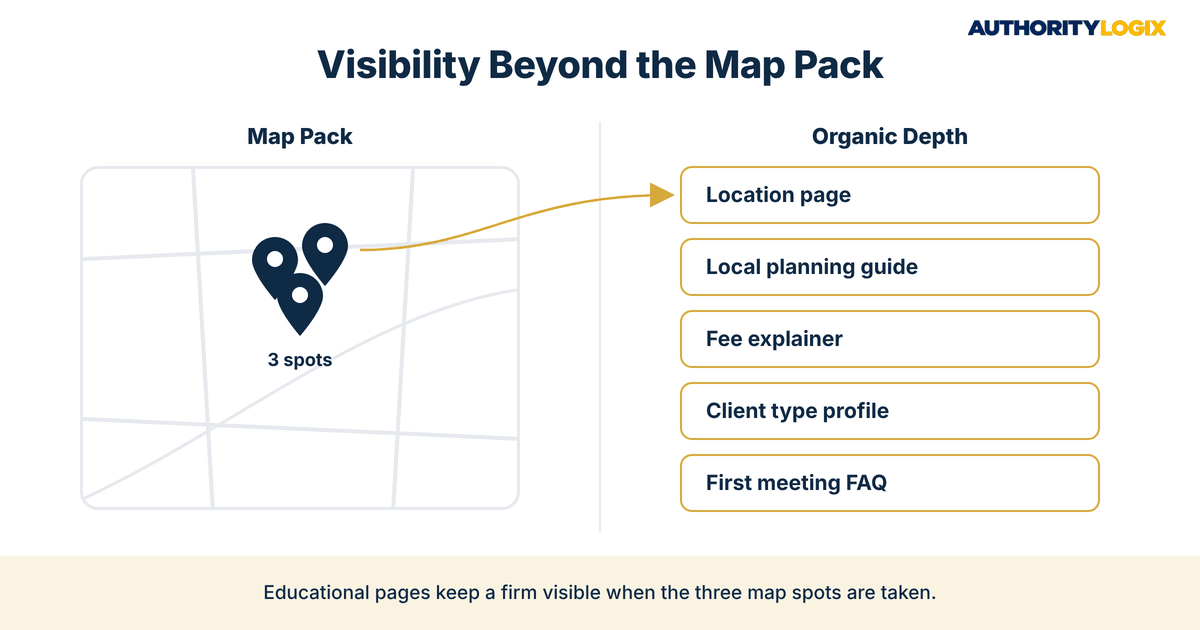
Wealth manager local visibility has a ceiling if it stops at the map pack. Three listings appear in that box, and in a dense market dozens of firms compete for them in financial advisor local search. The firms that win over time also rank in the organic results below the map for questions like “how to choose a fiduciary in [city]” or “retirement income planning for [county] business owners.”
Those rankings come from depth, not from a single service page. A wealth manager who publishes clear explanations of local estate rules, property tax considerations for retirees, or the planning issues facing a region’s dominant industries builds topical authority that a map listing alone cannot. The publishing structure in the content system explains how to organize that depth
Turning Local Questions Into Financial Advisor Local Search Rankings
The most useful local pages answer questions your advisors already hear in first meetings. A firm near a large employer might explain how that company’s retirement plan fits into a broader strategy, without giving individual advice. A firm in a retirement destination might explain the planning issues new residents face when they move from another state. Each page makes financial advisor local search work harder, because it ties your firm to the place and to the problem at once.
Writing these pages takes care in a regulated field. Every statement has to be educational, accurate, and reviewed by compliance before it goes live, which is where specialized finance content development saves time. The goal is wealth manager local visibility built on pages a chief compliance officer can approve quickly.
- A page for each office location, with named advisors and services
- Guides to the planning questions most common in your area
- Explainers on your fee structure and fiduciary standard
- Answers to the questions prospects ask in first meetings
Reviews and Reputation Within Compliance Rules
Reviews are a local ranking factor and a trust factor at the same time. BrightLocal’s 2026 Local Consumer Review Survey, which covers local businesses in general, found that 97% of consumers read reviews, 74% look for reviews written in the last three months, and 89% expect owners to respond. Wealthtender found that more than 80% of respondents want to read online reviews about financial advisors before choosing one.
What the SEC Marketing Rule Requires for Reviews
For years advisors avoided reviews because the old testimonial rule effectively prohibited them. The SEC Marketing Rule changed that, with a compliance date of November 4, 2022. Testimonials and endorsements are now permitted when the firm clearly discloses whether the reviewer is a client, whether they were compensated, and any material conflicts. The SEC has also brought enforcement actions against advisers for testimonial and rating violations, so the process has to be documented and reviewed by your compliance team, not improvised.
A compliant review program becomes part of your authority distribution once it runs on a schedule. Ask satisfied clients through a consistent, approved process. Make sure required disclosures sit where the reviews are displayed, as your compliance team directs. Respond to reviews in a way that never confirms a client relationship or discusses account details.
Reviews feed financial advisor local search in two ways. They help the profile rank, and they help the prospect decide once it does. The firms that treat reviews as one part of a connected lead generation system, rather than a one-time push, see the profile, the location page, and the review count improve together over time.
Financial Advisor Local Search Mistakes Advisors Make
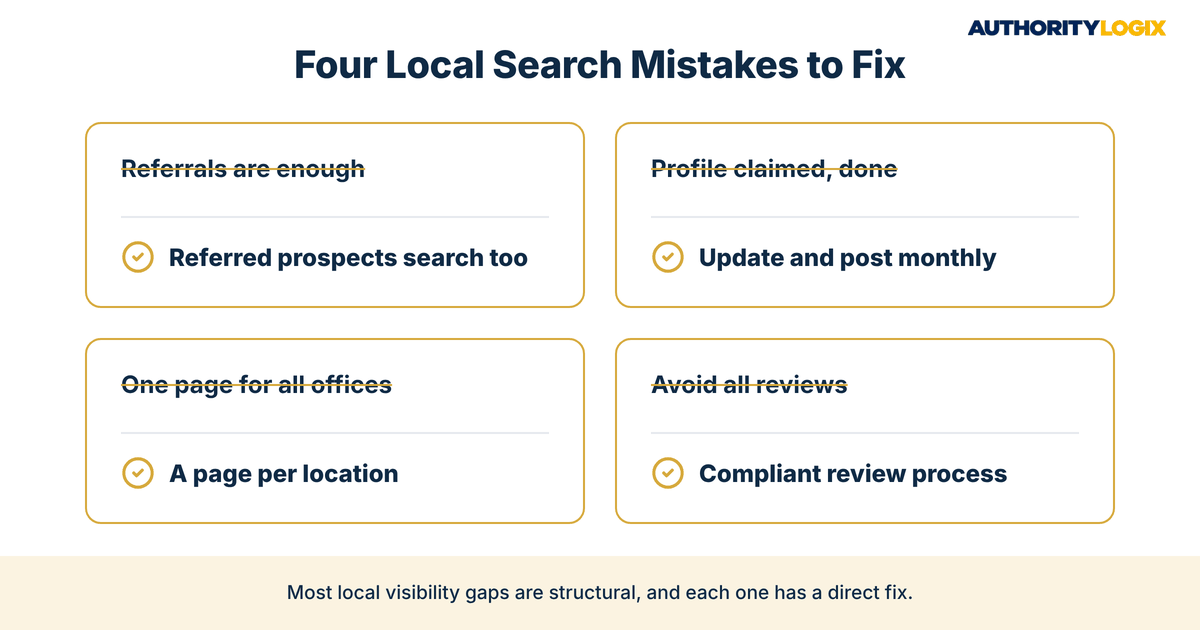
Most local visibility problems for advisory firms are structural rather than creative. Here are the most common, along with the questions advisors ask most often about financial advisor local search.
Mistake: “Our referral network is strong, so local search does not matter.”
Your referral network is a ceiling, not a foundation. Referred prospects still search your name, and the profile they find either confirms the recommendation or raises doubts. A referral-only practice also has no way to reach the half of prospects who start with a search engine. The lead system approach treats referrals and search as two inputs to one pipeline instead of competing strategies.
Mistake: “We claimed the profile, so we are done.”
A claimed profile with no description, no photos, no posts, and three reviews from 2019 tells Google and prospects that nothing is happening. Profiles need ongoing updates, fresh reviews, and links to current pages on your site. Neglected profiles are one of the first financial advisor local search issues we look at in what we do, because they are usually the fastest problem to fix.
Question: Can an RIA with one office compete with national firms in local search?
Yes, often more easily than in national search. Map results weigh proximity and relevance, which favors the firm that is actually in the town. A single office with a complete profile, a strong location page, and steady reviews can win financial advisor local search against a national brand that has a thin page for that city.
Question: How long does financial advisor local search take to show results?
Profile and citation fixes can show movement within a few months, while educational pages that rank in organic results usually take longer. The order matters more than the speed, and the sequence behind how we build an engagement reflects that: foundations first, then location pages, then the educational content that keeps the firm ranking.
Want local prospects to find you first? We’ll build your local search presence.
Financial Advisor Local Search Is Where Wealthy Prospects Look First
Financial advisor local search will not replace referrals. It decides what happens after a referral, and it reaches the prospects who never had one. The long-term view in the growth playbook applies directly here: the local foundations you build this year keep working in the years that follow, while paid placements stop the day the budget ends.
BKDSCR.com, the AuthorityLogix proof-of-concept in the NYC outer-borough DSCR market, was built with 18 pillar pages, 7 investor tools, and 48 blog posts, and it generates inbound leads with zero paid ads. The same structure applies to an advisory firm, and why it works comes down to connected pages that each have a clear job.
The honest assessment is that most advisors reading this already have what high-net-worth prospects want: experience, credentials, and a record of client outcomes. What they lack is a financial advisor local search footprint that makes that record visible at the moment a prospect looks. If your firm is ready to close that gap, work with us to map what to build first.