


Key Takeaways
- Financial firm thought leadership content is original, point-of-view publishing built from what a lender or advisor already knows about their market — not recycled rate updates or generic tips.
- 73% of B2B decision-makers say thought leadership is a more trustworthy basis for judging a company’s capabilities than its marketing materials, according to the 2024 Edelman-LinkedIn B2B Thought Leadership Impact Report.
- Only 15% of buyers in that same study rated the thought leadership they read as very good or excellent — the bar is low, and most firms are still not clearing it.
- Content Marketing Institute found that 96% of B2B marketers say their organizations create thought leadership content, yet at many companies fewer than 5% of employees contribute to it.
- A lender expert content system turns principal knowledge into a repeatable pipeline: capture, draft, review, publish, distribute, measure.
- Financial firm thought leadership content earns its return through infrastructure — pages that link, rank, and get distributed — not through one-off posts.
Table of Contents
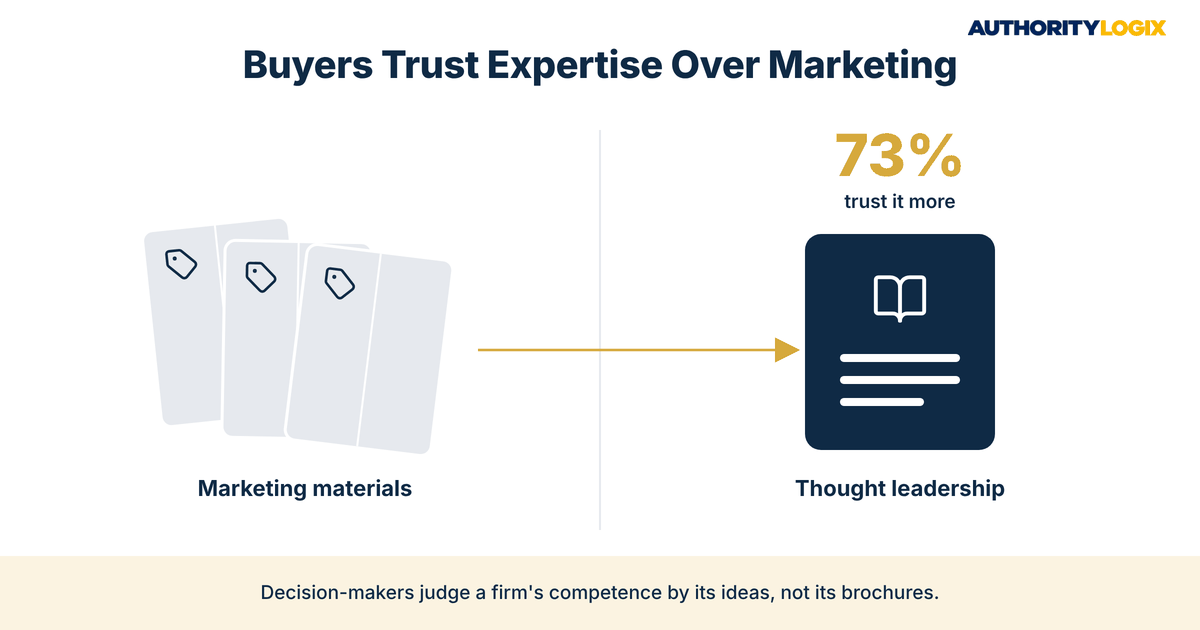
Financial firm thought leadership content is the work most lenders and advisors say they are doing — and the work very few are doing in a way the market can see. You have spent years underwriting files, sitting across from nervous borrowers, or walking clients through volatile markets. But when a prospect searches your name and finds a rate sheet, a stock photo, and a blog post from two years ago, the market sees a vendor, not an authority.
That gap has a name: credible but invisible. The fix is not more posts. It is a system that turns what you already know into published, findable proof — the same principle behind the educational content approach that builds trust before a prospect ever calls.
What Financial Firm Thought Leadership Content Actually Means
Strip away the buzzword and financial firm thought leadership content is simple: a clear, defensible point of view on a question your buyers care about, backed by experience they cannot get from a generic source. For a DSCR lender, that might be a breakdown of why certain rental deals fail the ratio in a specific borough. For an advisor, it might be a plain-language explanation of how sequence-of-returns risk works, framed as education rather than a recommendation.
It is not product announcements, rate alerts, or AI-generated listicles with your logo on top. Those fill a feed. They do not change how a prospect judges your competence. Financial firm thought leadership content does, because it shows the judgment behind the work.
There is also a search dimension most firms miss. Google evaluates financial pages as Your Money or Your Life topics, which raises the bar for demonstrated experience and expertise — exactly what original, principal-driven writing provides. The mechanics are covered in our SEO playbook, but the short version is that financial firm thought leadership content and search authority are built from the same raw material.
Why Buyers Trust Financial Firm Thought Leadership Content Over Marketing
The trust gap is measurable. In the 2024 Edelman-LinkedIn B2B Thought Leadership Impact Report, which surveyed about 3,500 decision-makers, 73% said thought leadership is a more trustworthy basis for assessing a company’s capabilities than its marketing materials. Those are B2B buyers, but the psychology carries straight into lending and advisory relationships, where trust is the product.
The same study found that only 15% of buyers rated the content they read as very good or excellent. That is the opening. Most financial firm thought leadership content is average, so a firm that publishes with real depth stands out quickly. Every service on our services hub is organized around closing that gap for financial firms.
The Financial Services Authority Guide covers the full trust and credibility framework that financial firm thought leadership content plugs into.
Mortgage Thought Leadership Strategy Built on Real Market Knowledge
A mortgage thought leadership strategy starts with an inventory, not a publishing schedule. Before anyone writes a word, list the questions borrowers and referral partners ask you every week, the deals you have seen go sideways, and the opinions you hold that competitors would not say out loud. That list is the raw material for financial firm thought leadership content, and nobody else has it.
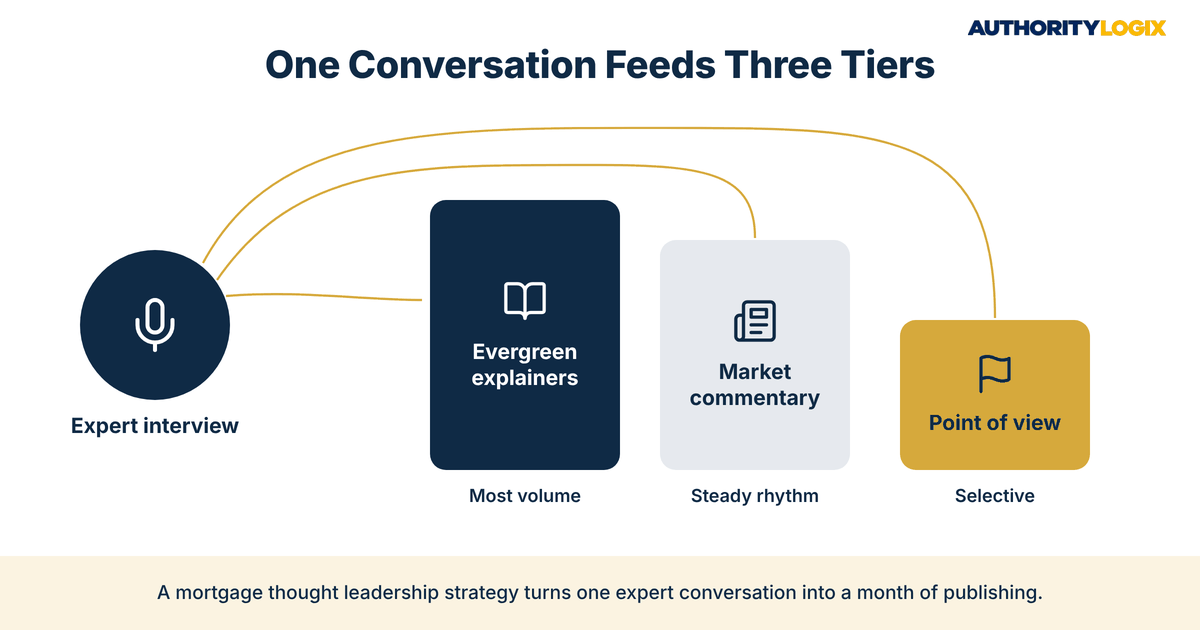
From there, the strategy sorts that knowledge into three tiers. Evergreen explainers answer the questions that never go away. Market commentary interprets what is happening now — rate moves, guideline changes, local inventory shifts — through your experience. Point-of-view pieces take a position, such as why a certain loan structure gets oversold to first-time investors. Financial firm thought leadership content needs all three, published in roughly that order of volume.
Format matters less than consistency of voice. A principal who writes a weekly short take for LinkedIn and a monthly long-form article for the website builds recognition faster than a firm that publishes sporadically across six channels. The mechanics of that first channel are covered in our piece on LinkedIn authority, and they apply to loan officers as much as advisors.
Turning One Conversation Into a Month of Publishing
The most efficient mortgage thought leadership strategy runs on interviews, not blank pages. A 30-minute recorded conversation with a senior loan officer can yield one long-form article, three LinkedIn posts, and an FAQ entry. That is how financial firm thought leadership content scales without consuming the principal’s week.
Where those pieces live matters as much as how they are made. Scattered posts decay in a feed within days, while organized pages keep working for years. That is why every piece should land inside a structured educational hub where explainers, commentary, and point-of-view articles link to each other by topic.
Advisor Market Authority Content That Earns Attention
Advisor market authority content has a harder job than most. Financial advisors publish inside a tight compliance frame — FINRA Rule 2210 governs broker-dealer communications with the public, and the SEC Marketing Rule shapes what registered investment advisers can say about performance and testimonials. Many firms read those rules as a reason to say nothing interesting. Firms that build authority read them as a boundary for financial firm thought leadership content.
Inside that boundary, there is plenty of room. Explaining how a planning concept works, which questions to ask before a major financial decision, or how a regulatory change affects households is educational, and it shows judgment without promising outcomes. Financial firm thought leadership content for advisors wins on clarity and perspective, never on return claims.
The bigger obstacle is internal. Content Marketing Institute’s B2B research for 2026 found that 96% of marketers say their organizations create thought leadership content, yet at many companies fewer than 5% of employees contribute to it. In advisory and lending firms, that usually means the principal is the only voice — and the principal is also the busiest person in the building.
That bottleneck creates a credibility gap: deep expertise inside the firm, almost none of it visible outside. Closing it means getting knowledge out of the principal’s head efficiently. When advisor market authority content depends on one person finding free evenings, it stops in the first busy quarter.
Edelman and LinkedIn’s 2025 follow-up study sharpens the point. In the 2025 Edelman-LinkedIn B2B Thought Leadership Impact Report, 74% of hidden buyers named recognition as a leading expert as a factor in their final decision, and 85% pointed to a provider’s demonstrated understanding of their specific challenges. Firms that build content systems around real client questions demonstrate both at once, every time they publish.
Not sure whether your firm’s expertise is visible to the prospects searching for it? The FS Authority Gap Assessment shows where your thought leadership, content, and credibility signals stand against competitors in your market.
Lender Expert Content System: Publishing With Purpose
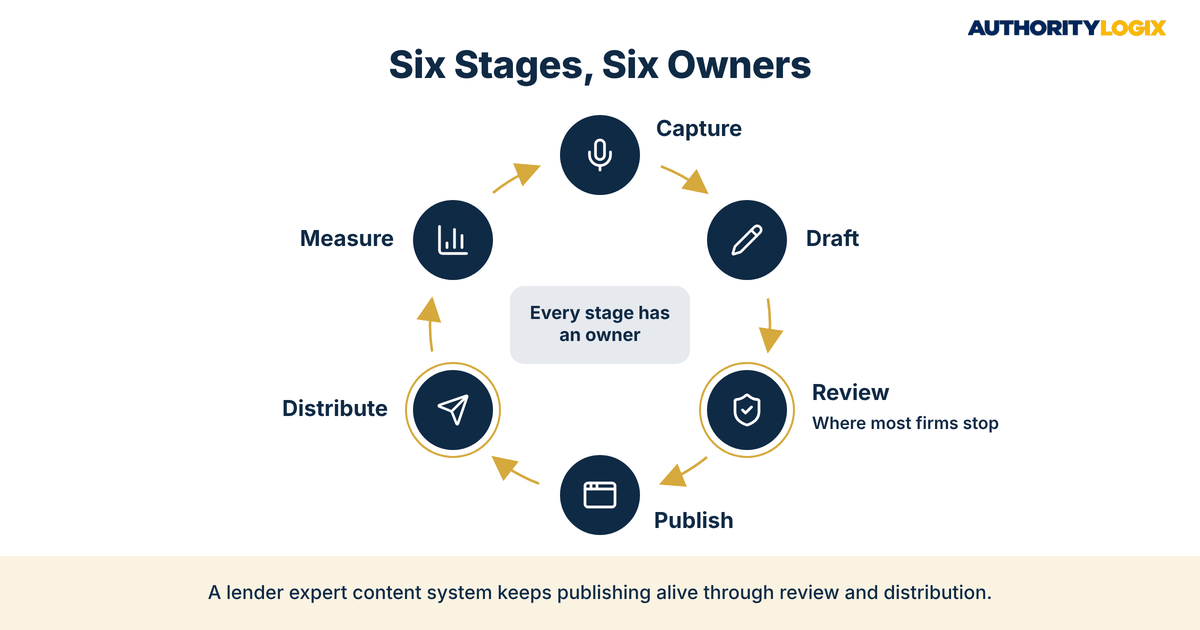
A lender expert content system is the difference between a firm that publishes when inspiration strikes and a firm that publishes on a rhythm the market starts to expect. It has six stages, and each one has an owner. Skip a stage and the system breaks — usually at compliance review or distribution, where most firms quietly stop.
| Stage | What Happens | Owner | Common Failure |
|---|---|---|---|
| Capture | Recorded interview or voice memo with a principal on one client question | Principal and editor | Waiting for the principal to write |
| Draft | Editor turns the conversation into financial firm thought leadership content | Editor | Generic copy that loses the principal’s voice |
| Review | Compliance check for claims, disclosures, and advertising rules | Compliance lead | A review queue with no deadline |
| Publish | Page goes live inside its topic cluster with internal links | Web owner | Orphan posts with no links in or out |
| Distribute | Article is cut down for LinkedIn, email, and syndication | Distribution owner | Publishing once and moving on |
| Measure | Ranking pages, inquiries, and referral mentions tracked monthly | Principal | Counting likes instead of conversations |
The structure above mirrors the compliance-aware blueprint in our content system guide, scaled down for a firm with one or two subject-matter experts. The point is not bureaucracy. Every stage has a deadline and a name attached, so financial firm thought leadership content survives a busy month.
What Makes a Lender Expert Content System Repeatable
Repeatability comes from templates and a backlog. Keep a running list of 20 to 30 approved topics, a standard article structure, and a review checklist that compliance has signed off on in advance. When the structure is fixed, review gets faster, because the reviewer knows exactly where claims and disclosures sit.
Writing quality is the last piece. Financial readers notice the difference between copy written by someone who understands a debt service coverage ratio and copy written by someone who looked it up. Specialized finance content development exists for that reason — so the principal’s judgment survives the editing process intact.
BKDSCR.com is the working example. It was built from scratch in the NYC outer-borough DSCR niche with 18 pillar pages, 7 interactive investor tools, and 48 SEO-optimized blog posts, all running on this kind of system with zero paid ads. Every post traces back to a real investor question — financial firm thought leadership content applied to one niche.
Distributing Financial Firm Thought Leadership Content Beyond the Website
Publishing is half the job. An article with no distribution reaches the people already looking for you, and almost no one else. Financial firm thought leadership content has to travel to where prospects and referral partners already spend their attention — LinkedIn feeds, email inboxes, industry publications, and search results.
Each channel gets a different cut of the same idea. The full article lives on the site, and a 150-word summary with one sharp point goes to LinkedIn. A short note with the link goes to past clients and referral partners. A syndicated version extends reach into news and podcast platforms through structured authority distribution, which also builds the external signals search engines use to judge credibility.
The 2025 Edelman-LinkedIn report explains why that reach matters. The 2025 Edelman-LinkedIn report found that 95% of hidden buyers say high-quality thought leadership is more effective than traditional marketing or product information, and 79% said they are more likely to champion a vendor during the RFP process when it consistently publishes quality thought leadership. Consistency is the operative word — distribution turns financial firm thought leadership content into a pattern the market notices.
Distribution should also feed a capture point. Every distributed piece needs a next step — a guide download, a checklist, a short assessment — that turns attention into a conversation. Connecting financial firm thought leadership content to that pipeline is the job of a first-party lead system, and without one, reach produces recognition but no inquiries.
Financial Firm Thought Leadership Content Mistakes That Read as Marketing
Most firms that try thought leadership and quit made one of a handful of predictable mistakes. Each one turns expertise into something that reads like an ad. Here are the ones that show up most often in audits of financial firm thought leadership content.
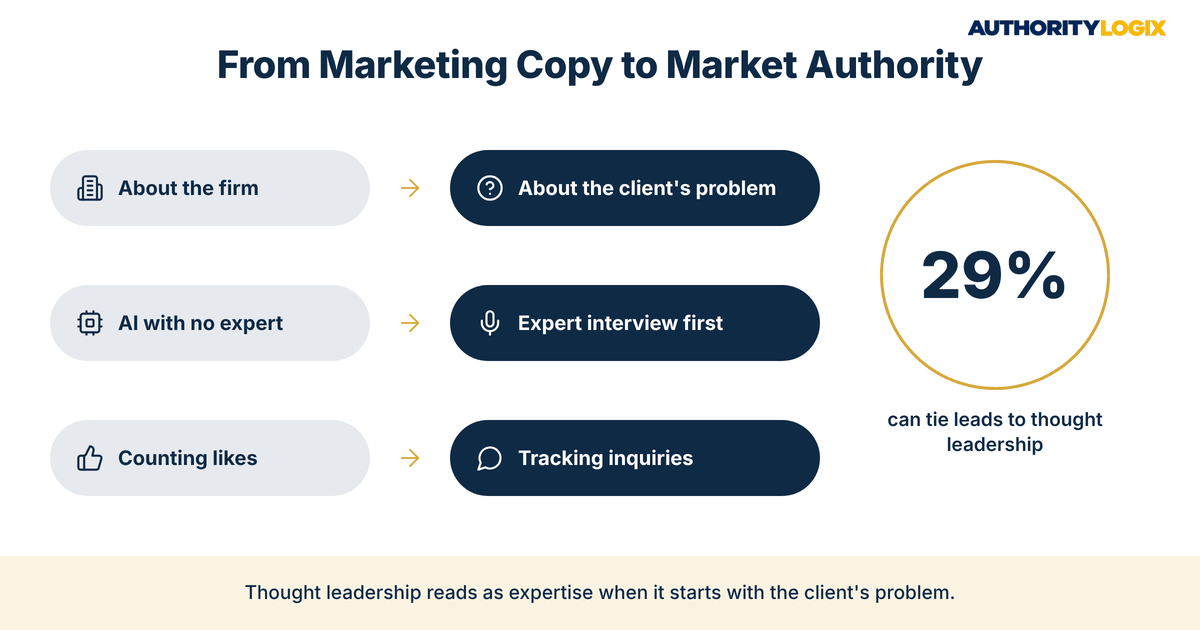
Mistake: Writing about the firm instead of the client’s problem
Content that leads with your awards, team photos, and loan products is a brochure. Prospects respond to pieces that name their problem in their own language and walk through it. Once firms make that shift, lead generation starts working, because the content attracts people already wrestling with the question you just answered.
Mistake: Handing the voice to AI with no expert input
Content Marketing Institute’s 2026 research found that about 9 in 10 B2B marketers already use AI to produce content, but fewer than 4 in 10 say it has improved performance. AI can speed up drafting. It cannot supply a principal’s experience, and financial firm thought leadership content without that experience is just more average copy in a crowded feed.
Mistake: Measuring likes instead of conversations
The 2024 Edelman-LinkedIn study found that only 29% of B2B organizations can tie leads or wins to specific thought leadership efforts, and 19% have no measurement process at all. Track inquiries, referral mentions, and ranking pages instead. That attribution setup is part of what we do at the start of every engagement, because a system you cannot measure is a system you will eventually abandon.
How long before financial firm thought leadership content produces inquiries?
There is no guaranteed timeline, and anyone who promises one is selling a campaign. Early signals — indexed pages, ranking movement, a few referral mentions — usually appear before steady inbound inquiries do, and the pace depends on market competition and publishing consistency. What is predictable is that the firm that starts now builds a lead the firm that waits must pay to close.
Do we need a full-time writer to build this?
No. Most firms need a few hours of principal time per month, an editor who knows finance, and a defined review step. That split — principal knowledge in, finished pages out — reflects how we build every engagement, with the topic architecture, templates, and distribution set up once at the start.
Want thought leadership that clients and prospects actually read? We’ll turn your expertise into content that builds lasting authority.
Recognized Expertise Is Built, Not Claimed
Calling yourself a market authority does nothing. The market decides who the authorities are, based on what it can see, search, and share. Firms that understand this treat financial firm thought leadership content as a long-term asset, the way our growth playbook frames every visibility investment.
The honest assessment is this. Most lenders and advisors already have more expertise than the firms outranking them. What they lack is the infrastructure that turns that expertise into published, findable, distributed proof. BKDSCR.com is the evidence behind why it works, built in a live market with our own time and money.
Financial firm thought leadership content is not a quick fix or a content sprint. It rewards the firms that start before their competitors do, and authority compounds for those who build something it can compound on. If you want that system built around your expertise rather than squeezed into your evenings, work with us is where that conversation starts.