


Key Takeaways
- Financial services PR authority is the credibility a lender or advisor earns when independent journalists quote, cite, or feature the firm — something no ad budget can purchase directly.
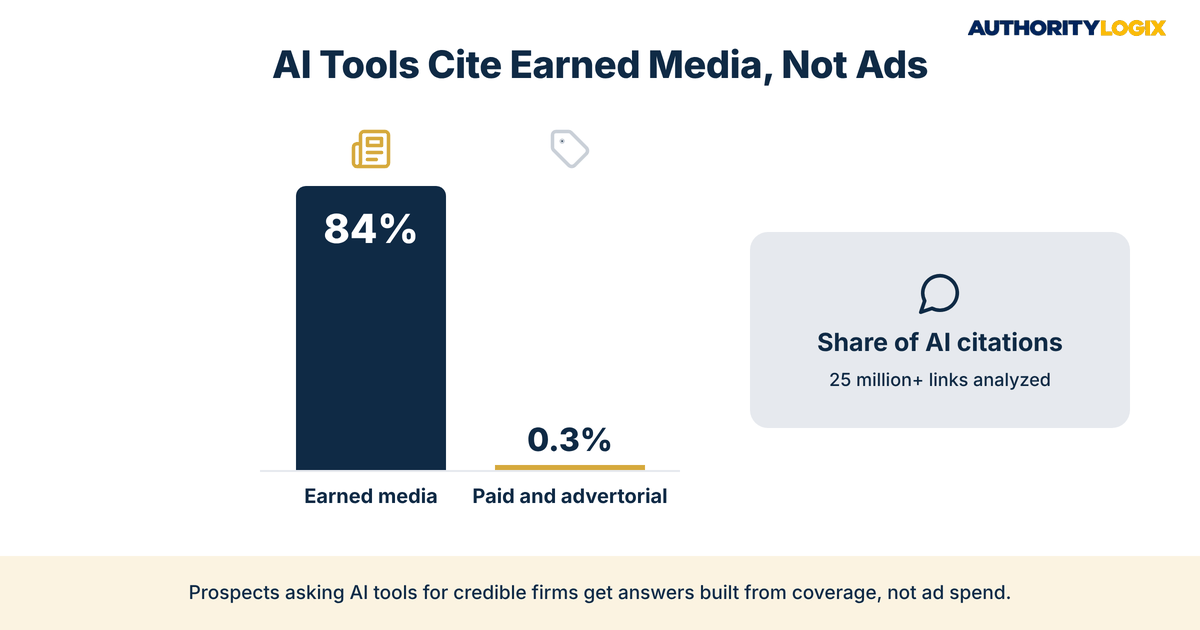
- Earned media accounts for 84% of the sources AI tools cite, while paid and advertorial content accounts for just 0.3%, according to Muck Rack’s May 2026 Generative Pulse analysis.
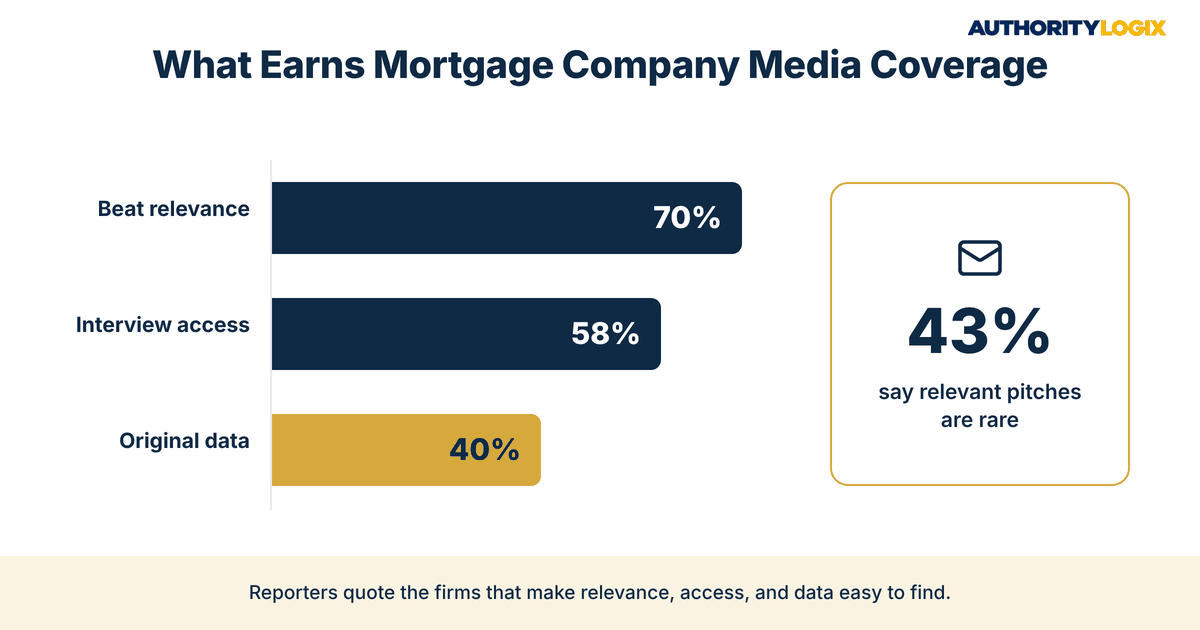
- Mortgage company media coverage starts with relevance: 70% of journalists want pitches that clearly fit their beat, and 40% want original data, per Muck Rack’s State of Journalism 2026.
- Advisor press coverage credibility depends on compliance discipline — FINRA Rule 2210(f) governs public appearances, so interviews need supervision built into the process.
- A lender earned media strategy works as a system: publish proprietary data, pitch the right beat, then distribute and link every mention back into the firm’s own platform.
- Financial services PR authority keeps working after the campaign ends, because coverage keeps getting cited, searched, and shared long after ad spend would have stopped.
Table of Contents
Financial services PR authority is the one form of credibility a mortgage company, DSCR lender, or advisory firm cannot buy outright — and most firms with 15 or 20 years of real expertise have almost none of it. You know your market. Yet when a borrower, an investor, or an AI assistant looks for a credible voice on your specialty, it finds the competitor quoted in a trade publication last quarter. That is the credibility gap in its purest form: credible but invisible.
Paid ads rent attention while the budget lasts. They cannot make an editor decide your view on rates or DSCR underwriting is worth printing. That decision is the value of earned media, and it is why financial services PR authority behaves differently from every other visibility channel a firm can fund.
Why Financial Services PR Authority Outlasts Paid Visibility
The clearest evidence comes from how AI search tools pick their sources. Muck Rack’s Generative Pulse report, published in May 2026 after analyzing more than 25 million links across 17 industries, found that earned media accounts for 84% of the citations returned by AI tools such as ChatGPT, Claude, and Gemini. Paid and advertorial content accounted for 0.3%. Journalism alone made up 27% of all cited links. When a prospect asks an AI assistant which lenders understand investment property financing, the answer is assembled from coverage, not ads.
That shift changes the math on visibility. Search rankings, AI answers, and referral validation now draw on the same pool of third-party signals, which is why the SEO playbook treats media mentions as part of search infrastructure rather than a separate publicity line item. A firm with strong financial services PR authority shows up in all three places at once. A firm relying on paid placement disappears from all three the day the budget pauses.
Trust is the other half of the equation. Edelman’s 2024 Trust Barometer supplemental report on financial services found that 62% of respondents trust financial services companies to do the right thing, with investment management lower at 54%. In a sector where roughly four in ten people start out skeptical, a journalist’s independent judgment carries weight a firm’s own claims do not — the gap financial services PR authority closes. Infrastructure compounds. Ads stop.
Coverage feeds the firm’s own platform rather than replacing it, and that platform has to prove the coverage was deserved. The financial services hub shows how content, distribution, and lead capture fit together so each earned mention lands on infrastructure built to convert it.
The Financial Services Authority Guide breaks down every trust signal lenders and advisors need to turn real expertise into credibility the market can see.
Mortgage Company Media Coverage: What Earns a Mention
Mortgage company media coverage rarely comes from announcing a new hire. Journalists cover what readers need, and the firms quoted are the ones that make a reporter’s job easier. Muck Rack’s State of Journalism 2026 report found that 43% of journalists say relevant pitches for their beat are rare. That scarcity is the opening.
The same survey shows what journalists actually want: 70% want clear relevance to their beat, 58% want interview access to relevant sources, and 40% want original data or research. Cision’s 2025 State of the Media report, based on more than 3,000 journalists across 19 markets, adds that 86% would immediately reject a pitch that does not match their beat or audience. Relevance is the filter that decides who earns financial services PR authority and who gets ignored.
The Financial Services PR Authority Assets Reporters Actually Use
The firms that earn repeat coverage build a library of material a reporter can use on deadline. That library usually starts as educational content written for borrowers and clients — explainers on DSCR ratios, rate-lock timing, or the documents a self-employed borrower needs — and becomes source material when a journalist needs an expert who has already explained the topic clearly. Four assets do most of the work:
- Proprietary data: loan-volume trends, average DSCR ratios on submitted deals, or regional rent-to-price observations from your own pipeline.
- A named expert with a clear specialty and a published point of view.
- Short, quotable answers to the questions borrowers and clients ask most often.
- A media page with a bio, headshot, and approved topics.
National outlets publish finance stories every day, and each one needs sourced expert voices. Forbes finance coverage alone runs pieces on student loans, taxes, and retirement savings — questions mortgage and advisory firms answer for clients every week. The firm that has already published clear answers builds financial services PR authority first.
Organization matters as much as volume. A reporter searching for a source on investor financing will trust a structured educational hub — topics grouped, internally linked, and kept current — far more than a chronological blog with three posts from 2023. Mortgage company media coverage tends to follow the firm whose expertise is easiest to verify.
Advisor Press Coverage Credibility and Compliance
For registered advisors and broker-dealer representatives, advisor press coverage credibility comes with a compliance layer that lenders face in a different form. FINRA Rule 2210 governs communications with the public, and paragraph (f) sets standards for public appearances, including interviews, seminars, and media commentary. FINRA’s Regulatory Notice 12-29 explains that firms must supervise public appearances through written policies and procedures, and that scripts, slides, and handouts used at them count as communications under the rule.
Compliance is not a reason to avoid building financial services PR authority. It is a reason to build the process before the first interview request arrives. Firms that pre-approve topics, keep reviewed talking points, and route quotes through compliance can say yes to a reporter on deadline. Firms without that process usually say no, and the reporter calls someone else.
Building Compliance Into Financial Services PR Authority
The safest material for a reporter is material that has already passed review. Pre-approved finance content — market commentary, borrower explainers, and planning frameworks written in plain language — gives compliance something stable to sign off on and gives journalists something accurate to quote. Advisor press coverage credibility grows when every quote matches what the firm has already published.
Cision’s report also found that 72% of journalists worry about factual errors in AI-generated PR content. In a regulated industry, that concern runs both ways: the reporter wants an accurate expert, and the firm wants nothing published to read as a recommendation or a promised outcome.
This is where most firms stall: producing reviewed, quotable material once is manageable, but producing it monthly alongside client work is not. Firms that sustain financial services PR authority usually run it through content systems that schedule topics, route drafts to compliance, and publish approved pieces on a fixed cadence, so the press-ready library grows without the principal writing every word.
Not sure where your firm stands on financial services PR authority? The FS Authority Gap Assessment shows where your authority signals are thin and what to build first.
Lender Earned Media Strategy as a Repeatable System
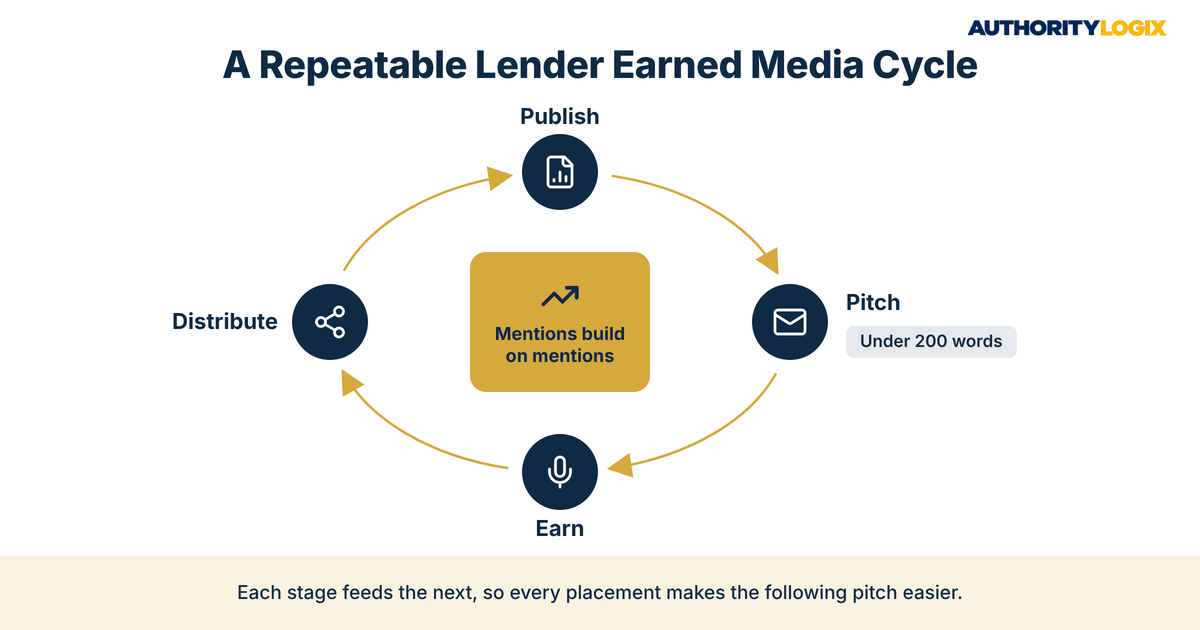
A lender earned media strategy fails when it depends on one lucky placement. The firms that keep getting quoted treat PR as a cycle with four stages, each one feeding the next. The goal is not a single headline but a steady pattern of mentions that builds financial services PR authority search engines, AI tools, and referral partners can all find.
| Stage | What the Firm Does | What It Produces |
|---|---|---|
| 1. Publish | Release proprietary data or a clear explainer on the firm’s own site | A citable source that seeds financial services PR authority |
| 2. Pitch | Send a one-to-one email under 200 words, matched to the reporter’s beat | Coverage requests and interview slots |
| 3. Earn | Provide interview access and pre-approved quotes on deadline | Independent mentions that build financial services PR authority |
| 4. Distribute | Syndicate, share, and link every mention back to the firm’s platform | Financial services PR authority that keeps working in search and AI |
The pitch details in that table come from the data. Muck Rack’s State of Journalism 2026 found that 69% of journalists prefer pitches under 200 words, 62% prefer a one-to-one email, and 78% prefer pitches sent before noon. The same report found that 86% of journalists say at least some of their work began with a PR pitch. A disciplined lender earned media strategy simply respects how reporters already work.
Where Financial Services PR Authority Gets Multiplied
Stage four is where most firms leave value behind. A mention in a trade publication reaches that publication’s readers once, but structured authority distribution — syndication, LinkedIn posts that reference the coverage, and an updated media page — extends its reach to every channel the firm controls. Each placement then supports the next pitch, because reporters check who else has quoted you.
None of the four stages work without a publishing engine underneath them. The content system behind a lender earned media strategy decides which data gets released each quarter, which explainers get refreshed, and which topics are pre-cleared for interviews. Without it, PR runs on bursts of effort that fade when the principal gets busy.
Turning Financial Services PR Authority Into Search and Referral Leads
Coverage has a shelf life, and the Generative Pulse data shows how long it lasts. More than half of the journalism that AI tools cite was published in the past 12 months, and citation volume drops sharply after the first six months. Financial services PR authority built from one 2023 feature is already fading. Authority that holds is built from a steady stream of recent mentions.
The fastest way to extend each placement is to put it in front of people who already know you. Referral partners, past clients, and real estate agents rarely read trade publications, but they do see the principal’s feed, which is why LinkedIn authority matters as a companion to media coverage. A short post on what the reporter asked turns one mention into a client conversation.
Search engines read coverage too. A linked mention is a third-party signal of expertise, and an unlinked one still adds to what AI tools draw on. Either way, financial services PR authority pays off only when the firm’s own pages confirm the impression the article created.
The final step is capture. A reader who finds the firm through an article should land on a page with a next step — a calculator, a guide, or a consultation request — not a generic homepage. That is the job of the lead system: it converts the trust that financial services PR authority creates into first-party inquiries the firm owns.
What Firms Get Wrong About Financial Services PR Authority
Most firms that try PR once and quit made one of a few predictable mistakes. Each is fixable, and each reflects a question owners ask before committing to financial services PR authority.
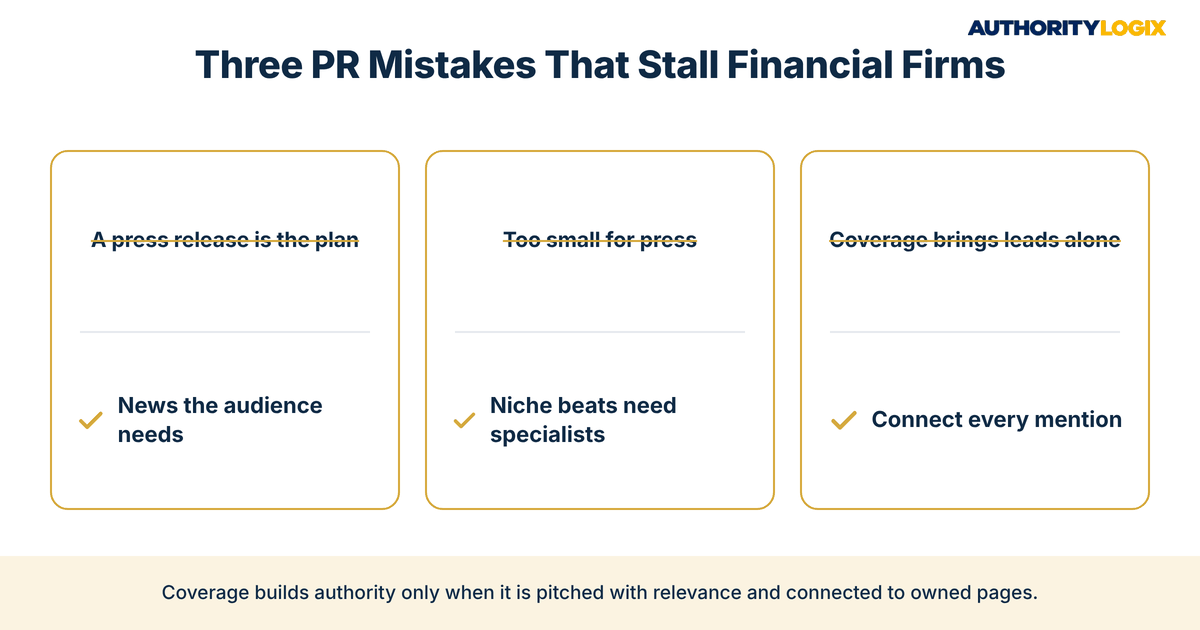
Mistake: Treating a press release as a PR strategy
A press release is a tool, not a plan. Cision found that 72% of journalists still call press releases the most useful resource PR teams provide, but a release only works when it carries news a reporter’s audience needs. Announcing a new branch rarely clears that bar, and even a strong release needs lead generation infrastructure on the receiving end, or the readers it attracts have nowhere to go.
Question: Can a smaller lender or advisor actually get press?
Yes, and smaller firms often have an advantage on local and niche beats. Reporters covering a specific housing market or investor segment need sources with direct knowledge, and a principal who closes DSCR loans in Queens every week knows more about that market than a national bank spokesperson. Building that positioning is a core part of what we do, because specificity is how a smaller firm earns financial services PR authority.
Mistake: Expecting coverage to produce leads on its own
A feature article does not call anyone back. Firms that see results connect each mention to an owned page, a follow-up offer, and a distribution plan, which is the sequence behind how we build authority platforms for financial firms. Financial services PR authority without that infrastructure produces a framed clipping and very little pipeline.
Question: How long before media coverage changes how prospects see the firm?
There is no fixed timeline, and any firm that promises one is guessing. What the data supports is cumulative effect: each recent mention adds to the financial services PR authority that search engines, AI tools, and prospects find, and the citation window favors firms that keep publishing.
Want earned media working for your firm instead of a one-time mention? We’ll turn your expertise into coverage that keeps building credibility.
Authority You Earn Cannot Be Outbid
The firms that will own their markets in five years are building assets a bigger budget cannot copy. A competitor can match your ad spend in a week. It cannot buy the three years of quotes, citations, and published expertise behind your name, which is why the growth playbook treats earned credibility as a long-term asset rather than a campaign.
The AuthorityLogix approach was proven on its own build first. BKDSCR.com was built in the NYC outer-borough DSCR market with 18 pillar pages, 7 investor tools, and 48 blog posts, and it generates inbound leads with zero paid ads. Seeing that build is the clearest explanation of why it works — infrastructure first, distribution second, and every piece connected.
The honest assessment is this: most lenders and advisors already have the expertise reporters are looking for. What they lack is the system that packages it, clears it through compliance, puts it in front of the right journalist, and connects every mention back to a platform built to convert. Financial services PR authority is earned one placement at a time, and if you want that system built around your firm, work with us is where it starts.