


Key Takeaways
- A financial services self running lead system is connected infrastructure — educational pages, resource offers, follow-up, and routing — that keeps producing inbound leads after the build.
- Speed decides qualification: the Lead Response Management study from MIT and InsideSales found the odds of qualifying a lead fall 21 times when the first call comes at 30 minutes instead of 5.
- HubSpot’s 2026 State of Marketing survey of more than 1,500 marketers found 93.8% say lead quality improved, yet 30% still call lead generation a top challenge.
- Kitces Research’s 2026 marketing study found SEO cost advisors $0.45 per dollar of new client revenue, against $4.14 for newsletters and $4.88 for social media.
- Mortgage company lead system automation should handle timing, delivery, and routing, while licensed people handle every specific conversation.
- A financial services self running lead system still needs the owner on a fixed schedule — you supply the judgment, and the system handles the distribution.
Table of Contents
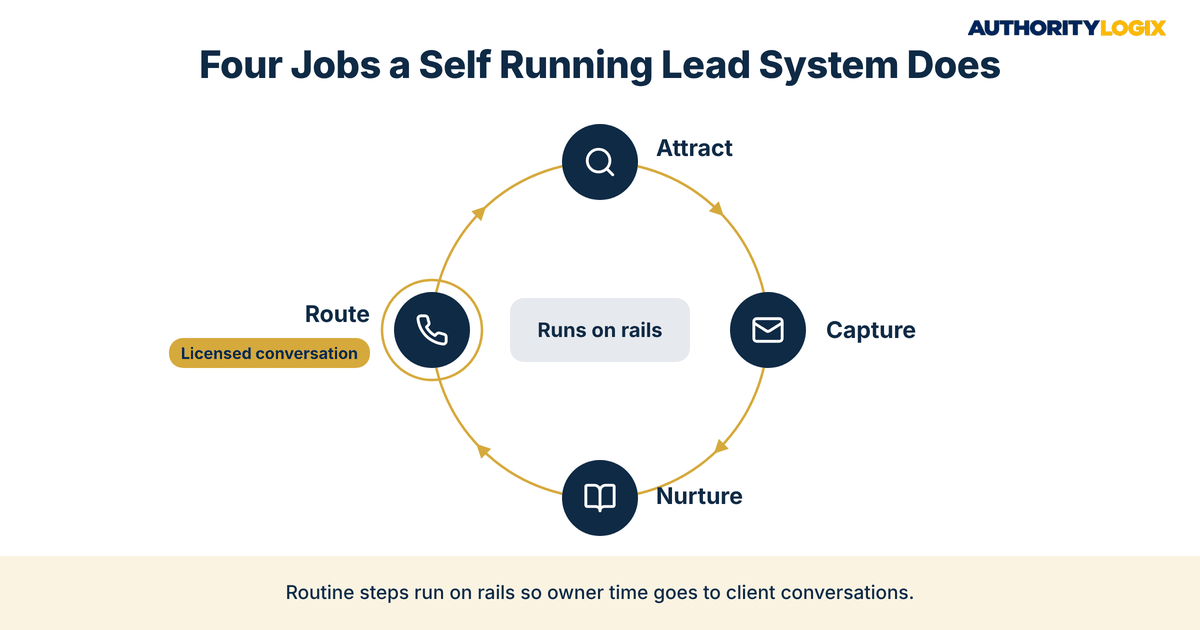
A financial services self running lead system is what most lenders and advisors actually mean when they say they need more leads. You have spent 15 or 20 years building expertise, and most new business still arrives through referrals you cannot schedule. The market trusts you once it meets you. Most of it never meets you, because nothing you have published works while you serve existing clients.
The fix is not more activity. A financial services self running lead system is infrastructure: educational pages that get found, useful offers that turn readers into contacts, follow-up that runs on a schedule, and routing that puts the right inquiry in front of the right person fast. Well-built lead magnets are usually the first component firms add, because they convert anonymous readers into named prospects. Below is how each piece works and how the pieces connect.
What a Financial Services Self Running Lead System Actually Is
A financial services self running lead system is a set of connected assets that does four jobs without the owner starting each one by hand. It attracts prospects through search and distribution, captures their contact details in exchange for something useful, nurtures them with education until they are ready, and routes them to a licensed person at the moment of intent. Self-running does not mean hands-off. It means the routine motion happens on rails, so your time goes to conversations instead of chasing.
Most firms already own pieces of a financial services self running lead system: a website, a CRM, maybe a newsletter. What they lack is the connection between them. A blog post with no next step, a form that drops leads into an unwatched inbox, a list that hears from you once a quarter — each is idle, and idle components produce nothing.
Why a Financial Services Self Running Lead System Beats Referral Dependence
Referrals remain the most trusted source of new business in financial services. The issue is control. Kitces Research’s 2026 marketing study of 506 advisors found that high-growth advisory firms get only about a third of their new client revenue from referrals, while slower-growing peers rely on referrals for roughly 80%. The fast growers added channels they control.
Controlled channels borrow the credibility that earns referrals. A prospect who reads three of your explanations before calling arrives partly trusting you, which is the principle the authority guide lays out in detail. When your trust signals are visible online, the system can do the introducing that a referral partner used to do.
Buyers now decide most of the way before contact. Gartner’s research on B2B buying found that buyers spend only 17% of their buying time meeting with potential suppliers and 27% researching independently online. Everything on the AuthorityLogix services hub for financial firms is organized around that reality: most of the decision happens before anyone picks up the phone, and a financial services self running lead system is built to be present for it.
The Financial Services Growth Playbook shows how a financial services self running lead system fits into a long-term growth plan that compounds instead of resetting every quarter.
Advisor Expertise to Leads Infrastructure: The Inputs
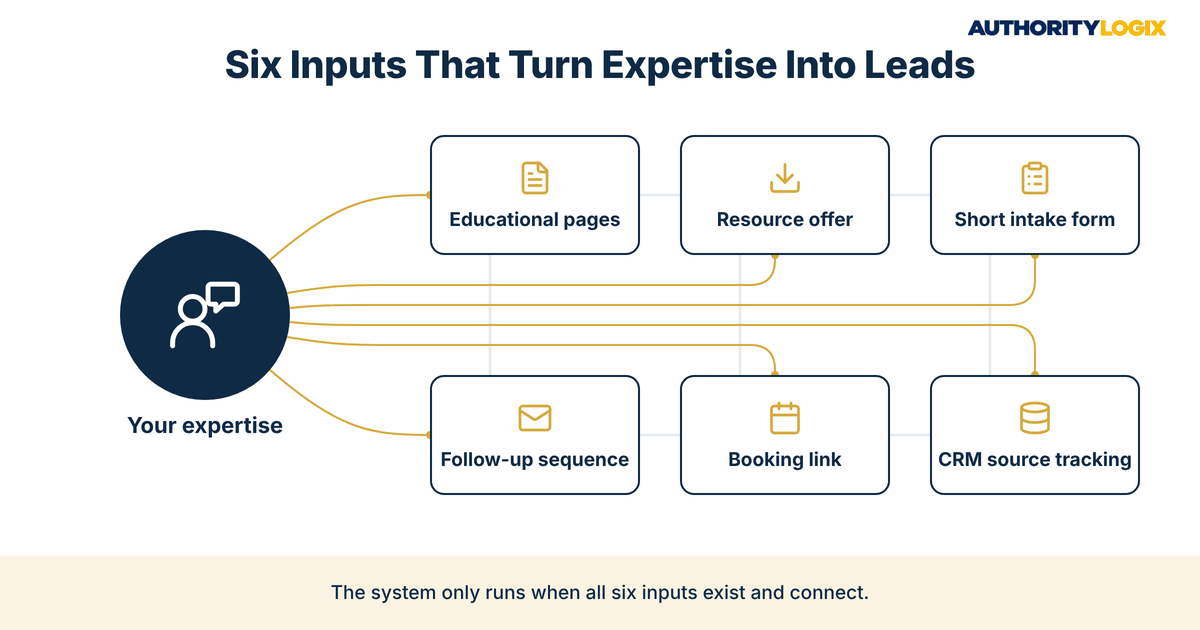
In financial services, the raw material is you. Advisor expertise to leads infrastructure starts with the questions clients ask in every first meeting: how a DSCR loan is underwritten, what a self-employed borrower must document, what a retiree should bring to a planning review. The infrastructure turns those answers into assets that work while you are in meetings.
A financial services self running lead system needs six inputs. It only runs when all six exist and connect.
- Educational pages that each answer one specific question, written to be found in search
- A downloadable resource, such as a borrower document checklist or a retirement-income question guide
- A short intake form that asks only what you need to route the inquiry
- An automated follow-up sequence that delivers education over several weeks
- A booking link tied to a real calendar, so ready prospects can act immediately
- A CRM that records where every lead came from
The follow-up sequence is where most firms underinvest. A prospect who downloads a checklist in March may not be ready until August, and without a structured email nurture path that gap is where the lead goes cold. Each message should teach one thing and offer one next step.
Where the Expertise Lives Once It Is Published
Scattered posts do not add up to authority. Grouping your explanations by topic inside an educational hub tells search engines and prospects that your firm covers a subject in depth, and gives every new article a home. That structure is what lets one piece of advisor expertise to leads infrastructure keep producing inquiries for years instead of weeks.
BKDSCR.com, the AuthorityLogix proof-of-concept in the NYC outer-borough DSCR niche, was built this way: 18 pillar pages, 7 interactive investor tools, and 48 SEO-optimized blog posts organized around investor questions. It generates inbound leads organically with zero paid ads, and it was built in under 18 months. The pages and tools are the inputs; the connections are what turn them into a financial services self running lead system.
Mortgage Company Lead System Automation Without Losing the Human Touch
Mortgage company lead system automation earns its keep in one place above all others: speed. The Lead Response Management study, led by Dr. James Oldroyd of MIT with InsideSales.com and drawn from more than 15,000 leads and 100,000 call attempts, found that the odds of contacting a lead fall 100 times when the first call comes at 30 minutes instead of 5. The odds of qualifying that lead fall 21 times over the same window.
Harvard Business Review’s audit of 2,241 companies, “The Short Life of Online Sales Leads,” found an average response time of 42 hours among firms that responded at all, and 23% never responded. Firms responding within an hour were nearly 7 times as likely to qualify the lead as those that waited an hour longer.
No loan officer can answer every inquiry in five minutes from a closing table. Automation closes that gap by confirming instantly, delivering the resource, alerting the right person by text, and offering a booking link. Mapping those steps is the core of any lead funnel, and in a financial services self running lead system that map comes before any software purchase.
The human touch belongs where judgment and licensing do. Automation should never quote rates, approve scenarios, or give individualized recommendations; those conversations stay with licensed people and inside your compliance process. Automation makes sure every inquiry is acknowledged and every prospect hears from a person while interest is high. Documented content systems make this split easier, because approved material is ready for every automated message.
The market is moving the same way. In HubSpot’s 2026 State of Marketing report, automation ranked as the second most-cited trend, named by 47.4% of marketers, behind AI-personalized content. The same survey found 93.2% of marketers say personalized or segmented experiences led to more leads and purchases, which is exactly what a segmented mortgage company lead system automation sequence is designed to deliver.
Not sure where your firm stands on building a financial services self running lead system? The assessment shows which components you already have and which connections are missing.
Lender Authority Lead Generation Machine: How the Pieces Connect
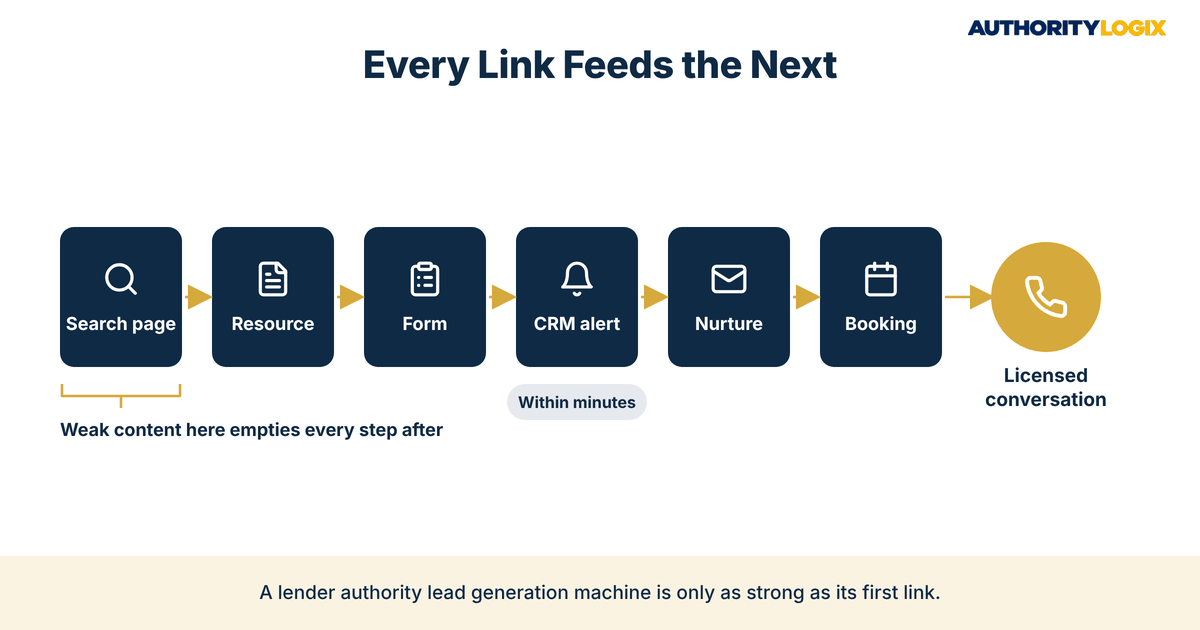
A lender authority lead generation machine is the same set of inputs wired together so each one feeds the next. Search brings a borrower to an educational page, the page offers a resource, the resource captures an email, the sequence educates, and the booking link converts. Getting found is the first link in that chain, and the SEO playbook covers how lenders and advisors earn those first visits.
The table below maps each component of a financial services self running lead system to its job and to the component it feeds. Read it top to bottom, in the order a prospect moves through it.
| Component | Its Job in the System | What It Feeds |
|---|---|---|
| Search-ready educational page | Answers one question a borrower or client is already searching | Resource offer |
| Resource offer | Converts an anonymous reader into a named contact | Intake form |
| Intake form | Captures only what routing requires | CRM and instant alert |
| CRM and instant alert | Records the lead source and notifies the right person within minutes | Nurture sequence and booking link |
| Nurture sequence | Delivers education until the prospect is ready to talk | Booking link |
| Booking link | Lets a ready prospect schedule without phone tag | Licensed conversation |
Every row in a financial services self running lead system depends on the one above it. If the educational pages are thin, nothing downstream fills, which is why the quality of your finance content matters more than the sophistication of the automation behind it. A lender authority lead generation machine with weak content at the top is an expensive way to send emails to nobody.
Testing a Financial Services Self Running Lead System Before You Trust It
Before calling the system self-running, test it end to end. Submit your own form, download your own resource, and time how long a person takes to reach you. Then confirm the CRM recorded the source and the nurture sequence started. Most firms find at least one broken connection, and each is a place where leads were quietly leaking.
Keeping a Financial Services Self Running Lead System Running With Minimal Owner Time
The owner’s time is the scarcest input, so a financial services self running lead system has to be designed around it. Kitces Research found the most efficient advisory firms rely less on the advisor’s own time as they grow, and its channel data shows why channel ownership matters. SEO cost advisors $0.45 in marketing spend per dollar of new client revenue and client referrals cost $0.34, while newsletters cost $4.14 and social media cost $4.88.
The same study found social media’s cost fell to $0.45 per dollar when fully outsourced, versus $1.77 when advisors ran it themselves. Specialists executing a defined system beat sporadic effort by a busy owner, even on the same channel.
The practical structure is a fixed rhythm. You supply expertise in a recorded interview or a short review session each month, and a documented content system turns that input into articles, resource updates, and nurture emails. You approve it for compliance, but never write it from scratch.
Distribution is the other half. After publishing, syndication, LinkedIn positioning, and email delivery run on schedule without weekly owner decisions. Structured authority distribution puts every new asset in front of a qualified audience automatically, turning one round of expertise into months of visibility.
HubSpot’s 2026 survey also found 83.5% of marketers are expected to produce more content than before. That pressure is why a financial services self running lead system built on reuse, with one interview feeding an article, a resource update, and several emails, outperforms trying to publish more from scratch. Infrastructure compounds. Ads stop.
What Firms Get Wrong About a Financial Services Self Running Lead System
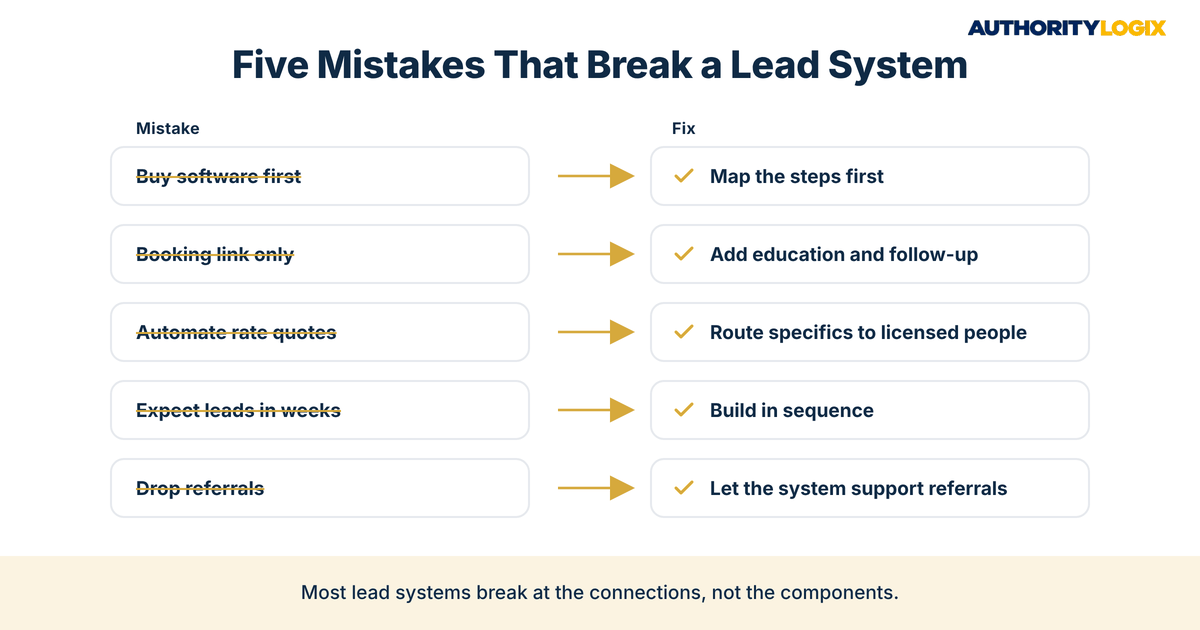
Most broken systems fail at the connections. These are the questions and mistakes that come up most often when lenders and advisors build a financial services self running lead system.
Can we buy software and call it a system?
No. Software automates steps you have already defined; it does not define them. A financial services self running lead system starts with mapped steps, and firms that buy a CRM first usually end up with an expensive contact list.
Is a booking link enough on its own?
A booking link only converts prospects who are already ready, which is a small share of any audience. Pairing it with education and follow-up, the core of structured lead generation infrastructure, captures the larger group still researching. Without it, the system only harvests demand someone else created.
Should automated messages include rate or product details?
Keep automated messages educational and route anything specific to a licensed person under your compliance review. Automated individualized recommendations create regulatory risk the system was never meant to carry. That boundary is part of what we do for every financial services firm, because compliance-aware content is a requirement, not an add-on.
How long until the system produces leads?
Search-driven components take months, not weeks. Capture and nurture components can start working with the traffic you already have, which is why build order matters. The sequence of foundation pages, then capture, then nurture, then distribution is laid out in how we build, so early components produce value while later ones mature.
Do we stop asking for referrals?
Never. A financial services self running lead system makes referrals stronger, because referred prospects check you out online before they call. When they find depth, the referral moves forward with less friction.
Ready for a lead system that runs without daily pushing? We’ll connect the content, capture, and follow-up so it works on its own.
Expertise Is the Asset
The honest assessment is that a financial services self running lead system is not a shortcut. It takes a deliberate build, months for search components to mature, and steady owner input. For a deeper look at pipeline mechanics, the lead system framework walks through each stage from first visit to booked meeting.
What it replaces is worth the effort: the feast-and-famine cycle of referral-only growth and the treadmill of paid leads that stop the day the budget stops. Every component of a financial services self running lead system keeps working after it is built, and each one makes the next more effective, which is why it works for firms whose expertise is already real.
Most lenders and advisors already have the expertise the system needs. The missing piece is the infrastructure that makes the market see it, and if you want that infrastructure mapped around your firm, you can work with us to start with the components you already own.