


Key Takeaways
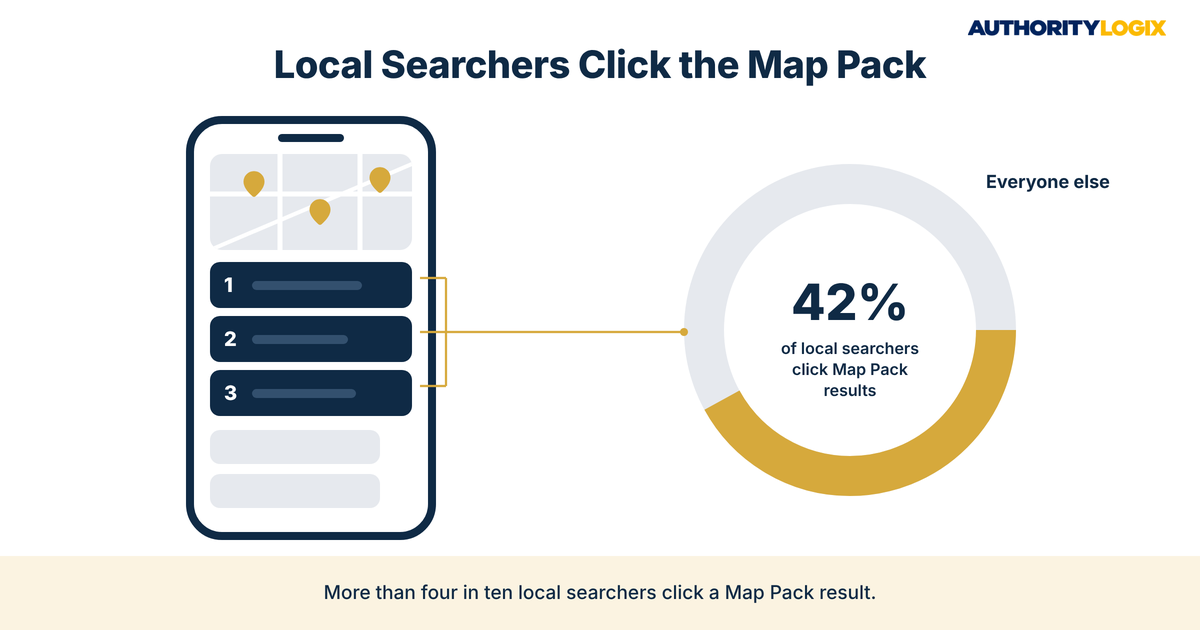
- Google map pack mortgage clicks are not shared evenly — the three listings in the local pack sit above the organic results, and Backlinko reports that 42% of local searchers click results inside the Map Pack.
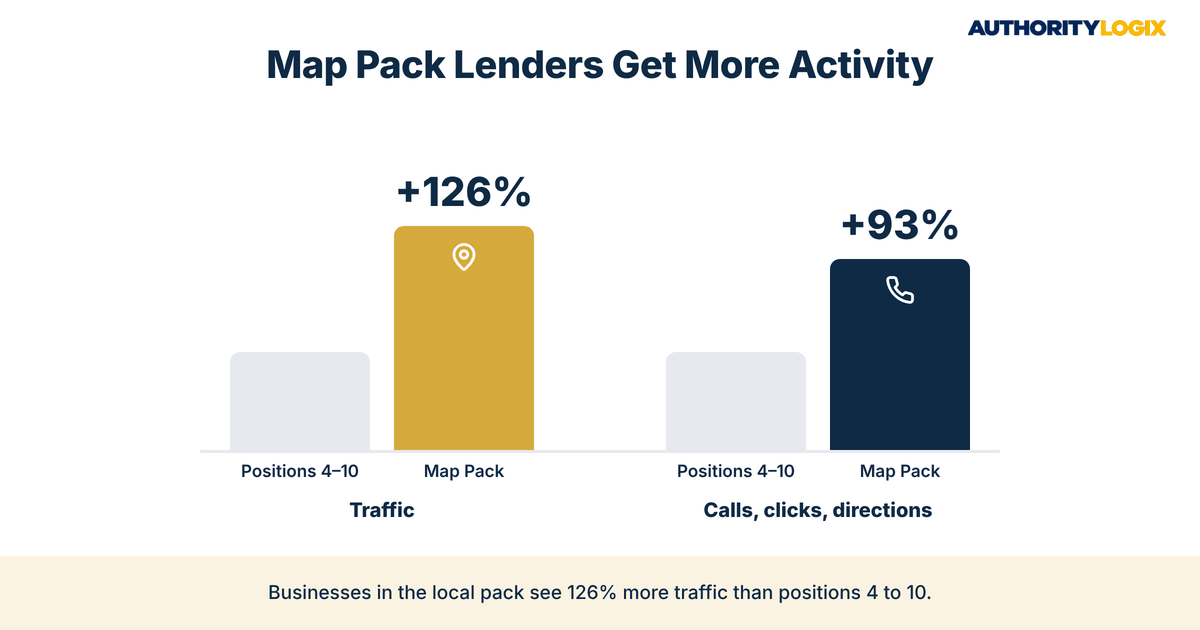
- Map pack businesses see 126% more traffic and 93% more calls, clicks, and direction requests than businesses ranked 4 through 10, according to SOCi data compiled by Semrush.
- Google states that local rankings — and the Google map pack mortgage clicks that follow — rest on relevance, distance, and prominence — and that there is no way to pay for a better local ranking.
- Review recency now carries real weight: 74% of consumers look for reviews written in the last three months, according to BrightLocal’s 2026 Local Consumer Review Survey.
- Winning Google map pack mortgage clicks is only half the job — the profile, the website, and the follow-up system decide whether a click becomes an application.
- Lenders outside the top three are rarely less qualified. They are credible but invisible, and the gap is infrastructure, not expertise.
Table of Contents
Google map pack mortgage clicks decide which lenders get the first call in almost every local market, and most lenders never see that decision being made. A borrower types “mortgage lender near me,” Google returns three businesses on a map, and the conversation usually starts with one of those three. Lenders who have invested in local SEO already know the map is where local intent lands — what fewer have measured is how steeply the clicks fall off after position three.
You may have 20 years of closed loans and a referral network every agent in town respects. None of that shows up on the map unless the infrastructure behind your Google Business Profile tells Google it should. This article covers how Google map pack mortgage clicks are distributed, who earns the top three positions, and what lenders can build to compete — without paying for placement, because Google does not sell it.
Why Google Map Pack Mortgage Clicks Concentrate in Three Positions
The local pack is the block of three map results Google shows above the standard organic listings for searches with local intent. On most phones it fills the first screen, so the borrower sees three lenders before anything else. Backlinko’s local SEO statistics show that 42% of people who run a local search click on results inside the Google Maps Pack. Lenders below position three are left competing for Google map pack mortgage clicks with organic results and ads.
That concentration is not a quirk. The pack shows ratings and review counts at a glance, and borrowers treat the three listings as Google’s shortlist. A lender in position four is not slightly less visible than a lender in position three — for most borrowers, that lender is not on the page they read. Google map pack mortgage clicks reward the shortlist and starve everyone else.
How Google Map Pack Mortgage Clicks Fall Off After Position Three
SOCi data compiled by Semrush found that businesses in the local map pack get 126% more traffic than businesses ranked 4 through 10, along with 93% more calls, website clicks, and direction requests. For a lender, those three actions are the front end of the funnel.
This is where credibility and visibility separate. The signals a borrower uses to choose among the three — star rating, review count, review recency, and a complete profile — are the same signals the authority guide treats as the foundation of lender credibility. The most respected lender in a county can still lose Google map pack mortgage clicks to a competitor with a better-maintained profile.
That gap is why this work belongs inside a visibility system rather than a one-time listing cleanup. The full set of FS services on the services hub shows the map pack as one layer of a connected platform. Lenders that treat it as a standalone tactic tend to win Google map pack mortgage clicks briefly and lose them within a year.
The Financial Services SEO Playbook covers how lenders and advisors build search visibility in local markets — from the map pack to the organic results beneath it.
Mortgage Local Pack Statistics Every Lender Should Know
Mortgage local pack statistics only matter if they change what a lender builds. Ellie Mae’s Connecting with Borrowers Online study found that 92% of borrowers researched online before contacting a lender, and our breakdown of mortgage search statistics covers that broader journey. The figures below focus on the local pack, where research turns into a phone call.
| Metric | Figure | Source |
|---|---|---|
| Local searchers who click results inside the Google Maps Pack | 42% | Backlinko |
| Extra traffic for map pack businesses compared with positions 4–10 | 126% more | SOCi, via Semrush |
| Extra calls, website clicks, and direction requests for map pack businesses | 93% more | SOCi, via Semrush |
| Average Google reviews for businesses in the top three local spots (all categories) | 561 reviews, 4.8-star average | Semrush |
| Consumers who look for reviews written in the last three months | 74% | BrightLocal, 2026 |
| Consumers who only use businesses rated 4.5 stars or higher | 31%, up from 17% | BrightLocal, 2026 |
The 561-review average comes from Semrush’s study of top-three local businesses across all categories, not mortgage alone, and most mortgage markets run far lower. That is useful news for any lender chasing Google map pack mortgage clicks, because the bar is set by local competitors, not national averages.
BrightLocal’s 2026 survey of 1,002 adults also found that 41% always read reviews when looking for a business, up from 29% a year earlier, and that 80% are more likely to use a business that replies to all of its reviews. Across mortgage local pack statistics, the pattern is consistent: Google map pack mortgage clicks go to activity that is recent, visible, and sustained.
Map visibility also cannot be separated from what sits behind the profile. A borrower behind one of those Google map pack mortgage clicks lands on your website, and if that site answers nothing, the click is wasted. Lenders who pair a strong profile with an educational hub give that borrower a reason to stay and call.
What Determines Lender Map Pack Visibility
Lender map pack visibility starts with a rule Google states in its Business Profile help documentation: local results are based mainly on relevance, distance, and prominence. Relevance is how well a profile matches the search, distance is how far the business is from the searcher, and prominence is how well known the business is, shaped by links, reviews, and ratings. Google adds that there is no way to request or pay for a better local ranking.
Distance is the one factor a lender cannot change without moving offices. The other two are built, which is why two lenders on the same street can hold very different shares of Google map pack mortgage clicks.
The Ranking Signals Behind Google Map Pack Mortgage Clicks
Whitespark’s 2026 Local Search Ranking Factors report, built from a survey of 47 local search experts scoring 187 factors, lists the primary Google Business Profile category as the top factor for local pack rankings. Proximity, keywords in the business title, and a physical address in the city of search follow closely. Review rating, quantity, recency, and a steady flow over time all sit in the top 15.
The business title should match the name the firm actually operates under, because Google’s guidelines prohibit keyword stuffing there. Most other signals are set once and neglected — a wrong primary category or missing service area can hold a lender back for years. Our walkthrough of GBP setup for mortgage lenders covers each field in order.
Prominence is where the longer build happens. Reviews, links, and mentions accumulate slowly, and they accumulate fastest for firms whose content systems keep producing material worth citing. Lender map pack visibility is earned off the map as much as on it.
Not sure where your firm stands on lender map pack visibility? The FS Authority Gap Assessment shows which local signals are missing and what to build first.
Raising Mortgage Search Click Through Rate From the Map Pack
Earning a top-three position is half the job. The other half is mortgage search click through rate — whether the borrower chooses your listing over the two beside it. Whitespark’s 2026 report ranks click-through rate from Pack and Maps results as the 13th most important local factor, so listings that earn Google map pack mortgage clicks tend to keep their positions.
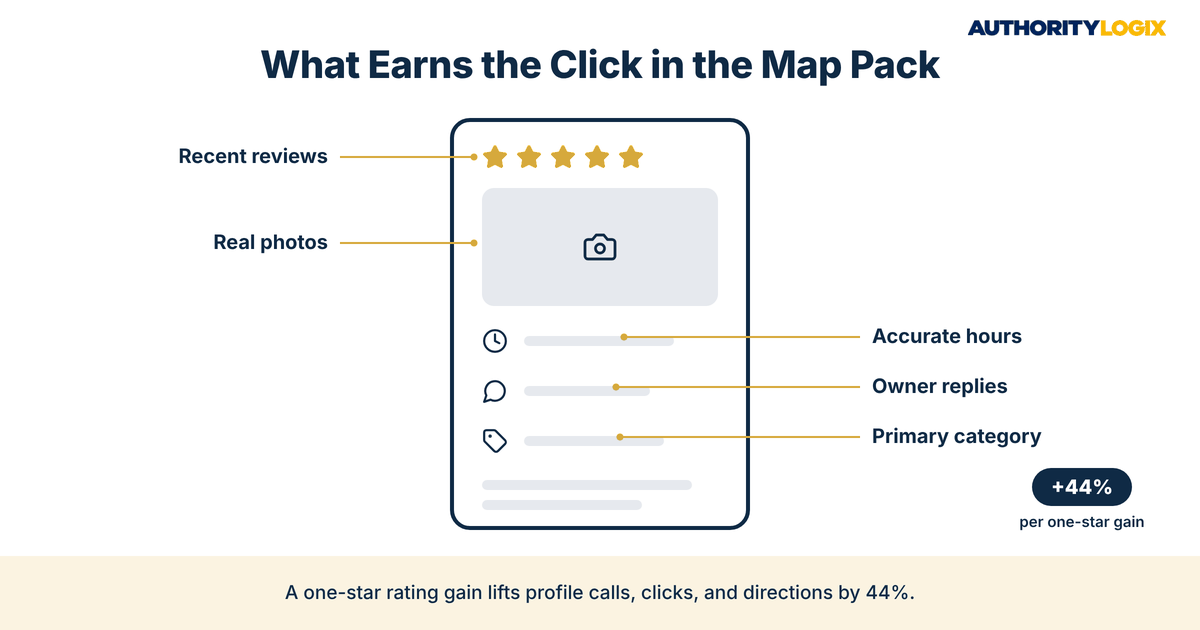
Borrowers decide on what the listing shows: rating, review count, the latest review, photos, hours, and category. SOCi data compiled by Semrush found that a one-star rating increase lifts calls, website clicks, and direction requests from a profile by 44%, and that every 10 new reviews raise profile conversion by 2.8%.
Five Listing Elements That Lift Google Map Pack Mortgage Clicks
- Review recency: a steady flow of new reviews, since 74% of consumers look for reviews from the last three months.
- Owner replies: a written response to every review, from a person rather than a template — BrightLocal found 50% of consumers are put off by generic replies.
- Real photos: the office and team, not stock images.
- Accurate hours and services: listed loan programs that match what the firm actually offers.
- A specific primary category: the category that matches the firm’s core business, set and verified.
None of these elements is complicated, but each one decays when nobody owns it. That is the argument for treating the profile as part of a content system rather than a listing someone set up three years ago. Review replies and photo updates then run on the same schedule as the website.
Mortgage search click through rate also depends on what the borrower expects on the other side. A listing that links to a page answering the question behind the search earns a better click than one that links to a generic homepage. That landing page work is finance content built for a specific borrower, and it is why some Google map pack mortgage clicks convert while others bounce.
Turning Google Map Pack Mortgage Clicks Into Applications
A click is not a lead, and a lead is not an application. Google map pack mortgage clicks arrive as a call, a website visit, or a direction request, and each needs its own path forward. Organic mortgage conversion rates vary widely from one firm to the next, a spread that reflects how much the site and the follow-up decide the outcome.
The call is the simplest path and the easiest to lose. If the profile number rings to voicemail during business hours, the borrower moves to the next listing and those Google map pack mortgage clicks are gone. A website visit needs a page that answers a question, shows the NMLS ID, and offers a clear next step.
Borrowers who are not ready to apply still have questions, and a calculator, guide, or checklist keeps the conversation going after the first visit. The full framework for that pipeline lives in the lead system resource, which maps each stage from first visit to application.
For most lenders, the gap is not traffic but follow-up. Google map pack mortgage clicks arrive, the borrower browses, and nothing captures the visit. Firms that build lead generation infrastructure behind the profile turn a share of those visits into contacts they can serve over weeks or months.
What Lenders Chasing Google Map Pack Mortgage Clicks Get Wrong
Most lenders outside the top three are not doing nothing — they are doing the wrong things, or the right things once. Here are the common mistakes and questions.
Mistake: Treating the profile as a one-time setup
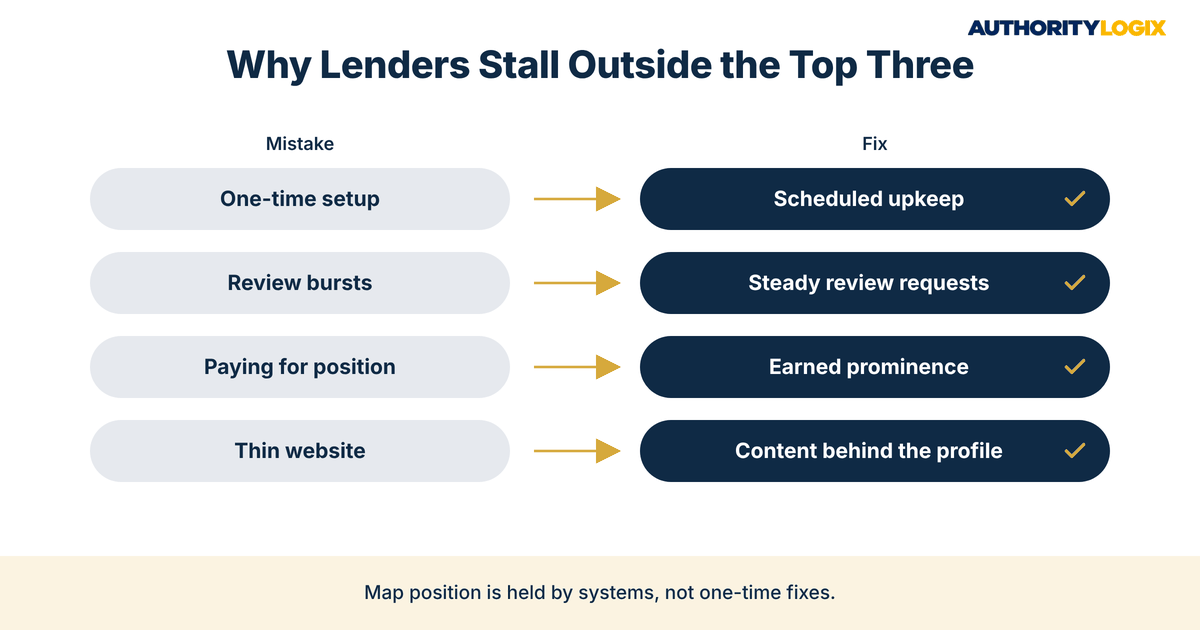
A profile completed in 2021 and untouched since is competing for the same Google map pack mortgage clicks as profiles updated every week. Reviews age and photos go stale, so someone, or some system, has to maintain it on a schedule.
Mistake: Asking for reviews in bursts
A push for 40 reviews in one month followed by silence leaves the profile stale six months later. A steady request after every closed loan — never with incentives, which Google’s policies prohibit — works better than a campaign. The same steady approach applies to mentions and links across the web, the work authority distribution is designed to handle.
Question: Can we pay Google for a better map position?
No. Google’s documentation states there is no way to request or pay for a better local ranking, so organic Google map pack mortgage clicks cannot be bought. Local Services Ads and search ads sit in separate placements and stop the day the budget stops. Infrastructure compounds. Ads stop.
Question: How long does it take to reach the top three?
It depends on the market, the competition, and the starting point, and anyone promising a fixed timeline is guessing. The honest first step is an audit of the profile, the site, and the review base — that audit is what we do at the start of every engagement.
Mistake: Fixing the map and ignoring the website
Prominence is shaped partly by links and mentions from other websites, and the website is where those links point. A lender with a strong profile and a thin site will plateau, because the profile has nothing behind it worth citing. The sequence — foundation, then content, then distribution — is laid out in how we build, the process behind every engagement.
Ready to move your office into the map results borrowers call from? We’ll build the profile, review flow, and local pages that earn the spot.
Three Positions, One Market, No Shortcut
Three positions per search, per market, is a fixed supply. Every lender in your area is competing for the same three spots and the same Google map pack mortgage clicks, and the firms holding them will not give them up by accident. The longer view of how that position becomes a durable asset is covered in the growth playbook.
BKDSCR.com, the AuthorityLogix proof-of-concept in the NYC outer-borough DSCR niche, was built with 18 pillar pages, 7 investor tools, and 48 posts — and zero paid ads. That build is the reason we can explain why it works from experience rather than theory: the visibility came from infrastructure, not ad spend.
The honest assessment is this. Most lenders who lose Google map pack mortgage clicks are not losing to better lenders — they are losing to better-maintained profiles, steadier reviews, and websites that give Google something to trust. If you want that infrastructure built rather than patched, the place to begin is a conversation, and work with us explains how it starts. The expertise is already yours; the work is making the market see it.