


Key Takeaways
- Mortgage Google search statistics consistently show that the majority of borrowers begin their lender research online — before calling anyone, before asking a referral, before filling out a form.
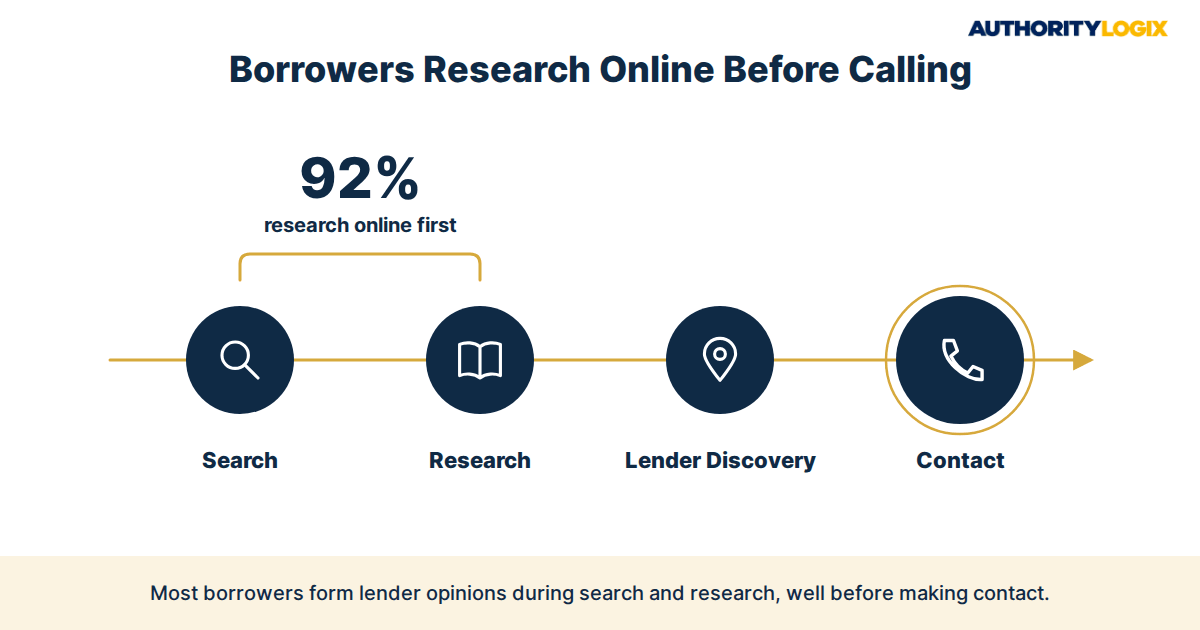
- 92% of borrowers did online research before reaching out to a lender, according to Ellie Mae’s Connecting with Borrowers Online study — up from 57% five to ten years earlier.
- Many of today’s homebuyers prefer handling much of the mortgage process online, yet most lenders remain invisible in the searches that trigger that journey.
- The lender a borrower finds first carries a significant trust advantage — being present at the research stage is not a marketing preference, it is a competitive position.
- Lenders who are not ranking for the searches their borrowers are running are not losing to better lenders — they are losing to lenders with better infrastructure.
- Visibility in mortgage search is an infrastructure problem, not a content volume problem. Posting more does not fix it. Building the right architecture does.
Table of Contents
What Mortgage Google Search Statistics Actually Tell Lenders
Mortgage Google search statistics have been telling lenders the same thing for nearly a decade — and most lenders are still not listening. Borrowers do not start their mortgage journey at an open house, a referral call, or a bank branch. They start it at a search bar. Authority guide principles apply here directly: the professional who shows up in that first search has a credibility advantage that is nearly impossible for a competitor to overcome later in the process.
Ellie Mae’s Connecting with Borrowers Online study found that 92% of recent mortgage borrowers did online research before reaching out to a lender — compared to just 57% of borrowers five to ten years prior. That gap is not a trend. It is a structural shift in how borrowers select a lender, and it has compounded every year since.
The implication for lenders is straightforward: if you are not present in the searches your borrowers are running, you are not in the consideration set. Referrals still matter — but they matter to the lender the borrower finds when they go online to validate the recommendation. The lender who ranks is the one who gets the call.
The Financial Services SEO Playbook covers how lenders, advisors, and mortgage companies build search visibility that compounds month over month.
The Mortgage Google Search Statistics Lenders Should Know
The 92% figure in this article’s title comes from the Ellie Mae study above, as reported in Ellie Mae study coverage. Here is what the data shows:
| Metric | Statistic | Source |
|---|---|---|
| Borrowers who research online before contacting a lender | 92% | Ellie Mae Connecting with Borrowers Online |
| Borrowers who researched where to get the best rate online | 72% | Ellie Mae Connecting with Borrowers Online |
| Borrowers who researched how much they qualified for online | 59% | Ellie Mae Connecting with Borrowers Online |
| Borrowers who researched lender trust online | 48% | Ellie Mae Connecting with Borrowers Online |
| Purchase borrowers who spent 10+ hours in online research | 2x more than refinance borrowers | Ellie Mae Connecting with Borrowers Online |
| Borrowers whose first lender contact was online | 34% | Ellie Mae Connecting with Borrowers Online |
What these numbers describe is a borrower journey that is almost entirely online before any lender interaction occurs. The lender a borrower encounters first — through a search result, a blog post, a local SEO guide, or a comparison page — owns the first impression. That first impression carries weight all the way through the decision process.
There is a second layer to this data that matters to lenders specifically: purchase borrowers — the highest-value segment for most lenders — were twice as likely as refinance borrowers to spend more than 10 hours researching online, according to Ellie Mae. They are not passively clicking. They are evaluating, comparing, and forming opinions. The lender whose content systems are built to serve that research phase will be in the conversation. The lender who is not visible at that stage will be out of it before the phone rings.
What Borrowers Are Actually Searching For — and When
Understanding mortgage Google search statistics at a surface level is useful. Understanding the search journey beneath the statistics is what separates lenders who use this knowledge from those who nod at it.
Borrowers do not search for a lender. They search for answers. The progression looks like this:
| Stage | What the Borrower Is Searching | What the Lender Needs |
|---|---|---|
| Awareness | “How much house can I afford?” / “What is a DSCR loan?” | Educational content that answers the question and introduces the firm |
| Consideration | “Best mortgage rates [city]” / “FHA vs conventional loan” | Comparison content, rate transparency, local SEO presence |
| Intent | “DSCR lenders near me” / “[lender name] reviews” | Strong GBP, review profile, trust signals, branded authority |
| Contact | Direct search for lender name or phone number | Fast-loading contact page, clear CTA, online application capability |
Most lenders build for the last two stages. They optimize their homepage, make sure their phone number is visible, and set up a basic loan application form. That is the minimum — and competing only at the minimum means the borrower has already formed an impression before they arrive.
The firms that win the research stage own the consideration stage by default. If a mortgage company’s blog answered the borrower’s question in week one of their research, that lender walks into the intent stage with a trust advantage that a competitor cannot buy with ad spend. The lead generation infrastructure that captures borrowers at the awareness stage costs far less per lead than the advertising needed to intercept them at the intent stage.

Why Most Lenders Are Invisible at the Moment That Matters
Mortgage Google search statistics describe a borrower behavior that most lenders acknowledge in meetings and ignore in practice. The reason is structural. Building visibility in search requires infrastructure — and most lenders have built a website, not a platform.
A website has a homepage, a few loan product pages, and a contact form. A platform has optimized loan program pages, educational content answering the questions borrowers are actually searching, a Google Business Profile that is actively managed, a local citation footprint that sends consistent NAP signals, and a blog that builds topical authority month after month. The difference between the two is the difference between being in the consideration set and being invisible. The financial services hub exists precisely because lenders need to see what a full platform looks like before they can build one.
The myth that drives most lenders’ inaction is that search visibility is a volume problem. Post more. Write more. Publish more. But a lender can publish two blog posts a week for a year and remain completely invisible if the architecture underneath those posts is not set up to signal topical authority to Google. Volume without infrastructure is just noise.
The Three Visibility Gaps the Mortgage Google Search Statistics Reveal
1. No content at the awareness stage. Across the mortgage and DSCR space, this is the first of three gaps that appear consistently. Lenders write about their loan products, not about the borrower’s questions. The borrower who searches “what is a debt service coverage ratio” or “how do I qualify for an investment property loan” finds a lender who answered that question. The lender who only wrote about their rates finds no one.
2. Thin or unoptimized loan program pages. Individual loan product pages — DSCR, FHA, VA, jumbo — are among the highest-converting pages a mortgage website can build. Most lenders have versions of these pages that are 150 words of boilerplate. A properly built loan program page answers every question a searcher has, targets the specific long-tail terms that signal purchase intent, and converts visitors who arrive through search.
3. No local presence beyond a basic listing. The Google Map Pack captures the majority of clicks for local mortgage searches. Most lenders have claimed their Google Business Profile and done nothing with it since. A managed GBP with consistent reviews, updated service categories, and active posting performs orders of magnitude better than an abandoned one. The GBP setup guide covers exactly how to close that local presence gap.
What Lenders Who Win in Google Search Are Doing Differently
The lenders who consistently appear in mortgage Google search results are not operating with bigger budgets. They are operating with better infrastructure. The gap is architectural, not financial — and it extends beyond traditional search. Lenders who have not addressed their AI search presence are losing referral validations in addition to organic traffic.
The lead generation system that drives inbound borrower inquiries for high-performing lenders is built on five components that work together. Any one of them alone produces marginal results. The combination is what produces compounding search visibility.
| Infrastructure Component | What It Does | Without It |
|---|---|---|
| Loan program pages (optimized) | Captures high-intent searches for specific loan types | Invisible to borrowers searching by product |
| Educational blog content | Builds topical authority, answers awareness-stage questions | Only visible to borrowers who already know who you are |
| Google Business Profile (managed) | Captures local map pack searches, builds review credibility | Loses to competitors who appear in the local 3-pack |
| Internal link architecture | Passes authority across the site, signals content depth to Google | Content published in isolation — no cumulative authority |
| Citation footprint (NAP consistency) | Reinforces local relevance signals across directories and data aggregators | Mixed signals that suppress local rankings |
BKDSCR.com — the AuthorityLogix proof-of-concept built in the NYC outer-borough DSCR investment niche — demonstrates what this infrastructure produces in a live competitive market. The platform was built with 18 pillar pages, a full educational blog, and a content architecture designed to capture every stage of the DSCR borrower search journey. It ranks for competitive DSCR and NYC real estate terms without paid advertising. The infrastructure is what made that possible — not the volume of posts alone.
The finance content development that underpins that kind of platform is systematic. It is not a collection of individual posts, but a connected architecture where every piece has a job and every piece feeds the next.
Not sure where your firm stands in your local search market? The FS Authority Gap Assessment identifies exactly where your visibility infrastructure is weak and what to build first.
The Mortgage Content System That Captures Borrowers at Every Search Stage
Building search visibility across all four borrower journey stages requires a content architecture, not a content calendar. A calendar tells you when to publish. An architecture tells you what to publish, why, and how each piece connects to the others.
The content system for mortgage companies that produces compounding search results is built in layers. The base layer is the loan program pages — one per product, fully optimized, built to rank for the specific search terms that indicate borrower intent. Above that sits educational content — blog posts, guides, and resource articles that answer the questions borrowers ask before they know which loan they need. Above that sits the authority distribution layer — the syndication, link-building, and local presence signals that tell Google the site is an authoritative source.
Most lenders build the base and skip the rest. The result is a site that technically covers its product offerings but has no educational footprint and no authority signals beyond its own domain. It competes only against the other lenders who have done the same thing — and loses to the one lender in the market that built the middle layer.
The Educational Hub Approach
High-performing lenders in competitive mortgage markets build what functions as an educational hub — a structured library of content that covers every question a borrower asks across their entire research journey. This is not a blog. A blog is a chronological stream of posts. An educational hub is organized by topic, linked internally so each piece passes authority to the others, and built to rank for the specific long-tail terms that high-intent borrowers search in the weeks before they apply.
The difference in search visibility between a lender with a blog and a lender with an educational hub is measurable within six to twelve months of launch. The hub creates topical authority — Google’s signal that this site is the reliable source for questions about this topic in this market. The blog creates content that competes for attention on publish date and then decays.

What Lenders Get Wrong About Mortgage Google Search Statistics
The data on borrower search behavior is widely cited in mortgage marketing conversations. The conclusions lenders draw from it are frequently wrong. Here are the most common misreads — and what the data actually says.
Wrong: “We just need to run more Google ads to show up in search.”
Paid search and organic search produce different outcomes at different stages of the borrower journey. Ads intercept borrowers at the moment of search — but at the awareness stage, when a borrower is two months from applying, they are not clicking ads. They are reading content. Organic visibility through educational content is the mechanism that captures awareness-stage borrowers. The growth playbook distinguishes between renting visibility through ads and building visibility through infrastructure. Infrastructure compounds. Ads stop.
Wrong: “Our referral network is strong — we don’t need search.”
Referrals send borrowers to a lender — and then those borrowers go online to validate the referral. They search the lender’s name, read reviews, look at the website, and assess the content before they call. A weak search presence does not kill referred business outright, but it introduces friction at exactly the moment the borrower needs reassurance. The authority distribution that makes a lender look credible online is what converts a referral from a warm introduction into a closed application.
Wrong: “We publish content regularly — we should be visible.”
Publishing content without a supporting architecture produces content, not visibility. If the posts are not organized around the specific searches borrowers run, not linked internally to build topical authority, not distributed to build the backlink signals Google uses to rank YMYL financial content, and not built on a technically sound site structure — they will not rank. Mortgage Google search statistics show that borrowers are searching. The data does not guarantee they will find any particular lender.
Wrong: “SEO takes too long — we need results now.”
The firms that made this calculation in 2022 are now competing against the lenders that started building in 2022 and have been ranking for their target searches for two years. The best time to build search infrastructure was 18 months ago. The second-best time is now — because every month of delay compounds the lead the competitor is building. The credibility gap article explains why that compounding advantage is structural — and why it widens every month the build is delayed.

Ready to be the lender borrowers find when their mortgage journey starts with a search?
What to Do With Mortgage Google Search Statistics — A Practical Starting Point
Knowing that 92% of borrowers research online before contacting a lender is useful context. Knowing what to do with that fact is what separates lenders who improve their search presence from those who share the statistic in a meeting and move on. For lenders building that infrastructure, the E-E-A-T guide covers the credibility signals Google uses to rank financial content — the layer beneath keyword optimization that most lenders skip entirely.
The starting point is an honest audit of where your search presence currently stands. Not a vanity check of whether your homepage loads — a real assessment of what you rank for, what your borrowers are searching that you are not showing up for, and what the gap between those two looks like. That audit is what we do at the start of every engagement, because the gap always looks different for each lender — and the fix depends entirely on what the gap actually is.
Once the gap is visible, the build sequence matters. Loan program pages before blog content. Blog content before syndication. Each layer needs the one beneath it to work. The lender who tries to build authority without fixing the foundational pages first will not see the results the infrastructure promises — because the infrastructure is incomplete. See how we build for the sequence we follow in every build.
| Build Phase | What Gets Built | Timeline |
|---|---|---|
| Foundation | Technical audit, loan program pages, GBP optimization, NAP citation cleanup | Month 1–2 |
| Content Architecture | Pillar page structure, educational hub plan, keyword mapping across all journey stages | Month 2–3 |
| Content Production | Blog posts, resource articles, FAQ pages targeting awareness and consideration queries | Month 3–ongoing |
| Authority Distribution | Syndication, link building, local citation expansion, review generation system | Month 4–ongoing |
| Measurement | Ranking tracking, organic traffic attribution, lead source reporting | Month 3–ongoing |
What Mortgage Google Search Statistics Cannot Tell You — and What They Can
Mortgage Google search statistics confirm that the borrower journey has moved online. They do not tell a specific lender whether they are visible in their market, which searches their borrowers are running that they are missing, or how far behind the leading competitor they currently are. That specificity requires an audit, not a statistic.
What the data does tell every lender clearly: being invisible in Google search is not a neutral position. It is a competitive disadvantage that compounds over time in favor of whoever is building the right infrastructure in your market right now. The lender who starts building search presence today will own the awareness stage for their borrowers twelve months from now. The lender who waits will spend that twelve months becoming easier to beat. If your firm is ready to change that, work with us is the starting point.
The honest answer is that most lenders in this market already have the expertise. They know their loan products, their borrower profiles, and their local market conditions better than any marketing firm that parachutes in from outside. The missing piece is the infrastructure that makes the market see it. Learn more about why it works through the AuthorityLogix proof-of-concept before deciding whether to build.