


Key Takeaways
- A mortgage website retargeting strategy brings back visitors who viewed a rate page, ran a calculator, or opened an application and then left — the borrowers already closest to a decision.
- WordStream’s 2026 Google Ads benchmarks put the Finance and Insurance conversion rate at 2.64%, which means the large majority of paid clicks leave without converting.
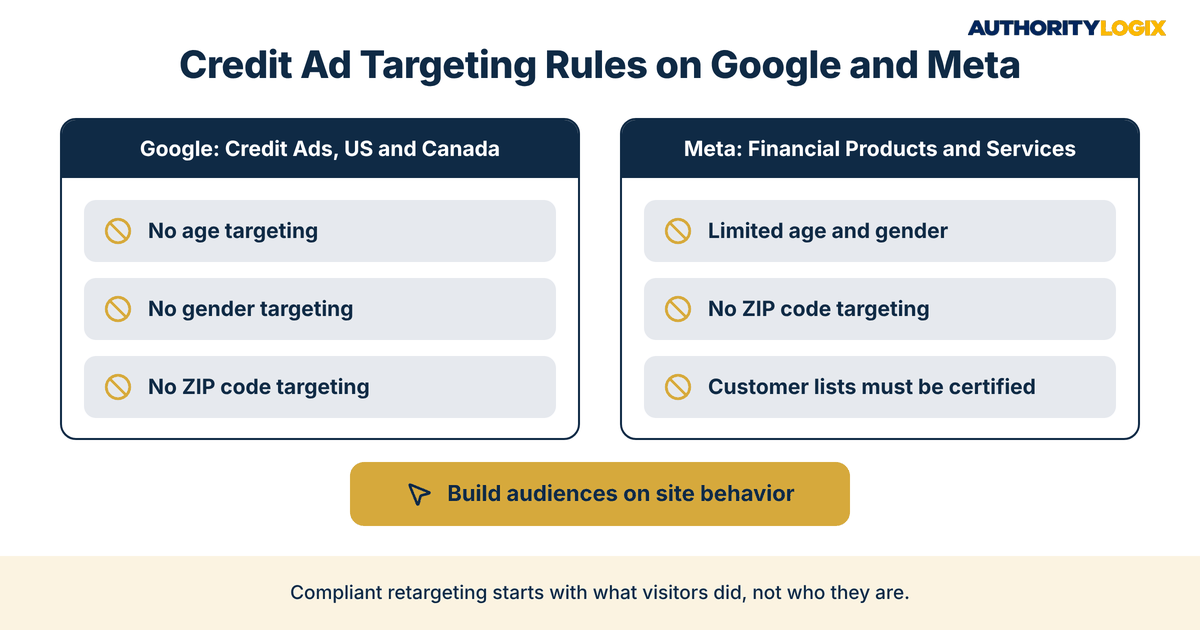
- Under Google’s personalized advertising policy, credit ads in the US and Canada cannot target by age, gender, parental status, marital status, or ZIP code, and Meta’s Financial Products and Services category carries similar limits.
- The audiences that hold up under those rules in a mortgage website retargeting strategy are built from on-site behavior — which pages a visitor read and how far they got — not from demographics.
- Retargeting paired with email nurture recovers more applications than either channel alone, because the ad reminds and the email teaches.
- A mortgage website retargeting strategy performs only as well as the traffic and content behind it. It multiplies earned visibility; it does not replace it.
Table of Contents
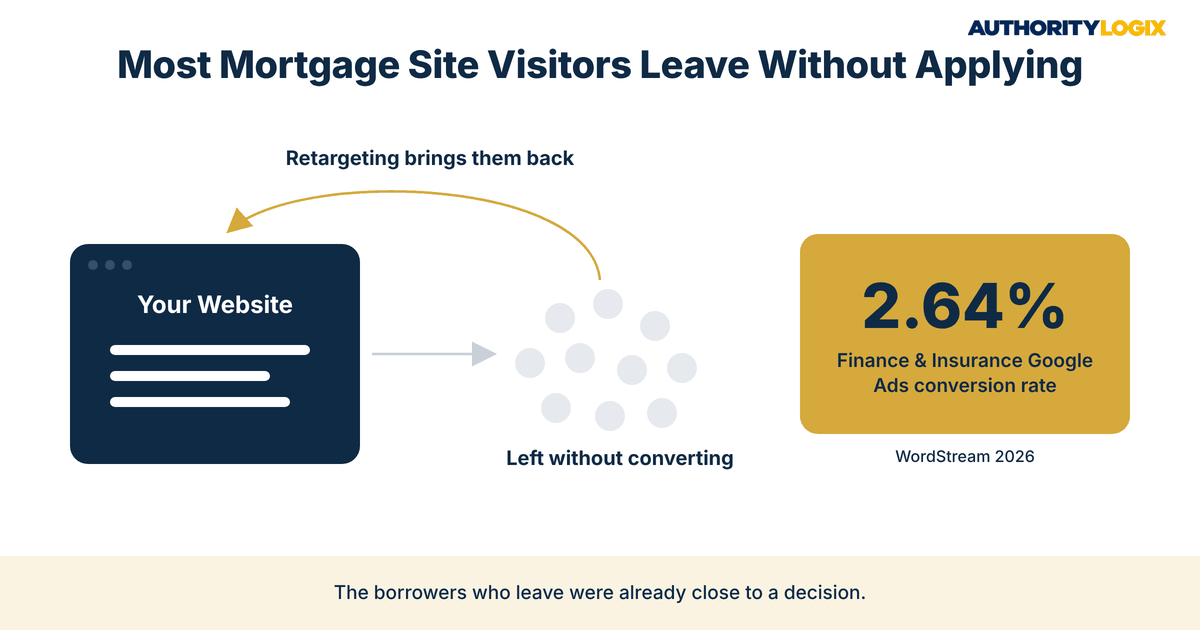
A mortgage website retargeting strategy starts with an uncomfortable fact: most of the borrowers who find your site leave without calling, applying, or sharing an email address. They read a rate page, run a payment calculation, maybe open the application, and then they are gone. If your lead funnel ends at the contact form, every one of those visitors quietly becomes someone else’s borrower.
That gap is rarely a credibility problem. Most lenders reading this have years of closed loans, satisfied borrowers, and real market knowledge behind them. The site simply has no system for staying in view after the first visit — which leaves the firm credible but invisible at the exact moment a borrower is comparing options.
Why a Mortgage Website Retargeting Strategy Recovers Lost Applications
Mortgage shopping is shorter and narrower than most firms assume. The CFPB’s mortgage shopping research found that almost half of borrowers did not shop around before applying, and roughly three in four applied with only one lender or broker. A LendingTree survey cited by the National Association of Realtors in 2024 found that 54% of recent buyers took only one quote. The lender who stays in front of a borrower during that short window often becomes the only lender the borrower seriously considers.
That is the case for a mortgage website retargeting strategy in plain terms: the borrower who already visited your site is the least expensive borrower you will ever reach again. They know your name, they have seen your loan programs, and they usually left for an ordinary reason — a phone call, a spouse to consult, a pay stub to find. Retargeting closes that gap with a reminder, not a cold pitch.
What a Mortgage Website Retargeting Strategy Actually Includes
A mortgage website retargeting strategy is often reduced to “show ads to past visitors.” A working version has four parts: a tracking tag on every page, audience lists segmented by behavior, ads written for each segment, and a destination page that picks up where the visitor left off. Trust runs through all four, and the authority guide explains why borrowers in a skeptical market need to see the same credible signals more than once before they act.
Each part depends on the one before it. A tag with no segments produces one generic audience. Segments with generic ads waste the segmentation, and good ads that land on a homepage force the borrower to start over. When firms browse the services hub to see how the pieces of a visibility system fit together, the pattern is the same everywhere: the parts only work when they are connected.
Retargeting is one stage of a larger pipeline. The Financial Services Lead Generation System shows how a mortgage website retargeting strategy connects to capture, nurture, and conversion.
Loan Officer Retargeting Ads Within Fair Lending Rules
Before any mortgage website retargeting strategy launches, the targeting rules matter more than the creative. Under Google’s personalized advertising policy, ads for credit products in the US and Canada — home loans included — cannot target audiences by gender, age, parental status, marital status, or ZIP code. The restriction has applied since October 19, 2020, and it covers loan officer retargeting ads the same way it covers any other credit campaign.
Meta applies a similar framework. Its Financial Products and Services special ad category, which replaced the older Credit category, limits age, gender, and ZIP code targeting, removes lookalike and detailed exclusion options, and since March 2025 requires US advertisers to certify the customer lists used in these campaigns. A mortgage website retargeting strategy has to be designed inside those limits from day one, not retrofitted after an ad is rejected.
Loan Officer Retargeting Ads Built on Behavior, Not Demographics
The practical answer for a mortgage website retargeting strategy is to build audiences from what visitors did on your site rather than who they are. Someone who read a DSCR program page, used a payment calculator, or opened the application has told you more than any demographic filter could. Google also treats negative financial status as a sensitive category, so avoid building lists from hardship-focused pages or writing ads that imply a visitor is in financial trouble. Run every audience definition past your compliance team before launch.
Behavior-based loan officer retargeting ads also perform better as education than as offers. A visitor who left a first-time buyer guide is better served by a reminder of the next question they will have than by a rate headline. Pairing that reminder with an email nurture sequence gives the visitor a second, lower-pressure path back once they share an address.
Every reminder needs a destination worth returning to. Firms that build an educational hub give their retargeting ads somewhere specific to send each segment — a down payment explainer, a loan comparison, a documents checklist. Without one, the ad sends a returning borrower to a generic homepage and makes them hunt for the page they were reading.
Mortgage Company Remarketing Audiences and Messages
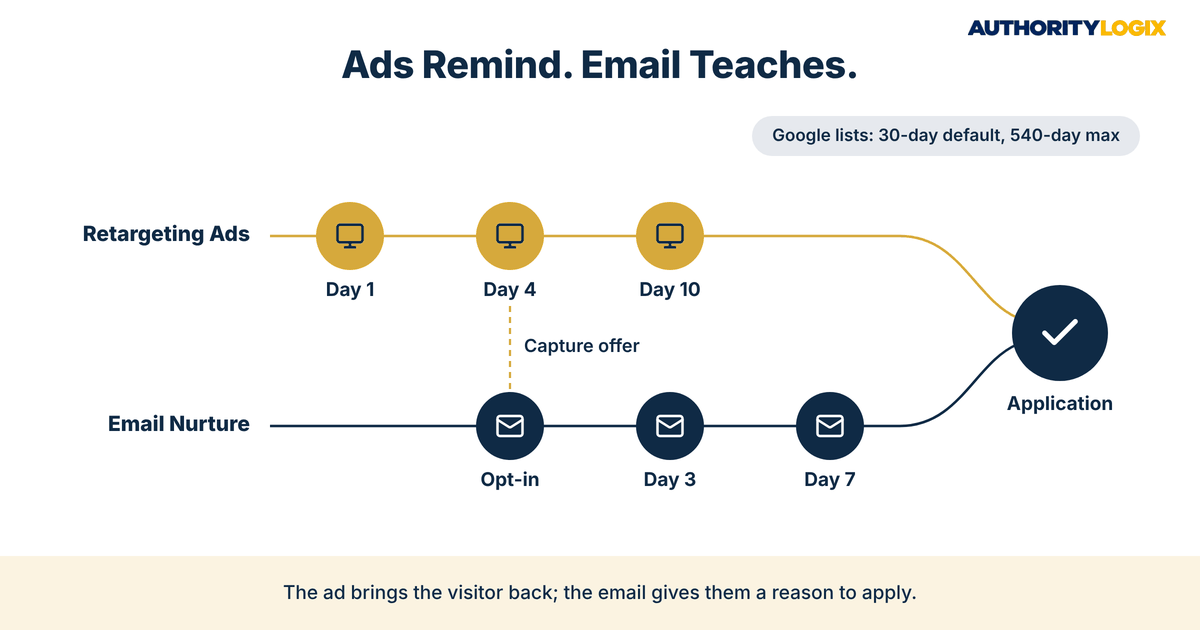
Mortgage company remarketing works when each audience gets a message matched to how far that visitor got. Google Ads keeps website visitors in a segment for 30 days by default, with a maximum membership duration of 540 days, and a list needs at least 100 active users in the last 30 days before it can serve. Those limits shape how finely you can segment, so a smaller lender may need fewer, broader lists until traffic grows.
| Visitor Segment | Signal on Your Site | Message That Fits | Suggested Window |
|---|---|---|---|
| Application starters | Opened the application but did not submit | The next step and the documents to have ready | 7–14 days |
| Calculator users | Ran a payment or affordability calculation | What the numbers mean for qualifying | 30 days |
| Rate and program viewers | Viewed rate or loan program pages | A plain-language program comparison | 30 days |
| Educational readers | Read two or more guides | The next guide in the sequence, then a consultation | 60–90 days |
| Recent converters | Submitted an application or contact form | None — exclude from every recovery ad | Exclude |
The exclusion row matters as much as the others. A borrower who already applied and keeps seeing “start your application” ads reads it as a firm that is not paying attention. A mortgage website retargeting strategy that excludes converters protects trust and budget at the same time.
Message quality depends on what the firm has already published. Lenders whose pipeline comes mostly from organic leads usually have more to say in a retargeting ad, because every guide a visitor read points to a natural follow-up. Firms without that library end up rotating the same rate headline to every segment.
That library does not appear by accident. Strong mortgage company remarketing draws on content systems that produce guides, comparisons, and explainers on a schedule, so each audience segment always has a relevant next piece to promote rather than a recycled offer.
Not sure whether your site has the content, tracking, and capture offers a mortgage website retargeting strategy needs to work?
Lender Retargeting Lead Recovery Paired With Email
Ads alone can only remind, even inside a well-built mortgage website retargeting strategy. Lender retargeting lead recovery works best when ads and email do different jobs: the ad brings the visitor back to the site, and the email — once the visitor shares an address — does the teaching that an ad has no room for. Each channel covers the gap the other leaves.
Paid attention also costs real money per visit. WordStream’s 2026 Google Ads benchmarks, drawn from 13,474 US search campaigns, put Finance and Insurance at a 9.83% click-through rate, a $3.39 average cost per click, a 2.64% conversion rate, and a $74.44 cost per lead. Those WordStream benchmarks measure search rather than display retargeting, but they show how quickly paid clicks add up when nothing on the site captures the visit.
How Lender Retargeting Lead Recovery Hands Off to Email
In a mortgage website retargeting strategy, the handoff point is the capture offer. A visitor who returns through an ad should land on a page with one clear, low-commitment offer: a documents checklist, a loan comparison guide, or a pre-qualification explainer. Once they opt in, the email sequence takes over and ad frequency should drop. Our SEO playbook covers how those same landing pages earn organic rankings, so they serve search visitors and returning visitors at once.
The emails themselves need substance. Borrowers who left once will leave again if the follow-up reads like a sales script. Sequences built from real finance content — explanations of program differences, closing timelines, and the questions borrowers actually ask — give the visitor a reason to open the next message and, eventually, to call.
Measuring a Mortgage Website Retargeting Strategy Against Funded Loans
Most retargeting reports stop at clicks and form fills. For a lender, those are leading indicators at best. A mortgage website retargeting strategy should be judged on applications submitted and loans funded from returning visitors, because that is the only number that pays for the media.
| Metric | What It Tells You | Where to Find It |
|---|---|---|
| Return visit rate by segment | Whether ads bring the right visitors back | Analytics audience reports |
| Capture rate on return visits | Whether landing pages convert returning traffic | Form and email platform data |
| Applications from retargeted visitors | Whether recovery reaches the application stage | CRM or loan origination system lead source field |
| Funded loans by original source | Whether recovered leads actually close | Funded-loan report from the loan origination system |
| Cost per funded loan | The true cost of the mortgage website retargeting strategy | Total ad spend divided by funded loans |
The lead source field is where most firms lose the thread. If the loan origination system records every returning borrower as “website” or “direct,” retargeting gets no credit and no blame. Agree on source tags before launch, and make sure the content system that publishes each guide also tags it, so you can see which pieces start the journeys that end in funded loans.
Measurement also shows where retargeting is doing work that broader visibility should be doing. If most recovered borrowers first arrived through a referral partner’s link or a syndicated article, that is a signal to invest more in authority distribution. More first visits from trusted sources produce larger, better-qualified retargeting lists.
Retargeting Mistakes That Waste Spend — and the Questions Lenders Ask
Most underperforming budgets behind a mortgage website retargeting strategy fail for the same handful of reasons. Below are the mistakes firms make most often, followed by the questions owners ask before they commit spend.
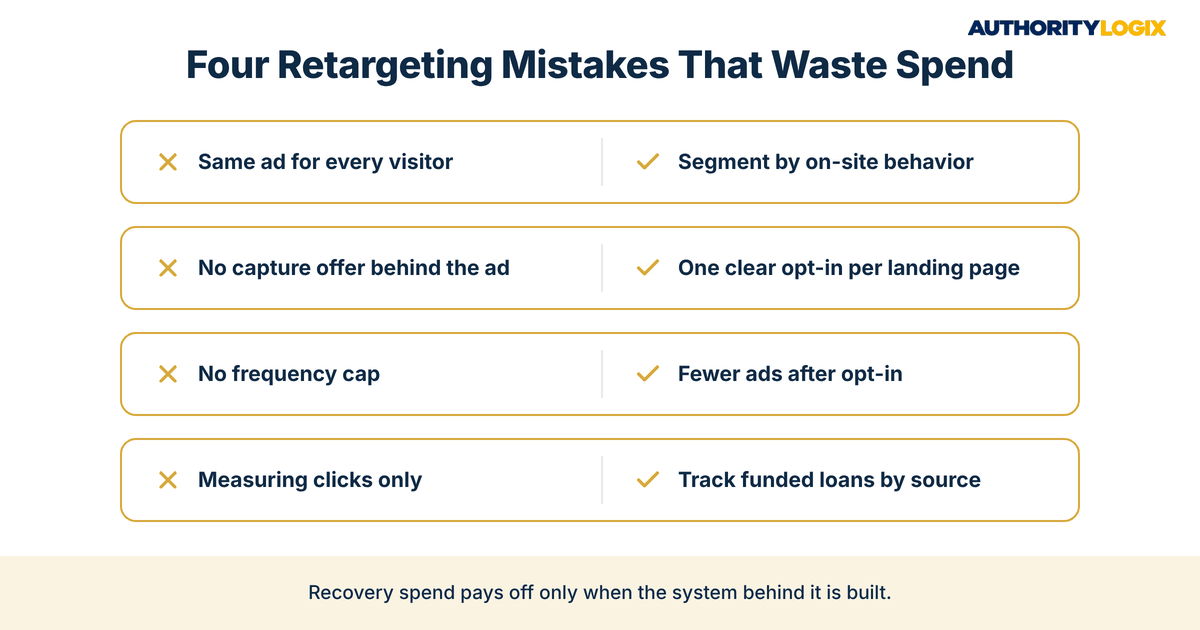
Mistake: Showing the same ad to every visitor
One list and one rate headline ignore everything the visitor told you. A borrower who abandoned an application and one who read a single blog post need different messages, different windows, and different landing pages. Segmenting by behavior is the step that turns retargeting from repetition into relevance.
Mistake: Running retargeting with no capture system behind it
A mortgage website retargeting strategy that sends visitors back to a page with no offer simply buys the same exit twice. Before adding spend, confirm that the site has a working lead generation path — a capture offer, a follow-up sequence, and a clear next step — that turns the return visit into a contact.
How often should a past visitor see our ads?
There is no universal number, and any vendor quoting one is guessing. Set a frequency cap, watch return-visit and capture rates by segment, and reduce frequency the moment a visitor opts in or applies. Overexposure reads as pressure in a category where borrowers are already cautious.
Can a small lender run a mortgage website retargeting strategy?
Yes, with fewer segments. Because Google requires at least 100 active users in a list before it serves, a low-traffic site may run two or three broad audiences instead of five. Growing first-visit traffic is usually the real constraint, and diagnosing where those visitors should come from is what we do at the start of most engagements.
Should we hire an agency just to run retargeting?
Only if the rest of the system already exists. A mortgage website retargeting strategy managed in isolation from content, email, and site structure tends to produce clicks without applications. Sequence matters, which is why how we build puts tracking, content, and capture in place before any recovery spend begins.
Ready to win back the visitors who left your mortgage site? We’ll set up retargeting tied to the pages they already viewed.
Why a Mortgage Website Retargeting Strategy Works Best on Traffic You Earned
A mortgage website retargeting strategy multiplies whatever traffic you already have. If most first visits come from paid clicks, recovery spend pays twice for the same borrower. If they come from organic search, referral partners, and published guides, retargeting reconnects with people who already found you on merit, and the growth playbook lays out why that earned base keeps acquisition costs from climbing every year. Infrastructure compounds. Ads stop.
BKDSCR.com, the AuthorityLogix proof-of-concept in the NYC outer-borough DSCR market, was built in that order: 18 pillar pages, 7 interactive investor tools, and 48 SEO-optimized blog posts, with zero paid ads. Each tool and guide gives a visitor a reason to come back, and that earned return path is why it works as the foundation for any recovery campaign layered on top.
The honest assessment is that a mortgage website retargeting strategy is a multiplier, not a foundation. Most lenders already have the expertise, the loan programs, and the borrower relationships; what they lack is the content and capture infrastructure that gives a returning visitor a reason to stay. Build that first, then add retargeting to recover the visitors it attracts. If you want help sequencing that build, start with work with us.