

Key Takeaways
- Real estate AI search visibility decides whether an investment firm is named inside the answer ChatGPT, Perplexity, or Google gives.
- Pew Research Center found that Google users clicked a traditional search result in 8% of visits when an AI summary appeared, compared with 15% when none did.
- Bain & Company found that about 80% of consumers rely on zero-click results in at least 40% of their searches.
- Google says no special optimizations or AI text files are needed for AI Overviews or AI Mode, so the work lives in the content itself.
- Real estate generative engine optimization rewards specific, quotable answers from firms with real market experience, not portal-style listing pages.
- Real estate AI search visibility is an infrastructure build: educational pages, consistent firm details, and outside mentions working as one system.
Table of Contents

Real estate AI search visibility is now the first filter between an investor with a question and the firm that could answer it. You may have twenty years of acquisitions and investors who trust you with repeat capital — and still be absent when someone asks ChatGPT which firms buy two-to-four-family properties in your market. The AI writes a confident answer, names a handful of sources, and your firm is not one of them.
That is the credible but invisible problem moved into a new interface. The AuthorityLogix real estate industry hub is organized around one idea: the expertise already exists, and the job is building the infrastructure that lets search systems — traditional or AI — find it, trust it, and repeat it.
What Real Estate AI Search Visibility Looks Like in 2026
The shift is measurable. Pew Research Center tracked the browsing of 900 U.S. adults in March 2025 and found that users who saw a Google AI summary clicked a traditional search result in 8% of visits, compared with 15% of visits when no summary appeared. Users also ended their browsing session on 26% of pages with an AI summary, versus 16% of pages without one.
| Search Behavior (Pew Research Center, 2025) | With an AI Summary | Without an AI Summary |
|---|---|---|
| Clicked a traditional search result | 8% of visits | 15% of visits |
| Ended the browsing session on the page | 26% of pages | 16% of pages |
| Clicked a link inside the summary itself | 1% of visits | No summary shown |
| What it means for real estate AI search visibility | The answer is the first impression | The ranking is the first impression |
The pattern holds beyond Google. Bain & Company found in February 2025 that about 80% of consumers now rely on “zero-click” results in at least 40% of their searches, reducing organic web traffic by an estimated 15% to 25%, according to its zero-click research. For real estate AI search visibility, that means the answer itself has become the storefront.
None of this makes your website irrelevant. It changes what the website is for: it becomes the source material an AI system reads before it decides whom to mention. The trust signals laid out in the authority guide — a named principal, a visible track record, consistent firm details — are the same signals that make a firm safe for an AI answer to cite. Real estate AI search visibility is earned on your own pages first.
Specialization matters more in AI answers than it did in ten blue links. A generalist site that covers every property type in every market gives a model nothing distinctive to quote, while a firm with clear niche authority in one strategy, such as outer-borough two-family buildings or build-to-rent communities, gives it a precise answer to repeat. Real estate AI search visibility favors the firm that is unmistakably about something.
The Real Estate Local SEO Playbook covers the search foundation that real estate AI search visibility is built on — the profile, pages, and local signals AI systems read before they answer.
Why AI Answers Cite Some Firms and Skip Others
AI systems do not pick sources at random. Google describes a technique called query fan-out, in which its AI features issue multiple related searches across subtopics and data sources to build a response, then identify more supporting web pages while the answer is being generated. Each of those sub-searches is another chance for your page to be pulled in — or passed over.
Pew’s data shows how concentrated the citations already are. Wikipedia, YouTube, and Reddit were the most commonly linked sources in the AI summaries Pew examined, together accounting for 15% of the sources listed. A real estate investment firm is competing for the remaining slots, and real estate AI search visibility goes to the pages that answer a sub-question more directly than any of them.
The Citation Signals Behind Real Estate AI Search Visibility
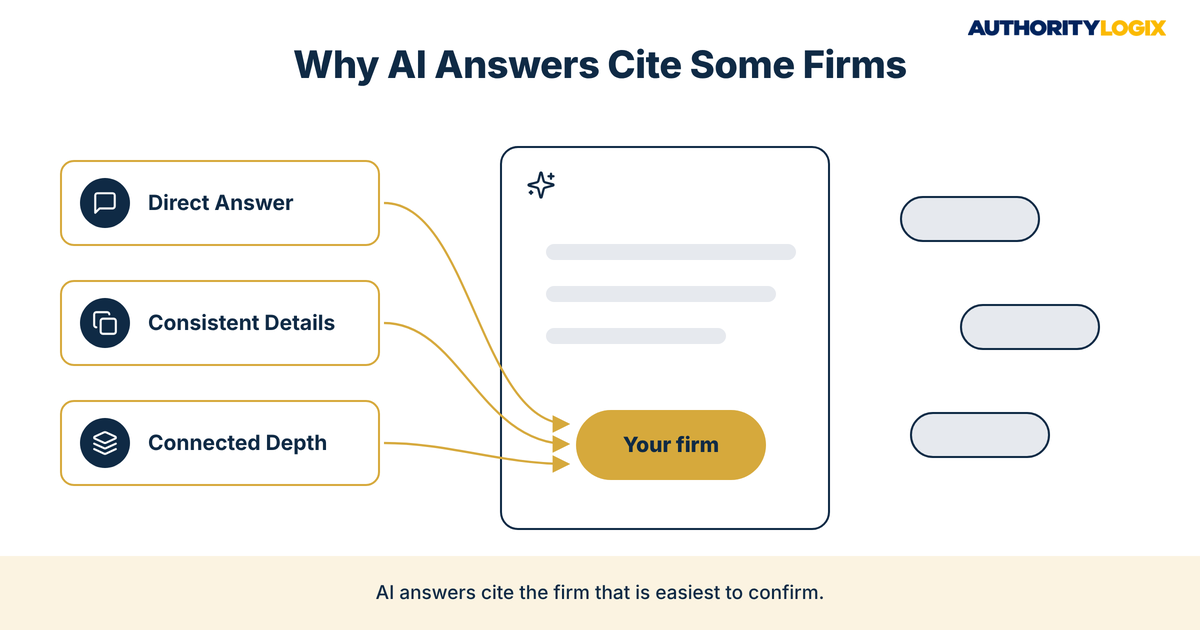
Three signals separate the firms that get named from the ones that get skipped. The first is a direct answer: a page that states, in plain language, what the firm buys, where, and on what terms. The second is consistency — the same firm name, principal, and market focus across your site, your Business Profile, and every directory. The third is depth, meaning enough connected pages that a model can confirm one claim with another. Building those three together is what we do for real estate firms.
Most firms already have a presence online — a homepage, a team page, a listings feed — but a presence is not a source. An AI system looking for an answer about cap rates in a specific submarket, or about how a firm structures joint ventures, needs pages that explain rather than pages that advertise. Real estate AI search visibility belongs to the firm that publishes the explanation.
Investment Firm ChatGPT Perplexity Visibility: Where the Answers Come From
Investment firm ChatGPT Perplexity visibility starts with understanding how each tool builds an answer. When OpenAI launched ChatGPT search in October 2024, it said chats now include links to sources such as news articles and blog posts, with a Sources button that opens the references. Perplexity says each of its answers includes numbered footnotes linking to the original sources. Both tools show their work, which means both have to find work worth showing.
The user side matters just as much. In Bain’s December 2024 survey of 1,117 consumers, 68% of LLM users said they use the platforms to conduct research and summarize information. An investor vetting a sponsor or a seller weighing a cash offer is doing exactly that kind of research, and real estate AI search visibility decides whether your firm appears in the summary they read.
Google’s reach raises the stakes further. Alphabet CEO Sundar Pichai said on the company’s July 2025 earnings call that AI Overviews had reached 2 billion monthly users. Answers at that scale are assembled from pages that explain real estate investing in specific terms, which is the purpose of investor content written from operating experience. Every page that answers a question better than anyone else adds to your real estate AI search visibility.
Single articles rarely carry that weight alone. A connected educational hub — a library of pages on underwriting, market selection, deal structures, and the questions your investors ask most, each linking to the others — gives AI systems the depth to confirm one answer with another. For investment firm ChatGPT Perplexity visibility, a library outweighs a lone blog post.
Not sure where your firm stands on real estate AI search visibility? The RE Authority Gap Assessment shows which pages, signals, and listings AI answers can and cannot find today.
AI Search Real Estate Agent Queries vs Investment Firm Queries: Same Rules
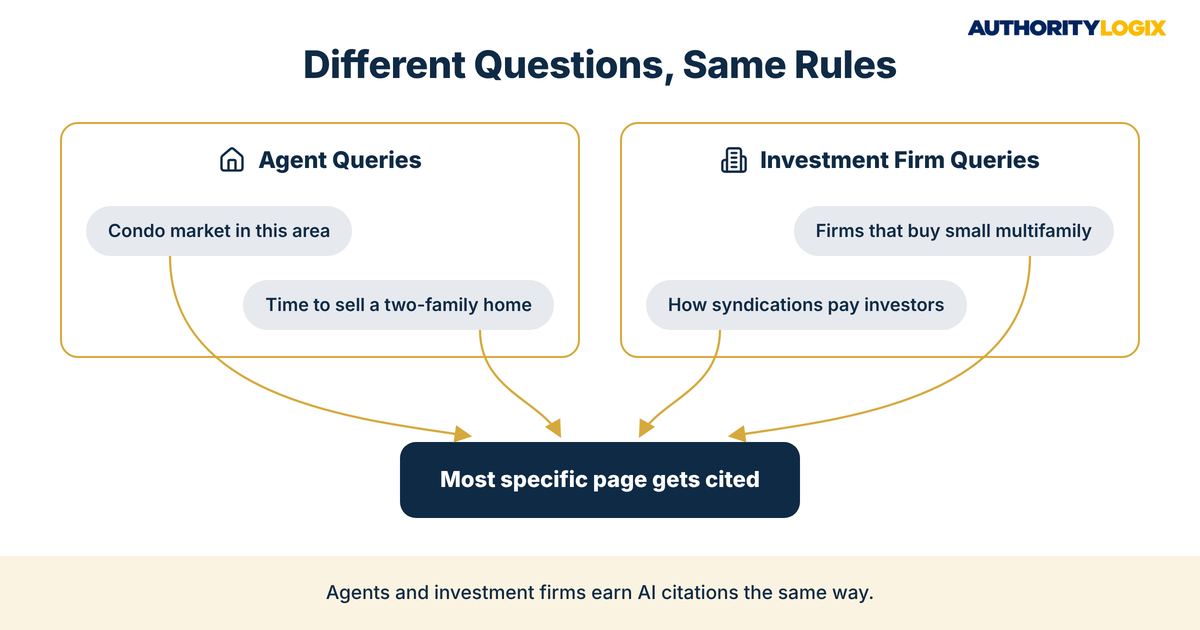
An AI search real estate agent query and an investment firm query look different on the surface. A homeowner asks which agents know the condo market in their part of town; an investor asks which firms buy small multifamily buildings or offer passive syndication opportunities. Underneath, the AI handles both the same way: it fans out into sub-questions and looks for the page that answers each one most specifically.
| Query Type | Example Question | What the AI Needs to Cite You |
|---|---|---|
| Agent — local market | “Which agents know the condo market in this area?” | A market page with current, first-hand observations from the agent |
| Investment firm — acquisitions | “Which firms buy small multifamily buildings for cash?” | A buy box page that states property types, markets, and terms |
| Investment firm — investors | “How do real estate syndications pay investors?” | An explainer that describes the firm’s actual structure |
| Brand validation | “Is [firm name] legitimate?” | Consistent firm details, reviews, and third-party mentions |
The rules are the same because the machinery is the same. Whether the reader is an agent’s prospect or a firm’s limited partner, real estate AI search visibility comes from pages that state facts plainly and connect to supporting pages. That consistency is hard to sustain by hand, which is why content systems that turn closed deals, market observations, and recurring client questions into published pages matter more than any single article.
One Publishing Engine for Agents and Investment Firms
A brokerage with an investment arm, or a firm that also lists properties, does not need two strategies. The publishing blueprint in the content system treats every page as an answer to one specific question, which is exactly the unit an AI system retrieves. Real estate AI search visibility grows fastest when one engine feeds both audiences.
You can see the model at work across the AuthorityLogix real estate resource library, where each article answers one question and links to the guides above and beside it. That structure is deliberate: it gives search systems a clear map of how the ideas connect.
Real Estate Generative Engine Optimization: Building Content AI Can Quote
Real estate generative engine optimization is the practice of writing pages so an AI system can lift a clear, accurate answer from them and credit your firm. Google says outright that you don’t need new machine-readable files, AI text files, or markup to appear in its AI features, so the work lives in the content itself.
What Makes a Page Quotable for Real Estate AI Search Visibility
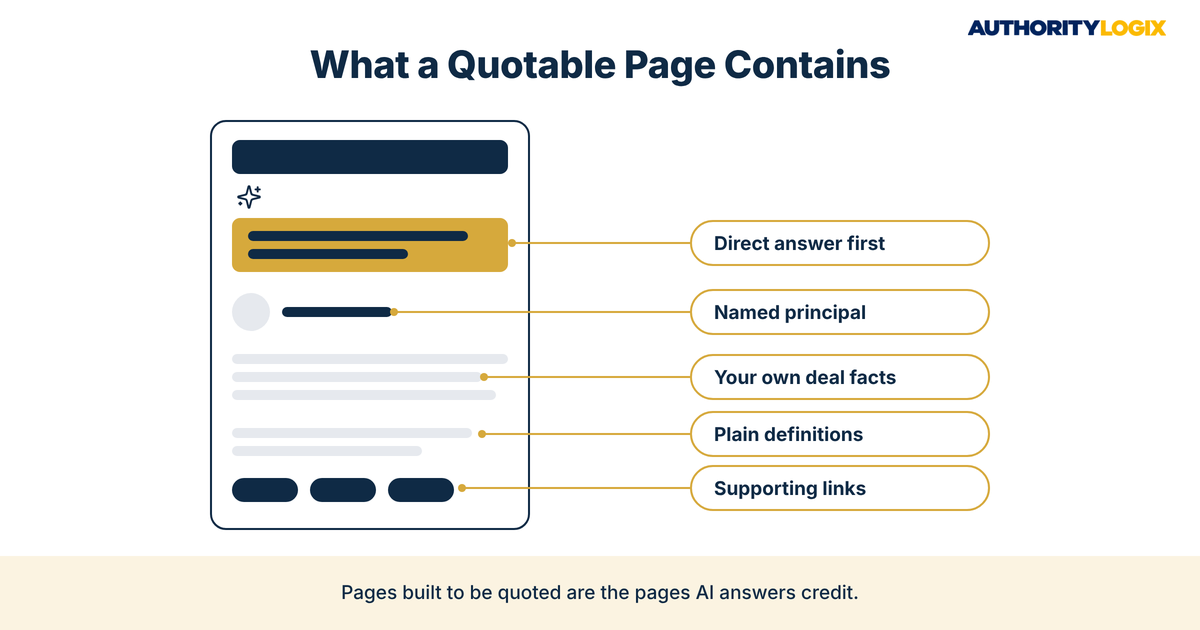
A quotable page has traits that generic listing pages lack. These are the checks we apply to every real estate page built to earn AI citations:
- A direct answer in the first two sentences, before any background
- Specific facts from your own operations: markets, property types, hold periods, and the deal sizes you actually do
- A named principal or team member with real experience attached to the page
- Plain-language definitions of terms like DSCR, cap rate, or preferred return
- Internal links to the pages that support each claim
- Structured data that matches the visible text, as Google’s guidance asks
AI systems cross-check what they read, and a firm mentioned in trade publications and industry directories gives them corroboration that a lone website cannot. That is the job of authority distribution: putting the same expertise in front of the sources AI answers already draw on. Real estate AI search visibility is strongest when the market says the same thing about you that your site does.
BKDSCR.com, the AuthorityLogix proof-of-concept in the NYC outer-borough DSCR niche, was built on this pattern: 18 pillar pages, 7 interactive investor tools, and 48 SEO-optimized blog posts, built in under 18 months with zero paid ads. The order matters, and how we build starts with the pillar pages that define a niche before adding the posts that answer narrower questions. Real estate generative engine optimization follows the same sequence.
Real Estate AI Search Visibility Mistakes and Common Questions
Most firms that struggle here are not short on expertise. They are applying assumptions from an earlier era of search. These are the questions firm owners ask most often.
Is there a special file or tag that gets a firm into AI answers?
No. Google states that there are no additional requirements or special optimizations needed for AI Overviews or AI Mode, and that you don’t need new machine-readable files or AI text files. A vendor selling one fix for real estate AI search visibility is selling the wrong thing.
Can listing pages carry the load on their own?
Listings change weekly and look the same on every site that syndicates them, so they give an AI system little reason to credit one firm. Educational pages do the heavy lifting, and they also feed lead generation, because an investor who reads your explanation of a deal structure arrives with context before the first call.
Should we stop investing in traditional search?
No. Pew found that 18% of the Google searches in its study generated an AI summary, which means most searches still showed standard results alone. The same fundamentals serve both, and real estate AI search visibility is built on the pages that already rank.
How do we know if AI answers are mentioning our firm?
Ask the tools directly: which firms buy in your market, who runs your strategy, what people say about your firm. Run the same questions monthly and record who gets named. Pair that with intake tracking inside your lead generation system, because a question on your contact form about how the prospect found you captures AI referrals that analytics misses.
Does AI visibility replace referrals?
It widens the top of the pipeline; it does not replace relationships. Your referral network is a ceiling, not a foundation, and real estate AI search visibility is how prospects outside that network find you in the first place.
Want your firm named in the AI answers investors and sellers read first? Let’s build the real estate AI search visibility system — pages, signals, and distribution — that puts it there.
What AI Visibility Will and Won’t Replace
AI answers will replace a share of the clicks your website used to get, and Bain’s estimate of 15% to 25% less organic web traffic is a fair warning. They will not replace the trust an investor needs before wiring capital. The growth playbook treats visibility as a long-term asset for that reason: pages that earn citations keep earning them long after they are published, and real estate AI search visibility built that way does not stop when a budget does.
Generic portals have scale, but they cannot explain how your firm underwrites a deal or why you buy in the markets you buy. That knowledge belongs to you, and it is the raw material AI systems are looking for. It is also why AuthorityLogix builds this work as infrastructure rather than campaigns: we built it for BKDSCR.com first, with our own time and money.
The honest answer is that most real estate firms already have the expertise AI answers are looking for. What they lack is the infrastructure that makes that expertise readable, consistent, and easy to cite. Real estate AI search visibility is the result of building it in the right order, not a trick waiting to be discovered.