


Key Takeaways
- Real estate coach thought leadership content is what agents read before they book a call, and it decides which coach looks like the expert worth hiring.
- In the 2025 Edelman-LinkedIn B2B Thought Leadership Impact Report, 74% of B2B decision-makers cited recognition as a leading expert in the field as a top factor when finalizing a decision.
- NAR’s 2025 Member Profile found members with two years or less in the business had a median gross income of $8,100, against $78,900 for members with 16 years or more — the gap coaches are hired to close.
- A coaching thought leadership content strategy starts with arguments — contrarian calls, diagnoses, and named frameworks — not with topics.
- A weekly cadence built from your existing coaching calls turns one long-form article into several finished pieces.
- Real estate coach thought leadership content only books discovery calls when every piece leads to a clear, specific next step.
Table of Contents
Why Real Estate Coach Thought Leadership Content Decides Who Gets Hired
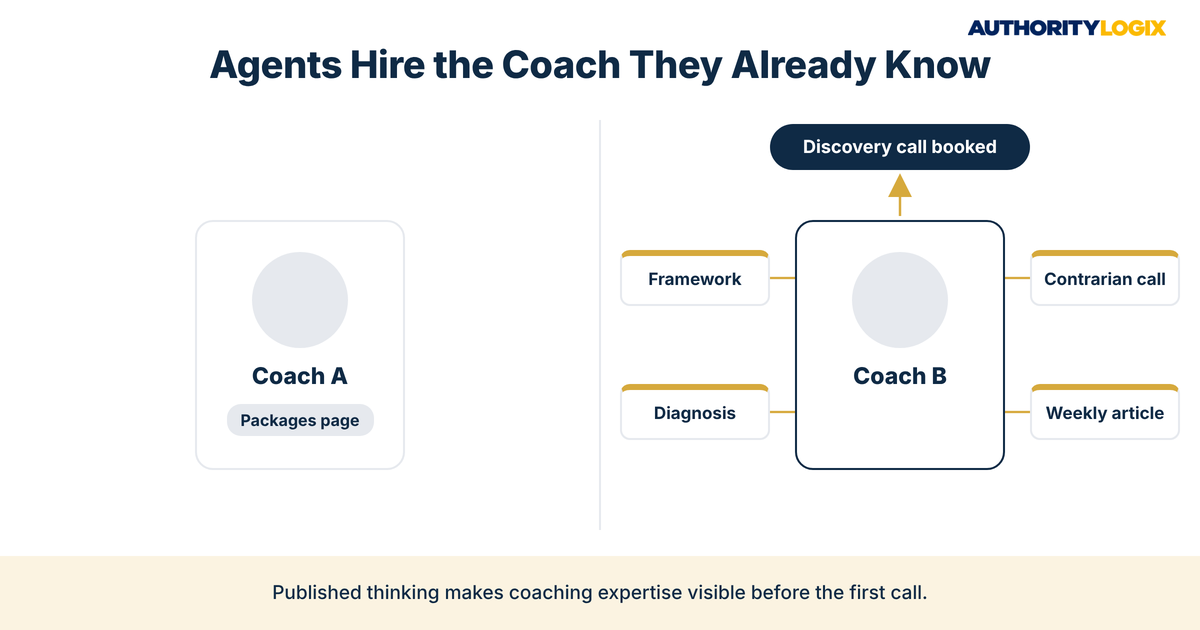
Real estate coach thought leadership content is what an agent reads before booking a call with you, and for most coaches it is the thinnest part of the business. You may have built a team from zero and trained producers who now run their own offices, yet an agent who looks you up finds an old podcast episode and a packages page. Coaches who already show up in local search through the local SEO playbook still face a harder question once an agent arrives: what does this coach actually believe, and is it worth paying for?
That is the credible but invisible problem in coaching form. The expertise is real, but the market sees only a sales page. Real estate coach thought leadership content closes that gap by putting your actual thinking — your frameworks, your opinions, your read on the market — in front of agents before the first conversation.
Professional buyers already choose experts this way. The 2025 Edelman-LinkedIn B2B Thought Leadership Impact Report surveyed nearly 2,000 management-level professionals, and as Demand Gen Report summarized it, 74% of B2B decision-makers cited recognition as a leading expert in the field among the top factors when finalizing a decision on a vendor. Even more, 85%, cited a demonstrated understanding of their specific challenges and needs. Agents hiring a coach are not corporate buying committees, but they are making the same kind of purchase: they are buying someone’s judgment.
The coaching market inside the real estate industry is crowded with programs that look identical from the outside — weekly calls, accountability, scripts, a private group. When the offers look the same, agents choose on perceived expertise, and the coach whose ideas they have already read starts the sales conversation halfway to yes. Real estate coach thought leadership content is how that perceived expertise gets built before anyone asks for a price.
None of this requires you to become a full-time writer. It requires content systems that turn the coaching you already do — group calls, workshops, deal reviews — into published material on a schedule.
The Real Estate Authority Guide lays out the full market authority framework that real estate coach thought leadership content plugs into — positioning, proof, and trust signals.
What an RE Coach Market Authority System Looks Like From the Agent’s Side
Start with who is reading. NAR’s 2025 Member Profile found that the typical Realtor had 12 years of experience, but members who had worked in the business for two years or less reported a median gross income of $8,100, compared with $78,900 for members with 16 years or more. That gap is the coaching market. Newer agents want to close it, and experienced agents want to move past a plateau.
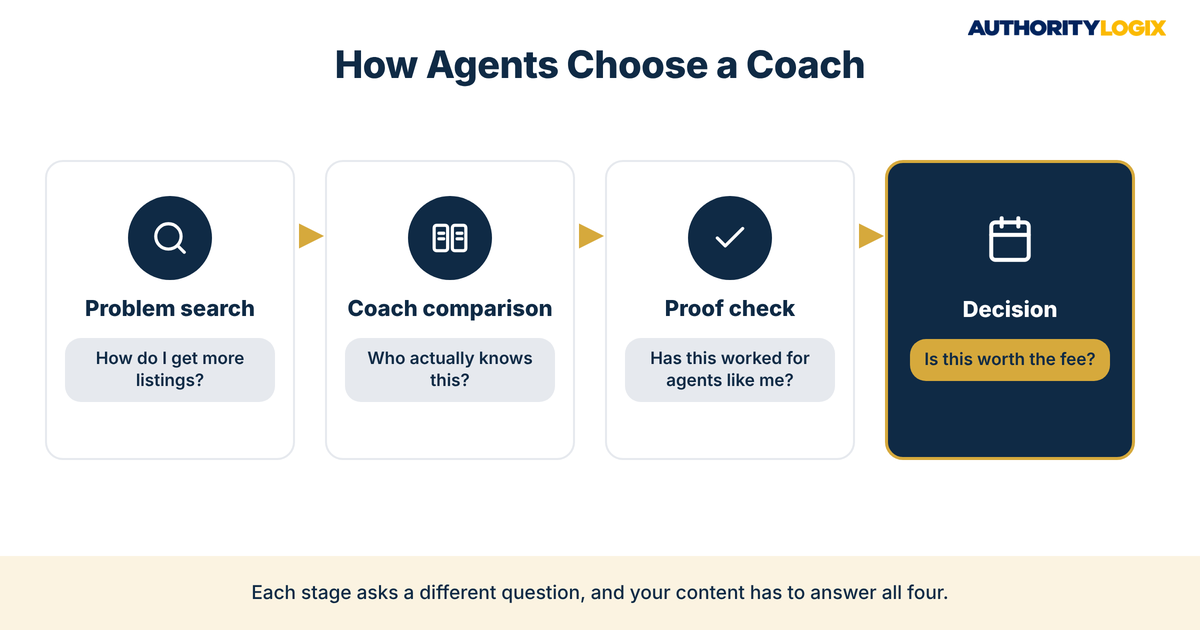
An RE coach market authority system meets those agents where their search starts. An agent rarely types a coach’s name first — they search a problem, such as how to win listings without cold calling. Your real estate coach thought leadership content on that problem is the first touchpoint, and the lead generation system behind it decides whether a reader becomes a subscriber, a workshop attendee, or a discovery call.
| Stage | What the Agent Is Asking | What Your Content Has to Show |
|---|---|---|
| Problem search | “How do I get more listings?” | A specific answer with your method named |
| Coach comparison | “Who actually knows this?” | Real estate coach thought leadership content with a clear point of view |
| Proof check | “Has this worked for agents like me?” | Client results described honestly, shared with permission |
| Decision | “Is this worth the fee?” | A clear next step and an honest scope of what coaching covers |
Each stage asks a different question, and an RE coach market authority system answers them in order. Agents who jump from the first search straight to a sales page usually stall at the proof check, because nothing sits between the problem and the price.
Coaches who work with investor-focused agents or teams face a sharper version of this. Those agents read cap rate breakdowns and deal analysis before they read anything about mindset, so the investor content they find has to show you understand the numbers side of the business. Real estate coach expert content that skips the math reads as generic to that audience.
How a Coaching Thought Leadership Content Strategy Picks Its Arguments
A coaching thought leadership content strategy starts with arguments, not topics. A topic is “time blocking for agents.” An argument is “time blocking fails for agents who never separated prospecting from follow-up.” Topics produce interchangeable posts, while arguments produce real estate coach thought leadership content an agent can agree with, push back on, or remember a week later.
The Edelman-LinkedIn research points the same way. In that survey, 91% of hidden buyers wanted insights that uncover unseen risks or opportunities for their industry or business, and 86% favored perspectives that challenge their assumptions. Agents already know the standard advice; they want the coach who can explain why it is not working for them.
Three Argument Types That Anchor Real Estate Coach Thought Leadership Content
- The contrarian call: a common piece of agent advice you believe is wrong, and the reason you believe it
- The diagnosis: the specific reason agents at a certain stage stall, drawn from what you hear in sessions
- The framework: a named, repeatable method you teach, broken into steps an agent can test this week
Most coaches already have all three but say them on calls instead of publishing them. Real estate coach thought leadership content captures what is already being said and gives it a permanent address.
Arguments also have to show where they come from. Readers and search engines both look for evidence of first-hand experience, which is why E-E-A-T signals — your coaching history, your credentials, and specific examples — belong inside the content itself rather than only on an About page. Real estate coach thought leadership content written in your voice, from your own sessions, carries those signals naturally.
Over time, the arguments need a home. An educational hub organizes them by the problems agents bring to coaching — listings, team building, conversion, business planning — so a reader who agrees with one argument can find the next five without leaving your site.
Not sure where your coaching business stands on real estate coach thought leadership content? The RE Authority Gap Assessment shows which arguments, pages, and proof points agents can and cannot find today.
Building Real Estate Coach Thought Leadership Content on a Weekly Cadence
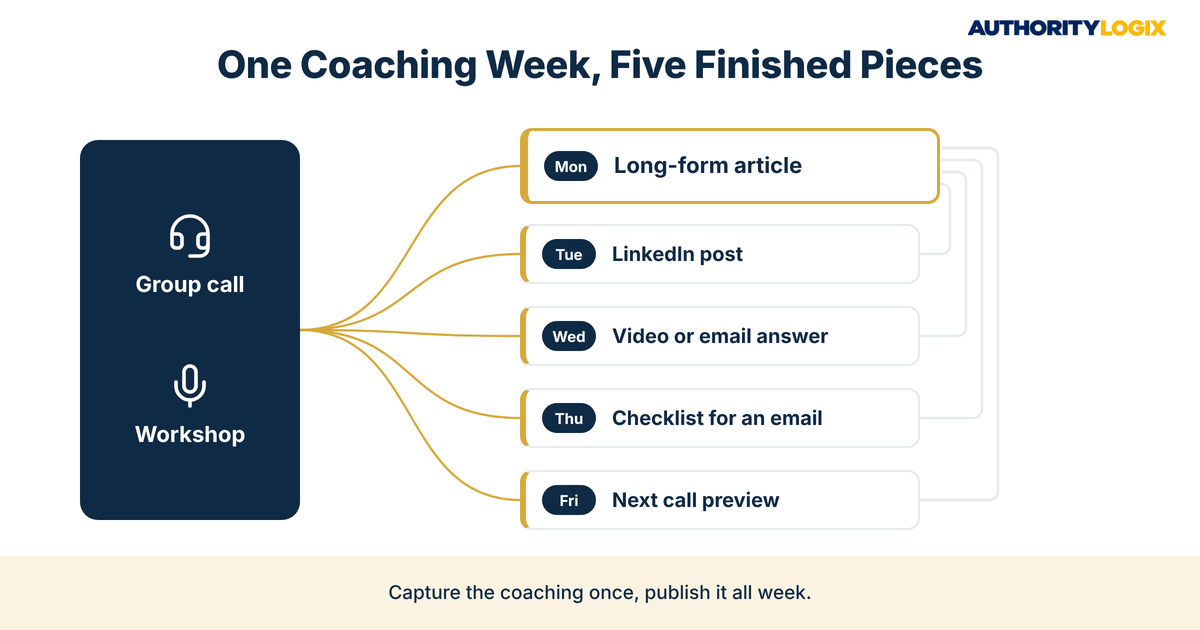
Real estate coach thought leadership content works best on a weekly cadence because coaching already runs on one. Group calls, one-on-one sessions, and workshops each produce questions, objections, and examples. The job of real estate coach thought leadership content is to capture that raw material once and turn it into several finished pieces.
A Weekly Publishing Rhythm Built From Your Coaching Calendar
| Day | Source Material | Finished Piece |
|---|---|---|
| Monday | Questions from last week’s group call | One long-form article answering the strongest question |
| Tuesday | The article’s core argument | A LinkedIn post that states the argument in your words |
| Wednesday | A recurring client objection | A short video or email answering it directly |
| Thursday | A framework from a workshop | A one-page checklist offered in exchange for an email address |
| Friday | Next week’s call topic | A brief preview that invites readers to attend |
The rhythm matters more than the volume. One long-form article per week, broken into four smaller pieces, does more work than five unrelated posts, and the hub-and-spoke model in the content system blueprint shows how each piece points back to the article that holds the full argument. That connection is what lets real estate coach thought leadership content build topical depth instead of scattering it.
Every piece also needs a job beyond being read. The Thursday checklist is where readers become contacts, and that only works when the lead generation infrastructure behind it — a landing page, a short email sequence, a booking link — is in place before the checklist goes live.
Distribution is the last layer. Real estate coach thought leadership content published only on your site reaches the agents who already found you, while authority distribution places the same arguments on LinkedIn, podcasts, and industry publications agents already read. That is how a coach’s ideas start appearing in places the coach never posted directly.
This is the same model AuthorityLogix used to build BKDSCR.com, its proof-of-concept platform in the NYC outer-borough DSCR investment niche. That build includes 18 pillar pages, 7 interactive investor tools, and 48 SEO-optimized blog posts, and it was built in under 18 months with zero paid ads. The niche is different from coaching, but the weekly system behind it transfers directly to real estate coach thought leadership content.
Turning Real Estate Coach Expert Content Into Booked Discovery Calls
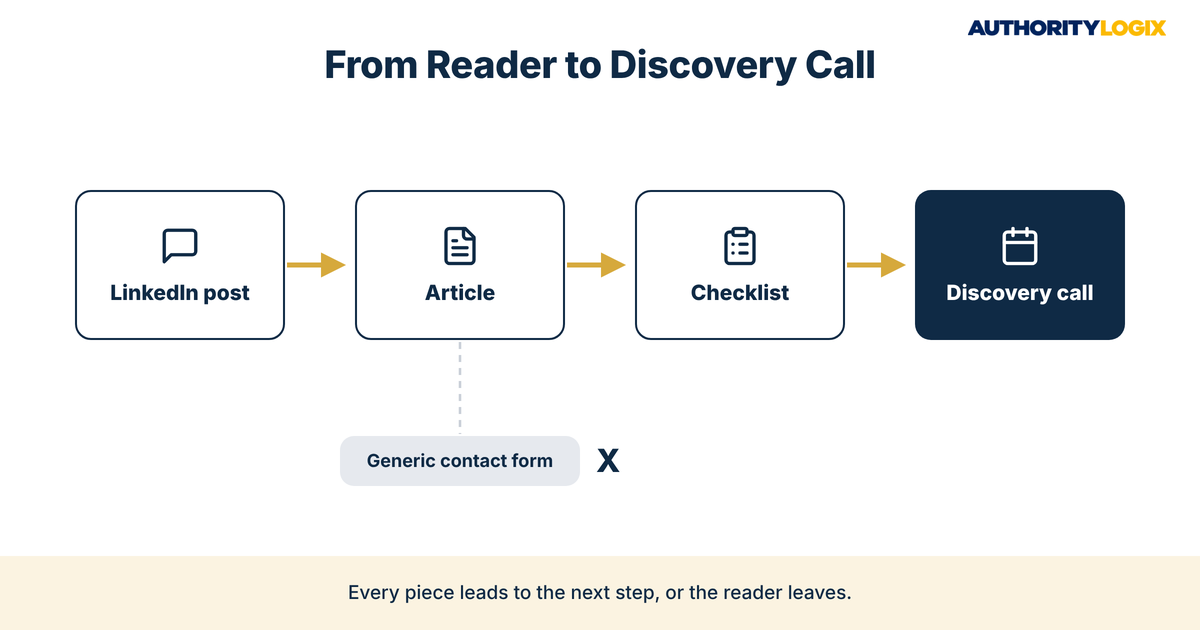
Real estate coach expert content earns attention, but booked discovery calls come from what happens after the read. An agent who finishes your article on listing presentations is warm for a short window. If the next step is a generic contact form, most of that warmth is lost.
The 2025 Edelman-LinkedIn report found that hidden and target buyers agree (95%) that high-quality thought leadership is more effective than traditional marketing or product information in conveying a supplier’s capabilities, thinking, and value. For a coach, that means real estate coach thought leadership content does more selling than the sales page — provided the article leads somewhere specific.
What a Real Estate Coach Thought Leadership Content Path Needs
- A named next step at the end of every article, tied to that article’s problem
- One lead magnet per core coaching problem, not one generic download
- A short email sequence that continues the argument instead of pitching
- A booking page that explains what the call covers and who it is for
- A follow-up message that references the piece the agent actually read
The path should mirror how a well-built library works, and the AuthorityLogix real estate resource library is organized on the same logic: each article leads to a deeper guide, each guide leads to an assessment, and the assessment leads to a conversation. For real estate coach thought leadership content, the equivalent path runs from article to checklist to a short diagnostic call.
LinkedIn is often where that path starts, because brokers and team leaders read there daily. A LinkedIn authority approach treats every post as an entry point into the longer argument on your site, so real estate coach expert content on LinkedIn sends readers to the article and the article sends them to the call.
What Real Estate Coaches Get Wrong About Thought Leadership
Most coaches who struggle here are not short on ideas. They are working from habits built for selling programs rather than publishing arguments, and the questions below are the ones coaches ask most often.
Is a podcast enough on its own?
A podcast builds familiarity with people who already listen, but it rarely appears when an agent searches a specific problem. Written real estate coach thought leadership content is searchable, linkable, and easy to skim, so the podcast works best as source material for articles rather than a replacement for them.
Should I give my frameworks away for free?
Yes, in outline. Agents hire you for the application, the accountability, and your judgment on their situation — not for the steps themselves. Publishing the framework as real estate coach thought leadership content proves you have one.
How do I avoid sounding like every other coach?
Write from your sessions, not from other coaches’ material. The specific objection a client raised on Tuesday is more original than any trend piece.
Can I hand this off without losing my voice?
You can, as long as the expertise stays yours and only the production moves. Interviews, call recordings, and workshop notes become drafts you review, which is what we do for real estate professionals who are credible in their market but missing from its search results. You stay the subject matter expert, and the system handles publishing.
Does real estate coach thought leadership content replace referrals?
No — it adds a second source of clients alongside them. Referrals stay valuable, and the growth playbook explains how compounding visibility sits next to referral business rather than competing with it. The goal is a pipeline that does not depend on any single source.
Ready to turn the frameworks you teach every week into real estate coach thought leadership content that books discovery calls? We will build the publishing and conversion system around your coaching.
The Honest Timeline for Becoming the Coach Agents Already Know
Real estate coach thought leadership content does not fill a calendar in the first month. The early months build the library and sharpen the arguments, and recognition tends to follow once there is enough depth for agents and search engines to take seriously. Nobody can honestly promise when that happens or guarantee a ranking position.
The sequence matters. The order laid out in how we build puts the conversion path and the first pieces of real estate coach thought leadership content in place before distribution, so the attention you earn has somewhere to land. Coaches who reverse that order end up with visibility that leaks.
The proof behind this approach is a live build, not a theory. BKDSCR.com was built with AuthorityLogix’s own time and money in a competitive real estate niche, and that build is the clearest answer to why AuthorityLogix works in systems rather than one-off campaigns.
The honest answer is that most real estate coaches already have the expertise agents are looking for. What is missing is the infrastructure that makes the market see it — real estate coach thought leadership content that is organized, distributed, and connected to a clear next step. Authority compounds, and the coaches who start building it now are the ones agents will already know.